Showing posts with label asylum. Show all posts

Thursday, May 08, 2008

Smugglers' Paradise, Refugee Hell

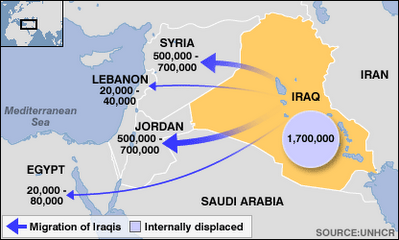
To experts and historians, the Iraq Refugee Crisis is unprecedented. With well over 4 million Iraqis either internally displaced or forced to leave the country, the tales of horror and suffering are countless. As one Iraqi woman put it:

"If someone could describe what it is like to live in hell you would understand, than the world would understand what it is like to live in Baghdad. Every time somebody goes out you wonder if he or she will return. Every time a girl goes out you do not know if she will return or if she will be abducted, raped or murdered. It is like in hell."

For Iraqis, living in hell does not end when some of them seek refugee in neighboring countries. Many of them live in harsh conditions and faced by lack of legal status, work permits, and international support, they are heavily dependent on their own savings for financial support. In order to change this reality, Iraqis seek to relocate to other countries where they could enjoy better lives. One of the most popular destinations is Sweden. Getting to Sweden is not easy and once an Iraqi decides to get out of hell, hell will become paradise. Sadly, it is a paradise for smugglers not the Iraqi refugees. It is a paradise because it is a $300 million dollars industry for the smugglers.

EPIC came across a report that details the difficult journey of vulnerable and desperate Iraqi refugees from Syria to Sweden. The report was produced by the Kaliber radio show, an investigative journalism program on Swedish Radio. According to the report, the cost of smuggling one person is around $12000-15000 and despite this large amount of money, the refugees go through life-threatening experiences to reach their dream destination. Looking back at his experience, one refugee said "If I knew that the way would be so difficult, I would never have had taken this way. I might as well have got killed home in Iraq."

Click here to read entire report.

We find this report appalling and we invite you to join us in calling for increased support for the Iraqi refugees in neighboring countries and inside Iraq as well. The need for supporting these refugees is fiercely urgent as discussed by prominent Iraq scholars and NGO representatives during the Iraq Action Days.

You could help end such horrible stories by calling your Congress members and urging them to provide more support for vulnerable Iraqis and by supporting EPIC’s work.

Together we can make the vulnerable be in paradise before they go through hell.

Photo Caption:
An elderly Iraqi refugee sleeps rough on the streets of Amman, Jordan. Even if Iraqis manage to flee the violence in their own country, they often face hardships in neighboring nations. Image Courtesy: © Dana Hazeen/IRIN

Tuesday, March 27, 2007

"Iraqi Volunteers, Iraqi Refugees: What is America's Obligation?"

I went to a House Foreign Affairs Subcommittee on the Middle East and South Asia hearing yesterday concerning the plight of the millions of displaced Iraqis, both within and outside Iraq. The panelists testimonies covered a number of topics: personal stories of Iraqi civilians who have aided the U.S. and therefore are facing extreme danger; the millions of Iraqis living outside of the country and the humanitarian crisis in which they find themselves; the challenges lawmakers must confront in backing legislation that funds acceleration of the resettlement process; as well as the need for the U.S. to finally come to terms with the humanitarian catastrophe in Iraq and accept the moral responsibility of addressing it.

The first panel consisted of Ellen Sauerbrey, Assistant Secretary of the Bureau of Population, Refugees, and Migration. The second panel was made up of Major General Paul D. Eaton; George Packer, staff writer at The New Yorker; Kristele Younes, refugee advocate at Refugees International; and a former employee of the U.S. embassy in Baghdad who, for security purposes, had to go by the alias "Sarah."

The common theme of the hearing was that it has taken the Administration and lawmakers far too long to acknowledge and address the suffering of displaced Iraqis, especially those who have risked their lives by working with American and Coalition forces. Assistant Secretary Sauerbrey attempted to explain why admitting Iraqi refugees into the U.S. is such a lengthy process and why the Administration has not taken legislative or monetary steps to provide relief and safety for the 3.9 million displaced Iraqis. She explained that the Presidential determination for resettlement this year is 70,000 inclusive, and that 10% of that--or 7,000 spots--is designated for Iraqis. Representative Mike Pence of Indiana, suggested that 7,000 is UNHCR's capacity for processing refugees, not ours. He went on to state that there is a nonpartisan consensus that the problem should be addressed and that questions should be asked.

Chairman Gary L. Ackerman of New York agreed, stating that if lawmakers and the Administration were serious about processing Iraqi refugees it could be done. Sauerbrey argued that since 9/11, and the Immigration of Nationality Act, the process has gotten much longer for Homeland Security to conduct security clearances. Four to six months is the average length of time for someone to go through the process of asylum.

Many obstacles are facing Iraqis as they seek refuge. For example, there is no way of processing IDPs for resettlement; they must first leave Iraq under extremely dangerous conditions and then apply through UNHCR in a neighboring country. If someone has paid a ransom for a kidnapped family member, or paid off the insurgency for their own lives, the U.S. considers this "providing material support to terrorists"and the individuals will not be granted visas under the provisions of the PATRIOT and Real ID Acts. Iraqis who worked or are still working with the U.S. are not allowed housing in the Green Zone, and no protection is given to them. Only 500 Special Immigrant Visas are given a year, and only to direct hires of the government; this is not including the countless Iraqis who worked for contractors and subcontractors.

Major General Eaton explained that 70,000 Chinese and 80,000 Indian immigrants were accepted into the United States in 2006. He urged lawmakers to immediately identify Iraqis who have helped the U.S. and grant them asylum, regardless of quotas. George Packer argued that, "We cannot allow more Iraqis to die while we fine-tune refugee settlement." His first recommendation was to make in-country processing available, or at the very least, to ensure safe transfer to neighboring countries. Kristele Younes warned lawmakers that the problem stretches farther than Iraqis who have aided U.S. efforts; the millions living in Syria and Jordan, and those displaced within the country should not be forgotten. She urged an increase in funding for local Iraqi and International NGOs, as well as fully endorsing UNHCR recommendations.

"Sarah" relayed her personal story of working with the U.S. and being hopeful that she would be a part of the liberation and democratization of Iraq. She now lives in Jordan, unable to return to her home in Iraq. She did not receive protection while working for the CPA, and was eventually fired when her job was given to a Jordanian citizen. Today, "Sarah" lives in fear, with nowhere to go; she is considered by many of her countrymen to be a traitor and a spy. She said that she does not regret having worked with the Americans in Iraq, only that she trusted the U.S. government, but they never trusted Iraqis.

Real initiatives must be taken to address the plight of the 3.9 million displaced Iraqis. General Eaton asked that our government act with the dignity and respect that the Iraqi people deserve. Chairman Ackerman explained that:
If the world's only superpower cannot protect Iraqis from the danger we put them in, then we are facing a bigger problem than I thought.
He stated that there must be funding and legislation put forth to back the rhetoric of concern coming from the Administration.

Monday, February 05, 2007

Addressing Iraqi Refugee Crisis

With the Bush administration's next step in Iraq looming, more people are beginning to question the US' refusal to accept responsibility for the millions of Iraqi civilians who are suffering from our previous missteps. In accordance with certain international legal norms, the United States has an obligation to address this urgent question. The reality of displaced persons, both within Iraqi borders and outside the country, is a real and pressing problem that is not being addressed by the Bush Administration and only beginning to receive attention from Congress.

For peace and reconstruction to be a success, Iraqis need to feel that they are safe in their homes and that their interests there are protected. According to Sabrina Tavernise in a January 28, 2007 article in the New York Times, the moderates are almost all gone and the middle class that were expected to be involved in building democracy have "given up and moved away." She explains that a year ago the hope of Iraqi brotherhood was a reality, but that now sectarianism and violence have overshadowed the optimism for unity and peace.

A recent editorial in the New York Times states, "the current price tag for the war is $8 billion a month, yet the State Department plans to spend only $20 million in the coming fiscal year to help shelter Iraqi refugees and to resettle them here." Since the start of the war, the United States has admitted only 466 Iraqi refugees and for the near future plans to admit only 50 Iraqi and Afghan refugees per year. The US certainly has greater capabilities to provide asylum to fleeing Iraqi civilians.

The editorial suggests that the administration allow around 70,000 Iraqi and Afghan refugees a year; start organizing dialogue with Iraq's neighbors on how to handle the escalation of Iraqi nationals living and migrating to their countries; and comply with the request from the UNHCR for $60 million for the protection and shelter of displaced Iraqis. The human suffering that has been taking place in Iraq cannot be lost in the debate over the troop surge or beginning a withdrawal. Whatever decision the Bush administration makes in the coming months, the problem of displaced Iraqis and the protection that they are entitled to will persist, and must be addressed.
 
Clicky Web Analytics