At the beginning of September 2008 the Iraqi Oil Ministry signed a preliminary deal with Royal Dutch Shell to exploit natural gas in the Basra area. It was only the second agreement signed between Iraq and a foreign company to exploit its natural resources since the U.S. invasion in 2003. The Oil Ministry has been criticized by a variety of different groups within Iraq for this action, leading to inertia one year later. Now it’s been announced that Shell will have to wait even longer as officials say that nothing can be done until after the January 2010 Iraqi national elections.
The Deputy Oil Minister announced on September 5, 2009 that the Shell deal would have to wait for finalization until after the 2010 elections. He said that Iraqi politics would not allow any movement until afterward.
The preliminary agreement is a three-way deal between Royal Dutch Shell, Japan’s Mitsubishi, and the Iraqi Oil Ministry. Because Iraq has no new hydrocarbons law, the Oil Ministry used an old Saddam era laws to work out the proposed contract with Shell. Originally, the state-owned South Oil Company was going to own 51% of a joint venture, and Shell would have the other 49%. In February 2009 Mitsubishi joined with Shell, and pledged to go in 5%. The deal could be worth between $3-$4 billion over five years, and involve 500-600 cubic feet of natural gas per day. Currently Iraq has the 10th largest natural gas reserves in the world, and produces 1.7 billion cubic feet a day, but wants to increase that to 5.1 billion by 2015. Most of the natural gas in Basra is burned off instead of captured because Iraq lacks the infrastructure to do so. Overall, Iraq claims it looses more than 60% of its natural gas at a cost of up to $40 million a day.
The initial deal received immediate approval by the cabinet, but has been criticized by a number of groups. First, was the former oil minister under Saddam who asked why the government offered no-bids on such a large project. Second, members of parliament criticized the negotiations as being non-transparent. Third, the Oil and Gas Committee in the legislature worried that Shell would be given a monopoly with a 25-year contract. The committee, as well as the Fadhila party that held the governorship of Basra at the time, also said that they should’ve be included in the negotiations. Members of the committee have also claimed the deal is unconstitutional since it did not include parliament. Finally, there are disputes about how much of the natural gas will go to domestic needs, and how much will be exported, as well as the area of operations Shell will be given, will it be just for Basra or all of southern Iraq?
Iraq’s natural gas is largely underdeveloped, but has huge potential. Like the country’s oil it is a highly contested resource. On the one hand the Oil Ministry believes that foreign companies are required to exploit it, and the Oil Minister believes he can make these deals with only cabinet approval. Iraq’s parliament objects to this, claiming that they should be included in the negotiations, and have any contract ratified by them. There are also nationalist factions, and those that mistrust foreign companies, that think that the gas, like Iraq’s petroleum, should only be developed by the state. All of these arguments have held up the Shell-Mitsubishi deal for one year now, and there’s no telling whether the 2010 parliamentary elections will allow any further movement. This is the price foreign companies have to pay for attempting to do business in Iraq right now since the government is largely incapable of making big decisions because it is so divided and dysfunctional. In the meantime Iraq will be wasting most of its gas until some kind of final deal is worked out.
SOURCES
Ciszuk, Samuel, “Iraq politics impact Shell gas deal,” Iraq Oil Report, 4/20/09
Crooks, Ed and Khalaf, Roula, “Shell in Iraqi gas deal worth up to $4bn,” Financial Times, 9/8/08
Dow Jones, “Shell, Iraq gas Deal Progressing, Cabinet To OK Study-Official,” 7/6/09
Graeber, Dan, “Iraq approves gas deal with Royal Dutch Shell,” Iraq Oil Report, 9/7/08
Iraq Oil Report, “Iraq opts for long term oil deals, ditches no-bids,” 9/9/08
Khadduri, Walid, “Oil in a Week – Iraqi Oil 2008-2009,” Al-Hayat, 1/12/09
Lando, Ben, “Shell-Iraq gas company is a monopoly, secret agreement shows,” UPI, 11/4/08
Lando, Ben and Majeed, Alaa, “Gas deal no monopoly, Shell and Iraq say,” UPI, 11/6/08
Macalister, Terry, “Iraq parliament promises to push Shell out of gas deal,” Guardian, 4/18/09
- “Iraqi government fuels ‘war for oil’ theories by putting reserves up for biggest ever sale,” Guardian, 10/13/08
Rasheed, Ahmed, “Iraq Lawmakers Say Will Challenge Shell Gas Deal,” Reuters, 11/26/08
Salahedin, Sinan, “Iraq-Shell gas deal likely to be delayed until after January elections, official says,” Associated Press, 9/5/09
- “Iraqi official: Mitsubishi to join Iraq gas deal,” Associated Press, 2/12/09
Yacoub, Sameer, “Iraq, Shell sign deal,” Associated Press, 9/22/08
Showing posts with label natural gas. Show all posts
Showing posts with label natural gas. Show all posts
Wednesday, September 16, 2009


Thursday, July 16, 2009
1st Oil Bidding Round Flops In Iraq
On June 29, 2009 the Iraqi Oil Ministry offered up six oil fields, and two natural gas fields for long-term deals with international companies. The process was one of the most open and transparent in recent history as it was broadcast live on Iraqi television. 35 companies were pre-approved to participate, but only 22 placed bids. The Oil Ministry was offering 20-year technical service agreements. The companies would be paid a flat fee to invest technology, but would also be paid a fee for each extra barrel of oil produced. The winning companies were also to pay a hefty signing bonus in the form of multi-million dollar loans. Because there were so many objections to the deals, the Oil Ministry claimed that Iraq would earn $1.7 trillion over 20-years from the contracts, while the companies would only be paid $16 billion. Iraq would also get up to $2.6 billion in loans from the signing bonuses.
In the end the process turned out to be a flop. The oil companies first offered an opening bid for how much they expected to be paid for each barrel of increased output, and then the government reveled their price. The two sides were then to negotiate and agree upon an amount. In the end, only one consortium of British Petroleum (BP) and China’s CNPC won a bid for the South Rumaila field in Basra. BP-CNPC wanted $3.99 per extra barrel, while the government asked for $2. BP-CNPC ended up agreeing to the Oil Ministry’s price. That was because it was the smallest gap between the companies’ demands and the Ministry’s. In comparison, the government was willing to pay $8.50 for extra production from the Akkas gas field in Anbar, while the foreign businesses wanted $38. One natural gas field in Diyala didn’t even receive a bid.
It was apparent that Baghdad had unrealistic expectations about their offers, something Anthony Cordesman from the Center for Strategic and International Studies warned about after a recent trip to Iraq. He wrote that Iraqi officials were just thinking about the possible profits, and not about workable business models that international companies would accept. The first round of bidding seems to have proven his point.
This event was supposed to be a defining moment for Iraq’s oil industry. The country relies upon petroleum for almost all of its revenue, and with the drop in oil prices and budget deficit, the Oil Ministry was promising that this first round of bidding would open the country up to the foreign know how necessary to boost production, while protecting the nation’s resources. In the end it turned out to be a fiasco. Only one deal was agreed upon, and the Oil Ministry proved that it was out of touch with economic realities. With oil prices down, the companies, not the oil producing nations have the upper hand, as the former are desperate for deals, which gives the corporations more leeway to negotiate. This could’ve been expected as the Oil Minister’s plans have been ad hoc at best, and he’s scrapped earlier ideas to increase output in 2008. Iraq’s oil wealth will continue to be underdeveloped and mismanaged with this continued leadership, robbing the country of the money that it so desperately needs after years of wars and international sanctions.
Oil And Natural Gas Fields And Bids
 South Rumaila Oil Field – Basra Province
Reserves: 7.3 billion barrels
Bidders:
1. British Petroleum and China’s CNPC
2. Exxon-Mobile and Malaysia’s Petronas
Initial Bid: BP-CNPC $3.99 per extra barrel
Oil Ministry’s Bid: $2 per extra barrel
Winning Bid: $2 per extra barrel by BP-CNPC
West Qurna Oil Field – Basra Province
Reserves: 7.4 billion barrels
Bidders:
1. Exxon-Mobile and Royal Dutch Shell
2. Spain’s Reposal with Denmark’s Maersk Oil and Gas and Norway’s Statoil Hydro
3. Russia’s Lukoi
4. France’s Total
5. China’s CNPC
Initial Bid: Exxon-Mobile and Royal Dutch Shell $4 per extra barrel
Oil Ministry’s Bid: $1 per extra barrel
No winners
Kirkuk Oil Field – Tamim Province
Reserves: 6.5 billion barrels
Bidders: Royal Dutch Shell and China’s Sinopec and Turkish Petroleum Corp
Initial Bid: $7.89 per extra barrel
Oil Ministry’s Bid: $2 per extra barrel
No winners
Zubair Oil Field – Basra Province
Reserves: 4 billion barrels
Bidders:
1. Italy’s Eni, China’s Sinopec, and South Korea’s Occidental and Korean Gas
2. India’s ONGC, Gazprom Russia, and Turkish Petroleum Corp
3. Exxon-Mobile, Royal Dutch Shell, and Petronas
4. British Petroleum and China’s CNPC
Initial Bid: Eni, Sinopec, Occidental and Korean Gas $4.80 per extra barrel
Oil Ministry’s Bid: Unknown
No winners
Maysan Group Oil Field – Maysan Province
Reserves: 2.5 billion barrels
Bidders: China’s CNOOC and Sinochem
Initial Bid: $21.40 per extra barrel
Oil Ministry’s Bid: $2.30 per extra barrel
Deal has been referred to Iraqi cabinet
Bai Hassan Oil Field – Maysan Province
Reserves: 2.3 billion barrels
Bidders: Conoco Phillips, China’s Sinopec and CNOOC
Initial Bid: $26.70 per extra barrel
Oil Ministry’s Bid: $4 per extra barrel
Deal has been referred to Iraqi cabinet
Akkas Natural Gas Field – Anbar Province
Reserves: 4,000-4,500 billion cubic feet
Bidders: Italy’s Edison, Malaysia’s Petronas, China’s CNPC, Turkey’s TPAO,
And Korea’s Gas Corp
Initial Bid: $38 for extra production
Oil Ministry’s Bid: $8.50 for extra production
No winners
Mansuriyah Natural Gas Field – Diyala Province
Reserves: 3,100 billion cubic feet
Bidders: None
SOURCES
Aswat al-Iraq, “Plan to develop Bai Hassan, Kirkuk oil fields,” 7/4/09
Chmaytelli, Maher and DiPaola, Anthony, “Iraq Says May Earn 100 Times More Than Oil Companies (Update1),” Bloomberg, 6/23/09
Chon, Gina, “Big Oil Ready for Big Gamble in Iraq,” Wall Street Journal, 6/24/09
- “Foreign Firms Bid for Iraqi Oil Licenses,” Wall Street Journal, 6/30/09
- “Oil Companies Reject Iraq’s Contract Terms,” Wall Street Journal, 7/1/09
Cordesman, Anthony, “Observations From a Visit to Iraq,” 6/15/09
Dow Jones, “UPDATE:Iraq Parliament Panel: Rumalia Deal Needs Lawmakers’ OK,” 7/3/09
Hafidh, Hassan, “FOCUS: Oil Majors Line Up For Iraq’s First Bid Round,” Dow Jones, 6/29/09
Hoyos, Carola, Warrell, Helen, and Bernard, Steve, “Crude Competition,” Financial Times, 6/30/09
Al Jazeera, “Foreign oil firms reject Iraq terms,” 6/30/09
Lando, Ben, “Oil bid debrief,” Iraq Oil Report, 7/8/09
Lando, Ben and Latif, Nizar, “One oil field awarded, many questions remain,” Iraq Oil Report, 6/30/09
Londono, Ernesto, Ibrahim, K.I., and Mufson, Steven, “Anxious Oil Giants Pass on Iraq,” Washington Post, 7/1/09
Reuters, “Iraq To Move Up Second Energy Bidding Round,” 7/2/09
Salaheddin, Sinan, “Iraqi PM dissatisfied with energy auction results,” Associated Press, 7/2/09
Sly, Liz, “Iraq awards BP-led consortium a contract to develop oil field,” Los Angeles Times, 7/1/09
In the end the process turned out to be a flop. The oil companies first offered an opening bid for how much they expected to be paid for each barrel of increased output, and then the government reveled their price. The two sides were then to negotiate and agree upon an amount. In the end, only one consortium of British Petroleum (BP) and China’s CNPC won a bid for the South Rumaila field in Basra. BP-CNPC wanted $3.99 per extra barrel, while the government asked for $2. BP-CNPC ended up agreeing to the Oil Ministry’s price. That was because it was the smallest gap between the companies’ demands and the Ministry’s. In comparison, the government was willing to pay $8.50 for extra production from the Akkas gas field in Anbar, while the foreign businesses wanted $38. One natural gas field in Diyala didn’t even receive a bid.
It was apparent that Baghdad had unrealistic expectations about their offers, something Anthony Cordesman from the Center for Strategic and International Studies warned about after a recent trip to Iraq. He wrote that Iraqi officials were just thinking about the possible profits, and not about workable business models that international companies would accept. The first round of bidding seems to have proven his point.
This event was supposed to be a defining moment for Iraq’s oil industry. The country relies upon petroleum for almost all of its revenue, and with the drop in oil prices and budget deficit, the Oil Ministry was promising that this first round of bidding would open the country up to the foreign know how necessary to boost production, while protecting the nation’s resources. In the end it turned out to be a fiasco. Only one deal was agreed upon, and the Oil Ministry proved that it was out of touch with economic realities. With oil prices down, the companies, not the oil producing nations have the upper hand, as the former are desperate for deals, which gives the corporations more leeway to negotiate. This could’ve been expected as the Oil Minister’s plans have been ad hoc at best, and he’s scrapped earlier ideas to increase output in 2008. Iraq’s oil wealth will continue to be underdeveloped and mismanaged with this continued leadership, robbing the country of the money that it so desperately needs after years of wars and international sanctions.
Oil And Natural Gas Fields And Bids
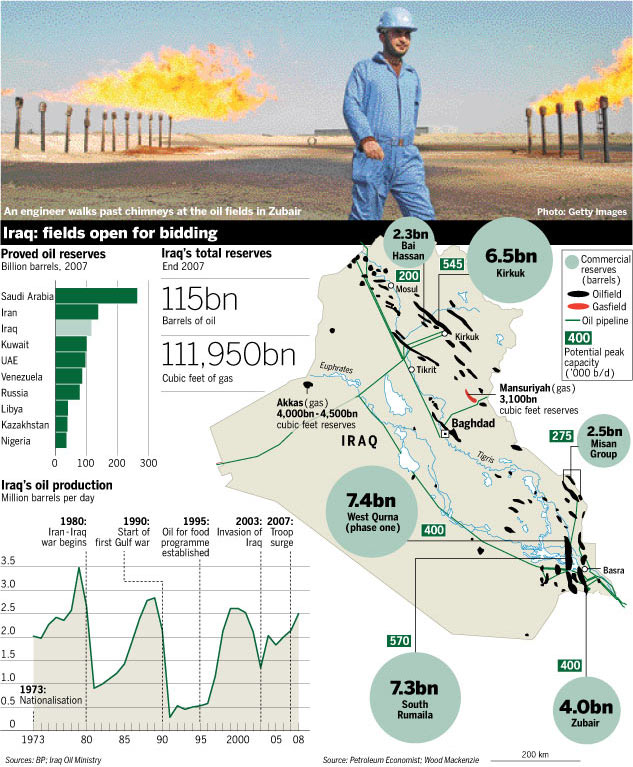 South Rumaila Oil Field – Basra Province
Reserves: 7.3 billion barrels
Bidders:
1. British Petroleum and China’s CNPC
2. Exxon-Mobile and Malaysia’s Petronas
Initial Bid: BP-CNPC $3.99 per extra barrel
Oil Ministry’s Bid: $2 per extra barrel
Winning Bid: $2 per extra barrel by BP-CNPC
West Qurna Oil Field – Basra Province
Reserves: 7.4 billion barrels
Bidders:
1. Exxon-Mobile and Royal Dutch Shell
2. Spain’s Reposal with Denmark’s Maersk Oil and Gas and Norway’s Statoil Hydro
3. Russia’s Lukoi
4. France’s Total
5. China’s CNPC
Initial Bid: Exxon-Mobile and Royal Dutch Shell $4 per extra barrel
Oil Ministry’s Bid: $1 per extra barrel
No winners
Kirkuk Oil Field – Tamim Province
Reserves: 6.5 billion barrels
Bidders: Royal Dutch Shell and China’s Sinopec and Turkish Petroleum Corp
Initial Bid: $7.89 per extra barrel
Oil Ministry’s Bid: $2 per extra barrel
No winners
Zubair Oil Field – Basra Province
Reserves: 4 billion barrels
Bidders:
1. Italy’s Eni, China’s Sinopec, and South Korea’s Occidental and Korean Gas
2. India’s ONGC, Gazprom Russia, and Turkish Petroleum Corp
3. Exxon-Mobile, Royal Dutch Shell, and Petronas
4. British Petroleum and China’s CNPC
Initial Bid: Eni, Sinopec, Occidental and Korean Gas $4.80 per extra barrel
Oil Ministry’s Bid: Unknown
No winners
Maysan Group Oil Field – Maysan Province
Reserves: 2.5 billion barrels
Bidders: China’s CNOOC and Sinochem
Initial Bid: $21.40 per extra barrel
Oil Ministry’s Bid: $2.30 per extra barrel
Deal has been referred to Iraqi cabinet
Bai Hassan Oil Field – Maysan Province
Reserves: 2.3 billion barrels
Bidders: Conoco Phillips, China’s Sinopec and CNOOC
Initial Bid: $26.70 per extra barrel
Oil Ministry’s Bid: $4 per extra barrel
Deal has been referred to Iraqi cabinet
Akkas Natural Gas Field – Anbar Province
Reserves: 4,000-4,500 billion cubic feet
Bidders: Italy’s Edison, Malaysia’s Petronas, China’s CNPC, Turkey’s TPAO,
And Korea’s Gas Corp
Initial Bid: $38 for extra production
Oil Ministry’s Bid: $8.50 for extra production
No winners
Mansuriyah Natural Gas Field – Diyala Province
Reserves: 3,100 billion cubic feet
Bidders: None
SOURCES
Aswat al-Iraq, “Plan to develop Bai Hassan, Kirkuk oil fields,” 7/4/09
Chmaytelli, Maher and DiPaola, Anthony, “Iraq Says May Earn 100 Times More Than Oil Companies (Update1),” Bloomberg, 6/23/09
Chon, Gina, “Big Oil Ready for Big Gamble in Iraq,” Wall Street Journal, 6/24/09
- “Foreign Firms Bid for Iraqi Oil Licenses,” Wall Street Journal, 6/30/09
- “Oil Companies Reject Iraq’s Contract Terms,” Wall Street Journal, 7/1/09
Cordesman, Anthony, “Observations From a Visit to Iraq,” 6/15/09
Dow Jones, “UPDATE:Iraq Parliament Panel: Rumalia Deal Needs Lawmakers’ OK,” 7/3/09
Hafidh, Hassan, “FOCUS: Oil Majors Line Up For Iraq’s First Bid Round,” Dow Jones, 6/29/09
Hoyos, Carola, Warrell, Helen, and Bernard, Steve, “Crude Competition,” Financial Times, 6/30/09
Al Jazeera, “Foreign oil firms reject Iraq terms,” 6/30/09
Lando, Ben, “Oil bid debrief,” Iraq Oil Report, 7/8/09
Lando, Ben and Latif, Nizar, “One oil field awarded, many questions remain,” Iraq Oil Report, 6/30/09
Londono, Ernesto, Ibrahim, K.I., and Mufson, Steven, “Anxious Oil Giants Pass on Iraq,” Washington Post, 7/1/09
Reuters, “Iraq To Move Up Second Energy Bidding Round,” 7/2/09
Salaheddin, Sinan, “Iraqi PM dissatisfied with energy auction results,” Associated Press, 7/2/09
Sly, Liz, “Iraq awards BP-led consortium a contract to develop oil field,” Los Angeles Times, 7/1/09
Wednesday, July 01, 2009
Oil Minister Under Attack On Eve Of Awarding New Contracts
Oil Minister Hussain Shahristani is under attack from all sides as he is about to award new long-term oil contracts to foreign companies. There are those that are afraid of the influence of international corporations, others that object to the legality of the contracts, some that want to go after Prime Minister Nouri al-Maliki since Shahristani is an ally, and finally those that oppose the Minister’s direction overall. Despite these troubles, Shahristani is intent on going forward with his plan to boost Iraq’s oil production through these deals.
On June 29 and 30, 2009 the Oil Minister will award 20-year oil contracts for six of Iraq’s largest oil fields and two undeveloped natural gas ones. 35 companies have been pre-approved for bidding on these deals including Exxon-Mobile, Shell, Italy’s Eni SpA, Russia’s Lukoil, and China’s Sinopec. The oil fields have up to 44 billion barrels, while the gas ones hold up to 22 trillion cubic feet in reserves. This is part of the Oil Minister’s plan to boost overall oil production to 2.9 million barrels per day by the end of 2009, and 6 million barrels per day in several years. Iraq currently is production about 2.3 million barrels per day.
Before the bidding begins however, the Oil Minister has come under increasing attacks from all sides. On June 23 he appeared before parliament’s oil and gas committee who demanded that the oil deals be approved by parliament. These complaints are motivated by a number of factors. First, the head of the committee is a Kurd. The Kurdistan Regional Government (KRG) has had a running battle with Oil Minister Shahristani over its independent oil policy for over a year now. Many lawmakers that are opponents of the Prime Minister want to assert the authority of the parliament to be a check on his power, hence their demand that the legislature confirm the contracts. Oil Minister Shahristani is also a close ally of Maliki who ran as part of his State of Law list in the 2009 provincial elections.
The KRG itself has warned the Oil Minister about his plans as well. The Kurds demand that they be included in any negotiations over oil deals in Kirkuk. They have warned that they will reject any deals that they are not consulted about, and will not provide security or their cooperation with oil companies that conduct work there as a result. The governor of Tamim province, the home of Kirkuk, who is a Kurd, said he and the provincial council should also be brought into the process. The Kurds consider Kirkuk there’s, even though it’s a disputed territory whose future is caught up in the political divisions within the country. Their threats about oil deals there are part of their attempt to establish de facto control of the area.
Members of the state-run South Oil Company, the largest in the country, have also come out against the oil contracts. The Oil Unions’ Federation in Basra demanded that the 1st round of bidding be cancelled. They said that Iraq’s oil could be sufficiently developed by the Oil Ministry with no outside help. The Director General of the company also sent a memo to Shahristani a few days earlier saying that the deals would cripple the economy, and objected to their length. He said that the government run oil companies were already doing much of the same work, and that they only need technical help from foreigners. The director also warned that the deals could be held up in court because they could conflict with existing laws and projects. The Director General suggested that the Oil Ministry only give out short-term technical service agreements instead. This group of critics is motivated by fear of neo-colonialism. They want to protect Iraq’s natural resources from foreign oil companies who they believe will exploit the nation for themselves and leave nothing for Iraq.
Finally, two former Oil Ministers and current officials of the ministry have also come out against the contracts. Saddam’s Minister Esam al-Chalabi said that it was a mistake to start with fields that were already producing, because that would create conflicts between the existing and future work. He warned that any new contracts could be annulled as a result. Prime Minister Ibrahim al-Jaafari’s Oil Minister Ibrahim Bahr al-Ulum voiced the same concerns as the South Oil Company about the potential for foreign control of Iraq’s resources. There are allegedly several high Oil Ministry officials that are also against the contracts complaining about technical issues. This is another group of former and current members of the oil industry that are concerned about Shahristani’s approach to boosting Iraq’s production. They are worried about conflicts his policy might lead to, and the overall direction Shahristani is going in.
There is plenty more to criticize the Oil Minister about as well. His plans have been haphazard at best. In 2008 he was ready to give out short-term oil contracts, and then suddenly cancelled them. Since then the Ministry and state-run petroleum companies have begun giving out a slew of contracts for new work, some of which will happen in fields that are up for bid. Those deals and contracts for foreign consultants should’ve been given out last year when the country was flush with money. It’s also not clear that the Ministry has any ideas about how to create effective business models to effectively develop the field. All of these problems may be due to the fact that Shahristani had no experience in the oil business until Prime Minister Maliki appointed him. Beforehand, Shahristani was a nuclear physicist who after the U.S. invasion was best known for his contacts with Grand Ayatollah Ali al-Sistani.
Iraq’s oil business is a mess. After several wars, years of sanctions, and attacks from the insurgency the infrastructure is falling apart, and many technocrats have fled. Oil is especially important because it accounts for the vast majority of the country’s revenues. Oil Minister Shahristani believes that the industry needs up to $50 billion to be developed. The only way that it can obtain that is through partnership with foreign companies. It’s difficult to enter into these contracts since Iraq has been unable to pass a new oil law since the U.S. invasion. That has led the Minister to push ahead with his own strategy to gain investment and boost production, which has been full of missteps. This has drawn the ire of all sides from those afraid of foreigners, to ones opposed to Maliki and the central government, to ones with different views of Shahristani’s approach. None of these groups are likely to stop the bidding round at the end of June, but it’s likely they will continue to stand in the way of Shahristani’s policy at every turn, making the deals very risky for any companies that win them. That will mean more problems for Iraq’s most important resource.
SOURCES
Abbas, Mohammed, “Iraq Kurds say must have say on Kirkuk oil fields,” Reuters, 6/1/09
Aswat al-Iraq, “Kirkuk governor urges coordination over oil contracts,” 6/17/09
Chon, Gina, “Big Oil Ready for Big Gamble in Iraq,” Wall Street Journal, 6/24/09
Cockburn, Patrick, “Iraqi Oil Minister accused of mother of all sell-outs,” The Independent, 6/18/09
Cordesman, Anthony, “Observations From a Visit to Iraq,” 6/12/09
Dow Jones, “2nd UPDATE: Iraqi Oil Workers Demand Bid Round Cancellation,” 6/22/09
Ibrahim, Waleed, “UPDATE 1-Iraq oil min in parliament, facing foes of deals,” Reuters, 6/23/09
Mohsen, Amer, “Iraq Papers Sat: The I’tilaf is Back!” IraqSlogger.com, 6/19/09
Raphaeli, Dr. Nimrod, “The Oil Sector in Iraq: Prospects and Problems,” Middle East Media Research Institute, 6/11/09
Reuters, “ANALYSIS-Risk rises on Iraq oil deals after industry revolt,” 6/21/09
Shadid, Anthony and Vick, Karl, “Candidate Slate Shows Shiites Closing Ranks,” Washington Post, 12/7/04
UPI, “Iraqi oil director wants to scrap deals,” 6/18/09
Visser, Reidar, “The Map of Electoral Coalitions South of Baghdad Is Taking Shape,” 10/31/08
On June 29 and 30, 2009 the Oil Minister will award 20-year oil contracts for six of Iraq’s largest oil fields and two undeveloped natural gas ones. 35 companies have been pre-approved for bidding on these deals including Exxon-Mobile, Shell, Italy’s Eni SpA, Russia’s Lukoil, and China’s Sinopec. The oil fields have up to 44 billion barrels, while the gas ones hold up to 22 trillion cubic feet in reserves. This is part of the Oil Minister’s plan to boost overall oil production to 2.9 million barrels per day by the end of 2009, and 6 million barrels per day in several years. Iraq currently is production about 2.3 million barrels per day.
Before the bidding begins however, the Oil Minister has come under increasing attacks from all sides. On June 23 he appeared before parliament’s oil and gas committee who demanded that the oil deals be approved by parliament. These complaints are motivated by a number of factors. First, the head of the committee is a Kurd. The Kurdistan Regional Government (KRG) has had a running battle with Oil Minister Shahristani over its independent oil policy for over a year now. Many lawmakers that are opponents of the Prime Minister want to assert the authority of the parliament to be a check on his power, hence their demand that the legislature confirm the contracts. Oil Minister Shahristani is also a close ally of Maliki who ran as part of his State of Law list in the 2009 provincial elections.
The KRG itself has warned the Oil Minister about his plans as well. The Kurds demand that they be included in any negotiations over oil deals in Kirkuk. They have warned that they will reject any deals that they are not consulted about, and will not provide security or their cooperation with oil companies that conduct work there as a result. The governor of Tamim province, the home of Kirkuk, who is a Kurd, said he and the provincial council should also be brought into the process. The Kurds consider Kirkuk there’s, even though it’s a disputed territory whose future is caught up in the political divisions within the country. Their threats about oil deals there are part of their attempt to establish de facto control of the area.
Members of the state-run South Oil Company, the largest in the country, have also come out against the oil contracts. The Oil Unions’ Federation in Basra demanded that the 1st round of bidding be cancelled. They said that Iraq’s oil could be sufficiently developed by the Oil Ministry with no outside help. The Director General of the company also sent a memo to Shahristani a few days earlier saying that the deals would cripple the economy, and objected to their length. He said that the government run oil companies were already doing much of the same work, and that they only need technical help from foreigners. The director also warned that the deals could be held up in court because they could conflict with existing laws and projects. The Director General suggested that the Oil Ministry only give out short-term technical service agreements instead. This group of critics is motivated by fear of neo-colonialism. They want to protect Iraq’s natural resources from foreign oil companies who they believe will exploit the nation for themselves and leave nothing for Iraq.
Finally, two former Oil Ministers and current officials of the ministry have also come out against the contracts. Saddam’s Minister Esam al-Chalabi said that it was a mistake to start with fields that were already producing, because that would create conflicts between the existing and future work. He warned that any new contracts could be annulled as a result. Prime Minister Ibrahim al-Jaafari’s Oil Minister Ibrahim Bahr al-Ulum voiced the same concerns as the South Oil Company about the potential for foreign control of Iraq’s resources. There are allegedly several high Oil Ministry officials that are also against the contracts complaining about technical issues. This is another group of former and current members of the oil industry that are concerned about Shahristani’s approach to boosting Iraq’s production. They are worried about conflicts his policy might lead to, and the overall direction Shahristani is going in.
There is plenty more to criticize the Oil Minister about as well. His plans have been haphazard at best. In 2008 he was ready to give out short-term oil contracts, and then suddenly cancelled them. Since then the Ministry and state-run petroleum companies have begun giving out a slew of contracts for new work, some of which will happen in fields that are up for bid. Those deals and contracts for foreign consultants should’ve been given out last year when the country was flush with money. It’s also not clear that the Ministry has any ideas about how to create effective business models to effectively develop the field. All of these problems may be due to the fact that Shahristani had no experience in the oil business until Prime Minister Maliki appointed him. Beforehand, Shahristani was a nuclear physicist who after the U.S. invasion was best known for his contacts with Grand Ayatollah Ali al-Sistani.
Iraq’s oil business is a mess. After several wars, years of sanctions, and attacks from the insurgency the infrastructure is falling apart, and many technocrats have fled. Oil is especially important because it accounts for the vast majority of the country’s revenues. Oil Minister Shahristani believes that the industry needs up to $50 billion to be developed. The only way that it can obtain that is through partnership with foreign companies. It’s difficult to enter into these contracts since Iraq has been unable to pass a new oil law since the U.S. invasion. That has led the Minister to push ahead with his own strategy to gain investment and boost production, which has been full of missteps. This has drawn the ire of all sides from those afraid of foreigners, to ones opposed to Maliki and the central government, to ones with different views of Shahristani’s approach. None of these groups are likely to stop the bidding round at the end of June, but it’s likely they will continue to stand in the way of Shahristani’s policy at every turn, making the deals very risky for any companies that win them. That will mean more problems for Iraq’s most important resource.
SOURCES
Abbas, Mohammed, “Iraq Kurds say must have say on Kirkuk oil fields,” Reuters, 6/1/09
Aswat al-Iraq, “Kirkuk governor urges coordination over oil contracts,” 6/17/09
Chon, Gina, “Big Oil Ready for Big Gamble in Iraq,” Wall Street Journal, 6/24/09
Cockburn, Patrick, “Iraqi Oil Minister accused of mother of all sell-outs,” The Independent, 6/18/09
Cordesman, Anthony, “Observations From a Visit to Iraq,” 6/12/09
Dow Jones, “2nd UPDATE: Iraqi Oil Workers Demand Bid Round Cancellation,” 6/22/09
Ibrahim, Waleed, “UPDATE 1-Iraq oil min in parliament, facing foes of deals,” Reuters, 6/23/09
Mohsen, Amer, “Iraq Papers Sat: The I’tilaf is Back!” IraqSlogger.com, 6/19/09
Raphaeli, Dr. Nimrod, “The Oil Sector in Iraq: Prospects and Problems,” Middle East Media Research Institute, 6/11/09
Reuters, “ANALYSIS-Risk rises on Iraq oil deals after industry revolt,” 6/21/09
Shadid, Anthony and Vick, Karl, “Candidate Slate Shows Shiites Closing Ranks,” Washington Post, 12/7/04
UPI, “Iraqi oil director wants to scrap deals,” 6/18/09
Visser, Reidar, “The Map of Electoral Coalitions South of Baghdad Is Taking Shape,” 10/31/08
Tuesday, June 16, 2009
The Moribund Kirkuk Committee
The 2009 Provincial Election Law postponed voting in Tamim province because of the disputed city of Kirkuk. Article 23 created a committee made up of seven parliamentarians, two Kurds, two Turkman, 2 Arabs, and one Christian, who were supposed to come up with a power sharing deal for the province before voting would happen there. They were to complete their work by March 31, 2009, but because of their inability to make any decisions they got a two-month extension. May 31 has come and gone and the committee is no closer to finishing their work, so they have been given another week. This is likely to happen again and again as the Article 23 committee appears more for show than actual work.
According to a United States Institute of Peace delegation that went to Iraq in May 2009, the Article 23 Committee was created as a public relations move by parliament. When it was devising the provincial election law the legislators felt they had to show that they were doing something about Kirkuk, so they created the committee. Since it started its work in February 2009 it has hardly met, has little money, and no one thinks that it will lead to anything. The effect is that elections in Tamim are to be delayed indefinitely.
Tamim is a key province in the divide between Arabs and Kurds. The Kurds have been trying to legally annex Kirkuk since the U.S. invasion. They were able to insert Article 140 into the Iraqi constitution in 2005, which said that there should be a census and referendum on the future of all disputed areas by December 31, 2007. That was extended until June 30, 2008, but both deadlines came and passed with no action. Since then the United Nations has taken over the role of finding a resolution to the area. In April 2009 they presented their suggestions. Kurdish officials have called Kirkuk their Jerusalem, and said that they will not rest until it has been annexed by Kurdistan. Kirkuk is also home to one of Iraq’s three largest oil fields, and perhaps two-thirds of its natural gas reserves. Until new voting is held the Kurds want a majority of the seats on the provincial council to reflect their population. The Arabs and Turkmen on the other hand, want the council divided evenly between them and the Kurds, plus a seat for Christians. This situation is likely to remain deadlocked as well. That would seem to suit the Kurds that have de facto control of the provincial council, but in the long-term Arab politicians seem to think that the central government will win. They believe in time, as the Iraqi security forces grow in strength, they will eventually be able to rest control of all of the disputed territories from the Kurds. A U.S. military officer told the United States Institute of Peace officials that as soon as the Iraqi Army had its full compliment of M1 Abrams tanks, the Kirkuk dispute would be over.
The fear of course is that this could lead to violence. The U.S. commander in Iraq General Ray Odierno says that Arab-Kurdish tensions are one of his top priorities. American think tanks have also expressed concern. So far things have remained political, even as Prime Minister Nouri al-Maliki began pushing the Kurds over the disputed territories in 2008. Baghdad taking on the Kurds in Kirkuk however, would be a totally different dynamic. This would seem a prime example of a case needing U.S. mediation before it departs, but the Americans have been deferring to the U.N.. The U.N. in turn, can do little without U.S. support. That means not only are provincial elections not going to happen in Tamim, but a resolution to Kirkuk’s final status is going nowhere as well.
SOURCES
Abbas, Mohammed, “Iraq Kurds say must have say on Kirkuk oil fields,” Reuters, 6/1/09
Agence France Presse, “Iraq delays Kirkuk election report by a week: MP,” 5/31/09
Biddle, Stephen, “Reversal in Iraq,” Center for Preventative Action Council on Foreign Relations, May 2009
Daly, John, “Analysis: Kirkuk elections and Iraqi oil,” UPI, 6/2/09
Haynes, Deborah, “Transcript of The Times interview with General Ray Odierno,” Times of London, 4/9/09
International Crisis Group, “Oil For Soil: Toward A Grand Bargain On Iraq And The Kurds,” 10/28/08
Jakes, Lara, “Key UN report to suggest power-sharing plan in Iraq’s divided Kirkuk,” Associated Press, 3/29/09
Al-Khalidi, Diaa, “kirkuk awaits election law,” Niqash, 3/11/09
Londono, Ernesto, “Kurds, Arabs Maneuver Ahead of U.N. Report on N. Iraq,” Washington Post, 4/17/09
Radio Free Europe/Radio Liberty, “Iraqi Parliament’s Mission To Kirkuk Ends In Failure,” 5/27/09
Reilly, Corinne, “U.N. experts urge power sharing in Kirkuk,” McClatchy Newspapers, 4/22/09
Serwer, Daniel and Parker, Sam, “Maliki’s Iraq between Two Elections,” United States Institute of Peace, May 2009
Visser, Reidar, “The Kirkuk Issue Exposes Weaknesses in Iraq’s Ruling Coalition,” Historiae.org, 8/7/08
According to a United States Institute of Peace delegation that went to Iraq in May 2009, the Article 23 Committee was created as a public relations move by parliament. When it was devising the provincial election law the legislators felt they had to show that they were doing something about Kirkuk, so they created the committee. Since it started its work in February 2009 it has hardly met, has little money, and no one thinks that it will lead to anything. The effect is that elections in Tamim are to be delayed indefinitely.
Tamim is a key province in the divide between Arabs and Kurds. The Kurds have been trying to legally annex Kirkuk since the U.S. invasion. They were able to insert Article 140 into the Iraqi constitution in 2005, which said that there should be a census and referendum on the future of all disputed areas by December 31, 2007. That was extended until June 30, 2008, but both deadlines came and passed with no action. Since then the United Nations has taken over the role of finding a resolution to the area. In April 2009 they presented their suggestions. Kurdish officials have called Kirkuk their Jerusalem, and said that they will not rest until it has been annexed by Kurdistan. Kirkuk is also home to one of Iraq’s three largest oil fields, and perhaps two-thirds of its natural gas reserves. Until new voting is held the Kurds want a majority of the seats on the provincial council to reflect their population. The Arabs and Turkmen on the other hand, want the council divided evenly between them and the Kurds, plus a seat for Christians. This situation is likely to remain deadlocked as well. That would seem to suit the Kurds that have de facto control of the provincial council, but in the long-term Arab politicians seem to think that the central government will win. They believe in time, as the Iraqi security forces grow in strength, they will eventually be able to rest control of all of the disputed territories from the Kurds. A U.S. military officer told the United States Institute of Peace officials that as soon as the Iraqi Army had its full compliment of M1 Abrams tanks, the Kirkuk dispute would be over.
The fear of course is that this could lead to violence. The U.S. commander in Iraq General Ray Odierno says that Arab-Kurdish tensions are one of his top priorities. American think tanks have also expressed concern. So far things have remained political, even as Prime Minister Nouri al-Maliki began pushing the Kurds over the disputed territories in 2008. Baghdad taking on the Kurds in Kirkuk however, would be a totally different dynamic. This would seem a prime example of a case needing U.S. mediation before it departs, but the Americans have been deferring to the U.N.. The U.N. in turn, can do little without U.S. support. That means not only are provincial elections not going to happen in Tamim, but a resolution to Kirkuk’s final status is going nowhere as well.
SOURCES
Abbas, Mohammed, “Iraq Kurds say must have say on Kirkuk oil fields,” Reuters, 6/1/09
Agence France Presse, “Iraq delays Kirkuk election report by a week: MP,” 5/31/09
Biddle, Stephen, “Reversal in Iraq,” Center for Preventative Action Council on Foreign Relations, May 2009
Daly, John, “Analysis: Kirkuk elections and Iraqi oil,” UPI, 6/2/09
Haynes, Deborah, “Transcript of The Times interview with General Ray Odierno,” Times of London, 4/9/09
International Crisis Group, “Oil For Soil: Toward A Grand Bargain On Iraq And The Kurds,” 10/28/08
Jakes, Lara, “Key UN report to suggest power-sharing plan in Iraq’s divided Kirkuk,” Associated Press, 3/29/09
Al-Khalidi, Diaa, “kirkuk awaits election law,” Niqash, 3/11/09
Londono, Ernesto, “Kurds, Arabs Maneuver Ahead of U.N. Report on N. Iraq,” Washington Post, 4/17/09
Radio Free Europe/Radio Liberty, “Iraqi Parliament’s Mission To Kirkuk Ends In Failure,” 5/27/09
Reilly, Corinne, “U.N. experts urge power sharing in Kirkuk,” McClatchy Newspapers, 4/22/09
Serwer, Daniel and Parker, Sam, “Maliki’s Iraq between Two Elections,” United States Institute of Peace, May 2009
Visser, Reidar, “The Kirkuk Issue Exposes Weaknesses in Iraq’s Ruling Coalition,” Historiae.org, 8/7/08
Sunday, April 26, 2009
Battle Over Control of Iraq’s Natural Resources Heats Up
In April 2009, the secretary of Iraq’s Oil and Gas Committee in parliament, Jabir Khalifa Jabir said that the government’s deal with Royal Dutch Shell to exploit natural gas in the south was illegal. That same committee criticized the Shell proposal in November 2008 as well. Both times the committee said that there was no transparency in the negotiations, no competition, and that it went against the interests of the country. This is part of the growing battle over who has control of Iraq’s natural resources.
In September 2008 the Oil Ministry contacted Shell to create a joint venture with the state run-South Oil Company to extract natural gas from the southern oil fields. The Iraqi government would control 51% of the joint company, and Shell 49%. The Oil Ministry claims that it looses $40 million a day in natural gas, which is burned off during oil production, because it doesn’t have the means to exploit it. The contract is supposed to last 25 years, and would give a virtual monopoly to Shell. The corporation is supposed to use the natural gas for both domestic needs and exports, but there are no specifics on how this is to work. It’s estimated that Shell could make up to $3-$4 billion in the next five years as a result, making it the largest oil or gas deal in the country’s history. In February 2009 the OIl Ministry also announced that Japan’s Mitsubishi would be working with Shell on gas production.
This has drawn the ire of the Oil and Gas Committee in parliament. In both November 2008 and April 2009 they have criticized the Shell deal. First there were no other companies considered. The Oil Ministry claims that this was okay because it will be a joint venture with a state-run company. The Ministry however, is not applying that standard for its oil deals where it is taking tenders from several different international corporations that are expecting to work as joint ventures as well. Second the committee objects to the fact that the wording of the agreement says that Shell will be the sole producer of natural gas in southern Iraq, giving it a monopoly. Jabir also claims that Article 97 of the Iraqi constitution requires all new natural resources contracts to be approved by parliament, and this has not happened, making it illegal. Jabir is also concerned that Shell will use most if not all of the gas it produces for export, rather than for domestic consumption.
The conflict between the Oil Ministry and the parliamentary committee is only the latest in a growing feud over control of Iraq’s oil and gas. As reported before, Oil Minister Hussein Shahristani has formulated a largely haphazard, and sometimes contradictory oil policy, which has failed to produce many results so far. Shahristani has been criticized as a result, and there are moves underway to strip him of much of his power. Other problems include the fact that the Iraqi legislature has not passed a new oil law, the petroleum companies have the upper hand with the drop in crude prices, and parliamentary elections in Iraq could make the Shell deal a campaign issue. Finally, much of the Iraqi public is extremely suspicious of foreign corporations, and are generally opposed to them exploiting the country’s resources. All of these issues together, probably mean that there will be little movement on the Shell contract or any oil one in the immediate future. The Oil Ministry and its critics will continue to argue over control, while the oil companies will be stand offish until the domestic situation in Iraq stabilizes.
SOURCES
Ciszuk, Samuel, “Iraq politics impact Shell gas deal,” Iraq Oil Report, 4/20/09
Crooks, Ed and Khalaf, Roula, “Shell in Iraqi gas deal worth up to $4bn,” Financial Times, 9/8/08
Graeber, Dan, “Iraq approves gas deal with Royal Dutch Shell,” Iraq Oil Report Blog, 9/7/08
Hafidh, Hassan and Herron, James, “UPDATE: Iraqi Govt OKs Mitsubishi To Join Shell In Gas Deal,” Wall Street Journal, 2/12/09
Iraq Oil Report, “Iraq opts for long term oil deals, ditches no-bids,” 9/9/08
Khadduri, Walid, “Oil in a Week – Iraqi Oil 2008-2009,” Al-Hayat, 1/12/09
Lando, Ben, “Shell-Iraq gas company is a monopoly, secret agreement shows,” UPI, 11/4/08
Lando, Ben and Majeed, Alaa, “Gas deal no monopoly, Shell and Iraq say,” UPI, 11/6/08
Macalister, Terry, “Iraq parliament promises to push Shell out of gas deal,” Guardian, 4/18/09
Rasheed, Ahmed, “Iraq Lawmakers Say Will Challenge Shell Gas Deal,” Reuters, 11/26/08
Salaheddin, Sinan, “Iraqi official: Mitsubishi to join Iraq gas deal,” Associated Press, 2/12/09
Yacoub, Sameer, “Iraq, Shell sign deal,” Associated Press, 9/22/08
In September 2008 the Oil Ministry contacted Shell to create a joint venture with the state run-South Oil Company to extract natural gas from the southern oil fields. The Iraqi government would control 51% of the joint company, and Shell 49%. The Oil Ministry claims that it looses $40 million a day in natural gas, which is burned off during oil production, because it doesn’t have the means to exploit it. The contract is supposed to last 25 years, and would give a virtual monopoly to Shell. The corporation is supposed to use the natural gas for both domestic needs and exports, but there are no specifics on how this is to work. It’s estimated that Shell could make up to $3-$4 billion in the next five years as a result, making it the largest oil or gas deal in the country’s history. In February 2009 the OIl Ministry also announced that Japan’s Mitsubishi would be working with Shell on gas production.
This has drawn the ire of the Oil and Gas Committee in parliament. In both November 2008 and April 2009 they have criticized the Shell deal. First there were no other companies considered. The Oil Ministry claims that this was okay because it will be a joint venture with a state-run company. The Ministry however, is not applying that standard for its oil deals where it is taking tenders from several different international corporations that are expecting to work as joint ventures as well. Second the committee objects to the fact that the wording of the agreement says that Shell will be the sole producer of natural gas in southern Iraq, giving it a monopoly. Jabir also claims that Article 97 of the Iraqi constitution requires all new natural resources contracts to be approved by parliament, and this has not happened, making it illegal. Jabir is also concerned that Shell will use most if not all of the gas it produces for export, rather than for domestic consumption.
The conflict between the Oil Ministry and the parliamentary committee is only the latest in a growing feud over control of Iraq’s oil and gas. As reported before, Oil Minister Hussein Shahristani has formulated a largely haphazard, and sometimes contradictory oil policy, which has failed to produce many results so far. Shahristani has been criticized as a result, and there are moves underway to strip him of much of his power. Other problems include the fact that the Iraqi legislature has not passed a new oil law, the petroleum companies have the upper hand with the drop in crude prices, and parliamentary elections in Iraq could make the Shell deal a campaign issue. Finally, much of the Iraqi public is extremely suspicious of foreign corporations, and are generally opposed to them exploiting the country’s resources. All of these issues together, probably mean that there will be little movement on the Shell contract or any oil one in the immediate future. The Oil Ministry and its critics will continue to argue over control, while the oil companies will be stand offish until the domestic situation in Iraq stabilizes.
SOURCES
Ciszuk, Samuel, “Iraq politics impact Shell gas deal,” Iraq Oil Report, 4/20/09
Crooks, Ed and Khalaf, Roula, “Shell in Iraqi gas deal worth up to $4bn,” Financial Times, 9/8/08
Graeber, Dan, “Iraq approves gas deal with Royal Dutch Shell,” Iraq Oil Report Blog, 9/7/08
Hafidh, Hassan and Herron, James, “UPDATE: Iraqi Govt OKs Mitsubishi To Join Shell In Gas Deal,” Wall Street Journal, 2/12/09
Iraq Oil Report, “Iraq opts for long term oil deals, ditches no-bids,” 9/9/08
Khadduri, Walid, “Oil in a Week – Iraqi Oil 2008-2009,” Al-Hayat, 1/12/09
Lando, Ben, “Shell-Iraq gas company is a monopoly, secret agreement shows,” UPI, 11/4/08
Lando, Ben and Majeed, Alaa, “Gas deal no monopoly, Shell and Iraq say,” UPI, 11/6/08
Macalister, Terry, “Iraq parliament promises to push Shell out of gas deal,” Guardian, 4/18/09
Rasheed, Ahmed, “Iraq Lawmakers Say Will Challenge Shell Gas Deal,” Reuters, 11/26/08
Salaheddin, Sinan, “Iraqi official: Mitsubishi to join Iraq gas deal,” Associated Press, 2/12/09
Yacoub, Sameer, “Iraq, Shell sign deal,” Associated Press, 9/22/08
Saturday, December 06, 2008
Parliament Criticizes Shell Natural Gas DealParliament Criticizes Shell Natural Gas Deal
The Iraqi Parliament recently criticized the Oil Ministry’s decision to sign a natural gas deal with Royal Dutch Shell. The Oil and Gas Committee said that the Oil Ministry had mishandled its business with Shell to develop natural gas that is produced from Basra’s oil fields. The committee said that the negotiations lacked transparency, would give Shell a 25-year monopoly, and was therefore against the national interests of the country. They suggested that the government renegotiate the agreement. The Oil Ministry responded by saying that there was nothing wrong with their talks with Shell, and that everything was legal.
In early September 2008, the Oil Ministry signed a deal with Shell to exploit and export natural gas from Basra’s oil fields. Shell would enter into a joint venture with the government owned Southern Oil Company who would control 51%. The contract was to develop between 500-600 million cubic feet of gas per day. Shell could invest up to $3-$4 billion, which also involves building infrastructure. Currently Iraq does nothing with this resource, which is a natural by product of oil production in the south. Iraq claims it looses $40 million a day as a result. The U.S. Energy Information Administration says that Iraq has the 10th largest natural gas reserves in the world. The gas would be used for Iraqi factories and power stations, but many believe most of it will be sold to foreign buyers. Because Iraq’s parliament has not passed a new hydrocarbon law, this deal was negotiated using old Saddam era legislation. Iraq’s cabinet quickly ratified the agreement.
Currently, Iraq’s parliament has little power or oversight authority over the country’s ministries. The legislature can call officials to testify and either support or complain about Baghdad’s actions, but other than that, there is nothing the Oil Committee can do about the Shell deal. Their only recourse to stop it would be to go to court, but that is highly unlikely. As reported before, the Oil Ministry has followed a haphazard course in its effort to develop the country’s energy resources. The Shell agreement was only the second made with a major foreign company since the invasion. The fact that there was no bidding process, the negotiations were held privately, and Shell was given a 25-year contract all give weight to the Committee’s concerns that this will lead to a monopoly of Basra’s natural gas. Iraq does need the know how of foreign companies to develop its resources, but rushing into deals as the Oil Ministry has done with its two major contracts so far, puts short term goals ahead of the long term interests of the country.
For more on the Shell deal see:
Iraq Signs Natural Gas Deal, As Half Of Oil Plan Is Dropped
SOURCES
Crooks, Ed and Khalaf, Roula, “Shell in Iraqi gas deal worth up to $4bn,” Financial Times, 9/8/08
Graeber, Dan, “Iraq approves gas deal with Royal Dutch Shell,” Iraq Oil Report Blog, 9/7/08
Iraq Oil Report Blog, “Iraq opts for long term oil deals, ditches no-bids,” 9/9/08
Khadduri, Walid, “Oil in a Week (International Oil Companies Return to Iraq),” Al-Hayat, 10/20/08
Lando, Ben, “Shell-Iraq gas company is a monopoly, secret agreement shows,” UPI, 11/4/08
Lando, Ben and Majeed, Alaa, “Gas deal no monopoly, Shell and Iraq say,” UPI, 11/6/08
Rasheed, Ahmed, “Iraq Lawmakers Say Will Challenge Shell Gas Deal,” Reuters, 11/26/08
Yacoub, Sameer, “Iraq, Shell sign deal,” Associated Press, 9/22/08
In early September 2008, the Oil Ministry signed a deal with Shell to exploit and export natural gas from Basra’s oil fields. Shell would enter into a joint venture with the government owned Southern Oil Company who would control 51%. The contract was to develop between 500-600 million cubic feet of gas per day. Shell could invest up to $3-$4 billion, which also involves building infrastructure. Currently Iraq does nothing with this resource, which is a natural by product of oil production in the south. Iraq claims it looses $40 million a day as a result. The U.S. Energy Information Administration says that Iraq has the 10th largest natural gas reserves in the world. The gas would be used for Iraqi factories and power stations, but many believe most of it will be sold to foreign buyers. Because Iraq’s parliament has not passed a new hydrocarbon law, this deal was negotiated using old Saddam era legislation. Iraq’s cabinet quickly ratified the agreement.
Currently, Iraq’s parliament has little power or oversight authority over the country’s ministries. The legislature can call officials to testify and either support or complain about Baghdad’s actions, but other than that, there is nothing the Oil Committee can do about the Shell deal. Their only recourse to stop it would be to go to court, but that is highly unlikely. As reported before, the Oil Ministry has followed a haphazard course in its effort to develop the country’s energy resources. The Shell agreement was only the second made with a major foreign company since the invasion. The fact that there was no bidding process, the negotiations were held privately, and Shell was given a 25-year contract all give weight to the Committee’s concerns that this will lead to a monopoly of Basra’s natural gas. Iraq does need the know how of foreign companies to develop its resources, but rushing into deals as the Oil Ministry has done with its two major contracts so far, puts short term goals ahead of the long term interests of the country.
For more on the Shell deal see:
Iraq Signs Natural Gas Deal, As Half Of Oil Plan Is Dropped
SOURCES
Crooks, Ed and Khalaf, Roula, “Shell in Iraqi gas deal worth up to $4bn,” Financial Times, 9/8/08
Graeber, Dan, “Iraq approves gas deal with Royal Dutch Shell,” Iraq Oil Report Blog, 9/7/08
Iraq Oil Report Blog, “Iraq opts for long term oil deals, ditches no-bids,” 9/9/08
Khadduri, Walid, “Oil in a Week (International Oil Companies Return to Iraq),” Al-Hayat, 10/20/08
Lando, Ben, “Shell-Iraq gas company is a monopoly, secret agreement shows,” UPI, 11/4/08
Lando, Ben and Majeed, Alaa, “Gas deal no monopoly, Shell and Iraq say,” UPI, 11/6/08
Rasheed, Ahmed, “Iraq Lawmakers Say Will Challenge Shell Gas Deal,” Reuters, 11/26/08
Yacoub, Sameer, “Iraq, Shell sign deal,” Associated Press, 9/22/08
Subscribe to:
Posts (Atom)


