Iraq is entering its seventh year since the U.S. invasion. Many things have changed in that time period, from the chaos that followed the collapse of the state after Saddam was overthrown, to the civil war that erupted, to the Surge. At the end of 2009 three Iraq analysts, Sam Parker of the United States Institute for Peace, Michael Hanna of the Century Foundation, and Reidar Visser of the Norwegian Institute of International Relations, wrote pieces speculating on what lay ahead for Iraq. All three agree that politics is the main forum for disputes within Iraq now, but don’t see much hope for the country’s elites to overcome their differences any time soon.
Sam Parker in his article “Is Iraq Back?” for Current History, and Michael Hanna in “Transitional state” in the Abu Dhabi newspaper The National start off by talking about Iraq’s current political situation. Both believe that politics has replaced violence as the main way groups in the country now resolve their problems. This started in early 2005 when some militants first began turning on Al Qaeda in Iraq, which would eventually snowball into most of the insurgency switching sides and giving up the fight to join the Anbar Awakening and the Sons of Iraq. Sunnis also greatly regretted boycotting the 2005 elections, which isolated them from local and national governments. In the 2009 provincial elections, Sunni turnout was very high as a result, and deaths have taken a sharp drop since then as a result. This process will continue in the 2010 vote, and has led Iraq from being a failed state to a fragile one.
What the central government now faces are three large and daunting problems, the first of which is sectarianism. Parker believes that this is now more about identity than religious differences, as Iraqis tend to vote for candidates of their own community. That means any future government will have to continue to include representatives of each of the major groups, the Kurds, Shiites, and Sunnis. These large groups however, are breaking up into smaller factions. The Shiites for example, ran on one large list in 2005, the United Iraqi Alliance, but in 2010 will be competing in two lists, the State of Law led by Prime Minister Nouri al-Maliki, and the National Alliance made up of the Supreme Islamic Iraqi Council and the Sadrists. Reidar Visser of the Norwegian Institute of International Relations in “COIN to Nowhere? Lesson from Iraq, Questions for Afghanistan” adds that he believes that these sectarian divisions have solidified rather than weakened. For example, while Maliki’s State of Law tried to create new cross-sectarian alliances after the 2009 elections and attempted to reach out to Sunnis and former Baathists, he was later stopped by criticisms by the other Shiite parties, pressure from Iran, and the Obama administration, which continues to stress a grand bargain between the three major groups. He then agrees with Parker and Hanna that any new Iraqi government will look and operate very much like the old one as a result.
The ethnosectarian groups also have long-standing differences over things like federalism versus centralism, oil policy, and the Arab-Kurd dispute. Hanna writes that there have been no serious efforts to deal with any of these issues, and that any new government is likely to be just as divided as the current one. Many of these problems have their origins in the 2005 constitution, which was drafted while the Iraqi state was weak and the sectarian war was just about to take off. The Arab-Kurd divide prevents any major changes to the document, leading to more deadlock. Hanna doesn’t believe that these divisions will lead the country back to civil war, and oddly adds that not dealing with them right now may be the best thing for Iraq right at the moment. He’s afraid that any move towards majority rule, and away from consensus could do more harm than good because the country’s weak institutions may not be able to deal with winners and losers. Visser has written extensively arguing the opposite, that the Iraqi system of consensus and quotas within the government should be ended because it only maintains the sectarian divisions.
The paralysis in Baghdad means that more mundane issues like basic governance, services, the displaced and refugees, corruption, jobs, poverty, etc. can’t be addressed. Technical issues like boosting oil production, and election laws for example get endlessly delayed because of the larger disputes between the ethnosectarian groups. The lack of development and the Arab-Kurd divide also allows militants to continue their attacks in Iraq.
All three analysts bring up important issues for Iraq’s future. Iraq is no longer a failed state as it once was. It is gaining back both its sovereignty and domestic standing. Violence is also down to its lowest level since the 2003 invasion, and the struggle for political power through peaceful means is now paramount. The inability of Baghdad to deliver on many basic needs however, its corruption, and sectarianism continue to eat away at its standing with the public. The continued factionalization of Iraq’s three major groups also means that it will be harder rather than easier to put together a new government and get things done. Parker and Hanna point out that this makes Iraq not much different from many other Third World countries who not only struggle with development, but also power sharing and ethnic differences. The problem is that public dissatisfaction with a government that seems dysfunctional can undermine a nascent democracy, and lead to a return to autocracy or worse, and that may be Iraq’s largest dilemma in the long-term.
SOURCES
Hanna, Michael, “Transitional state,” The National, 11/26/09
Parker, Sam, “Is Iraq Back?” Current History, December 2009
Visser, Reidar, “COIN to Nowhere? Lessons from Iraq, Questions for Afghanistan,” Iraq and Gulf Analysis, 12/1/09
Showing posts with label 2009 Provincial Elections. Show all posts
Showing posts with label 2009 Provincial Elections. Show all posts
Monday, January 04, 2010


Sunday, December 06, 2009
Human Rights Watch: Ninewa’s Minorities Under Pressure From Both Sunni Insurgents and Kurds
In November 2009 Human Rights Watch released a new report detailing the plight of minorities in Ninewa province entitled “On Vulnerable Ground.” The report covers the history of successive governments in Baghdad to Arabize Ninewa by pushing out minorities and Kurds and replacing them with Arabs, and then the ascendancy of Kurds there after the U.S. invasion. They turned around and tried to Kurdicize those same regions to advance their plans to annex the disputed territories there. At the same time, the Sunni Arab insurgency has targeted minorities for being non-believers or cooperators with the Americans. Minorities such as Christians, Shabaks, and Yazidis are therefore in a precarious situation being pressured from all sides to either leave or comply with stronger forces.
 Map of Mosul Province
“On Vulnerable Ground” starts with some historical background to Ninewa. Beginning in the 1930s the Iraqi central government started a program to Arabize Ninewa, which has historically been one of the most diverse areas in the country. It is the home to Arabs, Kurds, Christians, Shabaks, and Yazidis, especially in an area known as the Ninewa plains, which are the districts immediately to the east of Mosul. In the 1970s Baghdad stepped up its efforts to move Arabs into Ninewa and push Kurds and minorities out that only got worse under Saddam Hussein. After the Gulf War in 1991 Baghdad tried to pressure Kurds and minorities to register as Arabs, and would not give birth certificates to babies with non-Arab names for instance. They also pressured minorities to join militias and perform other tasks to prove their loyalty or face expulsion. Many Kurds and minorities moved to Kurdistan, which had gotten its autonomy in 1991.
 Map of the Ninewa Plain
After the U.S. invasion, the Kurdish peshmerga swept south into Ninewa with U.S. forces. Many Arabs who had moved there under the government’s programs fled before the advance. In the days after the fall of Mosul, the capital of Ninewa, the peshmerga also began kicking out Arab families from towns in the surrounding areas. These factors together increased the ethnic tensions in the province. In all the areas where the Kurds occupied they eventually established their influence through the presence of their peshmerga forces and control of the administration. The divide between Arabs and Kurds intensified after the 2005 provincial elections, when the Sunni Arabs decided to boycott. This allowed the Democratic Patriotic Alliance of Kurdistan, which was made up of the two major Kurdish parties, the Patriotic Union of Kurdistan and the Kurdistan Democratic Party, to win 31 of the 41 council seats in Ninewa.
The ascendancy of the Kurds, and the displacement and loss of power of the Sunni Arabs directly led to the growth of the insurgency in Ninewa. As reported before, Mosul remains the last urban stronghold of the Sunni militants. They in turn, have carried out some of the largest attacks in the Iraq war against Ninewa’s minorities. Christians, Yazidis, and Shabaks have all been singled out for mass casualty bombings, and targeted killings, taking thousands of lives, and forcing many minorities to flee the region. In one spate in October 2008 for example, the Christians of Mosul faced an organized campaign of murder and intimidation to drive them out of the city. 40 were killed, and 12,000 fled Mosul. Arabs and Kurds exchanged blame for the attacks, but Human Rights Watch’s interviews led them to believe that it was definitely the work of Arab insurgents. Some of the largest bombings in Ninewa this year have also been against Yazidis and Shabaks. Sunni militants consider all three groups, Christians, Yazidis, and Shabaks, to be non-believers or collaborators with the Americans.
From 2005 to the present the Kurds also carried out a systematic campaign to co-opt, cajole, threaten, and intimidate Ninewa’s minorities to support the Kurdistan Regional Government’s (KRG) plans to annex the disputed areas in the province. This has followed a two-pronged carrot and stick approach. First, the KRG has spent millions of dollars on minorities to win over their loyalty and create patronage systems. For example, the KRG’s Finance Minister Sarkis Aghajan, a Christian, was ordered by the KRG Prime Minister Nerchivan Barzani to build churches, fund Christian community organizations, and create Christian militia groups. They also used these means to undermine those who opposed the KRG’s plans. Second, the Kurds have used pressure and intimidation. Christians told Human Rights Watch that they were encouraged to sign forms calling for the annexation of Ninewa’s disputed areas by Kurdistan. The KRG also considers Yazidis and Shabaks to be Kurds, and have pressured them to register themselves as such to gain aid. Minority leaders and activists have also been targeted with the Kurds implicated in the attacks. Two Yazidi activists opposed to Kurdish aims were arrested and tortured for six months in 2007. The leader of the Shabak Democratic Gathering was killed by gunmen in July 2008 a few meters from a peshmerga checkpoint who did nothing before, during, or after the attack. Another Shabak politician claimed he was attacked by men wearing Kurdish uniforms before the 2009 provincial elections. Other minorities said they were stopped from attending political rallies by anti-Kurdish groups before the 2009 elections, and were warned that if they didn’t vote for the Kurdish Fraternal List they would lose their homes and jobs. Many of these tactics reminded Human Rights Watch of Saddam’s and earlier Arab government policies. Both the Kurds and minorities were victimized and expelled from Ninewa under the Arabization program. Now the Kurds are repeating many of these same policies to annex the northern regions of Ninewa to Kurdistan.
The 2009 elections turned out to be a major setback for the Kurds’ plans. They lost to the Arab led al-Hadbaa party who took all of the provincial offices, shutting the Kurds out of power, and calling for the withdrawal of the peshmerga. In response, the Kurdish Fraternal list is boycotting the provincial council, have refused to allow Arab officials to carry out their duties in Kurdish controlled areas, and have threatened to break away 16 towns and districts from Ninewa and create their own administration in protest. In June 2009 the KRG made the situation worse when it passed a draft constitution that claimed all of the disputed areas in Ninewa as part of Kurdistan, and said that the peshmerga had the right to operate in Ninewa.
In the end, Human Rights Watch is very worried about the future of minorities in Ninewa province. They are concerned as well, as a Christian leader recently said he is worried about increased attacks on his community in Mosul as Christmas approaches. They are facing the violence of Sunni insurgents, and the forced assimilation and co-option by the Kurds. They are also caught in the middle between the dispute between the central government, the al-Hadbaa provincial government, and the KRG for control of the disputed territories in Ninewa. Human Rights Watch’s findings are also not new. In December 2008 two similar reports were released, one by the United States Commission on International Religious Freedom on Iraqi minorities throughout the country, and another by the Brookings Institution and the University of Bern on minorities and displacement. They both noted the relentless attacks minorities have faced at the hands of insurgents, and the tactics the Kurds have employed against them. Due to these circumstances, Iraq’s minorities have been left with only two real options. First, many have fled becoming displaced or refugees. 20% of Iraq’s refugees for example are believed to be Christians. Second, those that have stayed in Ninewa have tried to align with one of the more powerful actors, whether it be the Kurds, or now the central government and the al-Hadbaa provincial council. None of these provide the protection and rights Ninewa’s minorities deserve, and as long as the divide exists between the KRG and Baghdad their situation is unlikely to get any better.
SOURCES
AK News, “Christians fear escalation of attacks with approach of Christmas,” 11/28/09
Badkhen, Anna, “Kurds evicting Arabs in north Iraq,” San Francisco Chronicle, 4/19/03
Ferris, Elizabeth and Stoltz, Kimberly, “Minorities, Displacement and Iraq’s Future,” Brookings Institution-University of Bern, December 2008
Human Rights Watch, “On Vulnerable Ground,” 11/10/09
United States Commission on International Religious Freedom, "Iraq Report - 2008," December 2008
 Map of Mosul Province
“On Vulnerable Ground” starts with some historical background to Ninewa. Beginning in the 1930s the Iraqi central government started a program to Arabize Ninewa, which has historically been one of the most diverse areas in the country. It is the home to Arabs, Kurds, Christians, Shabaks, and Yazidis, especially in an area known as the Ninewa plains, which are the districts immediately to the east of Mosul. In the 1970s Baghdad stepped up its efforts to move Arabs into Ninewa and push Kurds and minorities out that only got worse under Saddam Hussein. After the Gulf War in 1991 Baghdad tried to pressure Kurds and minorities to register as Arabs, and would not give birth certificates to babies with non-Arab names for instance. They also pressured minorities to join militias and perform other tasks to prove their loyalty or face expulsion. Many Kurds and minorities moved to Kurdistan, which had gotten its autonomy in 1991.
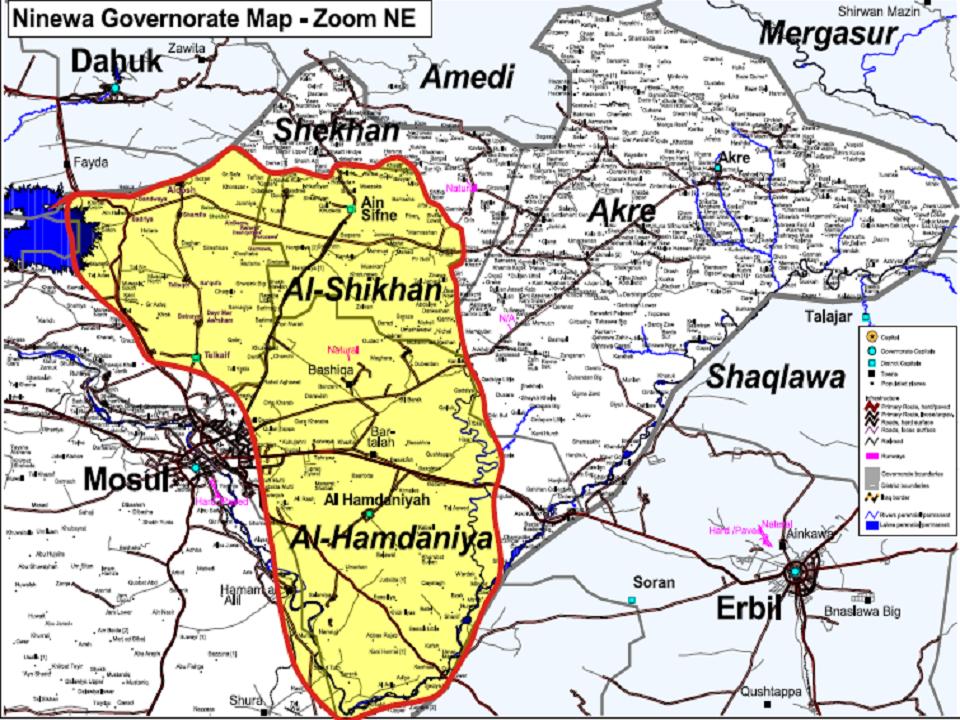 Map of the Ninewa Plain
After the U.S. invasion, the Kurdish peshmerga swept south into Ninewa with U.S. forces. Many Arabs who had moved there under the government’s programs fled before the advance. In the days after the fall of Mosul, the capital of Ninewa, the peshmerga also began kicking out Arab families from towns in the surrounding areas. These factors together increased the ethnic tensions in the province. In all the areas where the Kurds occupied they eventually established their influence through the presence of their peshmerga forces and control of the administration. The divide between Arabs and Kurds intensified after the 2005 provincial elections, when the Sunni Arabs decided to boycott. This allowed the Democratic Patriotic Alliance of Kurdistan, which was made up of the two major Kurdish parties, the Patriotic Union of Kurdistan and the Kurdistan Democratic Party, to win 31 of the 41 council seats in Ninewa.
The ascendancy of the Kurds, and the displacement and loss of power of the Sunni Arabs directly led to the growth of the insurgency in Ninewa. As reported before, Mosul remains the last urban stronghold of the Sunni militants. They in turn, have carried out some of the largest attacks in the Iraq war against Ninewa’s minorities. Christians, Yazidis, and Shabaks have all been singled out for mass casualty bombings, and targeted killings, taking thousands of lives, and forcing many minorities to flee the region. In one spate in October 2008 for example, the Christians of Mosul faced an organized campaign of murder and intimidation to drive them out of the city. 40 were killed, and 12,000 fled Mosul. Arabs and Kurds exchanged blame for the attacks, but Human Rights Watch’s interviews led them to believe that it was definitely the work of Arab insurgents. Some of the largest bombings in Ninewa this year have also been against Yazidis and Shabaks. Sunni militants consider all three groups, Christians, Yazidis, and Shabaks, to be non-believers or collaborators with the Americans.
From 2005 to the present the Kurds also carried out a systematic campaign to co-opt, cajole, threaten, and intimidate Ninewa’s minorities to support the Kurdistan Regional Government’s (KRG) plans to annex the disputed areas in the province. This has followed a two-pronged carrot and stick approach. First, the KRG has spent millions of dollars on minorities to win over their loyalty and create patronage systems. For example, the KRG’s Finance Minister Sarkis Aghajan, a Christian, was ordered by the KRG Prime Minister Nerchivan Barzani to build churches, fund Christian community organizations, and create Christian militia groups. They also used these means to undermine those who opposed the KRG’s plans. Second, the Kurds have used pressure and intimidation. Christians told Human Rights Watch that they were encouraged to sign forms calling for the annexation of Ninewa’s disputed areas by Kurdistan. The KRG also considers Yazidis and Shabaks to be Kurds, and have pressured them to register themselves as such to gain aid. Minority leaders and activists have also been targeted with the Kurds implicated in the attacks. Two Yazidi activists opposed to Kurdish aims were arrested and tortured for six months in 2007. The leader of the Shabak Democratic Gathering was killed by gunmen in July 2008 a few meters from a peshmerga checkpoint who did nothing before, during, or after the attack. Another Shabak politician claimed he was attacked by men wearing Kurdish uniforms before the 2009 provincial elections. Other minorities said they were stopped from attending political rallies by anti-Kurdish groups before the 2009 elections, and were warned that if they didn’t vote for the Kurdish Fraternal List they would lose their homes and jobs. Many of these tactics reminded Human Rights Watch of Saddam’s and earlier Arab government policies. Both the Kurds and minorities were victimized and expelled from Ninewa under the Arabization program. Now the Kurds are repeating many of these same policies to annex the northern regions of Ninewa to Kurdistan.
The 2009 elections turned out to be a major setback for the Kurds’ plans. They lost to the Arab led al-Hadbaa party who took all of the provincial offices, shutting the Kurds out of power, and calling for the withdrawal of the peshmerga. In response, the Kurdish Fraternal list is boycotting the provincial council, have refused to allow Arab officials to carry out their duties in Kurdish controlled areas, and have threatened to break away 16 towns and districts from Ninewa and create their own administration in protest. In June 2009 the KRG made the situation worse when it passed a draft constitution that claimed all of the disputed areas in Ninewa as part of Kurdistan, and said that the peshmerga had the right to operate in Ninewa.
In the end, Human Rights Watch is very worried about the future of minorities in Ninewa province. They are concerned as well, as a Christian leader recently said he is worried about increased attacks on his community in Mosul as Christmas approaches. They are facing the violence of Sunni insurgents, and the forced assimilation and co-option by the Kurds. They are also caught in the middle between the dispute between the central government, the al-Hadbaa provincial government, and the KRG for control of the disputed territories in Ninewa. Human Rights Watch’s findings are also not new. In December 2008 two similar reports were released, one by the United States Commission on International Religious Freedom on Iraqi minorities throughout the country, and another by the Brookings Institution and the University of Bern on minorities and displacement. They both noted the relentless attacks minorities have faced at the hands of insurgents, and the tactics the Kurds have employed against them. Due to these circumstances, Iraq’s minorities have been left with only two real options. First, many have fled becoming displaced or refugees. 20% of Iraq’s refugees for example are believed to be Christians. Second, those that have stayed in Ninewa have tried to align with one of the more powerful actors, whether it be the Kurds, or now the central government and the al-Hadbaa provincial council. None of these provide the protection and rights Ninewa’s minorities deserve, and as long as the divide exists between the KRG and Baghdad their situation is unlikely to get any better.
SOURCES
AK News, “Christians fear escalation of attacks with approach of Christmas,” 11/28/09
Badkhen, Anna, “Kurds evicting Arabs in north Iraq,” San Francisco Chronicle, 4/19/03
Ferris, Elizabeth and Stoltz, Kimberly, “Minorities, Displacement and Iraq’s Future,” Brookings Institution-University of Bern, December 2008
Human Rights Watch, “On Vulnerable Ground,” 11/10/09
United States Commission on International Religious Freedom, "Iraq Report - 2008," December 2008
Friday, November 27, 2009
Iraq’s Displaced Forgotten In Debate Over Election Law
Iraq’s parliament has spent months debating and negotiating over the 2010 election law. While it has discussed several issues such as the status of Kirkuk and voting for overseas Iraqis, nothing has really been said about Iraq’s internally displaced. The result is that many will likely be disenfranchised as happened in the 2009 balloting.
Recently, hundreds of displaced families protested in Diyala against the planned parliamentary vote. They said they would not participate because the voting rules were rigged against them. In the current election bill, Article IV says that displaced families can vote, but only in their original home district they were forced out of, and are ineligible if they transferred their food ration cards to another district. The Iraqi Election Commission has said that around 1 million displaced can vote under these regulations. The latest United Nations figures record around 1.6 million displaced, which means 600,000 people may be disenfranchised.
Another problem is that even those that can vote still have to register, and few have done so. In October 2009 the Iraqi Election Commission reported that only 20,000 displaced voters had signed up by then. The Commission said that it was setting up special teams to try to get more to participate. The same thing occurred in the 2009 provincial elections when the displaced were confused about the voter rules, and few registered. The result was that tens of thousands didn’t get to vote. That led to several protests.
Since there has been no real debate by Iraq’s politicians to correct these problems the same scenario is likely to play out in 2010. Iraq’s displaced are already facing a plethora of problems from findings jobs, housing, to getting services, now a sizeable number are probably going to be shut out of voting for their representatives for a second time.
SOURCES
Fadel, Leila, “Low turnout in Iraq’s election reflects a disillusioned nation,” McClatchy Newspapers, 2/1/09
Naji, Zaineb, “Voter Apathy Among Iraq Displaced,” Institute for War & Peace Reporting, 9/24/08
Niqash, “election law text,” 11/9/09
Radio Free Europe/Radio Liberty, “Iraqi Election Commission Urges Vote Law’s Approval,” 10/7/09
Al Sabah, “Many displaced families in Diyala boycott elections,” 11/17/09
United Nations High Commissioner for Refugees, “Return Update Iraq September 2009,” November 2009
Recently, hundreds of displaced families protested in Diyala against the planned parliamentary vote. They said they would not participate because the voting rules were rigged against them. In the current election bill, Article IV says that displaced families can vote, but only in their original home district they were forced out of, and are ineligible if they transferred their food ration cards to another district. The Iraqi Election Commission has said that around 1 million displaced can vote under these regulations. The latest United Nations figures record around 1.6 million displaced, which means 600,000 people may be disenfranchised.
Another problem is that even those that can vote still have to register, and few have done so. In October 2009 the Iraqi Election Commission reported that only 20,000 displaced voters had signed up by then. The Commission said that it was setting up special teams to try to get more to participate. The same thing occurred in the 2009 provincial elections when the displaced were confused about the voter rules, and few registered. The result was that tens of thousands didn’t get to vote. That led to several protests.
Since there has been no real debate by Iraq’s politicians to correct these problems the same scenario is likely to play out in 2010. Iraq’s displaced are already facing a plethora of problems from findings jobs, housing, to getting services, now a sizeable number are probably going to be shut out of voting for their representatives for a second time.
SOURCES
Fadel, Leila, “Low turnout in Iraq’s election reflects a disillusioned nation,” McClatchy Newspapers, 2/1/09
Naji, Zaineb, “Voter Apathy Among Iraq Displaced,” Institute for War & Peace Reporting, 9/24/08
Niqash, “election law text,” 11/9/09
Radio Free Europe/Radio Liberty, “Iraqi Election Commission Urges Vote Law’s Approval,” 10/7/09
Al Sabah, “Many displaced families in Diyala boycott elections,” 11/17/09
United Nations High Commissioner for Refugees, “Return Update Iraq September 2009,” November 2009
Monday, November 16, 2009
The Changing Face of Violence In Mosul
Mosul remains the second most violent city in Iraq after Baghdad. Almost everyday there are reports of drive by shootings, assassinations, or bombings. Still, there has been a slight decline in casualties since 2007, and a change in the nature of the fighting there.
The problems in Mosul began in 2004. Immediately after the U.S. invasion in 2003 the 101st Airborne Division under the command of General David Petraeus was able to pacify the city by using strong security measures, funding reconstruction projects, and getting all the major parties in the area to join the local council. When his troops left, the city was turned over to Iraqis who were not up to the job. This vacuum allowed insurgents to set up shop in 2004. Mosul became an important way station for Baathists and Al Qaeda in Syria to transfer money, supplies, and foreign fighters into Iraq. By 2005 Al Qaeda was largely in control of the western half of the city, and security deteriorated as a result.
The U.S. responded by asking the Kurdish peshmerga to move into Mosul to help with security. They took up residence in the largely Kurdish western half of the city, while Kurdish army units were deployed in the surrounding areas of Ninewa province. This facilitated the Kurdistan Democratic Party (KDP) taking over the local administration, and after the 2005 elections, they came to control the provincial council as well due to the Sunni Arab boycott. This created ethnic tensions between Arabs and Kurds, and more violence.
By 2008 Mosul had become the last urban bastion of the Iraqi insurgency. During the Surge in 2007 hundreds of militants were forced north to escape the increase in U.S. forces, and moved to Mosul. The ethnic divide there proved a fertile environment, as the insurgents increasingly portrayed themselves as the protectors of the Arabs against the Kurds. Security statistics show the changed environment. In the last three months of 2007 attacks and casualties were actually decreasing. In October 2007 there were an average of 1.51 attacks per day, resulting in 2.87 deaths and 5.83 wounded, compared to just 0.96 attacks per day, 1.58 deaths and 1.25 wounded by December. That averaged out to 1.26 security incidents per day, 2.52 deaths, and 3.73 wounded for the last three months of 2007. By the first half of 2008 that increased to 1.89 security incidents, 2.90 deaths, and 6.92 wounded.
The presence of so many insurgents in Mosul led to several Iraqi and U.S. offensives, with few results. Beginning in February 2008 U.S. forces began setting up combat outposts throughout the city, and erecting blast walls to try to control the movement of insurgents, as Iraqi forces created a Ninewa Operations Command after Prime Minister Nouri al-Maliki promised a “decisive battle” against Al Qaeda in the city in January. Deaths only decreased marginally, while the number of wounded increased dramatically over the next two months. They went from 3.34 deaths per day in February 2008 to 2.76 by April, while the number of wounded went from 2.75 to 7.60 during that same period. The problem was that rather than fighting, the militants instead chose to hide amongst the population, and adopted hit-and-run attacks.
Frustrated, in May Prime Minister Maliki announced Operation Lion’s Roar/Mother of Two Springs, but by August he admitted that it was a failure. Casualties actually increased in the two months after the offensive was launched going from 2.12 deaths per day, and 1.51 wounded in May to 3.58 deaths and 4.48 wounded by July. Following attacks on Christians in the city in October, U.S. and Iraqi forces launched Operation Mother of Two Springs II, and then Operation New Hope in February 2009. In October Operation Ninewa Wall was begun, which is almost exclusively Iraqi. Maliki also increasingly played up tensions with the Kurds, to try to rally the Sunni population of Mosul behind him to some success.
Casualties finally took a noticeable drop beginning in November 2008, but the security operations were not the cause. Rather it was the changing political situation in Mosul and Ninewa overall. In 2008 the al-Hadbaa party was formed to run in the 2009 provincial elections. The party was a coalition of Mosul elites, tribal leaders, and independent Kurds. Most important for the security situation, many Baathists and militants came to support the party as well. At the same time, the nationalist and Baathist factions of the insurgency were able to rest control of Mosul from Al Qaeda who had been losing ground in Iraq since the Anbar tribes turned on them beginning in 2005. These groups in turn, decided to try the political route after they boycotted the 2005 elections. The pending U.S. withdrawal was also a factor as many Sunni Arabs were afraid of greater Shiite domination after the Americans left, so they wanted to try to get positions in the government before that happened. Al-Hadbaa leaders were able to broker a cease-fire with the insurgents as a result, and the party ended up winning control of Ninewa in January 2009. Since then they have been able to forge a marriage of convenience with Maliki as both support a strong central government, and want the Kurdish peshmerga out of Mosul and Ninewa in general.
All of these factors led to a marked change in attacks in Mosul. Before armed clashes and shoot-outs were common in the city, along with all the bombings. Beginning in late 2008 through 2009 however, most attacks were drive by shootings, assassinations, house invasions, and still the bombs. The number of deaths went from 2.63 per day in the second half of 2008 to 1.97 in the first half of 2009, while the average number wounded dropped from 5.48 to 4.49 over the same period. From September to October the number of wounded also saw a noticeable drop.
Even with all of these changes Mosul remains a very dangerous place. Al-Hadbaa’s victory has increased tensions with the Kurdish Fraternal List that are boycotting the provincial council. That on-going ethnic divide provides a continued rationale for violence by some. In October 2009 Mosul still saw 66 attacks, 60 deaths, and 82 wounded. Until the problems between Arabs and Kurds are settled there, it will remain a largely war-torn city, unable to experience the slow return to normality that the rest of the country is beginning to experience.
The problems in Mosul began in 2004. Immediately after the U.S. invasion in 2003 the 101st Airborne Division under the command of General David Petraeus was able to pacify the city by using strong security measures, funding reconstruction projects, and getting all the major parties in the area to join the local council. When his troops left, the city was turned over to Iraqis who were not up to the job. This vacuum allowed insurgents to set up shop in 2004. Mosul became an important way station for Baathists and Al Qaeda in Syria to transfer money, supplies, and foreign fighters into Iraq. By 2005 Al Qaeda was largely in control of the western half of the city, and security deteriorated as a result.
The U.S. responded by asking the Kurdish peshmerga to move into Mosul to help with security. They took up residence in the largely Kurdish western half of the city, while Kurdish army units were deployed in the surrounding areas of Ninewa province. This facilitated the Kurdistan Democratic Party (KDP) taking over the local administration, and after the 2005 elections, they came to control the provincial council as well due to the Sunni Arab boycott. This created ethnic tensions between Arabs and Kurds, and more violence.
By 2008 Mosul had become the last urban bastion of the Iraqi insurgency. During the Surge in 2007 hundreds of militants were forced north to escape the increase in U.S. forces, and moved to Mosul. The ethnic divide there proved a fertile environment, as the insurgents increasingly portrayed themselves as the protectors of the Arabs against the Kurds. Security statistics show the changed environment. In the last three months of 2007 attacks and casualties were actually decreasing. In October 2007 there were an average of 1.51 attacks per day, resulting in 2.87 deaths and 5.83 wounded, compared to just 0.96 attacks per day, 1.58 deaths and 1.25 wounded by December. That averaged out to 1.26 security incidents per day, 2.52 deaths, and 3.73 wounded for the last three months of 2007. By the first half of 2008 that increased to 1.89 security incidents, 2.90 deaths, and 6.92 wounded.
The presence of so many insurgents in Mosul led to several Iraqi and U.S. offensives, with few results. Beginning in February 2008 U.S. forces began setting up combat outposts throughout the city, and erecting blast walls to try to control the movement of insurgents, as Iraqi forces created a Ninewa Operations Command after Prime Minister Nouri al-Maliki promised a “decisive battle” against Al Qaeda in the city in January. Deaths only decreased marginally, while the number of wounded increased dramatically over the next two months. They went from 3.34 deaths per day in February 2008 to 2.76 by April, while the number of wounded went from 2.75 to 7.60 during that same period. The problem was that rather than fighting, the militants instead chose to hide amongst the population, and adopted hit-and-run attacks.
Frustrated, in May Prime Minister Maliki announced Operation Lion’s Roar/Mother of Two Springs, but by August he admitted that it was a failure. Casualties actually increased in the two months after the offensive was launched going from 2.12 deaths per day, and 1.51 wounded in May to 3.58 deaths and 4.48 wounded by July. Following attacks on Christians in the city in October, U.S. and Iraqi forces launched Operation Mother of Two Springs II, and then Operation New Hope in February 2009. In October Operation Ninewa Wall was begun, which is almost exclusively Iraqi. Maliki also increasingly played up tensions with the Kurds, to try to rally the Sunni population of Mosul behind him to some success.
Casualties finally took a noticeable drop beginning in November 2008, but the security operations were not the cause. Rather it was the changing political situation in Mosul and Ninewa overall. In 2008 the al-Hadbaa party was formed to run in the 2009 provincial elections. The party was a coalition of Mosul elites, tribal leaders, and independent Kurds. Most important for the security situation, many Baathists and militants came to support the party as well. At the same time, the nationalist and Baathist factions of the insurgency were able to rest control of Mosul from Al Qaeda who had been losing ground in Iraq since the Anbar tribes turned on them beginning in 2005. These groups in turn, decided to try the political route after they boycotted the 2005 elections. The pending U.S. withdrawal was also a factor as many Sunni Arabs were afraid of greater Shiite domination after the Americans left, so they wanted to try to get positions in the government before that happened. Al-Hadbaa leaders were able to broker a cease-fire with the insurgents as a result, and the party ended up winning control of Ninewa in January 2009. Since then they have been able to forge a marriage of convenience with Maliki as both support a strong central government, and want the Kurdish peshmerga out of Mosul and Ninewa in general.
All of these factors led to a marked change in attacks in Mosul. Before armed clashes and shoot-outs were common in the city, along with all the bombings. Beginning in late 2008 through 2009 however, most attacks were drive by shootings, assassinations, house invasions, and still the bombs. The number of deaths went from 2.63 per day in the second half of 2008 to 1.97 in the first half of 2009, while the average number wounded dropped from 5.48 to 4.49 over the same period. From September to October the number of wounded also saw a noticeable drop.
Even with all of these changes Mosul remains a very dangerous place. Al-Hadbaa’s victory has increased tensions with the Kurdish Fraternal List that are boycotting the provincial council. That on-going ethnic divide provides a continued rationale for violence by some. In October 2009 Mosul still saw 66 attacks, 60 deaths, and 82 wounded. Until the problems between Arabs and Kurds are settled there, it will remain a largely war-torn city, unable to experience the slow return to normality that the rest of the country is beginning to experience.
Monthly Casualties In Mosul – Oct. 2007 to Oct. 2009
Attacks/ Incidents | Avg. # Of Attacks/ Incidents | Deaths | Avg. # Of Deaths | Wounded | Avg. # Of Wounded | |
2007 | ||||||
Oct. | 47 | 1.51 | 89 + 2 Americans | 2.87 | 181 + 2 Americans | 5.83 |
Nov. | 39 | 1.30 | 94 + 1 American | 3.13 | 124 + 1 American | 4.13 |
Dec. | 30 | 0.96 | 49 + 3 Americans | 1.58 | 39+ | 1.25 |
2008 | ||||||
Jan. | 58 | 1.87 | 107 + 6 Americans | 3.45 | 385 + 1 American | 12.41 |
Feb. | 56 | 1.93 | 97 + 1 American | 3.34 | 80 | 2.75 |
March | 64 | 2.06 | 86 | 2.77 | 267 | 8.61 |
April | 67 | 2.23 | 83 | 2.76 | 228 | 7.60 |
May | 42 | 1.35 | 66 | 2.12 | 47 + 3 Americans | 1.51 |
June | 58 | 1.93 | 89 | 2.96 | 253 | 8.43 |
July | 83 | 2.67 | 111 | 3.58 | 139 | 4.48 |
Aug. | 67 | 2.16 | 59 | 1.90 | 113 + 1 American | 3.64 |
Sep. | 80 | 2.66 | 82 | 2.73 | 140+ | 4.66 |
Oct. | 92 | 2.96 | 112 | 3.61 | 188 | 6.06 |
Nov. | 65 | 2.16 | 53 | 1.76 | 249 | 8.30 |
Dec. | 65 | 2.09 | 68 | 2.19 | 181 | 5.83 |
2009 | ||||||
Jan. | 52 | 1.67 | 56 | 1.80 | 56 | 1.80 |
Feb. | 81 | 2.89 | 58 | 2.00 | 111 | 3.96 |
March | 86 | 2.77 | 69 | 2.22 | 169 | 5.45 |
April | 79 | 2.63 | 53 | 1.76 | 191 | 6.36 |
May | 83 | 3.06 | 64 | 2.06 | 164 | 4.70 |
June | 73 | 2.43 | 58 | 1.93 | 123 | 4.10 |
July | 73 | 2.35 | 79 | 2.54 | 169 | 5.45 |
Aug. | 77 | 2.48 | 102 | 3.29 | 171 | 5.51 |
Sep. | 72 | 2.40 | 65 | 2.16 | 60 | 2.00 |
Oct. | 66 | 2.12 | 60 | 1.93 | 82 | 2.64 |
Avgs. | ||||||
4th Qtr 2007 | 38.66/ month | 1.26/day | 77.33/ month | 2.52/ day | 114.66/ month | 3.73/day |
1st Half 2008 | 57.5/ month | 1.89/day | 88.00/ month | 2.90/ day | 210.00/ month | 6.92/day |
2nd Half 2008 | 75.33/ month | 2.45/day | 80.83/ month | 2.63/ day | 168.33/ month | 5.48/day |
1st Half 2009 | 75.66/ month | 2.50/day | 59.66/ month | 1.97/ day | 135.66/ month | 4.49/day |
SOURCES
ABC News, "Iraqi woman and child killed by US fire," 5/11/08
Abouzeid, Rania, "In Mosul, Iraq's Insurgency Refuses to Be Tamed," Time, 3/18/09
Agence France Presse, "Death toll from bombing in Iraq's Mosul rises to 13," 6/3/08
Associated Press, "Al-Qaida in Iraq front group warns it will retaliate vs. US-Iraqi crackdown," 5/27/08
- "Female bomber kills 3 near bus stop in Iraq," USA Today, 3/19/08
- "Iraq: explosion in apartment kills at least 7, wounds 70," 1/23/08
- "Iraqi police: 18 killed in clashes with al-Qaeda," USA Today, 11/10/07
- "Police: Female suicide bomber kills 3 in Iraq," 2/17/08
Aswat al-Iraq, "2 bombs defused in Mosul," 10/26/09
- "2 civilians killed in Mosul," 10/21/09
- "2 civilians wounded in 2 separate incidents in Mosul," 10/5/09
- "2 cops wounded in Mosul blast," 10/5/09
- "2 killed in separate incidents in Mosul," 10/3/09
- "2 unknown bodies found in Mosul," 10/20/09
- "3 killed, 5 wounded in bombing in Mosul," 10/28/09
- "3 policemen killed, officer wounded in Mosul attack," 10/29/09
- "Blast in Ninewa wounds cement company chief," 10/18/09
- "Bomb wounds 2 in Mosul," 10/6/09
- "Children, mother wounded in Mosul blast," 10/12/09
- "Civilian killed in tribal clashes in Mosul," 10/12/09
- "Civilian wounded in IED blast near Mosul," 10/26/09
- "Contractor gunned down in Mosul," 10/12/09
- "District chief escapes attempt on his life in Mosul," 10/19/09
- "Guard killed in crowded souk in Mosul," 10/23/09
- "Gunmen assassinate tribal affairs office chief in Ninewa," 10/19/09
- "Gunmen storm building in Mosul, kill two civilians," 10/26/09
- "Hand grenade injures 4 in Mosul," 10/31/09
- "IED defused in western Mosul," 10/12/09
- "Iraq army kills gunman in Mosul," 10/19/09
- "Iraqi soldier killed, 2 wounded in Mosul," 10/23/09
- "Police kill gunman in northeastern Mosul," 10/2/09
- "Policeman killed, 3 civilians wounded separately in Mosul," 10/22/09
- "Policeman, gunman killed in Mosul," 10/22/09
- "Policeman survives IED blast near his vehicle," 10/18/09
- "Policeman wounded in Mosul blast," 10/13/09
- "Real-estate office owner killed in Mosul," 10/25/09
- "Sticky bomb defused at official building in Ninewa," 10/28/09
- "Sticky bomb kills, wounds 5 family members," 10/7/09
- "Sticky bomb wounds 5 in Mosul," 10/31/09
- "U.S. forces kill civilian, arrest 4 brothers," 10/27/09
- "Vendor, child killed in northern Mosul," 10/21/09
- "Woman killed, 2 civilians wounded by police mistake fire in Mosul," 10/16/09
- "Woman's head found in Mosul," 10/3/09
Brown, Drewn, "U.S. troops setting down roots in Mosul," Stars and Stripes, 2/23/08
CNN, "Bombings kill 11 in northern Ira," 7/7/08
- "Iraq to host Iran leader for first time since nations warred," 1/24/08
Dagher, Sam, "Fractures in Iraq City as Kurds and Baghdad Vie," New York Times, 10/28/08
Dimov, Marina, "Three members of same family murdered in northern Iraq," Visit Bulgaria, 9/12/08
DPA, "Al-Qaeda suspects, tribal policemen, TV presenter killed in Iraq," 6/17/08
- "At least 10 killed, 15 injured in attacks in Iraq," 2/25/08
- "At least 12 killed in Iraq violence," 3/11/08
- "At least 31 killed in Iraq violence, 100 wounded – 3rd Update," 12/25/07
- "At least 59 killed, 76 wounded in Iraqi violence (1st Lead)," 4/15/08
- "At least five killed, three wounded in Iraqi violence – Summary," 2/3/08
- "Christians, churches attacked in Iraq during celebration," 1/7/08
- "Female students kidnapped, US soldier dies in Iraq," 7/6/08
- "Four Iraqi soldiers killed in clashes in northern Iraq (Extra)," 5/7/08
- "Four killed, three injured in attacks in Mosul," 10/21/09
- "Governor of Iraq's Nineveh escapes assassination attempt – Update," 6/7/08
- "Iraq's Islamic Party leader assassinated in Mosul," 8/7/08
- "Nine killed, nine wounded across Iraq (Roundup)," 10/31/07
- "Plane engines, explosives, and another grave found in Iraq – Summary," 3/9/08
- "Policeman, soldier killed in two incidents in Iraq (Extra)," 8/14/08
- "Three killed, 13 injured in blasts in northern Iraq (2nd Lead)," 4/23/08
- "US troops kill nine suspected al-Qaeda members in Iraq," 2/18/08
Al Dulaimy, Mohammed, "Round-up of Daily Violence in Iraq – Monday 11 February 2008," McClatchy Newspapers, 2/11/08
- "Round-up of Daily Violence in Iraq – Monday 12 May 2008," McClatchy Newspapers, 5/12/08
- "Round-up of Daily Violence in Iraq – Monday 24 May 2008," McClatchy Newspapers, 5/24/08
- "Round-up of Daily Violence in Iraq – Monday October 5 2009," McClatchy Newspapers, 10/5/09
- "Round-up of Daily Violence in Iraq – Saturday October 24, 2009
- "Round-up of Daily Violence in Iraq – Sunday 4 May 2008," McClatchy Newspapers, 5/4/08
- "Round-up of Daily Violence in Iraq – Sunday 23 December 2007," McClatchy Newspapers, 12/23/07
- "Round-up of Daily Violence in Iraq – Tuesday 26 February 2008," McClatchy Newspapers, 2/26/08
- "Round-up of Daily Violence in Iraq – Wednesday 7 May 2008," McClatchy Newspapers, 5/7/08
- "Round-up of Daily Violence in Iraq – Wednesday 10 September 2008," McClatchy Newspapers, 9/10/08
Freeman, Sholnn, "At Least 35 Die As Bombers Hit Wedding Convoy," Washington Post, 5/2/08 - "U.S. Deaths in Iraq War Reach 4,000; Green Zone Is Shelled," Washington Post, 3/24/08
Hamilton, Eric, "The Fight for Mosul," Institute for the Study of War, 4/29/08
Hammoudi, Laith, "Round-up of Daily Violence in Iraq – Monday 8 September 2008," McClatchy Newspapers, 9/8/08
- "Round-up of Daily Violence in Iraq – Monday 26 October 2009," McClatchy Newspapers, 10/26/09
- "Round-up of Daily Violence in Iraq – Thursday 4 September 2008," McClatchy Newspapers, 9/4/08
- "Round-up of Daily Violence in Iraq – Thursday 20 October 2009," McClatchy Newspapers, 10/29/09
- "Round-up of Daily Violence in Iraq – Tuesday 13 October 2009," McClatchy Newspapers, 10/13/09
- "Round-up of Daily Violence in Iraq – Tuesday 22 April 2008," McClatchy Newspapers, 4/22/08
- "Round-up of Daily Violence in Iraq – Tuesday 29 April 2008," McClatchy Newspapers, 4/29/08
- "Round-up of Daily Violence in Iraq – Wednesday 5 March 2008," McClatchy Newspapers, 3/5/08
- "Round-up of Daily Violence in Iraq – Wednesday 13 August 2008," McClatchy Newspapers, 8/13/08
- "Round-up of Daily Violence in Iraq – Wednesday 14 October 2009," McClatchy Newspapers, 10/14/09
- "Round-up of Daily Violence in Iraq – Wednesday 27 August 2008," McClatchy Newspapers, 8/27/08
- "Round-up of Daily Violence in Iraq – Wednesday 27 February 2008," McClatchy Newspapers, 2/27/08
Holden, Michael, "U.S. and Iraqi forces begin al Qaeda action in Mosul," 2/11/08
Hussein, Jenan, "Round-up of Daily Violence in Iraq – Wednesday 28 October 2009," McClatchy Newspapers, 10/28/09
International Crisis Group, "Iraq's New Battlefront: The Struggle Over Ninewa," 9/28/09
Iraq Today, April 2008
- August 2008
- December 2007
- February 2008
- March 2008
- January 2008
- July 2008
- June 2008
- May 2008
- November 2007
- October 2007
- September 2008
Issa, Sahar, "Round-up of Daily Violence in Iraq – Friday 5 September 2008," McClatchy Newspapers, 9/5/08
- "Round-up of Daily Violence in Iraq – Friday 14 March 2008," McClatchy Newspapers, 3/14/08
- "Round-up of Daily Violence in Iraq – Friday 22 August 2008," McClatchy Newspapers, 8/22/08
- "Round-up of Daily Violence in Iraq – Monday 19 October 2009," McClatchy Newspapers, 10/19/09
- "Round-up of Daily Violence in Iraq – Sunday 20 July 2008," McClatchy Newspapers, 7/20/08
- "Round-up of Daily Violence in Iraq – Thursday 1 October 2009," McClatchy Newspapers, 10/1/09
- "Round-up of Daily Violence in Iraq – Thursday 7 February 2008," McClatchy Newspapers, 2/7/08
- "Round-up of Daily Violence in Iraq – Thursday 10 April 2008," McClatchy Newspapers, 4/10/08
- "Round-up of Daily Violence in Iraq – Thursday 17 January 2008," McClatchy Newspapers, 1/17/08
- "Round-up of Daily Violence in Iraq – Thursday 18 September 2008," McClatchy Newspapers, 9/18/08
- "Round-up of Daily Violence in Iraq – Thursday 20 March 2008," McClatchy Newspapers, 3/20/08
- "Round-up of Daily Violence in Iraq – Thursday 24 July 2008," McClatchy Newspapers, 7/24/08
- "Round-up of Daily Violence in Iraq – Wednesday 7 October 2009," McClatchy Newspapers, 10/7/09
Kadhim, Hussein, "Round-up of Daily Violence in Iraq – Monday 9 June 2008," McClatchy Newspapers, 6/9/08
- "Round-up of Daily Violence in Iraq – Monday 14 January 2008," McClatchy Newspapers, 1/14/08
- "Round-up of Daily Violence in Iraq – Monday 29 September 2008," McClatchy Newspapers, 9/29/08
- "Round-up of Daily Violence in Iraq – Thursday 3 October 2007," McClatchy Newspapers, 10/3/07
- "Round-up of Daily Violence in Iraq – Thursday 6 March 2008," McClatchy Newspapers, 3/6/08
- "Round-up of Daily Violence in Iraq – Thursday 11 October 2007," McClatchy Newspapers, 10/11/07
- "Round-up of Daily Violence in Iraq – Tuesday 01 April 2008," McClatchy Newspapers, 4/1/08
- "Round-up of Daily Violence in Iraq – Tuesday 06 May 2008," McClatchy Newspapers, 5/6/08
- "Round-up of Daily Violence in Iraq – Wednesday 23 January 2008," McClatchy Newspapers, 1/23/08
- "Round-up of Daily Violence in Iraq – Wednesday 24 September 2008," McClatchy Newspapers, 9/24/08
KUNA, "Attack in Mosul leads to injury of 17 people," 6/22/08
Mohammed, Mujahid, "Five arrested after Iraq TV crew murder," Agence France Presse, 9/14/08
Multi-National Corps – Iraq, "MNC-I Soldier attacked during military operations (Mosul)," 11/13/07
- "MND-N Soldiers attacked in Ninevah Province (Mosul)," 2/20/08
- "MND-North Soldiers attacked by small-arms fire (Mosul," 1/26/07
- "Task Force Iron Soldiers attacked in Mosul," 10/31/07
Nagpal, Sahil, "Governor of Iraq's Nineveh province survives assassination attempt," DPA, 6/7/08
Oppel, Richard, "Truck Bomb Kills Up to 16 Iraqis in Mosul," 10/17/07
Partlow, Joshua and Tyson, Ann Scott, "Five U.S. Soldiers Are Killed When Convoy Is Hit in Mosul," Washington Post, 1/29/08
PBS Frontline, "Interview Maj. Gen. David Petraeus," Beyond Baghdad, 2/12/04
Press TV, "Car bomb kills woman in Baghdad," 11/8/07
Reuters, "Bombs hit northern Iraq, forces expect more," 8/13/08
- "Car bomb kills 18 people in Iraqi city," 6/26/08
- "FACTBOX-Security developments in Iraq, April 1," 4/1/08
- "FACTBOX-Security developments in Iraq, April 2," 4/2/08
- "FACTBOX-Security developments in Iraq, April 4," 4/4/08
- "FACTBOX-Security developments in Iraq, April 6," 4/6/08
- "FACTBOX-Security developments in Iraq, April 11," 4/11/08
- "FACTBOX-Security developments in Iraq, April 12," 4/12/08
- "FACTBOX-Security developments in Iraq, April 13," 4/13/08
- "FACTBOX-Security developments in Iraq, April 15," 4/15/08
- "FACTBOX-Security developments in Iraq, April 19," 4/19/08
- "FACTBOX-Security developments in Iraq, April 22," 4/22/08
- "FACTBOX-Security developments in Iraq, April 23," 4/23/08
- "FACTBOX-Security developments in Iraq, April 25," 4/25/08
- "FACTBOX-Security developments in Iraq, April 27," 4/27/08
- "FACTBOX-Security developments in Iraq, April 30," 4/30/08
- "FACTBOX-Security developments in Iraq, Aug 4," 8/4/08
- "FACTBOX-Security developments in Iraq, Aug 5," 8/5/08
- "FACTBOX-Security developments in Iraq, Aug 6," 8/6/08
- "FACTBOX-Security developments in Iraq, Aug 8," 8/8/08
- "FACTBOX-Security developments in Iraq, Aug 11," 8/11/08
- "FACTBOX-Security developments in Iraq, Aug 14," 8/14/08
- "FACTBOX-Security developments in Iraq, Aug 15," 8/15/08
- "FACTBOX-Security developments in Iraq, Aug 18," 8/18/08
- "FACTBOX-Security developments in Iraq, Aug 21," 8/21/08
- "FACTBOX-Security developments in Iraq, Aug 23," 8/23/08
- "FACTBOX-Security developments in Iraq, Aug 25," 8/25/08
- "FACTBOX-Security developments in Iraq, Aug 27," 8/27/08
- "FACTBOX-Security developments in Iraq, Aug 28," 8/28/08
- "FACTBOX-Security developments in Iraq, Aug 30," 8/30/08
- "FACTBOX-Security developments in Iraq, Aug 31," 8/31/08
- "FACTBOX-Security developments in Iraq, Dec 25," 12/25/07
- "FACTBOX-Security developments in Iraq, Dec 28," 12/28/07
- "FACTBOX-Security developments in Iraq, Dec 29," 12/29/07
- "FACTBOX-Security developments in Iraq, Dec 30," 12/30/07
- "FACTBOX-Security developments in Iraq, Feb 4," 2/4/08
- "FACTBOX-Security developments in Iraq, Feb 6," 2/6/08
- "FACTBOX-Security developments in Iraq, Feb 7," 2/7/08
- "FACTBOX-Security developments in Iraq, Feb 8," 2/8/08
- "FACTBOX-Security developments in Iraq, Feb 9," 2/9/08
- "FACTBOX-Security developments in Iraq, Feb 11," 2/11/08
- "FACTBOX-Security developments in Iraq, Feb 19," 2/19/08
- "FACTBOX-Security developments in Iraq, Feb 20," 2/20/08
- "FACTBOX-Security developments in Iraq, Feb 24," 2/24/08
- "FACTBOX-Security developments in Iraq, Feb 25," 2/25/08
- "FACTBOX-Security developments in Iraq, Feb 27," 2/27/08
- "FACTBOX-Security developments in Iraq, Feb 28," 2/28/08
- "FACTBOX-Security developments in Iraq, Jan 1," 1/1/08
- "FACTBOX-Security developments in Iraq, Jan 2," 1/2/08
- "FACTBOX-Security developments in Iraq, Jan 7," 1/7/08
- "FACTBOX-Security developments in Iraq, Jan 13," 1/13/08
- "FACTBOX-Security developments in Iraq, Jan 16," 1/16/08
- "FACTBOX-Security developments in Iraq, Jan 17," 1/17/08
- "FACTBOX-Security developments in Iraq, Jan 20," 1/20/08
- "FACTBOX-Security developments in Iraq, Jan 23," 1/23/08
- "FACTBOX-Security developments in Iraq, Jan 30," 1/30/08
- "FACTBOX-Security developments in Iraq, July 1," 7/1/08
- "FACTBOX-Security developments in Iraq, July 3," 7/3/08
- "FACTBOX-Security developments in Iraq, July 5," 7/5/08
- "FACTBOX-Security developments in Iraq, July 7," 7/7/08
- "FACTBOX-Security developments in Iraq, July 8," 7/8/08
- "FACTBOX-Security developments in Iraq, July 9," 7/9/08
- "FACTBOX-Security developments in Iraq, July 11," 7/11/08
- "FACTBOX-Security developments in Iraq, July 12," 7/12/08
- "FACTBOX-Security developments in Iraq, July 13," 7/13/08
- "FACTBOX-Security developments in Iraq, July 14," 7/14/08
- "FACTBOX-Security developments in Iraq, July 15," 7/15/08
- "FACTBOX-Security developments in Iraq, July 16," 7/16/08
- "FACTBOX-Security developments in Iraq, July 18," 7/18/08
- "FACTBOX-Security developments in Iraq, July 19," 7/19/08
- "FACTBOX-Security developments in Iraq, July 20," 7/20/08
- "FACTBOX-Security developments in Iraq, July 21," 7/21/08
- "FACTBOX-Security developments in Iraq, July 22," 7/22/08
- "FACTBOX-Security developments in Iraq, July 24," 7/24/08
- "FACTBOX-Security developments in Iraq, July 25," 7/25/08
- "FACTBOX-Security developments in Iraq, July 28," 7/28/08
- "FACTBOX-Security developments in Iraq, July 31," 7/31/08
- "FACTBOX-Security developments in Iraq, June 2," 6/2/08
- "FACTBOX-Security developments in Iraq, June 8," 6/8/08
- "FACTBOX-Security developments in Iraq, June 9," 6/9/08
- "FACTBOX-Security developments in Iraq, June 14," 6/14/08
- "FACTBOX-Security developments in Iraq, June 16," 6/16/08
- "FACTBOX-Security developments in Iraq, June 17," 6/17/08
- "FACTBOX-Security developments in Iraq, June 19," 6/19/08
- "FACTBOX-Security developments in Iraq, June 22," 6/22/08
- "FACTBOX-Security developments in Iraq, June 24," 6/24/08
- "FACTBOX-Security developments in Iraq, June 29," 6/29/08
- "FACTBOX-Security developments in Iraq, June 30," 6/30/08
- "FACTBOX-Security developments in Iraq, March 4," 3/4/08
- "FACTBOX-Security developments in Iraq, March 10," 3/10/08
- "FACTBOX-Security developments in Iraq, March 12," 3/12/08
- "FACTBOX-Security developments in Iraq, March 16," 3/16/08
- "FACTBOX-Security developments in Iraq, March 17," 3/17/08
- "FACTBOX-Security developments in Iraq, March 18," 3/18/08
- "FACTBOX-Security developments in Iraq, March 19," 3/19/08
- "FACTBOX-Security developments in Iraq, March 21," 3/21/08
- "FACTBOX-Security developments in Iraq, March 25," 3/25/08
- "FACTBOX-Security developments in Iraq, May 2," 5/2/08
- "FACTBOX-Security developments in Iraq, May 4," 5/4/08
- "FACTBOX-Security developments in Iraq, May 5," 5/5/08
- "FACTBOX-Security developments in Iraq, May 6," 5/6/08
- "FACTBOX-Security developments in Iraq, May 9," 5/9/08
- "FACTBOX-Security developments in Iraq, May 13," 5/13/08
- "FACTBOX-Security developments in Iraq, May 20," 5/20/08
- "FACTBOX-Security developments in Iraq, May 22," 5/22/08
- "FACTBOX-Security developments in Iraq, May 24," 5/24/08
- "FACTBOX-Security developments in Iraq, May 26," 5/26/08
- "FACTBOX-Security developments in Iraq, May 29," 5/29/08
- "FACTBOX-Security developments in Iraq, May 30," 5/30/08
- "FACTBOX-Security developments in Iraq, Nov 3," 11/3/07
- "FACTBOX-Security developments in Iraq, Nov 5," 11/5/07
- "FACTBOX-Security developments in Iraq, Nov 6," 11/6/07
- "FACTBOX-Security developments in Iraq, Nov 19," 11/19/07
- "FACTBOX-Security developments in Iraq, Nov 22," 11/22/07
- "FACTBOX-Security developments in Iraq, Nov 23," 11/23/07
- "FACTBOX-Security developments in Iraq, Nov 24," 11/24/07
- "FACTBOX-Security developments in Iraq, Nov 26," 11/26/07
- "FACTBOX-Security developments in Iraq, Nov 27," 11/27/07
- "FACTBOX-Security developments in Iraq, Nov 29," 11/29/07
- "FACTBOX-Security developments in Iraq, Oct 1," 10/1/07
- "FACTBOX-Security developments in Iraq, Oct 2," 10/2/07
- "FACTBOX-Security developments in Iraq, Oct 9," 10/9/07
- "FACTBOX-Security developments in Iraq, Oct 9," 10/9/09
- "FACTBOX-Security developments in Iraq, Oct 11," 10/11/07
- "FACTBOX-Security developments in Iraq, Oct 11," 10/11/09
- "FACTBOX-Security developments in Iraq, Oct 12," 10/12/09
- "FACTBOX-Security developments in Iraq, Oct 14," 10/14/09
- "FACTBOX-Security developments in Iraq, Oct 15," 10/15/07
- "FACTBOX-Security developments in Iraq, Oct 15," 10/15/09
- "FACTBOX-Security developments in Iraq, Oct 16," 10/16/07
- "FACTBOX-Security developments in Iraq, Oct 17," 10/17/09
- "FACTBOX-Security developments in Iraq, Oct 18," 10/18/07
- "FACTBOX-Security developments in Iraq, Oct 18," 10/18/09
- "FACTBOX-Security developments in Iraq, Oct 19," 10/19/09
- "FACTBOX-Security developments in Iraq, Oct 20," 10/20/09
- "FACTBOX-Security developments in Iraq, Oct 21," 10/21/07
- "FACTBOX-Security developments in Iraq, Oct 22," 10/22/07
- "FACTBOX-Security developments in Iraq, Oct 24," 10/24/07
- "FACTBOX-Security developments in Iraq, Oct 26," 10/26/07
- "FACTBOX-Security developments in Iraq, Oct 30," 10/30/07
- "FACTBOX-Security developments in Iraq, Oct 30," 10/30/09
- "FACTBOX-Security developments in Iraq, Sept 1," 9/1/08
- "FACTBOX-Security developments in Iraq, Sept 3," 9/3/08
- "FACTBOX-Security developments in Iraq, Sept 9," 9/8/08
- "FACTBOX-Security developments in Iraq, Sept 9," 9/9/08
- "FACTBOX-Security developments in Iraq, Sept 10," 9/10/08
- "FACTBOX-Security developments in Iraq, Sept 13," 9/13/08
- "FACTBOX-Security developments in Iraq, Sept 17," 9/17/08
- "FACTBOX-Security developments in Iraq, Sept 18," 9/18/08
- "FACTBOX-Security developments in Iraq, Sept 20," 9/20/08
- "FACTBOX-Security developments in Iraq, Sept 21," 9/21/08
- "FACTBOX-Security developments in Iraq, Sept 22," 9/22/08
- "FACTBOX-Security developments in Iraq, Sept 23," 9/23/08
- "FACTBOX-Security developments in Iraq, Sept 25," 9/25/08
- "FACTBOX-Security developments in Iraq, Sept 28," 9/28/08
- "FACTBOX-Security developments in Iraq, Sept 29," 9/29/08
- "FACTBOX-Security developments in Iraq, Sept 30," 9/30/08
- "Iraqi, U.S. soldiers kill 14 gunmen in Mosul raids," 11/9/07
- "Kidnapped Iraq archbishop dead-Catholic news agency," 3/13/08
- "Truck bomb explodes near Iraq's largest dam," 12/17/07
Saeed, Samer, "U.S. troops erect walls in Mosul as inhabitants flee," Azzaman, 2/17/08
Surk, Barbara, "Truck bomb destroys key bridge in western Iraq," Associated Press, 10/17/09
Tait, Paul, "Severed heads and bodies found in Iraq field: police," Reuters, 1/29/08
U.S. Department of Defense, "News Release," 12/28/07
UPI, "Iraq violence claims nine lives," 9/12/08
- "Two soldiers die in Iraq car bomb," 7/19/08
Xinhua, "At least 2 killed in suicide truck bombing in N Iraq," 9/22/08
- "Car bomb hits police patrol in northern Iraq," 1/14/08
- "Car bomb kills policeman in northern Iraq," 9/8/08
- "Gunmen blow up 4 houses in N Iraq, child killed," 6/16/08
- "Gunmen kill provincial council member in N Iraq," 11/6/07
- "Head of provincial council survives bomb attack in N Iraq," 12/9/07
- "Insurgents blow up house of Sunni lawmaker in N Iraq," 9/23/08
- "Iraqi soldiers foil suicide bomb attack in Mosul," 4/29/08
- "Policeman killed in gunfire in northern Ira," 9/20/08
- "Policeman killed in shooting in N Iraq," 11/28/07
- "Seven killed in Iraq suicide car bombing," 9/2/08
- "Suicide car bomb injuring 14 in N Iraq," 6/23/08
- "Three policemen killed in insurgents' attack in Iraq," 1/4/08
- "Two people killed in bomb attack in northern Iraq," 5/24/08
- "Two suicide bombers hit police checkpoint in N Iraq," 11/4/07
Subscribe to:
Posts (Atom)


