Radhouane Nouicer refutes media accusations of inflated Iraqi refugee statistics in an informative presentation at the 2008 Iraq Action Days Forum. The Director of Bureau for Middle East North Africa at the United Nations High Commissioner for Refugees (UNHCR) challenges the audience to ignore the number nitpicking. As an alternative, he urges them to focus on the mass suffering of Iraqis whose acknowledgment by the global community is at “risk to go into a long shadow.”
Panel 2 Part 1 (37:29) from Sarah Shannon on Vimeo.
Following Mr. Nouicer’s presentation, Dana Graber Ladek, a specialist on Iraq displacement for the International Organization for Migration in Amman, Jordan, elaborates on “the worst refugee crisis since 1948.” Dana Graber Ladek explains, increased security, expended finances, visa restrictions, and lack of employment, have prompted between 80,000 and 100,000 Iraqis to attempt return to the homes they fled. Dana Graber Ladek addresses many of the pressing needs of the resettled Iraqis, most who have merely shifted status from refugees to internally displaced persons (IDP’s).
Panel 2 Part 2 (31:09) from Sarah Shannon on Vimeo.
“Why resettlement?” is the question raised by the 3rd panel speaker Bob Carey of the International Rescue Committee. Carey emphasizes that the U.S. humanitarian legacy is under threat due to a significant decline in resettlement privileges granted to refugees in the United States. Quotas for Iraqi refugee resettlement within the U.S. are grossly unmet. Carey also raises questions about refugees once they are resettled. How will the physical and psychological medical needs of resettled Iraqis be met? How can resettled refugees be assured jobs? What can the American public do to aid in a smooth relocation for Iraqis?
To hear the panelists answer questions from the audience click here Q&A
SPECIAL NOTE: Bob Carey of the International Rescue Committee is among the many distinguished panelists who will be presenting this Friday at the IRAQ AT THE CROSSROADS symposium at Rutgers School of Law-Newark.
Showing posts with label unhcr. Show all posts
Showing posts with label unhcr. Show all posts
Wednesday, October 22, 2008


Friday, August 08, 2008
A Vicious Cycle: Violence and Displacement in Iraq
 Last week, we attended an panel discussion with Joost Hiltermann of the International Crisis Group (ICG) and Michel Gabaudan of UNHCR: the UN Refugee Agency at the Carnegie Endowment for International Peace. They discussed the findings of ICG's new report, "Failed Responsibility: Iraqi Refugees in Syria, Jordan and Lebanon", which underscores the deepening crisis and failure of the Iraqi government and wider international community to meet the needs of vulnerable Iraqis.
Hilterman and Gabaudan strongly agree that Iraq’s stability can be improved by addressing the displacement crisis. The ICG Report describes how the forced exodus of millions of Iraqis profoundly impacts the security situation, an interaction generally overlooked by the American public.
Triggered by the violence in Iraq, the refugee crisis indirectly helps sustain and finance it [insurgency]. Armed groups whose actions led Iraqis to flee eagerly seized the properties they abandoned, either allocating them to supporters and co-religionists or selling them to generate funds. Such large-scale expropriation likely will fuel future strife if and when refugees return and try to reclaim their homes. As refugees fled, they often were robbed by armed militias and criminal gangs or charged levies at unofficial checkpoints manned by armed groups. Moreover, the exodus contributed to the sectarian homogenization of formerly mixed neighborhoods; this enabled armed groups to consolidate their control, recruit new fighters and levy taxes and fees to bankroll their violent activities. All in all, militias and armed groups exploited the refugee crisis for self-enrichment and war racketeering.As the ICG Report demonstrates, the humanitarian crisis and security situation are directly connected and both must be addressed to create stability. Furthermore, the panelists discussed how, at play in Iraq right now is a destabilizing and vicious cycle with violence causing displacement, which incites further violence. The report examines other ways in which the cycle manifests itself:
The mass exodus jeopardized Iraq's stability in yet another way. Many who left are professionals and administrators from the middle class. A shortage of such skilled laborers and managers inevitably hinders reconstruction. The reverse also is true: among those who remained are many who benefited from patronage or political protection. Having taken de facto control of the state's mid-management levels, they will not readily relinquish their gains. In other words, the refugee crisis further politicized the bureaucracy. Overall, these dynamics have given rise to a vicious economic cycle: violence triggers flight, flight hampers reconstruction, and faltering reconstruction in turn fuels violence.Hiltermann and Gabaudan stressed that the humanitarian crisis in Iraq is directly linked to security conditions, and therefore national stability. During the forum, Hiltermann noted that this serves as the perfect example of a "crossover issue where humanitarian issues have a great impact on the issue of stability and peace."
To create a more peaceful and secure Iraq, this destabilizing cycle of violence and displacement must be halted. Actively confronting the humanitarian crisis and addressing the needs of vulnerable Iraqis will help bring about stability and security to the nation and facilitate a safe environment for all Iraqis.
Photo Caption: Dr. Joost Hiltermann on the NewsHour on PBS
Wednesday, August 06, 2008
Reports: 8/6/2008
Key reports on the Iraq relief and development:
Stabilizing and Rebuilding Iraq: Iraqi Revenues, Expenditures, and Surplus
Government Accountability Office (GAO)
August 2008
From 2005 through 2007, the Iraqi government generated an estimated $96 billion in cumulative revenues (mostly from oil sales). For 2008, GAO estimates that Iraq could generate as much as $86 billion in total revenues. From 2005 through 2007, the Iraqi government spent an estimated $67 billion on operating and investment activities. The Iraqi government spent only 1% of total expenditures to maintain Iraq- and U.S.-funded investments such as buildings, water and electricity installations. From 2005 through 2007, Iraq was unable to spend all its budgeted funds. In 2007, Iraq spent 80% of its $29 billion operating budget and 28% of its $12 billion investment budget. For 2008, GAO estimates that Iraq could spend as much as $35.9 billion of its $49.9 billion budget. As a result, GAO estimates a cumulative budget surplus of about $29 billion from 2005 to 2007 and projects an additional $38 to $50 billion budget surplus for 2008 (although a proposed $22 billion Iraqi budget supplemental could reduce this projected surplus). U.S. and international officials identify the shortage of trained staff, weak procurement and budgeting systems, violence and sectarian strife, and other factors affecting the Iraqi government’s ability to spend more of its revenues on capital investments.
Failed Responsibility: Iraqi Refugees in Syria, Jordan and Lebanon
International Crisis Group (ICG)
July 2008
Although the security situation in Iraq shows progress, Iraqi refugees remain stranded, jobless and deprived of essential services, while the Iraqi government and the wider international community have failed in their responsibilities and are ill prepared to cope with a new refugee crisis, should it occur. While initially welcoming their Iraqi brethren, ICG reports that Syria and Jordan have put tough restrictions on entry. They provide few basic services and inadequate opportunities for jobs, health care and children's education. If the host countries can be faulted for unfriendly treatment of refugees, they deserve credit for receiving so many at great cost to their societies. By contrast, it is difficult to give the Iraqi government any credit. Flush with oil money, it has been conspicuously ungenerous toward its citizens stranded abroad. The attitude of Western nations also has been deeply troubling.
Iraq Displacement 2008 Mid-Year in Review
International Organization for Migration (IOM)
July 2008
During the first half of 2008, trends of decreased violence and a declining rate of displacement continued throughout the country. Yet the deteriorating conditions facing the 2.8 million Internally Displaced People (IDPs), as well as the limited returnee population, remain one of the most serious humanitarian crises in the world. The report finds that about half of the population continue to get their water from unsafe sources -- 53% from nearby rivers and streams and 52% from open or broken pipes. Meanwhile, shelter is consistently among the highest-priority needs cited by IDPs, and eviction threats coupled with rapidly rising rental prices have created an even more precarious housing situation in recent months. Food access was also poor, only three in ten had regular access to food rations. About half had intermittent access and 21% no access at all. In addition, approximately two million Iraqis are refugees, mostly in neighboring Syria and Jordan, resulting in a total of 5 million internally and externally displaced.
Assessment on Returns to Iraq Amongst Iraqi Refugee Population in Syria
United Nations High Commission for Refugees (UNHCR)
April 2008
A survey of nearly 1,000 Iraqis currently staying in Syria has shown that 95 percent fled their homeland because of direct threats or general insecurity and that only 4 percent currently had plans to return to Iraq.
Consolidated Appeal for Iraq 2008
United Nations Office for the Coordination of Humanitarian Affairs (OCHA)
February 2008
Conflict in Iraq has exacerbated chronic problems that stem from the past two decades. An estimated four million people in the country are in need of food assistance as the Public Distribution System is weakened, and only 40 percent of the population has reliable access to safe drinking water. As part of the global Consolidated Appeal Process (CAP) for 2008, the $265 million Emergency Appeal for Iraq brings together 14 UN agencies and 10 NGOs to deliver urgent relief to vulnerable people in Iraq over the next 12 months. Priority areas include health and nutrition, education, water and sanitation, housing and shelter, food, and protection. These operations are designed to move into recovery programs and are part of a wider effort to support Iraq’s own goals for stability and recovery.
Monday, August 04, 2008
Is Maliki a Friend to Iraqi Refugees?
 On a recent visit to Germany, Iraqi Prime Minister Nouri al-Maliki said he wanted to "encourage the thousands of Iraqis who fled the spiraling violence in their country in recent years to return home." At an international conference on Iraq in Stockholm, Prime Minister Maliki stated, “We have statistics that say that tens of thousands of refugees wish to return. We welcome them, we will give them privileges.” He is even going so far as to try and entice refugees to return to Iraq with promises of money when they return.
These statements by the Prime Minister are interesting for two reasons. First, Maliki's assessment that there are "thousands" of Iraqis who fled the country is a drastic understatement. According to recent estimates, there are as many as 2 million Iraqi refugees, roughly 750,000 in Jordan alone. But more importantly, the UN High Commission for Refugees (UNHCR) recommends that Iraqi refugees not return home yet because security conditions are not stable enough to support returns. In addition, a report recently published by the International Rescue Committee (IRC) states that “safe repatriation cannot be undertaken now or in the foreseeable future.”
Why is Maliki urging Iraqis to do specifically what the UNHCR and ground-based aid organizations say not to do?
One reason is politics. A large-scale return of Iraqi refugees back into Iraq would serve as a clear indication that Maliki’s security plan is succeeding and surely bolsters perceptions about his performance. There is a national election in Iraq in 2009 and, just like in the United States, public opinion matters even more around election time. Maliki wants to reinforce the notion that he is the right man to lead Iraq.
Another factor contributing to Maliki’s recent drive to encourage refugees to return to Iraq is the need for human capital. Many of the individuals who fled Iraq to escape violence were the professionals and educated middle-class Iraqis who had the resources and means to do so. As a result, Iraq lost a vast amount of human capital; its doctors, professors, and various experts. The process of rebuilding Iraq and creating a stable atmosphere will take two things: money and educated professionals. Iraq has no shortage of money; its estimated oil revenue for the 2008 fiscal year is 32 billion dollars; however it lacks the community-building experts who know how to effectively and efficiently allocate the money to produce the best results needed for structure. Maliki is attempting to regain some of the human capital that Iraq needs to rebuild and ensure that the recent improvements endure the test of time.
Despite Maliki’s assurances that Iraq is now safe for refugees to return home, some Iraqis are hesitant to trust him. In a report on Iraqi refugees in Jordan, Anna Badkhen, writing for the San Francisco Chronicle, quotes Raad Desher, a former goldsmith from Baghdad: “We don't believe Maliki…Militias are still killing people. Every day we hear news about new bombs in Iraq. We have no choice but to stay here.”
Clearly refugees must be encouraged to return only when security conditions allow for it. The the IRC report states: “We believe it is both dangerous and irresponsible to lure desperate refugees home with misleading statements about improved safety and security. Refugees should be discouraged from returning home to communities where they will not be safe.” So is Maliki just looking out for his own political interest, or does he truly believe that the security conditions permit a large-scale return of Iraqi refugees and the UNHCR is wrong?
Photo Caption: Iraq Prime Minister Nouri al-Maliki delivers a speech
Wednesday, July 02, 2008
U.S. Admits 1,721 Iraqi Refugees in June; Still Shy of 2008 Goal
Conflict in Iraq has forced more than 2 million Iraqis to flee their nation and over 2 million more to be displaced with Iraq. Unfortunately, the response from the U.S. government has been woefully inadequate.
The U.S. plans to allow 12,000 Iraqi refugees into the country during the 2008 Fiscal Year. The Associated Press reports that the administration admitted 1,721 Iraqi refugees in June, which is an increase from the 1,141 admitted in May. In addition to the goal of resettling 12,000 refugees, the administration is supposed to grant 5,000 Special Immigrant Visas. Normally, for a refugee to be resettled in the U.S., the UN High Commission on Refugees (UNHCR) must refer him for resettlement to the U.S. State Department before his application is processed. SIVs bypass the UN referral process because SIVs are designed for those Iraqi's who face immanent danger because of their ties to the United States coalition, including Iraqis who worked as translators and interpreters, or those with pressing medical needs.
Last year, Senators Kennedy (D-MA) and Smith (R-OR) co-sponsored the Refugee Crisis in Iraq Act, which established the Special Immigrant Visa program. The intent of the Kennedy-Smith bill is to ensure that 5,000 Iraqis are resettled in the U.S. through the SIV program annually. According to the act, the 5,000 resettled with SIVs is in addition to the goal of 12,000 admittance set by the Bush administration. We must ensure that the administration follows the intent of the Kennedy-Smith bill, rather than including the 5,000 SIV admittance as part of the 12,000 refugee quota.
The crisis is ongoing but thanks to support from fine folks like you, we are making hard fought gains in the right direction.
Thursday, June 19, 2008
World Refugee Day: June 20, 2008
As many of you know, tomorrow is the seventh annual World Refugee Day. The United Nations designated June 20 as World Refugee Day to recognize the contributions of refugees around the world and to remember their plight. The theme for the 2008 World Refugee Day is: "Protecting Refugees: Rebuilding Lives in Safety and Dignity." Right now, more than 5.2 million Iraqis have been driven from their homes. 2.5 million Iraqis fled from Iraq, seeking refuge in neighboring countries, particularly Jordan and Syria. Another 2.7 million are displaced within Iraq. Some estimate that 30% of the refugees are children. "Displacement leaves children at risk for disease, with lack of adequate healthcare and nutrition, and places many children at risk for abuse. Of the displaced children younger than five, almost half suffer from malnutrition."
The United Nations High Commission for Refugees, or UNHCR, is an agency of the United Nations mandated to lead and coordinate international action to protect refugees and resolve refugee problems worldwide. They also provide support to governments in the region that are struggling to cope with the huge influx of refugees from Iraq. So far, the UNHCR has registered more than 280,000 Iraqis in neighboring states, provided health care for 250,000 people and enabled 72,000 Iraqi refugee children to attend school. In January, UNHCR appealed for 261 million dollars to fund its operation aimed at helping some of the most vulnerable refugees. However, they only received 134 million, leaving them 127 million dollars short of the necessary funding to continue support in Iraq. António Guterres, the High Commissioner for Refugees for the UN stated, “Without this support, the humanitarian crisis we have faced over the past two years may grow even larger.”
A lot has been done to address the refugee crisis, but there are still many needs that are unmet.
What can you do to help on World Refugee Day?
To honor World Refugee Day, we urge you to sign the Humanitarian Pledge and send it to your peers. The pledge has 3 core components:
Yesterday, Ken Bacon, president of Refugees International, wrote an interesting article about the refugee crisis in Iraq and the response by the US government. In the article, he stated: “President Bush has never mentioned the plight of displaced Iraqis, and other White House officials act as though the problem doesn't exist.”
Please do not let the humanitarian crisis in Iraq continue to go unnoticed.
The United Nations High Commission for Refugees, or UNHCR, is an agency of the United Nations mandated to lead and coordinate international action to protect refugees and resolve refugee problems worldwide. They also provide support to governments in the region that are struggling to cope with the huge influx of refugees from Iraq. So far, the UNHCR has registered more than 280,000 Iraqis in neighboring states, provided health care for 250,000 people and enabled 72,000 Iraqi refugee children to attend school. In January, UNHCR appealed for 261 million dollars to fund its operation aimed at helping some of the most vulnerable refugees. However, they only received 134 million, leaving them 127 million dollars short of the necessary funding to continue support in Iraq. António Guterres, the High Commissioner for Refugees for the UN stated, “Without this support, the humanitarian crisis we have faced over the past two years may grow even larger.”
A lot has been done to address the refugee crisis, but there are still many needs that are unmet.
What can you do to help on World Refugee Day?
To honor World Refugee Day, we urge you to sign the Humanitarian Pledge and send it to your peers. The pledge has 3 core components:
- A belief that the people of Iraq and the United States are interconnected by events since the war began in 2003 and that more must be done to help the millions of displaced Iraqis.
- A call for President Bush, his successor, and Congress to do more to strengthen assistance to the region; to support effective relief, peace-building, and community-based development; and to increase US admission to vulnerable Iraqis.
- A commitment to help the millions of Iraqis in need of aid and to make a better, safer world.
Yesterday, Ken Bacon, president of Refugees International, wrote an interesting article about the refugee crisis in Iraq and the response by the US government. In the article, he stated: “President Bush has never mentioned the plight of displaced Iraqis, and other White House officials act as though the problem doesn't exist.”
Please do not let the humanitarian crisis in Iraq continue to go unnoticed.
Tuesday, May 27, 2008
The Undesired Road to Becoming a Refugee
 What drove me, and thousands of other Iraqis to leave our country, our homes and our lives was the growing fear of being kidnapped or killed by various armed groups. Suicide bombings and militia rampages had become routine, and the reliance by U.S. forces on air power too often resulted in a stray rocket killing innocent civilians. For you, my dear reader, and the international community at large, this “hectic and unstable security situation” is well known.
Overlooked in every newspaper headline and television newscast is the day-to-day reality for ordinary Iraqi families. How does one survive in an environment of daily conflict? How does one keep their children safe? What happens when the “security situation” in Iraq’s most cosmopolitan city, Baghdad, becomes too hectic and unstable? Imagine having to make the decision to leave everything behind, everything, without turning back and flying to nearest available country?
My family and I left Iraq with a certain amount of regret but with a lot of hope. Jordan was our destination because we had a lot of relatives and acquaintance who had left before us.
To my surprise, Jordan wasn’t as good as I hoped or expected it would. Problems began at the entry borders with questions of Why? With whom? For how long? We were asked as if we were coming for a vacation under normal circumstances. It was a shock to me as an Iraqi going to a close Arab country. Under the glare of the Jordanian authorities, I remember thinking ‘if anyone in the world should be aware and care about what’s happening in Iraq, it should be our Jordanian brothers and sisters.’ But to my surprise, they showed no compassion for our circumstances, only hypocrisy.
The Jordanian authorities demanded legal reasons for our entrance and stay in Jordan. Fleeing mortal dangers apparently was not a good enough reason. In the end, all we could get them to approve was one week. After that we would have to submit to the law of daily charged payments. The daily charge of illegal stay in Jordan is 1.5 Jordanian dinars which is the equivalent of more than $2 dollars. It is charged for all departing foreign visitors who have overstayed their visas, if not paid, a stamp on the passport will prevent the concerned visitor from entering Jordan in the future.
This wasn’t all, in order to get legitimate status as refugees, a status that is still hard for me to accept, we had to acquire documentation by the UNHCR. Without protected legal status as refugees, my family and I were at risk of deportation and further displacement.
We had to wait in a long line for nearly 4 hours, some people waited longer, to schedule a date for an interview with a UNHCR officer. The purpose of the interview is to determine whether or not we are truly refugees. The earliest available date was a month later.
On the day of the interview, there were 50 or more people, women and children standing in a line outside the UNHCR office in Amman, Jordan. Since it was still January, it was very windy and cold. Two hours later, they finally opened their doors and allowed us to enter the building. For another 5 hours, we waited in the crowded entranceway without any heat of any kind. The only pieces of furniture were the chairs that we sat on during our long hours of waiting.
When our turn came, as all the other families, a UNHCR staffer called our number and directed us to the room where our interview was to take place. A Jordanian lady was seated behind a computer. She asked us a few questions about how, when and why we left our home in Iraq. Then she instructed us to return to the waiting area until they call our number again.
Another 2-3 hours of waiting. Finally our turn was up again. They took individual photos of me and each member of my family. One hour later, we had the documents that we prayed would protect us.
All this trouble for a piece of paper that changes nothing about our status or our circumstances, or the status and circumstances of hundreds of thousands of other Iraqis who are obligated to undergo the same exhausting process.
In my next entry, I’ll write about what’s its like for Iraqi families living in Jordan.
The writer is an Iraqi refugee living in Jordan.
Photo caption: Thousands of Iraqi refugees gather outside the offices of a UN refugee agency in Damascus, Syria's capital, in February to register their names for obtaining refugee status.
(Bassem Tellawi/Associated Press)
Wednesday, November 14, 2007
Progress on the Syrian Front
 The New York Times recently reported that Syria will allow U.S. officials from the State Department and the Department of Homeland Security (DHS) to visit Damascus in order to screen and process Iraqis who have taken refuge in the Syrian capital.
Prior to the visit to Syria that brought on this new agreement, only the office of the UN High Commissioner for Refugees was allowed into Syria to process Iraqi refugees. UNHCR could then refer refugees to the U.S. for resettling, but many of these refugees were unable to reach State Department or DHS offices outside of Syria due to a severe lack of funds.
“This is obviously very good news,” said Jacob Kurtzer, a Congressional advocate for Refugees International. “We’re very happy, but it really does draw attention to the need for a continuous high-level diplomatic presence in Syria and the rest of the region.”I agree wholeheartedly with Jacob here. Lori Scialabba, who was appointed Associate Director of Refugee, Asylum and International Operations for U.S. Citizenship and Immigration Services just over a year ago, and James Foley, a career diplomat, deserve praise for speaking directly with Syria. We should also praise Syria, the UNHCR and UNICEF for accommodating 100,000 Iraqi schoolchildren in Syrian schools, a three-fold increase from last year's 33,000.
These developments are small victories for all of us, most importantly for the refugees themselves. But we need to keep an eye on the numbers and stay on top of the administration on this issue. There are 150,000 Iraqi schoolchildren in Syria who still need the education every child deserves. And bear in mind that in October, the first month of fiscal year 2008, the U.S. resettled just over 450 Iraqi refugees out of an expected 12,000 for the fiscal year. Already we're behind on our projections, but continuous pressure on Congress and the administration will get us the results we want.
Caption: Iraqi school children in a cramped basement in the Damascus district of Sayyida Zainab, a hub for Iraq refugees; M. Bernard for the UNHCR
Wednesday, October 31, 2007
The Iraq Crisis in Numbers: An Update
 Recently, the Baltimore Sun ran an article on the refugee crisis. I was happy to see a local newspaper tackling the issue; I take it (with a heavy dose of optimism) as an indication that more and more people are paying attention to the crisis.
The article focused on one of the six Iraqis resettled in Maryland in fiscal year 2007, a woman named Ban Saadi Abdallattif, who came to the States with her nine-year-old son Sajad Mokhalad Bashar. Ms. Abdallattif was a teacher when she lived in Diyala. But the February, 2006 Samarra bombing of Al-Shi'a Al-Askari mosque marked a dramatic spike in violence that took the lives of her uncle and cousin, and which nearly led to her brother's kidnapping. Theirs is a mixed Shi'a and Sunni family, making them targets for both sides of the conflict. She fled to Syria with her entire family just over a year ago and arrived in Laurel, Maryland, this September.
Ban Saadi Abdallattif is awaiting a Social Security number so that she can begin work. Her son is in school in Laurel. She is relieved to be in the safety of the U.S. and does not plan to return to Iraq.
Sadly, Ban Saadi Abdallattif and her son represent only a fraction of the displacement crisis, and a remarkably lucky fraction at that. This fact is starkly indicated by the following stats, which clearly demonstrate the concerted effort that is required to address the crisis:
Internally Displaced Persons in Iraq: 2.3 million (UN High Commissioner for Refugees)
Refugees outside of Iraq: 2.4 million (UNHCR)
Total number displaced: 4.7 million (UNHCR)
UNHCR referrals to the United States as of Oct 5: 11,911 (Baltimore Sun)
Total number of Iraqi refugees admitted in the 2007 fiscal year: 1,608 (Human Rights First)
Of these, number referred by the UNHCR in FY07: 1,510 (HRF)
Number referred by a U.S. embassy program for Iraqi employees in FY07: 98 (HRF)
Special immigrant visas issued to translators and their family members in FY07: 820 (HRF)
Iraqi governorates with restrictions on internal movement: at least 11 of 18 (UNHCR)
UNHCR Syria: 1.4 million Iraqi refugees; 128,000 registered, nearly 36 percent with specific needs (UNHCR)
UNHCR Jordan: 1 million Iraqi refugees; 48,833 registered, 14.4 percent with specific needs (UNHCR)
Friday, July 13, 2007
Good News: UNHCR Receives $19 Million Donation
 According to a press release from the State Department, the U.S. has just contributed an additional $19 million to the United Nations High Commissioner for Refugees (UNHCR) for Iraq refugee programs.
This contribution will provide urgently needed humanitarian assistance to Iraqi refugees in Jordan, Syria, Lebanon, and other countries in the region as well as to Internally Displaced Persons (IDPs) and non-Iraqi refugees inside Iraq. It supports UNHCR's initiative to raise enrollment of Iraqi refugee children in schools throughout the region from 60,000 at present to 200,000 during the 2007-2008 school year. It will also support an increase in primary health services for Iraqi refugees in the region and sustain protection through registration, legal assistance, and resettlement activities for Iraqi refugees.
Inside Iraq, UNHCR coordinates the international response to Iraq's IDPs and refugees, provides emergency assistance to over 150,000 of the more than 2 million internally displaced Iraqis, and gives lifesaving assistance to 45,000 third-country refugees, including 15,000 Palestinians.
On July 12, 2007 UNHCR issued a Revised Supplementary Appeal for the Iraq Situation Response, raising its Iraq program budget to $123 million. This new U.S. contribution, along with our earlier contribution of $18 million, brings our total 2007 contribution to UNHCR's Iraq programs to $37 million.
This is a great start -- but $37 million is only 30% of $123 million, and traditionally the U.S. has funded at least half of UNHCR requests. Because we are in large part responsible for this refugee/IDP crisis, we can and must do more.
You can still do your part by taking two minutes to personalize our pre-written letter to Congress in support of legislation that would further fund UNHCR and protect and assist Iraqi refugees. And if you've already taken action, maybe pass the link along to a few friends or make a donation to EPIC today.
Tuesday, July 03, 2007
Meet Kirk Johnson, Part 2
 Back in early May, on my first day as an intern here at EPIC, Erik Gustafson told me about a young man named Kirk Johnson. Erik told me Kirk was a former USAID employee who had worked in Iraq and was now compiling a list of Iraqi refugees who had worked with the U.S. and who fled as a result of “collaborating” with the occupation. It was a fascinating story, and I was eager to meet him.
I spoke with Kirk later that day over the phone. It turned out we had both studied Arabic at the American University in Cairo, and each felt very strongly about the moral obligation of the United States to address the worsening disaster in Iraq, especially in regard to Iraqi refugees. Since then, I have become more actively involved with Kirk and his work.
Today EPIC releases the second and final Ground Truth Interview with Kirk Johnson. In the first interview, Kirk talked about his experiences in Iraq and Fallujah and about his PTSD-related accident in the Dominican Republic. (See my recent blog on non-combat PTSD here and see the New York Times July 5th top story on the topic here.) Now, he talks about his work back in the U.S. and the dire situation faced by Iraqi refugees. Kirk shares traumatic stories of his Iraqi friends who were targeted for their work with the U.S. and subsequently abandoned by their allies. They are in urgent need of international support.
UNHCR promised to refer 7,000 Iraqi refugees to the U.S. for resettlement, which they accomplished ahead of schedule last month. The ball is now in our court. We have been blogging and delivering constituents' letters to Congress in support of Iraqi refugees for months now. It is the responsibility of this administration to expedite the process of resettlement for high-risk refugees and to bring in as many of our allies as possible before the end of this fiscal year, and in years to come.
Monday, May 14, 2007
Iraqi Refugees and the Administration's (Lack of) Response
Military preemption and unilateral action are the centerpieces of the Bush Doctrine, a policy that has landed our country in the deadly quagmire that is Iraq. Having prompted a civil war, it follows that the United States bears the moral responsibility for handling the humanitarian situation and, by extension, the regional refugee crisis.
The Iraq Study Group says the U.S. should “take the lead in funding assistance requests from the UNHCR and other humanitarian agencies.” Rather than tackling the refugee problem directly, U.S. embassies do rely on the UNHCR’s referrals for immigration. But of the 3,000 UNHCR referrals, the U.S. has taken only 68 since the beginning of fiscal year 2007 (as I mentioned in my last entry).
Do a bit of research and you will find that, in nearly every way the U.S. could help Iraqi refugees, the government has fallen severely short. Even regarding Iraqis who have assisted the U.S. military and embassies - who seemingly everyone agrees should be a priority--we have set too low a standard. Murthy Law Firm notes that special immigration visas for translators were capped at fifty per fiscal year. This quota was reached just over a month after the beginning of fiscal year 2007.
The refugee crisis is all the more urgent given that Iraq’s neighbors are beginning to make flight from Iraq more difficult and, in some cases, are turning Iraqis back at the border. According to Refugees International and Human Rights Watch, Syria, Jordan, Egypt, Kuwait and Saudi Arabia are placing increasing entry requirements for Iraqis. Syria and Jordan have taken in far more Iraqis than any other country in the Middle East, but new restrictions leave fewer options for those in greatest need.
Internally displaced persons (IDPs) number at 800,000 since February 2006 alone. A March 2007 Congressional Research Service report notes, “Iraq’s internal population displacement appears to be accelerating into a humanitarian crisis that is well beyond the current capacity on the ground.”
In particular, it appears the Department of Homeland Security has fallen short. The DHS, which gives the final green light for refugees to immigrate, “has yet to come up with a new screening process so that refugees can be vetted for security purposes,” says Al Kamen in today’s Washington Post. Kenneth Bacon, President of Refugees International, adds, “Until this is a top-level government concern, not much is going to happen.”
The U.S. has begun acknowledging its obligation toward Iraqi refugees. As I wrote in my last entry, Representative Earl Blumenauer (D-OR-3, right) proposed legislation to bring 20,000 Iraqis into the country this year. Bills such as this represent the first step in addressing the refugee crisis. There remains much work to be done in other parts of government. The Department of Homeland Security must, at very least, determine its new screening protocol and make the immigration process as efficient as possible while still maintaining security. The government also needs to earmark more than the meager $100 million promised for refugees by Paula Dobriansky, and much more than the $17 million appropriated for IDPs. Finally, the U.S. needs to work closely on the ground with the UNHCR, Iraq and its neighbors to alleviate this crisis.
Rep. Earl Blumenauer (D-OR-3) (EPIC Photo/Chris Breuer - 5/10/07)
Wednesday, April 18, 2007
Iraq Refugee Situation: A Brief Update
A couple times over the last three weeks I've mentioned a UNHCR conference was set to be held in Geneva yesterday. I wanted to post a couple links relating to the conference for you to check out. Interesting to compare the UNHCR goal of resettling 20,000 of the most vulnerable refugees this year with the US agreeing to accept 7,000 refugees. With 3.9 million displaced Iraqis, 2 million of whom are refugees, the UNCHR figure only represents one percent of refugees. Keeping in mind the daily-worsening humanitarian crisis that continues to cause the number of refugees to swell, the conference issued a call for Western states to take more responsibility for refugee resettlement.
Of particular concern among many is the lack of US visas being granted to Iraqi allies, such as the thousands of interpreters who have risked their lives to work with the US-led coalition in Iraq. Taking an important step toward rectifying this, the Senate last week passed a bill authorizing the issuing of 500 visas for such individuals and aimed at fixing the backlog that is currently stalling the visa process. Similar legislation is pending in the House. The introduction of these bills perhaps has something to do with the media ratchetting up the pressure on Congress to rectify America's abandonment of Iraqi interpreters. For a great example of this, check out this compelling editorial from today's NYT.
Of particular concern among many is the lack of US visas being granted to Iraqi allies, such as the thousands of interpreters who have risked their lives to work with the US-led coalition in Iraq. Taking an important step toward rectifying this, the Senate last week passed a bill authorizing the issuing of 500 visas for such individuals and aimed at fixing the backlog that is currently stalling the visa process. Similar legislation is pending in the House. The introduction of these bills perhaps has something to do with the media ratchetting up the pressure on Congress to rectify America's abandonment of Iraqi interpreters. For a great example of this, check out this compelling editorial from today's NYT.
Thursday, March 29, 2007
3D Security Strategy and US Iraq Policy
Today, the Senate passed their version of the Iraq spending bill that the House passed last week. The Senate legislation includes some hopeful signs that Congress is changing its focus on America's Iraq policy, including a $130 million allocation for Iraq’s refugees and internally displaced persons and an appropriation of $500 million above and beyond the President’s request in economic assistance to foster development and job creation.
No question that these are hopeful signs. Their inclusion in the spending bill means that the Senate listened to what many, including America's top general in Iraq, have been saying: the US cannot and will not bring stability to Iraq simply by flexing its military muscle; economic and diplomatic work must be done along side military operations. By sending money to bolster humanitarian efforts and development projects in Iraq, the Senate has brought important and too-often underfunded peace building tactics into America's Iraq strategy.
Hopeful signs are starting to come from the administration as well. Just this week Secretary of State Rice travelled to the Middle East to help thaw the currently frozen Israeli-Palestinian peace process, which the Iraq Study Group correctly assessed as a destabilizing force throughout the Middle East. Any diplomatic efforts that seek to find solutions to the crisis in Iraq must also address the half-century long animosities between Palestine and Israel, said the Study Group. Another good sign on the diplomatic front is America's willingness to engage in talks with Syria and Iran about stabilizing Iraq. You should keep an eye out for further collaboration, because UNHCR will be hosting a conference next month on Iraq's humanitarian and refugee crises.
These positive changes don't happen spontaneously. They are the product of hard work by people like Dr. Lisa Schirch, interviewed by EPIC for our Ground Truth Project series, who helps our leaders to broaden their conceptions of how to achieve national security. Her organization--dubbed the "3D Security Initiative" for the three "d's" of defense, diplomacy, and development--seeks to promote the encorporation of all three of these tools into American foreign policy, not only to stabilize Iraq, but to also to reinforce US domestic security.
Wednesday, February 14, 2007
Childhood as a War Casualty

The UN Office for the Coordination of Humanitarian Affairs has recently featured some highly disturbing stories detailing the impact of the war on Iraqi children. The photo on the left is from one of these articles, which discusses Doctors Without Borders operations in Jordan through the story of Shams, an infant who at six month of age was blinded by a car bomb blast near her family's home in Baghdad. Her mother died in the explosion.
Fast forward a year, and Shams and her father are now in a Jordanian hospital awaiting treatment from a plastic surgeon from Doctors Without Borders. While the surgery aims to lessen Shams' physical disfigurement caused by the car bomb, there is no possibility of restoring her vision. Her optic nerves have been destroyed to the point where she can no longer even perceive lightness or darkness.
This article, from last November, describes conditions in Iraq--lack of sanitation, good quality food, medicines, doctors, clean water, and not to mention the violence--that have put the country's children in a very precarious state. Unfortunately, since November, things have not improved and increasing levels of violence and dwindling funding are forcing the few remaining NGOs that administer aid to Iraqi children to leave the country. Under extreme physical, psychological and developmental stress, Iraqi children turn to drug use and prostitution, according to another article on the UN site:
"Sami Rubaie, 12, lives on the streets of Baghdad. He said he ran away from home because he could not stand the beatings he got from his father for not bringing home enough money from begging all day. He soon turned to glue sniffing. To support his habit, he recently joined a gang and now men have sex with him in exchange for glue and money.The Guardian has an article in which some experts speculate on the long-term psychological impact that the violence will have on Iraq's children:
“'I cry every time a man has sex with me and they usually hit me because I am crying. After I do it, my boss gives me a good quantity of glue and around US $3 dollars for food. I know what I’m doing is wrong but it’s better than living with daily beatings from my father for not bringing him enough money,' Sami said."
"Lynne Jones, a child psychiatrist with the International Medical Corps who studied children under war in Bosnia, said: 'Children are often incredibly resilient. In a number of studies, trauma in children in war zones has tailed off quite rapidly once the violence dies down.' Their continued wellbeing depends on the kind of environment in which they live after that, and the values of their families or parents, she said.Such reports starkly emphasize the need to increase humanitarian aid in Iraq. In doing so, we can start to alleviate the suffering of child victims by increasing the resources and services available to them. With an increase in funding for organizations like the UNHCR and the IOM, US legislators will not end all the horrors in Iraq, but they can do something to help the most innocent victims of this war.
... Dr Hassan told the Guardian of his fears for Iraq's current young generation. 'Do not make the mistake of blaming the occupation and the recent war for all of this,' he said. "For more than three decades, young Iraqis have been forced to learn how to kill. We must now learn instead about dialogue and compromise. Otherwise, we will continue to produce psychopathic personalities for whom violence is simply a means of negotiating daily life.'"
Monday, February 05, 2007
Addressing Iraqi Refugee Crisis
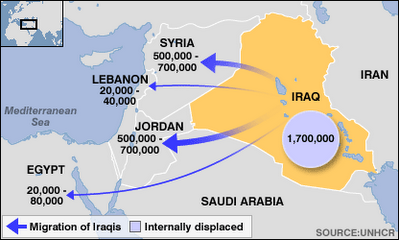 With the Bush administration's next step in Iraq looming, more people are beginning to question the US' refusal to accept responsibility for the millions of Iraqi civilians who are suffering from our previous missteps. In accordance with certain international legal norms, the United States has an obligation to address this urgent question. The reality of displaced persons, both within Iraqi borders and outside the country, is a real and pressing problem that is not being addressed by the Bush Administration and only beginning to receive attention from Congress.
For peace and reconstruction to be a success, Iraqis need to feel that they are safe in their homes and that their interests there are protected. According to Sabrina Tavernise in a January 28, 2007 article in the New York Times, the moderates are almost all gone and the middle class that were expected to be involved in building democracy have "given up and moved away." She explains that a year ago the hope of Iraqi brotherhood was a reality, but that now sectarianism and violence have overshadowed the optimism for unity and peace.
A recent editorial in the New York Times states, "the current price tag for the war is $8 billion a month, yet the State Department plans to spend only $20 million in the coming fiscal year to help shelter Iraqi refugees and to resettle them here." Since the start of the war, the United States has admitted only 466 Iraqi refugees and for the near future plans to admit only 50 Iraqi and Afghan refugees per year. The US certainly has greater capabilities to provide asylum to fleeing Iraqi civilians.
The editorial suggests that the administration allow around 70,000 Iraqi and Afghan refugees a year; start organizing dialogue with Iraq's neighbors on how to handle the escalation of Iraqi nationals living and migrating to their countries; and comply with the request from the UNHCR for $60 million for the protection and shelter of displaced Iraqis. The human suffering that has been taking place in Iraq cannot be lost in the debate over the troop surge or beginning a withdrawal. Whatever decision the Bush administration makes in the coming months, the problem of displaced Iraqis and the protection that they are entitled to will persist, and must be addressed.
Wednesday, January 17, 2007
"Iraq is now a democracy, there is no reason to flee"
 Yesterday's Senate Judiciary Committee hearing on the "Plight of Iraqi Refugees" was really quite unusual in that it actually had some teeth; the senators refused to sugar-coat anything, getting to the heart of the matter in each of their questions, and the witnesses responded in kind.
As might be expected the most fascinating testimonies came from two Iraqis who had worked with coalition forces in Iraq and have been granted asylum in the U.S. They each go into detail describing the threats they faced on a daily basis. Just one example from "John" whose identity was concealed for security purposes:
"I went to work delivering water to the Americans along with my son. At about 9 o'clock that mooring, we saw what appeared to be a road blockade ahead. Before we could realize what was happening, my son and I were dragged out of the cab of our truck. We were positioned face down on the side of the road by a group of terrorists."
I could not make out the identity of these men but they were heavily armed and were wearing green bandanas decorated with the three-stars from the Iraqi flag. They kept saying to me, "Don't work with the Americans," and one of them struck me in the face with the butt of his gun permanently damaging jaw. Another man twisted my son's arm so severely that he broke it. They knew my name and instructed me that this was a warning and that I would be killed if I continued assisting the Americans. After they made their threat they departed, leaving us bloodied on the side of the road. [full testimony]"And the remarkable thing is, after the attack, John went on delivering water for the Americans. Thousands of Iraqis like John are risking their lives to help coalition forces and hundreds of thousands of others are threatened due to the conditions the U.S. has created in Iraq, so you would think that the least the U.S. can do is accept Iraq refugees. However, as Ellen Sauerbrey, the Assistant Secretary of State Population, Refugees and Migration, testified, only 466 Iraqis have been granted refuge in the U.S. Meanwhile Syria has an open border policy and has accepted hundreds of thousands of Iraqi refugees, despite their being an enormous strain on its economy and with little assistance from the international community.
Why hasn't the U.S. accepted more refugees? After all, it can be argued that the U.S. is primarily responsible for the refugee crisis. Simply put, the U.S. administration has chosen to deny that there is such an ongoing crisis. This is what the U.S. government told Lisa Ramaci-Vincent when she tried to get an Iraq translator into America; "Iraq is now a democracy, there is no reason to flee." The administration believes, and perhaps rightly so, that acknowledging the refugee crisis would be tantamount to admitting failure in Iraq. Sean Garcia of Refugees International noted in his own conversations with State Dept. officials that:
many are reluctant to say, 'These are refugee flows, these are people fleeing the chaos.' Rather, they just acknowledge that people are leaving Iraq, but claim that they don’t know why.Because Iraq is now a democracy, there is no reason to flee.
To read the testimonies of each witness including a very interesting statement on the international effort to address the crisis from Michel Gabaudan, Regional the Representative for the U.S. and Caribbean Office of the United Nations High Commissioner for Refugees go here.
All in all, I think Ken Bacon, the President of Refugees International sums it up pretty well: "While we don’t yet know how to stabilize Iraq, we do know how to protect and support refugees. We must start now."
Couple more links
* NPR has also recently began highlighting the refugee crisis with an interview with Sen. Kennedy, and a story on an Iraqi translator trying to leave the U.S.
* "As refugees flee Iraq, few gain sanctuary in U.S." in The International Herald Tribune
* "Iraq's Hidden Refugee Crisis: An Interview with Sean Garcia" conducted by the Education for Peace in Iraq Center
Subscribe to:
Posts (Atom)


