Showing posts with label farming. Show all posts

Thursday, October 08, 2009

Iraq’s 2009 Drought

Iraq is facing a drought again. Officially, it has been going on for the last two years. Unofficially the United Nations says four. The lack of rain, no government water policy, and population growth are the main causes, but Baghdad has been blaming its neighbors as well. Iran, Syria, and Turkey have all built dams that affect Iraq’s two main rivers, the Euphrates and Tigris, along with smaller tributaries. Iraq needs 500 cubic meters per second from both major rivers according to the Water Ministry, but as of August 2009 was only receiving 440 cubic meters per second from the Euphrates and 100-160 cubic meters from the Tigris. All four countries have been holding meetings over water issues, with few results.

Together these problems are having larger and larger effects upon Iraq’s agriculture, rural areas, and power supply. Iraq’s rice production has dropped from 500,000 tons per year to 250,000 tons. Wheat has declined from 3.5 million tons to 1 million tons. As a result, Iraq has become one of the largest food importers in the world, when it was self-sufficient in the 1980s. It will need to import 4 million tons of wheat alone this year, at a cost of $1.4 billion. Overall, Iraq will have to buy 80% of its food needs this year. The drought is also leading to population shifts. 3,000 people in Basra have left their homes because of rising salt levels in the land. In Ninewa, 60 out of 150 villages in the Al-Tal district are deserted in what was once the most productive wheat and barley area of the province. 90% of the land is also desert or suffering from desertification. A report by the European Water Associated warned that Iraq could become barren like Saudi Arabia if something isn’t done. Hydroelectric power production is also down. In the city of Nasiriyah in Dhi Qar province, two of four turbines have been shut down because water levels are so low.

With no government planning, little money to support farmers, minimal international aid, and a lack of cooperation so far from its neighbors, Iraq’s water situation is likely to get worse before it gets better. More rain is likely to be the only respite, otherwise it will face another year of drought, whose effects are spreading from the countryside to Iraq’s cities with migration, decreased power production, and food imports.


Farmland Affected
Affected farmland 36,919 square kilometers
Total farmland 96,706 square kilometers
% of affected farmland 38.7%
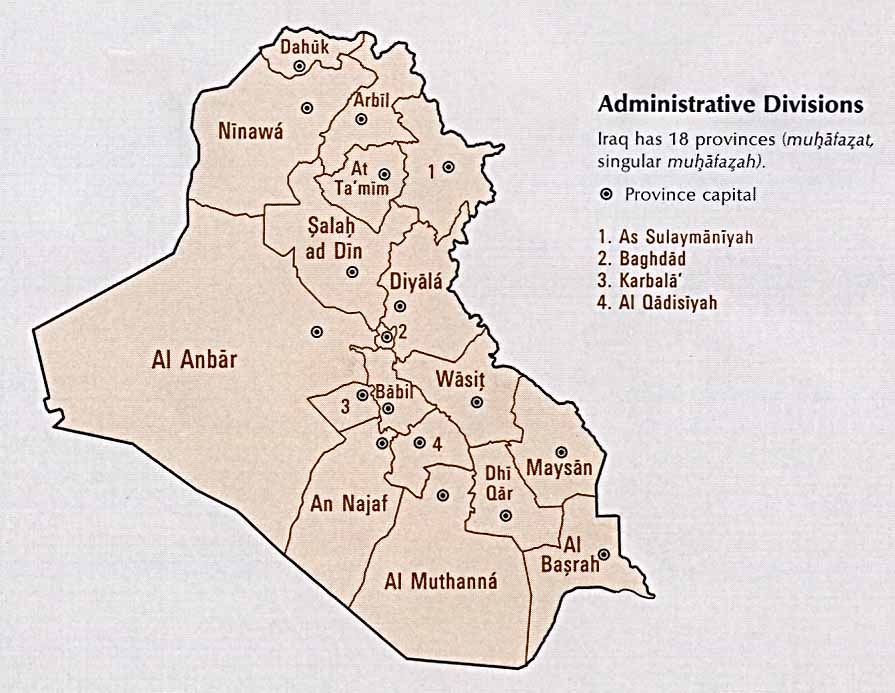
Babil, Irbil, Ninewa, Salahaddin, Tamim, – 46-56%
Dhi Qar, Diyala, Maysan – 31-45%
Baghdad, Karbala, Najaf, Qadisiyah – 26-30%
Anbar, Basra, Muthanna, Wasit – 6-25%
Sulaymaniya – 4-5%
Dohuk – 0%

SOURCES

Blua, Antoine, “Iraq Tussles With Neighbors Over Water,” Radio Free Europe/Radio Liberty, 9/13/09

Chulov, Martin, “Water shortage threatens two million people in southern Iraq,” Guardian, 8/26/09

DiPaola, Anthony and Alexander, Caroline, “Iraq Drought Cuts Harvest, Boosts Imports as Oil Cash Slips,” Bloomberg, 8/5/09

Hope, Bradley, “Iraq digs in to rebuild agricultural sector,” The National, 8/30/09

Inter-Agency Information and Analysis Unit, “The Humanitarian Situation In Iraq, Inter-Agency Fact Sheet,” United Nations Office for the Coordination of Humanitarian Affairs, August 2009

IRIN, “IRAQ: Drought hits rice, wheat staples,” 8/31/09b

Kamal, Adel, “desertification destroys ninawa villages,” Niqash, 7/17/09

Raphaeli, Dr. Nimrod, “Water Crisis in Iraq: The Growing Danger of Desertification,” The Middle East Media Institute, 7/23/09

Sly, Liz, “Iraq in throes of environmental catastrophe, experts say,” Los Angeles Times, 7/30/09

Special Inspector General for Iraq Reconstruction, “Quarterly Report and Semiannual Report to the United States Congress,” 7/30/09

Tharp, Mike, “Once world’s bread basket, Iraq now a farming basket case,” McClatchy Newspapers, 7/17/09

Williams, Timothy, “Idle Iraqi Date Farm Show Decline of Economy,” New York Times, 8/15/09

Friday, June 26, 2009

Center for a New American Security – Maintain The Status Quo In Iraq

In June 2009 the Center for a New American Security (CNAS) released a position paper on what U.S. policy towards Iraq should be under the new administration entitled, “After the Fire: Shaping the Future U.S. Relationship with Iraq.” The two authors, John Nagl, a famous former Army officer, and Brian Burton argue that the U.S. should foster Iraq as a long-term ally in the Middle East. The problem is that the U.S. is pulling out, the American public has grown tired of the war, and there is a recession. The CNAS paper worries that short-term thinking will outweigh the long-term goal of the U.S. to have stability in the Middle East. Almost all of the paper’s recommendations however are already being implemented, so what it’s really about is asking for the status quo to be maintained in Iraq past the U.S. withdrawal.

The paper sees four major challenges for the U.S. in Iraq. First, is the increasing divide between Arabs and Kurds. As reported before, a recent journal piece in Middle East Policy argued that this dispute could lead to the fall of the government, become a new source of violence, and even break up the country. Second, is integration of the Sunnis, who still need to find their place in the new political order. Third, is whether Iraq will slide back to authoritarianism. As a paper by two United States Institute of Peace officials recently noted, Prime Minister Nouri al-Maliki is now at the center of Iraqi politics. His opponents are worried that he may become an autocrat. Finally, Iraq’s future is threatened by its over reliance upon oil, which provides almost all of its revenue. The economic downturn has affected Baghdad’s hopes for development, jobs, services, and maintaining the security forces to name just a few.

To meet these challenges and ensure that Iraq is a long-term ally, the CNAS paper suggests five strategies Washington should follow. To deal with the Arab-Kurd divide, the U.S. should act as mediators, and support the United Nations effort to resolve the disputed territories, especially Kirkuk. The U.S. is already trying to help talks between the two sides across northern Iraq, and has stepped in to stop military confrontations. The U.S. also backs the U.N.’s plans for the disputed territories. With regards to the integration of the Sunnis, the writers believe supporting elections is the best course of action. The U.S. has been largely unsuccessful pushing Baghdad to reconcile with the Sunnis, so backing free and open voting where Sunni parties can gain power is the best alternative. This is something Washington has done since 2005. The U.S. also needs to help Iraq diversify its economy. CNAS suggests agriculture should be cultivated. The last few Defense Department quarterly reports to Congress have said the same thing. The problem is that Iraq’s farm sector faces so many institutional barriers such as a lack of tariffs and government support, inadequate irrigation, etc. that it could take over a decade for it to recover. To prevent the return of an autocratic leader in Iraq, the two writers suggest supporting institutions and professionalism. The U.S. already has advisers throughout the Iraqi military and ministries. Washington should also emphasize that it stands behind the Iraqi government, and not just Maliki, something that the Obama administration has already done as well. Finally, to encourage Iraq as a long-term ally the U.S. needs to re-integrate it into the region, and foster more ties between Washington and Baghdad. Getting Iraq’s neighbors to accept the Shiite led government in Baghdad has proven more difficult than expected. Countries like Saudi Arabia have given Iraq a cold shoulder since the invasion. Turkey on the other hand has changed its policy and become much closer recently. Other steps could be bringing more Iraqi military officers and students for training and education in the United States. The authors also believe that the U.S. needs to keep both civilian and military advisers in Iraq past the 2011 deadline for a U.S. withdrawal of combat troops.

Almost everything that the CNAS paper advocates is already being done by the U.S. administration. It is working with the Iraqi government and military, it is trying to mediate internal disputes, it is helping with the economy, it is trying to bring its allies in the region to open up to Baghdad, etc. The only question is whether President Obama will be open to keeping up this support for Iraq after 2011. That’s what “After the Fire” is really about, trying to ensure that all of these programs are maintained into 2012 and beyond.

SOURCES

Anatolia News Agency, “Turkish general says MoU between Turkey and Iraq to contribute to peace,” Today’s Zaman, 6/12/09

Department of Defense, “Measuring Stability and Security in Iraq,” March 2009
- “Measuring Stability and Security in Iraq,” September 2008
- “Measuring Stability and Security in Iraq,” December 2008

Al-Hayat, “US ambassador to Iraq offers to mediate between Kurds, Arabs in Mosul – paper,” BBC Monitoring International Reports, 6/4/09

International Crisis Group, “Oil For Soil: Toward A Grand Bargain On Iraq And The Kurds,” 10/28/08

Kazimi, Nibras, “Iraq: Trouble for Maliki,” Hudson New York, 4/24/09

Nagl, John and Burton, Brian, “After the Fire: Shaping the Future U.S. Relationship with Iraq,” Center for a New American Security, June 2009

Serwer, Daniel and Parker, Sam, “Maliki’s Iraq between Two Elections,” United States Institute of Peace, May 2009

Stansfield, Gareth Anderson, Liam, “Kurds in Iraq: the struggle between Baghdad and Erbil,” Middle East Policy, Spring 2009

Williams, Timothy and al-Salhy, Saudad, “Allotting of Iraqi Oil Rights May Stoke Hostility,” New York Times, 5/29/09

Friday, March 06, 2009

Another Tough Year Ahead For Iraq’s Farmers

Iraq was once one of the major agriculture producers of the Middle East. Now the farming sector has fallen into disrepair, and Iraq is a major food importer. Both Baghdad and the U.S. military however are hoping that it will make a come back to provide a source of growth to make up for the plummeting price of oil, and jobs for an economy that is still facing high unemployment. The problem is that the farm sector faces such large structural problems that it will probably take a decade for it to recover.

In 2008 Iraq faced one of the worst drought in years. Rainfall in 2007 was down 40% according to the Iraqi government, and affected the northern provinces of Irbil, Dohuk, Tamim, Diyala, and Ninewa the worst. Barley and wheat that are dependent upon rain were hit the hardest. Production for both dropped 51%, and in November 2008, the government announced that it would have to import 50 thousand tons of wheat to make up for the shortfall. The Ministry of Agriculture started several assistance programs, but U.S. government observers didn’t think that many were effective.

2009 looks to be no better. The Iraqi paper Al Sabah reported that the Water Resource Ministry announced in January that snow and rain were down 1/3 from normal levels. In February the Agriculture Minister said that farm production is down 30%. This year the United Nations has also designated Iraq one of 32 countries that needs external food aid. Iraq already imports 50% of its food needs.

The lack of water was just the latest hit to a sector of Iraq’s economy that has fallen on hard times since the 1980s. 26% of Iraqis are involved in farming, and it accounts for 8% of the country’s production making it one of the largest after oil. It has largely been neglected since the Saddam times however, and then faced international sanctions, the chaos and sectarian war that followed the U.S. invasion, and government incompetence. For example, many farm workers have left the rural areas for the cities. The fighting also disrupted trade within the country. Corrupt government officials is another issue. The chief Iraqi inspector in Wasit told The National that corruption was everywhere in the province. Many officials take cuts of aid that is supposed to go to farmers, and families often offer bribes to get assistance from the government. The government is also not able to supply fertilizer and water from the irrigation system. Electrical shortages have limited power for pumps. There are few tariffs, which means Iraq has been flooded with cheap food imports from Syrian, Iran, and Turkey since the U.S. invasion. The lack of adequate drainage is also leading to high salinity in the south. 5% of the country’s arable land is disappearing a year as a result. Finally, there is little use of modern farming techniques, and a lack of credit. Many farmers can’t qualify for loans anyway, and need bribes if they want one. All of these make Iraqis less competitive than their foreign competitors.

Baghdad is now trying to promote the farm sector in a drive to diversify the economy. Prime Minister Nouri al-Maliki announced a $200 million plan for agriculture. The government is going to subsidize seed sales and support for livestock and dates. Baghdad also has a plan to reclaim six million acres of land with high salinity. At the same time the government has cut subsidies for fuel and fertilizer.

Many U.S. officials in Iraq are skeptical of these plans. The head of the U.S. Provincial Reconstruction Team in Maysan and another member in the province told Reuters that the business was so dysfunctional and broken, and the government so incompetent and corrupt that it would be a Herculean task to revive farming. A U.S. Department of Agriculture report said the sector was “a disaster.” A U.S. farm expert thought it would take ten years to recover.

None of this is good news for Iraq’s struggling economy. The country is almost completely dependent upon oil to earn money. Now that prices have dropped for crude, the government is facing some tough decisions. Baghdad is talking about diversifying, and it’s important that the Agriculture Ministry is getting more money, but it’s unclear whether this is mere lip service or a real commitment.

SOURCES

Alsumaria, “Iraq waning farm sector urges recovery,” 3/3/09

Ashton, Adam, “Iraqi farmers are back in business, and Iraqis love local produce,” McClatchy Newspapers, 12/20/08

Aswat al-Iraq, “Agro-production down due to scarce rain – minister,” 2/23/09

Department of Defense, “Measuring Stability and Security in Iraq,” December 2008

Iraq Directory, “Iraq is Submitting a Tender to Buy 50 Thousand Tons of Wheat,” 11/25/08

Latif, Nizar, “Iraq in midst of ‘agricultural disaster,’” The National, 12/11/08

Ryan, Missy, “Iraq’s ailing farm sector more crucial than ever,” Reuters, 2/28/09

Al Sabah, “Iraq faces massive water shortage, Water Resources said,” 1/21/09

Sands, Phil and Latif, Nizar, “Corruption at the root of Iraq’s failing agriculture,” The National, 2/24/09

Special Inspector General for Iraq Reconstruction, “Quarterly Report and Semiannual Report to the United States Congress,” 1/30/09

Monday, March 02, 2009

February 2008 UNICEF Report on Iraq

UNICEF recently released a report on Iraq. It not only focused upon the country’s children, but health, education, poverty, and the displaced. The organization said that with the reduction in violence there was greater access to Iraq’s communities. That was revealing more examples of poverty and deprivation than anyone knew about previously.

The biggest issue UNICEF reported on was a developing measles threat. It said that nine provinces had reported measles affecting 6,000 people since early 2008. The Iraqi Ministry of Health is worried that it could spread. Najaf, Sulamaniya, Irbil, Maysan, and Dohuk were endangered by this disease, while a more recent report from the United Nations’ IRIN news agency said that Salahaddin, Tamim, Anbar, Diyala, Baghdad, Babil and Dhi Qar were hit the hardest. Most victims were small children under the age of six. Government officials said that the main cause of the spread of measles was the lack of security, which kept health workers out of many areas.

The United Nations agency also went to a few schools in the northern provinces of Diyala, Irbil, and Dohuk. All of them were lacking basic services, especially access to clean water. In Dohuk the schools lacked bathrooms, while children in two villages in Irbil were suffering from water born diseases.

The displaced was another issue the report dealt with. In Tamim, 900 children were found begging on the streets of Kirkuk. 100 of them were orphans. Around half were internal refugees. All of them were trying to support their impoverished families. Internal refugees that were returning to the province lacked shelter, and access to water and sanitation. In Basra 250 squatters in an old navy had no sanitation, health care, or clean water. On the positive side 1,325 displaced families returned to the city of Mosul in Ninewa.

In 2008 Iraq suffered a sever drought. The worst hit areas were in the north. UNICEF traveled to Irbil and Ninewa and saw the drought’s lingering effects. In two areas of Irbil there was high poverty exacerbated by the lack of water that destroyed their farms, which were also their main source of food.

Examples of impoverishment were also found in Anbar. The outskirts of the province had deep poverty. Two areas by Ramadi that suffered because of the violence are now improving because the government has started programs for children. They still lack adequate health, sanitation and other basic services however.

The last part of the report detailed the various projects UNICEF was working on in Iraq. So far, the organization has committed $8 million for humanitarian projects in 59 communities. Those have mainly focused upon water, schools, and health campaigns. The major problem is that United Nations can hardly meet its obligations. UNICEF is short 89% of the money it needs for its various programs.

UNICEF is hoping that the provincial elections will lead to more responsible local governments that will address the needs of the country’s children. They are afraid about the spread of measles. The lack of services is also a large problem across the country. Iraq’s infrastructure has not been kept up because of the violence. Even as that has declined, there is still large-scale neglect. Finally poverty is another major issue. It has led to children begging, and kept them from going to school. More and more of these cases are being discovered as attacks have declined. The lack of money for both the United Nations and the Iraqi government after the fall in oil prices will probably mean these issues will not be solved any time soon however.

SOURCES

IRIN, “IRAQ: Measles emerges in violence-hit regions,” 2/24/09

UNICEF, “UNICEF Humanitarian Action Update Iraq,” 2/17/09

Saturday, December 20, 2008

Drought Leads To Food And Grain Imports

As reported before, Iraq is facing one of the worst droughts in decades. Rainfall in 2007 was down 40% according to Baghdad. Central and northern Iraq have been hit the hardest in places like Diyala, Ninewa, Dohuk, and Irbil. The Ministry of Agriculture noted that this was exacerbating the shrinking amount of arable land in the country, which is dropping 5% per year. Some of Iraq’s main crops have been devastated by this turn of events. A U.S. Department of Agriculture report called the situation a “disaster.” To deal with the problem, the government has announced plans to import thousands of tons of food and grain.

Baghdad declared that it would buy foreign foodstuffs to make up for the drop in domestic agriculture. That would have to account for wheat production that is down 27%, and a 60% reduction in barley. In the north, wheat farming has fallen 80-98%. To make up the difference, the government plans on spending $132 million on food imports. It will be buying 2.8 million tons of wheat for example, a 40% increase from last year.

Iraqi authorities have claimed they are providing aid to beleaguered farmers as well. Prime Minister Nouri al-Maliki promised $200 million to help with the drought. The Agriculture Ministry has been offering loans and fertilizer. A farming consultant that works for the U.S. however, claimed that this policy was a joke. He said that farmers usually can’t qualify for the loans, and needed to bribe officials if they really wanted one. He went on to say that the government was useless in this situation. The lack of electricity and fuel, which are necessary for irrigation pumps, and deteriorating infrastructure has also hampered Baghdad’s response.

To add to the difficulties, the severity of the drought is leading to some displacement. Agriculture is one of the largest employers in the country, and there are reports that farmers, especially, in the north, have begun leaving their land for towns and cities looking for employment. As an example, in July, when Iraqi forces launched an offensive in Diyala, U.S. and Iraqi forces came across the Fatamia village, which only had 3-4 families out of 30-40 still there. The military claimed the villagers had fled insurgents, but a resident said they had left because of the drought.

Because of these myriad problems, it’s not known when Iraq will recover from this drought. Farms have been devastated, the country is importing food, people are leaving rural areas, and the government as usual is not competent enough to really help. This comes on top of the financial problems Baghdad is running into with the huge drop in oil prices. The budget will probably run a deficit soon, which could imperial the import plan. The one bright spot is that in October there was rain. Whether this was a significant amount is not known. Until then Iraq will still be in this predicament.

For more on Iraq’s drought see:

United Nations Humanitarian Report On Iraq

More On Iraq’s Drought

Drought Update II

Drought Update

Iraq’s Drought

SOURCES

Haynes, Deborah, “Iraqis hunt for insurgents in Diyala unearths only ghost towns and drought,” Times of London, 7/29/08

Iraq Directory, “Iraq is Submitting a Tender to Buy 50 Thousand Tons of Wheat,” 11/25/08

Latif, Nizar, “Iraq in midst of ‘agricultural disaster,’” The National, 12/11/08

Rasheed, Ahmed and Ryan, Missy, “Iraq’s farm sector crumbling as drought bites,” Reuters, 10/24/08

Shatab, Ali, “Iraq to increase grain imports due to drop in local produce,” Azzaman, 5/16/08

United Nations Office for the Coordination of Humanitarian Affairs, “Iraq Humanitarian Update,” October 2008

Wednesday, December 03, 2008

Iraq’s Troubled Economy

In the second half of 2008, there began to be reports about Iraq’ improving economy. After having been flat in 2007, the International Monetary Fund (IMF) predicted that Iraq’s economy would grow 7% in 2008. Some saw an improving future. Most of this was due to the skyrocketing price of oil that was occurring at the time, before it dropped. The Special Inspector General for Iraq Reconstruction said that even the non-petroleum sectors of the economy grew in the first half of 2008 however, except for farming that was hit by a drought. These macroeconomic numbers however hide the deep-seated problems the country is facing.

Oil Industry

The biggest issue with Iraq’s economy is that it is based upon a single primary product, oil, which is not labor intensive. Petroleum dominates Iraq. 94% of the country’s 2009 budget will come from oil according to the Ministry of Finance. The industry accounts for 65% of Gross Domestic Product (GDP) in 2008. The amount of money it generates for the country has also steadily increased. In 2005, oil earned over $22 billion. By 2008 it is estimated to garner $65 billion. While bringing in large amounts of cash, the industry does not require many workers. Only 2% of the workforce is involved in petroleum. This creates a predicament for the nation, as its major industry cannot provide any relief for unemployment and undermployment, which stands at around 60%.

Farming

Farming is one of the largest employers in the country, but has run into major problems since the invasion. 6% of GDP comes from farming in 2008, but it accounts for 27% of the workforce. Agriculture predominates in Wasit, 40% of the workforce, Salahddin, 35% of the workforce, Babil, 34% of the workforce, and Diyala, 30% of the workforce. Since 2003 this sector has fallen on hard times. One major cause was the move towards a free market initiated by the Coalition Provisional Authority (CPA). Under CPA Law No. 80, farming subsidies were ended, which led to many farms going under, unemployment, and migration to the cities. Rising fuel prices and shortages also limits the use of water pumps to irrigate fields. That has led to cheap foreign food imports flooding the Iraqi market from the United Arab Emirates, Saudi Arabia, Syria, China, India, and Iran. The government also runs a massive food ration system, which distorts prices. In 2008, the country was also hit by one of the worst droughts in years. As a result, wheat production dropped 27%, and barley 60%. The country will have to import millions of tons of farm products to make up for this shortfall.

Industry

Iraqi industry also suffered under the Coalition Provisional Authority. The CPA shut down much of the country’s large manufacturing plants, which were owned by the government, leading to more out of work Iraqis. By 2008 it accounted for only 2% of GDP. The Pentagon eventually began a plan to re-open these factories by encouraging foreign investment, and promising markets in the United States for their products. This policy ran into problems, as many foreign firms were unwilling to be involved in Iraq because of the violence and instability. The U.S. company that the Defense Department hired to run the program also came under investigation for mismanagement and abuses. By August 2007, only 9 factories had re-opened, less than 5% of the total. By the summer of 2008, the Ministry of Industry and Minerals initiated its own privatization program. Like the American one, Baghdad fared no better in attracting foreign investors. Another large barrier to industrial growth is the fact that Iraq has no tariffs on imported manufactured goods. Like farming, this has led to cheap foreign imports, especially from Iran, taking over much of Iraq’s market. This is causing more Iraqi businesses to close, and increasing unemployment.

Retail, Service and Construction Business

After oil, retail, wholesale, and service businesses are the second largest part of Iraq’s economy. Together they account for 20% of GDP. Like other Iraqi businesses, however, this sector has major issues. Violence of course, has been an inhibitor. A lot of companies have security guards to protect them. Even with attacks declining, there are still plenty of checkpoints and security operations that have strangled trade and delivery of goods. Power shortages are also a problem. Many businesses have invested in their own generators to make up for the shortages, but fuel is in short supply and therefore expensive. All of these together have increased costs, and made Iraqi products less competitive, leading to more imports. Because supply is so shoddy within the country however, some Iraqi companies have been able to hang on to their market share. There has also been a large increase in spending by Iraqis, especially for consumer goods since 2003, which accounts for the increase in this sector. It’s just that many of the products sold are not Iraqi.

On the positive side, many new Iraqi firms were able to develop thanks to the massive influx of American and international dollars for reconstruction. The U.S. has increasingly turned to giving contracts directly to Iraqi businesses for this line of work. In June 2008 it was reported that 3,500 Iraqi companies had been awarded $1.6 billion in construction business by the U.S. The Americans are ending their rebuilding effort however, so Iraqi companies will now have to turn to Baghdad for new funding.

Conclusion

Iraq has seen massive dislocations since 2003. Before the U.S. invasion, the economy was dominated by the state sector. Afterwards, the Americans started a privatization policy, which was badly planned and implemented. The result was thousands of Iraqis, especially professionals, were left out of work as many businesses closed. It should be no wonder than that a recent poll found 65.9% of Iraqis living below the international poverty level. Today private businesses and farms suffer from high costs, and cheap imports with little to no protective trade barriers. As a result, oil is an even larger part of the overall GDP, even though it provides few jobs. Even that has run into problems as the international price for crude has nosedived because of the world recession. Ironically, the government is still the largest employer in the country, despite the U.S. effort. 37% of households work in the public field, while salaries and pensions took up 20.4% of the 2007 budget. It is unlikely that Iraq will be able to fix any of these problems, and balance its economy any time soon. Baghdad has proven just as incompetent if not worse than the CPA in managing and planning. Grand announcements are usually made with little follow up. That will mean continued unemployment and poverty for a majority of Iraqis, with oil being the main industry keeping the economy going.

SOURCES

Alsumaria, “Iraq plan to reduce government jobs by 75%,” 11/10/08

Aswat al-Iraq, “Imported products subvert Iraqi economy,” 2/24/08

Davis, Eric, “Rebuilding a Non-Sectarianism in Iraq,” Strategic Insights, December 2007

Department of Defense, “Measuring Stability and Security in Iraq,” September 2008

Fairweather, Jack, “Business wanes as Baghdad takes over,” Financial Times, 6/4/08
- “Iraqi state enterprises warily reopen,” Financial Times, 6/16/08

Fifield, Anna, “Iraqis exist on margins of positive picture,” Financial Times, 10/21/08

Gunter, Frank, “Economic Development During Conflict: The Petraeus-Crocker Congressional Testimonies,” Strategic Insights, December 2007

Janabi, Ahmed, “Iraqis forced to abandon farming,” Al Jazeera, 5/11/08

Al-Jumaili, Hazem, “Iranian goods most popular in Iraq,” Azzaman, 9/7/08

Middle East Online, “Iraqi professionals forced to take small jobs,” 2/21/08

Rasheed, Ahmed and Ryan, Missy, “Iraq’s farm sector crumbling as drought bites,” Reuters, 10/24/08

Sachet, Khalid Hantoush, “Results of the Field Survey For Needs and Opinions of The Poor in Iraq,” Iraqi Al Amal Association and University of Baghdad, September 2008

Special Inspector General for Iraq Reconstruction, “Quarterly Report to the United States Congress,” 10/30/08

World Food Programme, “Comprehensive Food Security & Vulnerability Analysis: Iraq,” November 2008

Yacoub, Sameer, “United Arab Emirates to name ambassador to Baghdad,” Associated Press, 6/5/08

Xinhua, “Iraqi Factories Fight to Survive Turbulence,” 11/23/08
 
Clicky Web Analytics