Showing posts with label electricity. Show all posts

Wednesday, December 23, 2009

Electricity Output Reaches Post-Invasion High, But System Still Plagued By Problems

The Special Inspector for Iraq Reconstruction reported that for the fifth straight quarter Iraq’s average electricity supply increased from August to October 2009. For the 3rd quarter of 2009 Iraq produced 6,439 megawatts, a post-invasion high. That was a 10% increase from the 2nd quarter. In 2007 Iraq produced 4,488 megawatts, with 4,198 coming from the Ministry of Electricity, and 290 being imported. In 2009 the Ministry was responsible for 5,209 megawatts, 669 megawatts came from other countries, and 560 were from private generators. Iraq saw a 1,951 megawatt increase over those two years.

The growth in power supply comes from multiple sources. Half of the increase came from working on existing power plants at a cost of more than $2 billion in U.S. reconstruction aid since 2003. 29% of the increase was from two new private power plants opening in the Kurdistan Regional Government. 19% of this quarter's increase came from importing electricity from Iran and Turkey. In 2007 Turkey was the main supplier, providing 60% of imports, but since then Iran was eclipsed them, now accounting for 80%. The Electricity Ministry has also been able to make some small increases in its capacity. It has added two power plants on boats in Basra in 2009 for example, run by a Turkish company. They have a combined capacity of 250 megawatts.

The Ministry has bigger plans in store as well. In 2009 they finally got funding to buy turbines from General Electric and Siemens. These will be installed in twenty locations throughout the country. Every province except the three in Kurdistan will get at least one new power plant out of the deal. Construction is expected to begin in late 2010 or early 2011, and the new capacity will come on line in 2-6 years. When finished, the turbines will add an estimated 10,000 megawatts. There is a major problem with this plan however. Iraq's power grid cannot handle this increase. The transmission and distribution systems need to be renovated, but there are no plans to do so. There are also questions about whether the government will be able to provide fuel for all of these new plants adequately. The Electricity's Ministry promises therefore, may never be fulfilled. Baghdad will also have a hard time coming up with any extra money as it is facing a second year of budget deficits due to moderate oil prices, which provide almost all of its revenue.

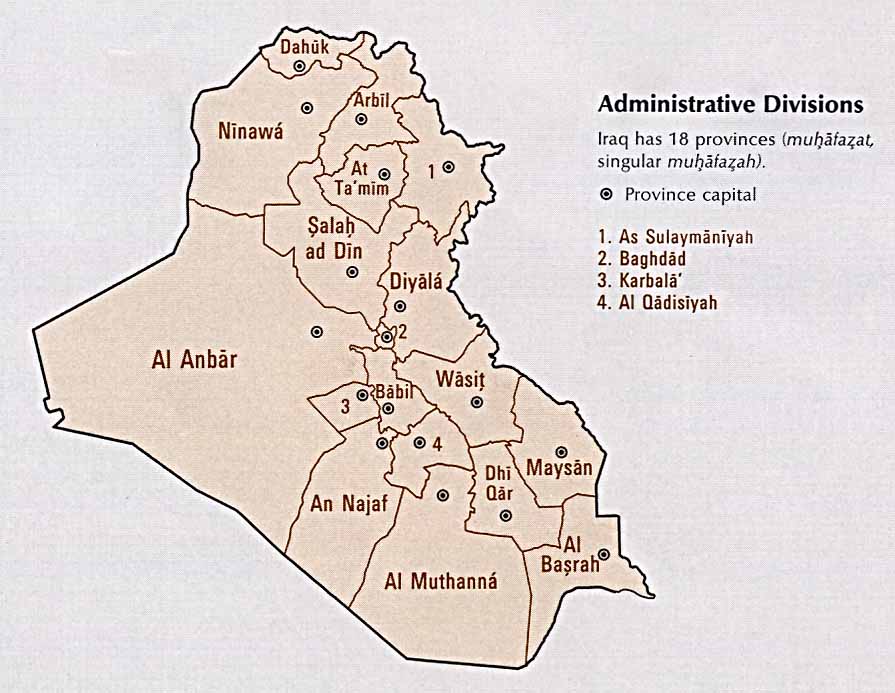
Despite the recent increases, the national grid still does not meet the country’s demands. The Special Inspector General believes that the gap between supply and demand is twice what it was in 2003, although it has been slightly reduced since 2007. Based upon estimates it’s believed that the Electricity Ministry served 69% of the national demand in the 3rd quarters of 2009. In the 3rd quarter of 2007, it only met 54%. In terms of the provinces, Sulaymaniya, Basra, Irbil, and Diyala in that order did the best supplying electricity, meeting anywhere from 83% to 99% of demand. That’s because those governorates either have their own power plants or import large amounts from Iran. At the opposite end of the spectrum, Wasit, 51%, Maysan, 53%, Babil 56%, Ninewa and Najaf at 58%, do the worst serving their people. Because Iraqis cannot rely upon the government for its power, most rely upon private generators.

Electricity Supply And Demand By Provinces

Province
Avg. Daily Electricity Load Served (MW)
Avg. Daily Estimated Electricity Demand (MW)
Avg. Daily Demand Met
Sulaymaniya
352
357
99%
Basra
806
929
87%
Irbil
356
411
86%
Diyala
196
236
83%
Dhi Qar
289
405
71%
Salahaddin
275
385
71%
Tamim
222
325
68%
Muthanna
137
202
68%
Anbar
219
329
67%
Baghdad
1,718
2,571
67%
Dohuk
132
203
65%
Karbala
164
273
60%
Qadisiyah
150
253
59%
Najaf
216
375
58%
Ninewa
491
851
58%
Babil
240
425
56%
Maysan
145
273
53%
Wasit
155
304
51%

Iraq’s generators also do not operate up to their capabilities. Nameplate capacity is how much a generator should be able to produce in ideal conditions. Feasible capacity is how much it can produce given the actual conditions. Iraq has a nameplate generating capacity of 15,300 megawatts, and a feasible capacity of 11,150. Both were 4% increases from the 2nd quarter of 2009. However in the 3rd quarter Iraq only operated at 38% of nameplate capacity and 52% of feasible capacity. The Qudas power plant in Baghdad for example, which the U.S. spent $250 million to renovate, has a nameplate capacity of 910 megawatts, but only averages 429 megawatts of actual production, 47% of its nameplate capacity.

After the overthrow of Saddam, Iraqis went on a buying spree of consumer electronics. This has greatly increased demand for power, which has not been met by the increase in production. The lack of adequate funds, the inability of the Electricity Ministry to spend what it gets, not enough skilled and trained personnel, poor maintenance and aging equipment, along with subsidized energy and a large black market in generators encourages use rather than conservation. These all mean that demand will continue to increase in the near future, and even with the new power plants and renovations, the power system will still probably be running a deficit.

SOURCES

Special Inspector General for Iraq Reconstruction, "Quarterly Report to the United States Congress," 10/30/09

Thursday, October 08, 2009

Iraq’s 2009 Drought

Iraq is facing a drought again. Officially, it has been going on for the last two years. Unofficially the United Nations says four. The lack of rain, no government water policy, and population growth are the main causes, but Baghdad has been blaming its neighbors as well. Iran, Syria, and Turkey have all built dams that affect Iraq’s two main rivers, the Euphrates and Tigris, along with smaller tributaries. Iraq needs 500 cubic meters per second from both major rivers according to the Water Ministry, but as of August 2009 was only receiving 440 cubic meters per second from the Euphrates and 100-160 cubic meters from the Tigris. All four countries have been holding meetings over water issues, with few results.

Together these problems are having larger and larger effects upon Iraq’s agriculture, rural areas, and power supply. Iraq’s rice production has dropped from 500,000 tons per year to 250,000 tons. Wheat has declined from 3.5 million tons to 1 million tons. As a result, Iraq has become one of the largest food importers in the world, when it was self-sufficient in the 1980s. It will need to import 4 million tons of wheat alone this year, at a cost of $1.4 billion. Overall, Iraq will have to buy 80% of its food needs this year. The drought is also leading to population shifts. 3,000 people in Basra have left their homes because of rising salt levels in the land. In Ninewa, 60 out of 150 villages in the Al-Tal district are deserted in what was once the most productive wheat and barley area of the province. 90% of the land is also desert or suffering from desertification. A report by the European Water Associated warned that Iraq could become barren like Saudi Arabia if something isn’t done. Hydroelectric power production is also down. In the city of Nasiriyah in Dhi Qar province, two of four turbines have been shut down because water levels are so low.

With no government planning, little money to support farmers, minimal international aid, and a lack of cooperation so far from its neighbors, Iraq’s water situation is likely to get worse before it gets better. More rain is likely to be the only respite, otherwise it will face another year of drought, whose effects are spreading from the countryside to Iraq’s cities with migration, decreased power production, and food imports.


Farmland Affected
Affected farmland 36,919 square kilometers
Total farmland 96,706 square kilometers
% of affected farmland 38.7%
Babil, Irbil, Ninewa, Salahaddin, Tamim, – 46-56%
Dhi Qar, Diyala, Maysan – 31-45%
Baghdad, Karbala, Najaf, Qadisiyah – 26-30%
Anbar, Basra, Muthanna, Wasit – 6-25%
Sulaymaniya – 4-5%
Dohuk – 0%

SOURCES

Blua, Antoine, “Iraq Tussles With Neighbors Over Water,” Radio Free Europe/Radio Liberty, 9/13/09

Chulov, Martin, “Water shortage threatens two million people in southern Iraq,” Guardian, 8/26/09

DiPaola, Anthony and Alexander, Caroline, “Iraq Drought Cuts Harvest, Boosts Imports as Oil Cash Slips,” Bloomberg, 8/5/09

Hope, Bradley, “Iraq digs in to rebuild agricultural sector,” The National, 8/30/09

Inter-Agency Information and Analysis Unit, “The Humanitarian Situation In Iraq, Inter-Agency Fact Sheet,” United Nations Office for the Coordination of Humanitarian Affairs, August 2009

IRIN, “IRAQ: Drought hits rice, wheat staples,” 8/31/09b

Kamal, Adel, “desertification destroys ninawa villages,” Niqash, 7/17/09

Raphaeli, Dr. Nimrod, “Water Crisis in Iraq: The Growing Danger of Desertification,” The Middle East Media Institute, 7/23/09

Sly, Liz, “Iraq in throes of environmental catastrophe, experts say,” Los Angeles Times, 7/30/09

Special Inspector General for Iraq Reconstruction, “Quarterly Report and Semiannual Report to the United States Congress,” 7/30/09

Tharp, Mike, “Once world’s bread basket, Iraq now a farming basket case,” McClatchy Newspapers, 7/17/09

Williams, Timothy, “Idle Iraqi Date Farm Show Decline of Economy,” New York Times, 8/15/09

Thursday, October 01, 2009

Work Begins On Improving Iraq’s Electricity Supply But Problems Remain

This year Iraq is embarking on a massive development plan to increase its electrical network. It is buying new turbines, constructing new power plants, and garnering international loans and other financial assistance to pay for it. Iraq still lacks the capacity to supply all the power the country needs however.

In December 2008 Iraq signed a $3 billion contract with General Electric (GE) and Siemens to add over 10,000 megawatts to Iraq’s power grid. The problem was with Iraq’s budget cuts it had no money to pay the companies. Finally, in August 2009 the Iraqi Central Bank agreed to loan Baghdad $2.4 billion to pay part of the contract. Now equipment is finally being delivered, and work is going to begin.

On September 19, it was announced that Canada’s SNC-Lavalin Group and the Iraqi owned URUK Engineering Services each won $85 million contracts to install six turbines delivered by GE. SNC-Lavalin is going to install two 125-megawatt turbines in Hilla in Babil province in the next 18 months, while URUK is going to build a power plant with four 40-megawatt generators in Taji, Baghdad province within 15 months.

On August 19 Iraq finalized a loan from the International Monetary Fund (IMF). The loan is for $5.5 billion over five years at 1% interest. The IMF stipulated that it be spent on development projects, and most of it will go to improving the power system.

At the same time, not everything is going according to plan. The summer heat has put a seasonal strain on the power system. At the beginning of September people in Kut, the capital of Wasit demonstrated over the lack of fuel and electricity. A few days later the Electricity Minister gave a press conference to try to explain why there were still power shortages in the country. In August and September, the Electricity Ministry also complained about a Chinese, an Iranian, and a Jordanian company for not completing their work on five separate power plants.

For five straight quarters Iraq has increased its electricity production. The problem is that the supply is not close to meeting demand that has sky rocketed since the 2003 invasion. Not only that, but the power system is so old and decrepit after years of wars, sanctions, and lack of maintenance, that it can’t handle the amount of electricity that is needed. If Iraq was to ever install all of the power plants it requires, the entire grid would have to be rebuilt to handle the capacity, and Iraq does not have anywhere near the money to pay for that.

SOURCES

Aswat al-Iraq, “$2.4bn to pay for GE, Siemens contracts-minister,” 8/9/09
- “Iraq to get loan to improve electricity,” 8/19/09

Reuters, “Iraq awards power contracts to SNC, URUK,” 9/19/09
- “Iraq scraps $3 bln bond sale, eyes local debt,” 8/9/09

Al-Rubaai, Salah, “Protest over power shortages in southern Iraqi city,” Azzaman, 9/3/09

Special Inspector General for Iraq Reconstruction, “Quarterly Report and Semiannual Report to the United States Congress,” 7/30/09

Tuesday, September 29, 2009

Maliki’s Campaign Promises May Be Unrealistic

Prime Minister Nouri al-Maliki recently went on a short tour of southern Iraq to drum up support in anticipation of the January 2010 parliamentary elections. First he went to Basra, Iraq’s second largest city, on September 10, 2009. He then went to neighboring Dhi Qar province on September 14. Maliki’s State of Law List won both governorates in the 2009 vote, and control of the south is crucial in the Prime Minister’s re-election campaign.


During his visits Maliki gave speeches and talked with local officials about one of his main campaign themes, the provision of services. In Basra he berated the governor and provincial council for not improving water and electricity. Back in June the head of Basra’s reconstruction committee said that the province was short 97 billion Iraqi dinars to pay for projects. The province is also currently suffering from the effects of the drought with seawater from the Persian Gulf encroaching into fresh water areas. So far 5,000 villagers have left their homes because of the water crisis. In response, the day before Maliki arrived in Basra City, Baghdad transferred 208 billion dinars to the province to help with expenses, promised a $20 million water pipeline project to deliver fresh water, and announced $25 million to develop the area’s marshes. While in Dhi Qar he promised that the province would get its fair share of the budget, and said with improvements in the economy they could expect more money as well.

When Maliki’s State of Law list ran in the 2009 provincial elections they promised better governance and services, and are doing the same for the 2010 national ballot. This completely ignores the financial situation in Iraq. With the world recession the country’s main source of revenue, oil, took a precipitous drop in value. The 2009 budget saw large cuts as a result, with Iraq’s 18 provinces receiving a $1,748.2 million decrease in their capital budgets that pays for infrastructure and investment, while operational costs that go towards salaries, pensions, etc. ate up 80% of the overall budget. Oil prices have begun to creep back up, but so far, not enough to make a large increase in the 2010 budget. Maliki therefore, can talk to governors and provincial councils all he wants about better services, but there is simply no money to make that a reality right now.

SOURCES

Aswat al-Iraq, “Al-Maliki pays surprise visit to Thi-Qar,” 9/14/09
- “Minister says govt. unable to cover projects, eyes private sector,” 9/3/09
- “New financial amounts allocated for Basra,” 9/9/09
- “PM arrives in Basra,” 9/10/09

Chon, Gina, “Biden, on Iraq Trip, Will Meet Maliki,” Wall Street Journal, 9/16/09

Chulov, Martin, “Surge of seawater drives Iraqis from their homes in the south,” Guardian, 9/11/09

IraqSlogger.com, “Basra: Moritorium on New Development Projects,” 6/3/09

News Network Nasiriyah, “During a meeting with the masses of Dhi Qar,” 9/14/09

Friday, September 18, 2009

Iraq’s Electricity Minister Tries To Explain Continued Supply Problems

Iraq’s Electricity Minister gave a press conference on September 7, 2009 to try to explain Iraq’s long, hot summer. The Minister said Iraq is facing five problems with its electricity supply. First, the country does not have enough fuel to run some of its power plants. Second, the country’s budget problems are limiting the ministry’s spending power to boost and maintain production. The Electricity Ministry’s budget saw a huge increase from $1.389 billion in 2008 to $3.39 billion in 2009, a 144% increase, but almost all of that was went to operational costs. In 2008 the Ministry received $89.1 million for its operational budget, which goes towards salaries, pensions, etc., and $1.3 billion for capital expenditures that paid for infrastructure, and other investments. In the 2009 budget, operational costs shot up 2492% to $2.31 billion, while the capital budget decreased 17% to $1.08 billion. Another issue is that the Ministry has barely been able to spend its money. In 2008 it only expended 12% of its budget. Third, the water shortages and drought are reducing hydroelectric power production. Fourth, the Minister said that his staff had taken serious personal losses, noting 1,000 had been wounded or killed. His last remark was that the huge increase in sandstorms this year is straining the ability of the Ministry to maintain and clean its equipment.

On the positive side, the Minister said that by the end of the year General Electric and Siemens AG should begin work on installing new generators, providing technical assistance and training, and providing spare parts as part of a $3 billion deal signed in December 2008. The Ministry didn’t have the money to pay the two companies at first, but the Finance Ministry has finally okayed the transfer of $2.4 billion to them. Together they are expected to add up to 10,300 megawatts.

As reported before, Iraq has consistently boosted its power production in recent years. According to the Special Inspector General for Iraq Reconstruction, the Electricity Ministry has increased electrical output for five straight quarters. From April to June 2009 average daily production stood at 124,713 megawatt hours. One factor in this increase is the boost in energy imports from countries like Iran. In the second quarter of 2009 Iraq imported an average of 16,237 megawatt hours per day, an 82% increase from the same period in 2008, and a 118% increase from the second quarter in 2007. The problem is that demand has consistently increased since the 2003 invasion above supply, and power delivery is inconsistent across the country. With improved security, the public is also demanding more services. Finally, Baghdad is trying to entice foreign companies to invest in Iraq, and officials are worried that the inconsistent electricity will keep them away. The question is whether Iraq will be able to add enough to its power grid to meet all of these different needs.

SOURCES

Aswat al-Iraq, “$2.4bn to pay for GE, Siemens contracts-minister,” 8/9/09

Al-Shalchi, Hadeel, “Power problems mean Iraq suffers hot summer, again,” Associated Press, 9/7/09

Special Inspector General for Iraq Reconstruction, “Quarterly Report to the United States Congress,” 4/30/09
- “Quarterly Report and Semiannual Report to the United States Congress,” 7/30/09

Monday, August 03, 2009

Kurdistan Lacks Services And Employment


Kurdistan recently held parliamentary elections on July 25, 2009. The main topics in the vote were the rule of the Patriotic Union of Kurdistan (PUK) and the Kurdistan Democratic Party (KDP), and corruption. Just as important could be the economy. While there are many who tout the relative stability in Kurdistan and its foreign investment, the region actually lags behind in almost all humanitarian and economic indicators compared to the rest of the country.

The Kurdistan Region is made up of three provinces, Dohuk, Erbil, and Sulaymaniya. Irbil and Sulaymaniya have over one million inhabitants each, while Dohuk only has around 500,000. Dohuk is also home to over 100,000 internally displaced Iraqis.

Population

Dohuk 505,491

Irbil 1,542,421

Sulaymaniya 1,893,617

Internally Displaced In Kurdistan

Sulaymaniya 36,000

Ibril 62,034

Dohuk 112,392

The relative stability and security in Kurdistan has not provided the population there the opportunities or services one would expect. The employment situation in the Kurdistan Regional Government (KRG) is mixed. In Iraq overall 12% of men and 13% of women are without jobs. Men in Irbil and Sulaymaniya do better at 9% and 10% respectively, but in Dohuk 13% of men are lacking employment. Women do far worse however. In Irbil the unemployment rate for them is 16%, followed by 26% in Sulaymaniya and 30% in Dohuk. The percentage of men and women involved in the labor force are also lower in Kurdistan compared to Iraq. In the rest of the country 18% of women and 81% of men are either employed or looking for work. The labor force participation in Dohuk is only 7% for women and 76% for women. Irbil at 12% of women, 77% of men, and Sulaymaniya at 15% of women and 78% of men, only do slightly better.

Unemployment

Iraq: 13% women, 12% men

Irbil: 16% women, 9% men

Sulaymaniya: 26% women, 10% men

Dohuk: 30% women, 13% men

Labor Force Participation

Iraq: 18% women, 81% men

Dohuk: 7% women, 76% men

Irbil: 12% women, 77% men

Sulaymaniya: 15% women, 78% men

In terms of poverty Kurdistan actually does better than Iraq in general. 22% of Iraqis live in the lowest per capita income quintile. Irbil at 15% and Sulaymaniya at 18% do better, although in Dohuk 33% of the population is in the bottom group.

Poverty - % Living In The Lowest Per Capita Income Quintile

Iraq: 22%

Irbil: 15%

Sulaymaniya: 18%

Dohuk: 33%

Where the KRG lags behind is in education. Kurdistan has higher illiteracy rates, with 43% of women and 21% of men in Dohuk, 40% of women and 20% of men in Sulaymaniya, and 44% of women and 18% of men in Irbil in this situation, compared to 24% of women and 11% of men nationally. This is due to lower education levels. In Iraq 47% of women and 31% of men have less than a primary education. In Dohuk the rate is 65% of women and 49% of men, followed by 64% of women and 49% of men in Sulaymaniya, and 64% of women and 42% of men in Irbil.

Illiteracy

Iraq: 24% women, 11% men

Irbil: 44% women, 18% men

Sulaymaniya: 43% women, 20% men

Dohuk: 43% women, 21% men

% With Less Than A Primary Education

Iraq: 47% women, 31% men

Irbil: 64% women, 42% men

Sulaymaniya: 64% women, 49% men

Dohuk: 65% women, 49% men

Services are also worse in the KRG. Kurds receive much less electricity than the rest of the country. 55% of Iraqis have more than 11 hours of power cuts per day or are not connected to the power network at all. In Kurdistan more than 80% of the population in all three provinces experience these difficulties. Kurdistan is also lacking in sanitation. 26% of Iraqis are not connected to the sanitation system. Dohuk is close to the national average at 28% not being connected, but Sulaymaniya at 38% and Irbil at 48% don’t do as well.

Electricity – More Than 11 Hours of Power Cuts Or No Connection To Network

Iraq: 55%

Irbil: 84%

Sulaymaniya: 88%

Dohuk: 85%

Not Connected To the Sanitation Network

Iraq: 26%

Dohuk: 28%

Sulaymaniya: 38%

Irbil: 48%

Since 2003, Kurdistan has been one of the most stable parts of Iraq due to its tight security, limits on migration, and domination by the Kurdistan Democratic Party (KDP) and Patriotic Union of Kurdistan (PUK). These two ruling parties however, have not been able to take advantage of that to provide jobs, education, or services to the population. Instead the PUK and KDP have been more interested in maintaining their control, and building up their two major strongholds, the cities of Irbil and Sulaymaniya. Outside of those urban areas the rest of the KRG has been left underdeveloped. This was the first year that this became an issue when Kurds went to the polls. Even then, the PUK and KDP seem to have maintained their control of the KRG. If the elections lead to an actual opposition however, those two parties may finally begin serving the population rather than themselves because now they actually have to compete for the loyalties of the people.

SOURCES

Dagher, Sam, “Strong Showing Seen for Kurdish Challengers,” New York Times, 7/26/09

Danly, James, “The 2009 Kurdish Elections,” Institute for the Study of War, 7/23/09

Inter-Agency Information and Analysis Unit, “Dahuk Governorate Profile,” United Nations Office for the Coordination of Humanitarian Affairs, April 2009

- “Erbil Governorate Profile,” United Nations Office for the Coordination of Humanitarian Affairs, July 2009

- “Sulyamaniyah Governorate Profile,” United Nations Office for the Coordination of Humanitarian Affairs, July 2009

Friday, July 17, 2009

The Problems With Iraq’s Electricity Network

Iraq’s electricity production is far above what it was before the 2003 invasion, yet the lack of power is one of the main complaints average Iraqis have. The problem is two fold. First, after the invasion, those with money went on a buying spree purchasing air conditioners, refrigerators, etc., which greatly increased demand above what it was before when the country was under international sanctions. Second, the U.S. and Iraq have invested billions into the power system, yet much of the equipment can’t be maintained or supplied. Together this has caused continuing problems providing electricity to Iraq’s citizens.

In the first quarter of 2009 Iraq reached a new post-war high in electrical output. From January to March 2009 Iraq averaged 118,485 megawatts. With the importation of 13,021 megawatts from Iran and Turkey, total supply reached 131,506 megawatts. This was the third straight quarter that production was up, and was a 10% increase from the last three months of 2008. That averaged out to about 6,300 megawatts per day, which was far about the 4,075 megawatts supplied under Saddam in 2003 before the invasion, and the approximately 4,800 megawatts available in 2008.

Even with that increase the Special Inspector General for Iraq Reconstruction (SIGIR) estimates that the government only meets about 73% of demand in 2009. An Oxfarm International survey of Iraqi women in the second half of 2008 found that they felt access to power was worse in that year compared to 2006. A January 2009 survey also reported that 43% of respondents only got electricity half of the time. That was a 12% decrease from 2007.

Because Iraqis cannot rely upon the public power network, many turn to private generators to make up the difference. It’s unknown how much is produced this way, but it’s believed to be about 2,000-3,000 megawatts per day. 75% of respondents in the Oxfam survey said they used private generators. If families don’t own their own generator there are many individuals and businesses that offer the service for a fee. SIGIR visited the Haditha Primary Healthcare Center in Anbar for example, and found that it only got 5 hours of electricity from the government, and had to rely upon its own generator for the rest.

One reason that the municipal supply is inadequate is that the country is not generating as much power as it should. Iraq’s power plants operate at less than half of their feasible capacity. This is caused by a number of factors. First, Iraqis have problems operating, maintaining, and sustaining the plants installed by the Americans. Before the U.S. invasion, Iraq relied largely upon foreigners to operate their electrical system. These technicians have mostly left, and Iraq has a shortage of trained personnel because of the war. That means plants are often broken, under repair, or under producing. Another problem is that when the U.S. began its reconstruction effort in Iraq it installed western style turbines, which rely upon natural gas. Iraq has plenty of that resource, but it has never been developed. That means many of these turbines have to run on fuel instead, which burns out the equipment, causing more technical and maintenance difficulties. Iraq has also had severe fuel shortages to run the plants. To add to these difficulties, the Electricity Ministry has not gotten the money that it has requested, and has not been able to spend most of its budget anyway. In 2008 the Ministry got $1.389 billion, $1.3 billion of which was for its capital expenditures to invest in equipment. It only spent 12% of its money however. In 2009, because of the country’s budget problems, the Ministry is getting $1.08 billion for its capital budget, when it asked for $7 billion. The Electricity Minister worries that it won’t be able to keep up with its production this year as a result. This is especially true because the Ministry has bought new turbines, but not the equipment and contracted for the work to connect them to the distribution system.

With security improving in Iraq, the delivery of basic services is becoming a larger issue, and electricity is at the top of the list. Politicians ran on it during the January 2009 provincial elections, and it could be an issue again in the January 2010 provincial balloting. Both the American and Iraqi governments have invested billions into the electricity system, and production is far above what it was in the Saddam years, yet it is still not sufficient to meet demand. Kirkuk is reportedly the only city in the country that has 24-hour power, and that was just achieved in June 2009, (5) six years after the U.S. invasion. With budget, maintenance, fuel, and personnel issues, this could still be a problem six years from now.

SOURCES

Al-Khalid, Diaa, “twenty four hours of electricity in kirkuk!” Niqash, 6/30/09

Miller, T. Christian, “U.S. Missteps Leave Iraqis in the Dark,” Los Angeles Times, 12/25/05

Radio Free Europe/Radio Liberty, “Iraqi Official Says Power Outages To Ease,” 5/6/09

Special Inspector General For Iraq Reconstruction, “Hard Lessons,” 1/22/09
- “Quarterly Report to the United States Congress,” 4/30/09

Wednesday, June 24, 2009

Iraq’s Lack Of Budget Execution

In April 2009 Iraq passed its latest budget. It is larger than the 2008 one, but not as big as originally planned. The increases that individual ministries have received are largely for operational costs that go towards things like salaries and pensions, rather than for investing in the future. Another problem is that the major ministries responsible for revenues and services are still incapable of spending most of their capital budgets. This comes at a time when Iraq desperately needs to boost its growth.

Iraq’s 2009 budget is for $58.6 billion. That’s a 25.8% cut from the original amount of $79.8 billion, but still a 17% increase from the 2008 budget of $49.9 billion. Both Prime Minister Nouri al-Maliki and the Finance Minister Bayan Jabr were against the cuts saying that it would hamper services and the development of the economy, which is still mostly state run. It would have been impossible for Iraq to cover that original amount however. Even with the lower figure, Iraq is still expected to have a $20 billion deficit.

Most of the 2009 budget is for operational costs, with a cut in capital spending. The operational budget is for $45.9 billion, 78% of the total. The capital budget went down from $13.1 billion in 2008 to $12.7 billion in 2009, a 3% cut. In 2008 oil revenues were so large that a supplemental budget was passed, which increased the overall capital budget to $21.1 billion.

With U.S. reconstruction funding coming to an end, Iraq’s capital spending is the largest source of funding for rebuilding the country. Appropriately than, most of this year’s money will go to the Oil, Electricity, Finance, Water, and Industry and Minerals Ministries. Iraq’s Oil Ministry’s capital budget went up slightly from $2 billion in 2008 to $2.2 billion in 2009. The Electricity Ministry on the other hand, will face a 17% decrease in its capital spending from $1.3 billion in 2008 to $1.08 billion in 2009. The Ministry is worried that it won’t be able to increase capacity with that amount, as they originally asked for $7 billion. The Health Ministry will have the largest capital increase at +489%, going from $83.3 million to $408.1 million.

The problem is that Iraq has rarely been able to spend its capital budget. In 2005, when Iraq formally got its sovereignty back from the United States, it only spent 23% of its capital budget. That went down to 19% in 2006, and then up to 28% in 2007. In 2008 Baghdad made a huge leap when it expended 39% of its capital budget. Iraq’s main revenue, budget, and services ministries did worse however. The Oil, Water, and Electricity Ministries for example, appropriated $11.9 billion for capital spending from 2005 to 2007, but only spent $985 million of it. In 2007 Oil and Electricity only expended $1 million each from their capital budgets.

What are skyrocketing instead are the operational budgets. Nearly every ministry will see an increase in that department. The Oil Ministry for example will see a jump from $103.7 million in 2008 to $954.4 million this year in its operational account. The Electricity Ministry’s operational budget will go from $89.1 million in 2008 to $2.31 billion in 2009. The Health Ministry’s will increase from $1.872 billion in 2008 to $3.095 billion in 2009. Most of this money will be spent if Iraq follows its past trends. From 2005 to 2007 it spent $67 billion, 90% of which went to operating costs.

Iraq’s poor budget execution has led to massive surpluses. In 2005 Iraq had a $6.5 billion surplus. That went up to $29 billion leftover from the 2008 budget. The GAO estimated that Iraq built up a $47.3 billion surplus from 2005 to 2008. When parliament was drafting the 2009 budget they believed that they could tap into this money to pay for the expected deficit, but after the bill was passed the Finance Ministry and Central Bank of Iraq let them know that they were not obligated to use the surplus to cover the budget. Baghdad has had to get a loan from the International Monetary Fund instead to cover the difference.

Each year Iraq has passed a larger budget, and each year it has been able to spend more of its money. The major ministries however, are still only spending a measly portion of their budgets, and most of that is going towards salaries and pensions, rather than investing in Iraq’s future. The 2009 budget will pose an additional problem for Iraq, as it still has not earned enough from oil to pay its bills. Many ministries did not get the money they requested either, and each still needs billions. The Ministry of Oil said it requires $25 to $75 billion to reach its target of 6 million barrels per day. The Electricity Ministry estimated that it needs $27 billion over the next 6 to 10 years to meet all of the country’s demand by 2015. The U.S. thinks the actual amount might be twice as high. The World Bank believes that Iraq has to have $14.4 billion to fix its water system. These amounts will largely have to come from Baghdad from now on as foreign investors are still largely staying away, while U.S. and international donations are coming to an end. The inability to spend its capital budget, while operational costs are skyrocketing do not point to meeting these goals anytime soon in Iraq.

Major Revenue And Service Ministries’ Budgets 2008-2009


Oil Ministry
2008: $103.7 mil operational, $2 bil capital. TOTAL $2.103 bil, 16% spent
2009: $954.4 mil operational, $2.2 bil capital. TOTAL: $3.160 bil
2008-2009 Changes: +920% operational, +10% capital

Electricity Ministry
2008: $89.1 mil operational, $1.3 bil capital. TOTAL: $1.389 bil, 12% spent
2009: $2.31 bil operational, $1.08 bil capital. TOTAL: $3.39 bil
2008-2009 Changes: +259% operational, -16% capital

Water Ministry
2008: $109.6 mil operational, $375 mil capital. TOTAL: $484. mil. 48% spent
2009: $168.6 mil operational, $563.5 mil capital. TOTAL: $732.1 mil
2008-2009 Changes: +53% operational, +50% capital

Municipalities and Public Works Ministry
2008: $42.6 mil operational, $416.7 mil capital. TOTAL: $459.3 mil, 22% spent
2009: $479.6 mil operational, $468.2 mil capital. TOTAL: $947.8 mil
2008-2009 Changes: +1125% operational, +12% capital

Transportation Ministry
2008: $121.6 mil operational, $250 mil capital. TOTAL: $371.6 mil, 29% spent
2009: $209.7 mil operational, $324.2 mil capital. TOTAL: $533.8 mil
2008-2009 Changes: +72% operational, +29% capital

Communications Ministry
2008: $14.4 mil operational, $250 mil capital. TOTAL: $264.4 mil, 30% spent
2009: $88.2 mil operational, $216.1 mil capital. TOTAL: $304.3 mil
2008-2009 Changes: +612% operational, -15% capital

Health Ministry
2008: $1.872 bil operational, $83.3 mil capital. TOTAL: $1.956 bil
2009: $3.095 bil operational, $408.1 mil capital. TOTAL: $3.503 bil
2008-2009 Changes: +65% operational, +489% capital

Budget Expenditures 2005-2007

Iraqi Budget Expenditures 2005-2007
2005: $16.151 bil operational, $1.432 bil capital. TOTAL: $17.583 bil
2006: $21.173 bil operational, $1.615 bil capital. TOTAL: $22.788 bil
2007: $23.164 bil operational, $3.434 bil capital. TOTAL: $26.599 bil

Oil, Water, Electricity Ministries’ Capital Appropriations Versus Spending
2005: $3,482 mil appropriated, $373 mil spent
2006: $4,473 mil appropriated, $502 mil spent
2007: $4.034 mil appropriated, $110 mil spent
TOTAL: $11,990 mil appropriated, $985 mil spent

Oil Ministry Spending
2005: $160 mil spent, $49 mil operational, $111 mil capital
2006: $191 mil spent, $48 mil operational, $143 mil capital
2007: $36 mil spent, $35 mil operational, $1 mil capital

Water Ministry Spending
2005: $163 mil spent, $42 mil operational, $120 mil capital
2006: $145 mil spent, $54 mil operational, $91 mil capital
2007: $236 mil spent, $128 mil operational, $109 mil capital

Electricity Ministry Spending
2005: $147 mil spent, $5 mil operational, $142 mil capital
2006: $281 mil spent, $13 mil operational, $268 mil capital
2007: $78 mil spent, $77 mil operational, $1 mil capital

SOURCES

Agence France Presse, “Iraq presidency approves slashed budget,” 4/3/09

Cordesman, Anthony, “The Changing Situation in Iraq: A Progress Report,” Center for Strategic and International Studies, 4/1/09

Department of Defense, “Measuring Stability and Security in Iraq,” March 2009

Special Inspector General for Iraq Reconstruction, “Quarterly Report to the United States Congress,” 4/30/09

United States Government Accountability Office, “IRAQ Key Issues for Congressional Oversight,” March 2009
- “Iraqi Revenues, Expenditures, and Surplus,” August 2008

Wednesday, June 10, 2009

May 2009 International Organization for Migration Report On Iraq's Displaced

At the end of May 2009 the International Organization for Migration (IOM) released its latest report on Iraq's displaced. They specifically are worried about the fate of the two million plus Iraqis that have not returned home yet. They note that while thousands of displaced have gone back to their original provinces, the vast majority have not. Both groups continue to face problems such as finding work and housing, and gaining access to services and assistance. The IOM is concerned that many of these Iraqis will become permanent refugees.

Since 2007 the IOM has noted that Iraqis displaced after the February 2006 Samarra bombing, which triggered the sectarian war, have begun to return. The IOM has counted 49,464 of these families, or 296,598 people, that have come back. Only 7%, of those, 3,443 families, were refugees. That is a small fraction of the estimated 1.6 million that lost their homes after the 2006 attack. They have gone back to 765 different locations in Iraq. 90% of the post-Samarra displaced came from Baghdad, Diyala and Ninewa, so it should be no surprise that those three provinces, plus Anbar have seen the most returns. Qadisiyah, Muthanna, and Dhi Qar had the least with 44, 64, and 108 families respectively. 61% of displaced families surveyed said they wanted to go home.

Post-Feb. 2006 Displaced And Refugee Family Returns (Not Including Kurdistan)

Province

Returning Families

% That Are Refugee Families

Iraq

49,464

7%

Baghdad

31,497

4%

Diyala

8,779

1%

Anbar

4,536

27%

Ninewa

1,602

1%

Maysan

626

49%

Tamim

620

37%

Basra

500

0%

Karbala

298

21%

Babil

258

9%

Najaf

215

55%

Salahaddin

191

35%

Dhi Qar

108

31%

Muthanna

64

88%

Qadisiyah

44

23%

A major factor in returning is the proximity of the displaced to their original homes. 68% of the families that came back resided within their home province. That compared to 21% that were in another province, and 11% that came back from another country. That varied however across each province. In Muthanna and Najaf for example, 100% of the returnees were refugees, while none of those that came back to Basra and Ninewa were in foreign nation beforehand.

Origins Of Returnees By Province

Location

Refugees

Displaced Within Same Province

Displaced In Another Province

TOTAL

11%

68%

21%

Anbar

36%

52%

12%

Babil

15%

52%

33%

Baghdad

6%

71%

23%

Basra

0%

0%

100%

Diyala

6%

61%

33%

Karbala

92%

0%

8%

Maysan

0%

0%

100%

Muthanna

100%

0%

0%

Najaf

100%

0%

0%

Ninewa

0%

100%

0%

Salahaddin

88%

13%

0%

Tamim

58%

11%

31%

Wasit

50%

0%

50%

Conditions in Iraq appeared to be another major reason why families come back. 36.7% of returnees interviewed by the IOM said that better security was the top cause for returning. That was followed by 35.7% that believed a combination of improved security and difficult conditions where they lived was the major factor. Only 15.5% felt that they left because of the hardships they were going through.

Reasons For Return

Reasons for Return

%

Improved security in home area

36.7%

Improved security in home area and difficult conditions

35.7%

Very difficult conditions

15.5%

Other

5.8%

Government returnee payments

4.2%

Improved security in home area, difficult conditions, returnee payments

1.8%

Very difficult conditions and returnee payments

0.3%

The majority of families feel safe after their returns, but there are still some troubling incidents. 59.6% of those polled by the IOM said they felt safe all of the time after going back, while 39.4% said they only felt safe some of the time. There are various anecdotal stories of attacks and threats against displaced. In the Dora neighborhood of Baghdad an IED targeted displaced. Eighteen families in Abu Ghraib came back, but couldn't stay in their homes and became displaced again. Two families from Diyala went back, but were attacked by a militia, which led to the death of two family members. They left the province again as a result. According to IraqSlogger, in Adhamiya, Baghdad, the Sons of Iraq put "X"s on the houses of Shiites that had been displaced telling them not to come back in April 2009. The state of their property is another issue for returnees. 49.1% said that their houses were in good condition, but 38.7% found some damage to them.

The government has also been actively encouraging Iraqis to come back. Baghdad offered $851 for families that did. The authorities have recently announced that they were no longer registering people anymore, which was a prerequisite to receive the money. Not many returnees signed up for this program in the first place, and the government paid even fewer. The IOM found that only 44% of those surveyed had applied for the money, and of those, only 36% said they got it.

For those still displaced, finding work, services, and aid are major problems. 50.4% of male-headed households were out of work, and 97.3% of female-led ones were. Overall, 35% of those surveyed said they could work, but couldn't find a job. Salahaddin, 75%, Muthanna 70%, and Babil, 64%, had the highest responses in that category. In total, 56% of the displaced are unemployed. 64.2% of those surveyed claimed they had six hours or less of electricity. 83.8% did say they had access to the national water system, but that doesn't mean that it is potable. Almost all of the displaced, 98%, said they had their food ration card, but their access varied. 32% said they regularly got their rations, 60% said it was irregular, and 8% said they never got them. Ninewa was the worst with 99% saying they got their rations infrequently. Getting health care also varied greatly from province to province. 90% or more in Anbar, Maysan, Muthanna, Najaf, Ninewa and Salahaddin said they had adequate access, while 57% of returnees in Baghdad, 65% in Basra, and 78% in Tamim claimed they had none. When asked what their greatest needs were, displaced families said food, 63%, fuel, 51%, and health care, 40% were the top priorities. 88% also said they had received no aid outside of the government.

Unemployment

Total: 44% employed, 56% unemployed

Male-headed household: 49.6% employed, 50.4% unemployed

Female-headed household: 2.7% employed, 97.3% unemployed

Overall the IOM is worried about what will happen to the millions of Iraqis that have lost their homes because of the war. Only a small fraction has returned, and those that haven't face a plethora of problems, most importantly finding work and food. Those that have come back also face a similar set of problems. Neither the government, nor non-government organizations such as the IOM have the resources to deal with such a large population. The fear is that many of them will simply have to fend for themselves, perhaps creating a permanent class of displaced both within and without of Iraq for the foreseeable future.

SOURCES

International Organization for Migration, "IOM Emergency Needs Assessments; Post February 2006 Displacement In Iraq, Monthly Report," 4/1/09

- "IOM Monitoring And Needs Assessments of Iraqi Return, May 2009," May 2009

Smith, Daniel and al-Timimi, Yousif, "Residents: Some Sahwa Still Keeping Shi'a Out," IraqSlogger.com, 4/21/09

U.S. Reconstruction In Iraq Coming To An End

U.S. reconstruction in Iraq is coming to an end. The effort to rebuild the country following the 2003 invasion was the largest in American history, with the U.S. budgeting $51 billion for the project. That amount has almost all been spent, and no new large outlays are expected in the future, especially with the U.S. planning on withdrawing. The Special Inspector General for Iraq Reconstruction (SIGIR) believes that most of this money failed to achieve its goals. While the Iraqi security forces were successfully reconstituted, the larger goal of boosting services and the economy of Iraq failed.

Since March 2003 the U.S. has promised $51.0 billion for reconstruction in Iraq. $24.43 billion was for security, and $26.57 for the economy, government, and services. $42.16 billion of the total amount has been obligated for projects, while $37.89 billion was actually spent. Of the remaining $3.01 billion in unspent funds, $2.82 billion is for the Iraqi armed forces and police. The new Obama administration has asked for an additional $700 million, $449 million of which is supposed to go to reconstruction. The White House did not ask for any new money for the Iraqi security forces. Instead, the President wants to extend $1 billion in bridge funds left over from 2008 for that purpose.

The American program was originally aimed at rebuilding Iraq’s infrastructure and building a democracy, but as violence rose in the country, more and more money was appropriated for security. By April 2009 the Iraqi security forces took almost half of the funding at $24.43 billion compared to $11.82 billion for infrastructure like electricity, oil, gas, water, sanitation, transportation, and communications. The SIGIR reported that the rise in attacks in Iraq derailed much of the reconstruction program, delaying projects and adding additional costs.

The U.S. program has not been without success. The one area that the SIGIR believes has seen the best effort is the rebuilding of the Iraqi security forces. They now stand at over 700,000 strong. The Americans have also added 1.2 million cubic meters of sewage treatment capacity, brought up water production to 2.4 million cubic meters of potable water per day, and for three straight quarters electricity production has gone up. Power output is now higher than pre-invasion levels. The problem is since the overthrow of Saddam, demand for services has skyrocketed amongst Iraqis, and the U.S.-funded increases have not kept up. Only around 25% of Iraqis polled say they were satisfied with the sewage system for example.

Today, U.S.-reconstruction is coming to an end, leaving Iraq increasingly in charge. There are no current oil projects on-line for example. There is still $224.39 million going to be spent on electricity however. Now the Iraqi government is the largest source of funding for rebuilding. Its capital budget used for investment has recently gone down from $13.1 billion in 2008 to $12.7 billion this year. Iraq has also never been able to spend all of its money, like the Electricity Ministry that only spent 12% of its budget last year.

Now that Iraqis are taking control, transferring projects is becoming an issue. An April 26, 2009 SIGIR audit found that the U.S. had been turning over projects to Iraqis with no unified plan or process. Many are given to the Iraqi government whether they can handle them or not. Most transfers are also done at the local level, and the information is not passed up to Baghdad or Washington. Of $13.5 billion in projects studied by SIGIR, 72% were handed over to local authorities, and only 13% to the central government. That means neither government has a real idea on what has been done so far. Some of these projects were not even wanted by the Iraqis, and were left unused or were not maintained. The Iraqis in general also don’t have the experience or training in much of the equipment installed by the Americans. For instance, examinations of Iraqi health care facilities found that gear wasn’t always installed and Iraqis didn’t always know how to operate them. The SIGIR is worried that this will mean much of the U.S. investment will be wasted. The U.S. is trying to address this by spending $313.7 million on training and spare parts. That still doesn’t address the larger issue of how the Iraqis will take control of the thousands of projects built by the Americans.

In its review of the U.S. reconstruction effort, the SIGIR believes that much of the U.S. reconstruction project has failed. Iraqis are largely unhappy with the state of the economy, services, and government. Production of many services such as electricity is higher than under Saddam, but it’s only meeting a fraction of demand. The main problem was the lack of security, which was not planned for. That derailed and delayed much of the work. Violence also shifted the focus of the Americans to the point that the security forces received just as much money as building up the economy and government combined. The U.S. also tended to impose their views of what Iraq should have, rather than asking Iraqis what they wanted. Many of the large infrastructure projects therefore were not used properly, left to break down, or were never wanted. Some of the $51 billion budgeted for Iraq has gone to good work, especially the money appropriated by U.S. commanders to local Iraqis. The larger projects however are more of a mixed bag.

Total Outlays By U.S.

Security - $24.43 billion
$21.18 billion obligated
$18.58 billion expended
$3.24 billion unspent
$6.84 billion for equipment and transportation
$5.79 billion for infrastructure
$5.67 billion for training and operations
$2.42 billion for sustainment
$1.72 billion for rule of law
$1.0 billion for other

Infrastructure - $11.82 billion
$11.41 billion obligated
$10.86 billion expended
$553 million unspent

Infrastructure – Electricity - $5.09 billion
$4.98 billion obligated
$4.75 billion spent

Infrastructure – Water and Sanitation - $2.25 billion
$2.17 billion obligated
$2.01 billion spent

Infrastructure – Oil and Gas - $2.05 billion
$1.93 billion obligated
$1.88 billion spent

Infrastructure – Other - $1.31 billion

Infrastructure – Transportation and Communication - $1.12 billion
$1.09 billion obligated
$965 million spent

Governance - $7.02 billion
$5.64 billion spent
$2.38 billion obligated for capacity development
$1.92 billion obligated for democracy and civil society
$1.88 billion obligated for public services
$0.81 billion obligated for humanitarian relief

Economy - $1.47 billion
$1.25 billion spent

SOURCES

Special Inspector General for Iraq Reconstruction, “Asset-Transfer Process for Iraq Reconstruction Projects Lacks Unity and Accountability,” 4/26/09
- “Hard Lessons,” 1/22/09
- “Quarterly Report to the United States Congress,” 4/30/09
 
Clicky Web Analytics