Showing posts with label Jaafari Government. Show all posts

Wednesday, November 25, 2009

Columbia University Charts Sectarian Cleansing of Baghdad

Dr. Michael Izady of Columbia’s School of International and Public Affairs recently gave an interview to the Swiss-based International Relations and Security Network. He presented a series of maps that he put together on Baghdad during Iraq’s civil war. They show the effects of the fighting as the capital went from a mixed Sunni-Shiite city, into a segregated one.

Izady’s first map is from 2003 when the U.S. invasion began. There were majority Sunni and Shiite areas peppered throughout Baghdad. Sadr City in northeast Baghdad was the largest and most well known Shiite area, but there were others such as Amiriya in the west by Baghdad Airport, Ghazaliya in the northwest by Abu Ghraib, and Shula and Kadhimiya in the north. Majority Sunni areas were Hurriya in the north, Washash, Mansur, and Karkh in the central region, Sadiya in the south, and Adhamiya on the eastern bank of the Tigris River. The majority of the capital however was mixed Sunni-Shiite, especially in the central, southern, and northeastern regions.

Baghdad 2003
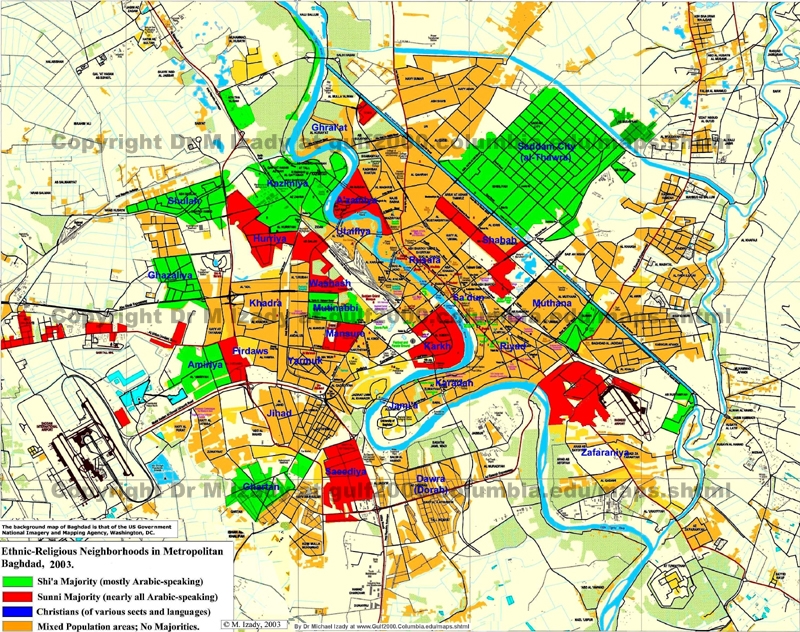

Green – Shiite majority
Red – Sunni majority
Blue – Christian majority
Yellow – Mixed Sunni-Shiite

The next map skips ahead to 2006. The February bombing of the Shiite shrine at Samarra in Salahaddin province north of Baghdad in that year is credited as beginning of the sectarian war, and Moqtada al-Sadr’s Mahdi Army is largely blamed for carrying out most of the ethnic cleansing. In actuality, in 2005 the Supreme Islamic Iraqi Council’s Badr Brigade militia took over the Interior Ministry under the government of Prime Minister Ibrahim al-Jaafari, and began setting up death squads and carrying attacks on Sunnis. The Supreme Council also began pushing out Sunnis from the security forces, and replacing them with its followers. The activities of the Badr Brigade were exposed in late 2005 when U.S. forces came across a secret detention facility in the capital holding 169 abused prisoners, some of which were tortured. The Interior Minister Bayan Jabr, a Badr Brigade leader, tried to deny the seriousness of the find.

The 2006 map shows the first changes in the sectarian make-up of the city. These can be seen in the outskirts of the city. Sadiya in the south for example, and Hurriya and Washash on the west bank of the Tigris went from Sunni to Shiite majority. The three neighborhoods directly northwest of Sadr City, Hayy Aden, Sahab, and Hayy Sumer went from being mixed to Shiite. In turn, Amiriya in the west went from Shiite to Sunni, along with Ghazaliya above it, and Jihad went from mixed to Sunni to the south. Karkh in central Baghdad, which surrounds the Green Zone, also went from Sunni to mixed.

Baghdad 2006
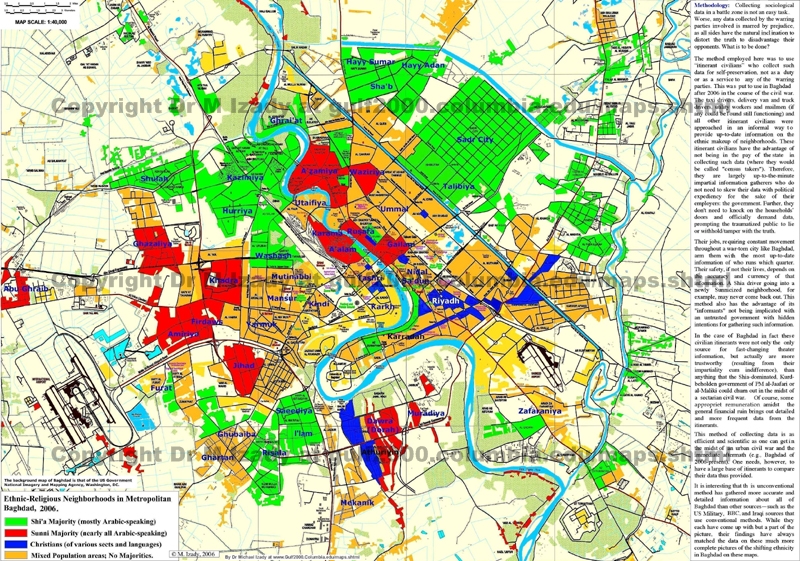


Green – Shiite majority
Red – Sunni majority
Blue – Christian majority
Yellow – Mixed Sunni-Shiite

The third map covers early 2007. At that time the sectarian war was still going full throttle. For example, the Brookings Institution’s Iraq Index recorded 3,462 killed in November 2006, 2,914 in December, 3,500 in January 2009, 2,700 in February, and 2,400 in March. By that time the segregation of Baghdad was pretty much complete. Adhamiya was the last large Sunni majority neighborhood left in the western half of the capital. Most Sunnis were now concentrated in a strip of western neighborhoods including Kindi, Mansur, Yarmuk, Khadra, Amiriya, and Ghazaliya, along with a few southern district like Dora and Muradiya. Only central Baghdad around the Tigris River had large numbers of mixed areas left with the northwest, northeast, southwest, and southeast all Shiite majority now.

Baghdad Early 2007
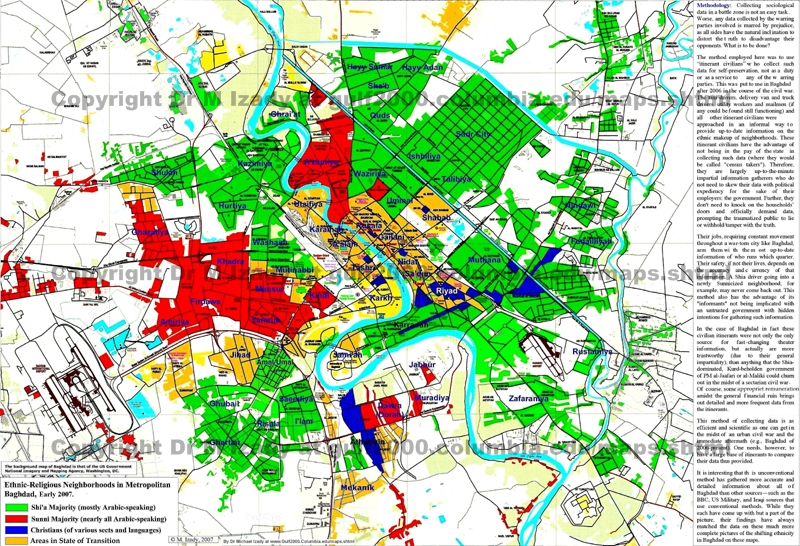
Green – Shiite majority
Red – Sunni majority
Blue – Christian majority
Yellow – Mixed Sunni-Shiite

The fourth map is from late 2007. The only real change was along the west bank of the Tigris. There, the southern section of Adhamiya became Shiite, while Resaca and Gaitanis became Sunni majority. During that period, the sectarian fighting was petering out. The Iraq Index counted 1,100 deaths in September 2007; the last time it would record over one thousand deaths in a single month. After that there were 950 killed in October, and 750 in November and December each. The Surge had also led to blast walls being erected around many of the Sunni neighborhoods and the creation of the Sons of Iraq program where the majority of the Sunni insurgency gave up and switched sides to align with the Americans rather than face annihilation at the hands of the Shiite militias, Al Qaeda in Iraq, or the United States. Both of those policies solidified the segregation of Baghdad.

Baghdad Late 2007
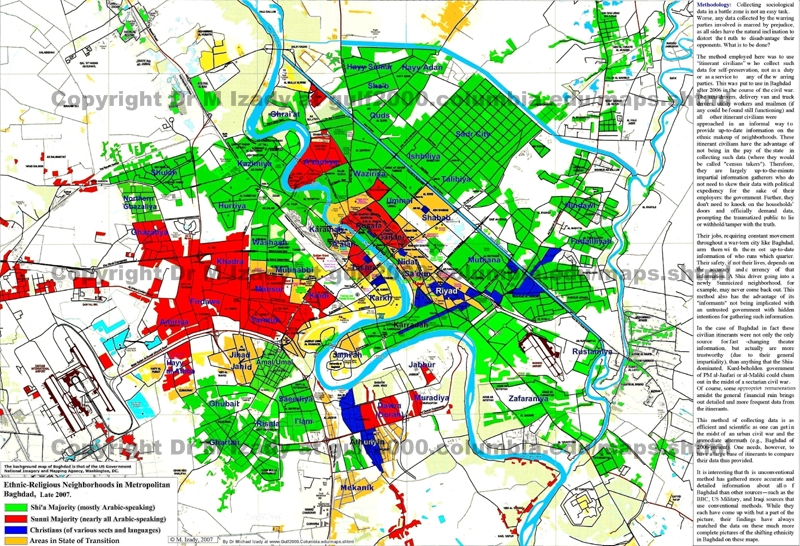
Green – Shiite majority
Red – Sunni majority
Blue – Christian majority
Yellow – Mixed Sunni-Shiite

The last map is from mid-2008. There were very few changes by that time. The only noticeable ones were around the Riyad area that went from mixed to Shiite on the western bank of the Tigris across from the Green Zone. By 2008 the sectarian war was over, the insurgency was reduced to largely carrying out terrorist bombings and hit and run attacks, and deaths were dropping.

Baghdad Mid 2008

Green – Shiite majority
Red – Sunni majority
Blue – Christian majority
Yellow – Mixed Sunni-Shiite

Izady believes that the ethnic cleansing of Baghdad by the Shiite militias and the Sons of Iraq movement were the major reasons why the civil war ended. The Badr Brigade and Mahdi Army effectively removed most of the Sunnis to a western strip of the capital, while the Sons of Iraq signaled the collapse of the insurgency. The Surge didn’t fully get underway until mid-2007, and facilitated the reduction of violence and segregation that was already underway. Izady thinks much of the same for Sadr’s August 2007 cease-fire. Again, the fighting was already winding down by then, and Sadr never told his followers to disarm, and many factions had broken away or become Special Groups that were no longer following Sadr’s direction, so there were plenty of militiamen still active. There were just fewer Sunnis to target, and many militia cells turned to exploiting their own Shiite communities instead.

The BBC did a similar set of maps comparing pre-2006 Baghdad to 2007 based upon information from the International Medical Corps. It found a very similar pattern of Shiite expansion in the east and northwest, the vast reduction of mixed neighborhoods, and the concentration of Sunnis in the west. Many other students of the Surge attribute these same factors for the end of the civil war, but just put different emphasis on each point.

The one disputable point that Izady made in his interview with the International Relations and Security Network was when he said he believed that Sunnis were reduced to 12% of Iraq’s population because of the fighting. He said many became refugees in Syria and Jordan. While the exact percentage Sunnis made up of Iraq and Baghdad are disputed, a general number used in sources such as the CIA Factbook is around 30%. How much they made up of Baghdad before the U.S. invasion is an even harder figure to calculate. In the December 2005 national elections however, the Sunni Iraqi Accordance Front and Iraqi National Dialogue Front pulled 22.9% of the vote in the capital, while the Iraqi National List, even though led by a Shiite, former Prime Minister Ilyad Allawi, also draws strongly from Sunnis, got 13.4%. That’s roughly 30% of Baghdad as well. If Izady is to be believed than just over half of the Sunnis fled the country. In 2003 Iraq had a population of around 26 million, if 30% were Sunnis that would be roughly 7.8 million, half of which would be 3.9 million people. The United Nations estimates that there are only 2.5 million refugees however, not all of which are Sunnis. There are other sources that think that Sunnis were only 15-20% of all Iraqis, which would be approximately 3.9million-5.2 million. That would match the refugee numbers much more closely.

Izady’s maps are a valuable resource in charting the changes that Baghdad witnessed after the U.S. invasion. It was and remains the center of power and conflict in the country to this day. The Shiite militias undertook a concerted effort to push Sunnis out of parts of the city beginning in 2005, and largely succeeded as Izady’s graphics show. When the insurgency largely gave up and joined the Sons of Iraq, and the U.S. put up blast walls around many communities, those marked the effective end of the sectarian war. The result is a segregated and Shiite dominated capital, that in a way is symbolic of post-Saddam Iraq as there was displacement across the country, and the Shiite parties are now in firm control of the government, with no real threat from other sects.

SOURCES

BBC, “Baghdad: Mapping the violence,” 2007

CIA, Factbook

Guler, Claudio, “Baghdad Divided,” International Relations and Security Network, 11/9/09

Independent Electoral Commission of Iraq, “Legislation Election of 15 December 2005,” 2006

International Crisis Group, “Shiite Politics In Iraq: The Role Of The Supreme Council,” 11/15/07

Matthews, Dylan and Klein, Ezra, “How Important Was the Surge?” American Prospects, 7/28/08

Murphy, Dan, “New Iraqi leader seeks unity,” Christian Science Monitor, 4/24/06

O’Hanlon, Michael Campbell, Jason, “Iraq Index,” Brookings Institution, 8/20/09

Otterman, Sharon, “IRAQ: The Sunnis,” Council on Foreign Relations, 12/12/03

Wong, Edward, “U.S. Splits With Iraqi Official Over Prisoner Abuse,” New York Times, 11/17/05

Monday, August 31, 2009

The Passing Of Abdul Aziz al-Hakim

August 26, 2009 saw the passing of Abdul Aziz al-Hakim, the leader of the Supreme Islamic Iraqi Council (SIIC). Hakim was a symbol of Iraqi politics immediately after the 2003-invasion. He was an opportunist and pragmatist who was willing to align himself with various groups to gain power. He was widely successful in the early years following the overthrow of Saddam, but then his star began to fade in 2007.

The SIIC has its roots in the Dawa Party and Tehran. In the 1950s, Ayatollah Muhammad Baqr al-Sadr and Ayatollah Mohsen al-Hakim created the Dawa Party rallying Shiites to the cause of an Islamic state. Hakim eventually left Dawa, and in the 1980s fled to Iran during the Iran-Iraq War with his two sons, Mohammed Baqr al-Hakim and Abdul Aziz al-Hakim. In 1982 Tehran formed the Supreme Council for Islamic Revolution in Iraq to counter the Dawa Party, and assert more influence over the Iraqi opposition. The Hakims in turn, pledged allegiance to Ayatollah Khomeini and the Iranian Revolution. In 1983 Iran created the Badr Brigade, which was an official arm of the Iranian Revolutionary Guards’ Qods Force. It fought on the Iranian side in the Iran-Iraq War, and recruited amongst Iraqi prisoners of war. After the Gulf War, Badr moved into southern Iraq and tried to unsuccessfully take over the Shiite uprising. These origins were always a major problem for the SIIC as many Iraqis resented the Hakims fleeing to Iran, their role in the Iran-Iraq War and the 1991 uprisings, and their pro-Khomeini stance.

Despite their Iranian origins, the Hakims were always pragmatic opportunists who would ally with any group that would give them a better chance at gaining power in Iraq. Beginning in the late-1980s they started quiet relations with the United States. In 1992 they joined the Iraqi National Congress, and its leader Ahmad Chalabi, was able to garner Washington’s support for the SIIC as the major Shiite party they would work with after the invasion. They also worked closely with the ruling Kurdish parties, the Patriotic Union of Kurdistan (PUK) and the Kurdistan Democratic Party (KDP), to plan for a post-Saddam Iraq. The three had forged ties when they all fought on the Iranian side in the Iran-Iraq War.

When the 2003 invasion of Iraq occurred, the SIIC was able to sweep into power and assume a larger position than they had support. First, they took over a series of cities like Kut, Khanaqin, Baquba, Basra, Najaf, and Karbala because of the vacuum left from Saddam’s overthrow. They also sank early attempts to include internal Iraqi leaders in any new government put together by the U.S. They quickly aligned themselves with Grand Ayatollah Ali al-Sistani as well to gain legitimacy and standing, and supported his call for elections to determine a new government and constitution, knowing that would benefit themselves since Iraq had a Shiite majority. Abdul al-Aziz al-Hakim ended up joining the Iraqi Governing Council, and assumed the leadership of the SIIC, when his brother Ayatollah Mohammed al-Hakim was killed in a car bombing in August 2003.

Beginning in 2005 Hakim and the SIIC were able to put together a string of ringing victories after the U.S. handed back sovereignty to Iraq. The SIIC was the driving force behind the United Iraqi Alliance in the 2005 elections, which came away with the most votes. It also joined with the Kurds to push through a new constitution, and together the SIIC, PUK, and KDP were the ruling coalitions behind the Ibrahim al-Jaafari and Nouri al-Maliki governments. The SIIC also took over the Interior Ministry under Jaafari, got their Badr Brigade integrated into the security forces, and set up death squads to begin the ethnic cleansing of Sunnis from Baghdad. In August 2005 they began promoting federalism, and a nine-province southern Shiite autonomous region. In 2006, the U.S. came to rely upon the SIIC to counter the Sadrists, who were their greatest rivals. The two had been having a long-running battle across southern Iraq. The SIIC was able to gain these victories because they were better organized than their rivals, the Sunnis and Sadrists boycotted the first two elections in 2005, and both Washington and Tehran supported them.

In 2007, the SIIC’s fortunes began to change. First, their call for an autonomous region proved to create more problems than good since many Shiites rejected the idea. The SIIC also controlled most of the southern provinces, and did a poor job governing and providing services. Third, the Hakim’s base was the middle class and merchants, who began to flee the country during the sectarian war. Fourth, the SIIC was never able to shake their image as tools of Tehran. To counter this the party tried to remake itself, dropping “Revolutionary” from their name becoming the Supreme Islamic Iraqi Council, claimed that they supported Ayatollah Sistani rather than Ayatollah Ali Khamanei in Iran, and said they had disbanded their militia the Badr Brigade, which they then called a social and political group. They also tried to provide social services to gain support amongst the poor, a move led by Abdul Hakim’s son, Ammar al-Hakim, who was being groomed as the successor to his father.

In 2008 and 2009 things got worse. Prime Minister Maliki began distancing himself from the SIIC by creating his own popular base with the Tribal Support Councils. Maliki also came out against federalism in both northern and southern Iraq, and called for a strong central government. In turn, the SIIC, KDP, and PUK talked about having a no confidence vote against the Prime Minister in December 2008, but they couldn’t decide upon a successor and were hoping that Maliki would trip up, and ruin his image. In the 2009 provincial elections, Maliki ran his own State of Law List against the SIIC, who was soundly beaten across the south and Baghdad. Despite these setbacks, Hakim tried to mend fences with Maliki by lobbying him to join a new version of the United Iraqi Alliance to run in the 2010 parliamentary balloting. This failed to materialize, as the Prime Minister wanted to lead the new list, something Hakim and the other parties refused to agree upon.

By the time of Hakim’s death, the SIIC was a shell of its former self. After the sweeping victories in 2005, the Supreme Council is now fading, and desperately trying to remake itself once again to return to power. They now talk about national unity, but they are remembered for their Iranian roots and pro-federalist stance. The death of Hakim could also lead to a power struggle within the organization. While Hakim’s son, Ammar, was the anointed successor, there are a number of possible rivals in the old guard like the head of the Badr Organization Hadi al-Ameri, Finance Minister Bayan Jabr, and Vice President Adel Abd al-Mahdi. The SIIC may be at a crossroads, lacking popular support and strong leadership with Hakim’s passing.

SOURCES

Abedin, Mahan, “The Supreme Council for the Islamic Revolution in Iraq (SCIRI),” Middle East Intelligence Bulletin, October 2003

Dagher, Sam, “Rising player with a vision for Shiite Iraq,” Christian Science Monitor, 11/20/07

Elkhamri, Mounir, “Iran’s Contribution to the Civil War in Iraq,” Jamestown Foundation, January 2007

Felter, Joseph and Fishman, Brian, “Iranian Strategy in Iraq, Politics and ‘Other Means,’” Combating Terrorism Center at West Point, 10/13/08

Kemp, Geoffrey, “Iran and Iraq The Shia Connection, Soft Power, and the Nuclear Factor,” United States Institute of Peace, November 2005

International Crisis Group, “Shiite Politics In Iraq: The Role Of The Supreme Council,” 11/15/07

Packer, George, “War After The War,” New Yorker, 11/24/03

Raghavan, Sudarsan, “Shiite Clerics’ Rivalry Deepens In Fragile Iraq,” Washington Post, 12/21/06
- “Shiite Contest Sharpens In Iraq,” Washington Post, 12/26/07

Ramzi, Kholoud, “daawa-siic conflict splits Shiite unity,” Niqash,” 11/27/08

Santora, Marc, “Shiite Power Broker Dies, in Blow to Iraqi Party,” New York Times, 8/26/09

Semple, Kirk, “Heavy battle between shiite militias reveals deep split in ruling coalition,” San Francisco Chronicle, 10/22/06

Serwer, Daniel and Parker, Sam, “Maliki’s Iraq between Two Elections,” United States Institute of Peace, May 2009

Visser, Reidar, “Abd al-Aziz al-Hakim Dies in Tehran,” Historiae.org, 8/26/09

Walt, Vivienne, “U.S. Ally: Shiite leader preached unity before attack,” San Francisco Chronicle, 8/30/03

Wednesday, June 24, 2009

Iraq’s Lack Of Budget Execution

In April 2009 Iraq passed its latest budget. It is larger than the 2008 one, but not as big as originally planned. The increases that individual ministries have received are largely for operational costs that go towards things like salaries and pensions, rather than for investing in the future. Another problem is that the major ministries responsible for revenues and services are still incapable of spending most of their capital budgets. This comes at a time when Iraq desperately needs to boost its growth.

Iraq’s 2009 budget is for $58.6 billion. That’s a 25.8% cut from the original amount of $79.8 billion, but still a 17% increase from the 2008 budget of $49.9 billion. Both Prime Minister Nouri al-Maliki and the Finance Minister Bayan Jabr were against the cuts saying that it would hamper services and the development of the economy, which is still mostly state run. It would have been impossible for Iraq to cover that original amount however. Even with the lower figure, Iraq is still expected to have a $20 billion deficit.

Most of the 2009 budget is for operational costs, with a cut in capital spending. The operational budget is for $45.9 billion, 78% of the total. The capital budget went down from $13.1 billion in 2008 to $12.7 billion in 2009, a 3% cut. In 2008 oil revenues were so large that a supplemental budget was passed, which increased the overall capital budget to $21.1 billion.

With U.S. reconstruction funding coming to an end, Iraq’s capital spending is the largest source of funding for rebuilding the country. Appropriately than, most of this year’s money will go to the Oil, Electricity, Finance, Water, and Industry and Minerals Ministries. Iraq’s Oil Ministry’s capital budget went up slightly from $2 billion in 2008 to $2.2 billion in 2009. The Electricity Ministry on the other hand, will face a 17% decrease in its capital spending from $1.3 billion in 2008 to $1.08 billion in 2009. The Ministry is worried that it won’t be able to increase capacity with that amount, as they originally asked for $7 billion. The Health Ministry will have the largest capital increase at +489%, going from $83.3 million to $408.1 million.

The problem is that Iraq has rarely been able to spend its capital budget. In 2005, when Iraq formally got its sovereignty back from the United States, it only spent 23% of its capital budget. That went down to 19% in 2006, and then up to 28% in 2007. In 2008 Baghdad made a huge leap when it expended 39% of its capital budget. Iraq’s main revenue, budget, and services ministries did worse however. The Oil, Water, and Electricity Ministries for example, appropriated $11.9 billion for capital spending from 2005 to 2007, but only spent $985 million of it. In 2007 Oil and Electricity only expended $1 million each from their capital budgets.

What are skyrocketing instead are the operational budgets. Nearly every ministry will see an increase in that department. The Oil Ministry for example will see a jump from $103.7 million in 2008 to $954.4 million this year in its operational account. The Electricity Ministry’s operational budget will go from $89.1 million in 2008 to $2.31 billion in 2009. The Health Ministry’s will increase from $1.872 billion in 2008 to $3.095 billion in 2009. Most of this money will be spent if Iraq follows its past trends. From 2005 to 2007 it spent $67 billion, 90% of which went to operating costs.

Iraq’s poor budget execution has led to massive surpluses. In 2005 Iraq had a $6.5 billion surplus. That went up to $29 billion leftover from the 2008 budget. The GAO estimated that Iraq built up a $47.3 billion surplus from 2005 to 2008. When parliament was drafting the 2009 budget they believed that they could tap into this money to pay for the expected deficit, but after the bill was passed the Finance Ministry and Central Bank of Iraq let them know that they were not obligated to use the surplus to cover the budget. Baghdad has had to get a loan from the International Monetary Fund instead to cover the difference.

Each year Iraq has passed a larger budget, and each year it has been able to spend more of its money. The major ministries however, are still only spending a measly portion of their budgets, and most of that is going towards salaries and pensions, rather than investing in Iraq’s future. The 2009 budget will pose an additional problem for Iraq, as it still has not earned enough from oil to pay its bills. Many ministries did not get the money they requested either, and each still needs billions. The Ministry of Oil said it requires $25 to $75 billion to reach its target of 6 million barrels per day. The Electricity Ministry estimated that it needs $27 billion over the next 6 to 10 years to meet all of the country’s demand by 2015. The U.S. thinks the actual amount might be twice as high. The World Bank believes that Iraq has to have $14.4 billion to fix its water system. These amounts will largely have to come from Baghdad from now on as foreign investors are still largely staying away, while U.S. and international donations are coming to an end. The inability to spend its capital budget, while operational costs are skyrocketing do not point to meeting these goals anytime soon in Iraq.

Major Revenue And Service Ministries’ Budgets 2008-2009


Oil Ministry
2008: $103.7 mil operational, $2 bil capital. TOTAL $2.103 bil, 16% spent
2009: $954.4 mil operational, $2.2 bil capital. TOTAL: $3.160 bil
2008-2009 Changes: +920% operational, +10% capital

Electricity Ministry
2008: $89.1 mil operational, $1.3 bil capital. TOTAL: $1.389 bil, 12% spent
2009: $2.31 bil operational, $1.08 bil capital. TOTAL: $3.39 bil
2008-2009 Changes: +259% operational, -16% capital

Water Ministry
2008: $109.6 mil operational, $375 mil capital. TOTAL: $484. mil. 48% spent
2009: $168.6 mil operational, $563.5 mil capital. TOTAL: $732.1 mil
2008-2009 Changes: +53% operational, +50% capital

Municipalities and Public Works Ministry
2008: $42.6 mil operational, $416.7 mil capital. TOTAL: $459.3 mil, 22% spent
2009: $479.6 mil operational, $468.2 mil capital. TOTAL: $947.8 mil
2008-2009 Changes: +1125% operational, +12% capital

Transportation Ministry
2008: $121.6 mil operational, $250 mil capital. TOTAL: $371.6 mil, 29% spent
2009: $209.7 mil operational, $324.2 mil capital. TOTAL: $533.8 mil
2008-2009 Changes: +72% operational, +29% capital

Communications Ministry
2008: $14.4 mil operational, $250 mil capital. TOTAL: $264.4 mil, 30% spent
2009: $88.2 mil operational, $216.1 mil capital. TOTAL: $304.3 mil
2008-2009 Changes: +612% operational, -15% capital

Health Ministry
2008: $1.872 bil operational, $83.3 mil capital. TOTAL: $1.956 bil
2009: $3.095 bil operational, $408.1 mil capital. TOTAL: $3.503 bil
2008-2009 Changes: +65% operational, +489% capital

Budget Expenditures 2005-2007

Iraqi Budget Expenditures 2005-2007
2005: $16.151 bil operational, $1.432 bil capital. TOTAL: $17.583 bil
2006: $21.173 bil operational, $1.615 bil capital. TOTAL: $22.788 bil
2007: $23.164 bil operational, $3.434 bil capital. TOTAL: $26.599 bil

Oil, Water, Electricity Ministries’ Capital Appropriations Versus Spending
2005: $3,482 mil appropriated, $373 mil spent
2006: $4,473 mil appropriated, $502 mil spent
2007: $4.034 mil appropriated, $110 mil spent
TOTAL: $11,990 mil appropriated, $985 mil spent

Oil Ministry Spending
2005: $160 mil spent, $49 mil operational, $111 mil capital
2006: $191 mil spent, $48 mil operational, $143 mil capital
2007: $36 mil spent, $35 mil operational, $1 mil capital

Water Ministry Spending
2005: $163 mil spent, $42 mil operational, $120 mil capital
2006: $145 mil spent, $54 mil operational, $91 mil capital
2007: $236 mil spent, $128 mil operational, $109 mil capital

Electricity Ministry Spending
2005: $147 mil spent, $5 mil operational, $142 mil capital
2006: $281 mil spent, $13 mil operational, $268 mil capital
2007: $78 mil spent, $77 mil operational, $1 mil capital

SOURCES

Agence France Presse, “Iraq presidency approves slashed budget,” 4/3/09

Cordesman, Anthony, “The Changing Situation in Iraq: A Progress Report,” Center for Strategic and International Studies, 4/1/09

Department of Defense, “Measuring Stability and Security in Iraq,” March 2009

Special Inspector General for Iraq Reconstruction, “Quarterly Report to the United States Congress,” 4/30/09

United States Government Accountability Office, “IRAQ Key Issues for Congressional Oversight,” March 2009
- “Iraqi Revenues, Expenditures, and Surplus,” August 2008
 
Clicky Web Analytics