Showing posts with label Sons Of Iraq. Show all posts

Monday, November 30, 2009

Fadhil Sons of Iraq Leader Sentenced To Death

On November 20, 2009 the head of the Sons of Iraq (SOI) in Baghdad’s Fadhil district, Adil al-Mashhadani, was sentenced to death by an Iraqi court. He was charged with the murder of a girl whose mother complained to him about the violence in the neighborhood during the sectarian war. Mashhadani was originally arrested in late March 2009, which set off a day of fighting between Iraqi and U.S. forces, and Mashhadani’s SOI. The SOI leader shows both who the U.S. was willing to work with during the Surge as well as Baghdad’s ambivalent attitude towards the Sons of Iraq program.

In the summer of 2007 General David Petraeus and his top advisers met to discuss a new Sunni policy. It was decided that the U.S. would try to replicate the Anbar Awakening in Baghdad, and other Sunnis areas in central and northern Iraq. In 2005 the Sunni tribes of Anbar had begun to turn on Al Qaeda in Iraq because they no longer perceived them to be allies, but as a threat since the Islamists were attempting to take over the insurgency and impinge on many of the tribes’ businesses. This inspired the Sons of Iraq (SOI) program where American forces began creating ties with insurgents and tribal groups that were willing to fight Al Qaeda.

Fadhil is a small neighborhood in eastern Baghdad near the Tigris River. The area was known for having a very active insurgency in 2006-2007 that was battling Shiite militiamen from Sadr City, which was just to the northeast, and carrying out attacks on the Americans. Adil Mashhadani was a cell leader there. He was a former member of the Republican Guard, and originally joined the fight against the Americans in Fallujah in 2004. In April 2007 Mashhadani’s forces were devastated in a fight with the U.S., followed by Al Qaeda attempting to replace him. Faced with the triple pressure from the Islamists, the Shiites, and the Americans, he decided to switch sides and work with the last. By May the U.S. battalion in Fadhil had organized Mashhadani's men into a SOI unit, and had also been able to work out a deal with the Shiites in the surrounding areas. By June Mashhadani was in firm control, creating his own little fief supported by U.S. troops and reconstruction money. In October Al Qaeda tried to strike back at him with a failed suicide attack. That led to a month’s long battle that expelled the Islamists from the rest of the area. By December 2009 the U.S. got him to reluctantly work with the Iraqi Army and government. This earned Mashhadani the respect of the first two U.S. officers to work with him, who protected him from officials in Baghdad that wanted him arrested for murder.

At the very end of December 2008 things started to change. A new U.S. unit began receiving information about Mashhadani’s men taking part in extortion, rape, and insurgent activity, while it was transferring Fadhil to Iraqi control. This caused tensions with Mashhadani who didn’t want to give up his power. He also complained that hardly any of his men were getting jobs or being paid by the government as promised. That all ended at the end of March when he was arrested by Iraqi Special Forces. His SOI unit, which only numbered about 150 men, was disbanded afterward.

Mashhadani’s detention and the subsequent fighting set off alarm bells in the U.S., but got a much more mixed reaction within Iraq. Many American commentators feared that his arrest would set off a wave of fighting between the government and the SOI since the Prime Minister had never approved of the program since its inception. Sunnis expressed both fear and approval. An SOI commander in Dora, Baghdad for example, was afraid that Iraqi forces would arrest him, while another in Adhamiya said that Mashhadani had been killing people and extorting money and therefore deserved what he got. Sheikh Ahmed Abu Risha of the Anbar Awakening chimed in that Mashhadani had been breaking the law, and called for an end to speculation that his arrest would undermine security in the country. His subsequent death sentence has created the same sort of mixed feelings amongst the SOI.

Adil Mashhadani was the type of man that the U.S. was willing to work with to bring an end to the sectarian war. The question has only been raised by a few like Nibras Kazimi of the Hudson Institute and Talisman Gate blog, but could the U.S. have avoided this whole ordeal if it had decided to crush the entire insurgency rather than attempting to divide and conquer it? After the Samarra bombing in February 2006, which set off the civil war, the Sunnis quickly realized that they were going to lose, as they were outnumbered 3 to 1 by the Shiites. At the same time Al Qaeda was focusing their violence on fellow insurgents who would not follow their lead. The Americans took advantage of this situation to cut a short-term deal with Sunnis like Mashhadani who were willing to turn on the Islamists to save their own skins, which created a long-term problem with the Iraqi government who never approved of the U.S. policy. Instead they could’ve let Mashhadani and Al Qaeda battle it out, and then swept up the remains. The problem for General Petraeus was that would’ve taken longer and led to more fighting at a time when he was under intense domestic pressure in the U.S. to show results as quickly as possible. The Sons of Iraq program appeared to be a way to do that, and the U.S. and Iraq are still facing the consequences as the Americans are trying to ensure the SOI get as many jobs as possible from a government that lacks both the will and capacity to do so.

SOURCES

Alsumaria, “Awakening council ex-leader sentenced to death,” 11/20/09
- “Awakening forces clash with Iraq police,” 3/30/09

Aswat al-Iraq, “Sahwa leader captured in central Baghdad on “terror” charges – spokesman,” 3/28/09

Burns, John and Rubin, Alissa, “U.S. Arming Sunnis in Iraq to Battle Old Qaeda Allies,” New York Times, 6/11/07

Dagher, Sam, “Market bombings: Baghdad locals want security, not Iraqi police,” Christian Science Monitor, 2/4/08

Kazimi, Nibras, “How To Do A “Surge,”” Hudson Institute, 4/2/09

Leland, John, “Iraq Sentences Sunni Leader to Death,” New York Times, 11/20/09

Nordland, Rod, “Rebellious Sunni Council Disarmed After Clashes, Officials in Baghdad Say,” New York Times, 3/31/09

Nordland, Rod and Rubin, Alissa, “Sunni Fighters Say Iraq Didn’t Keep Job Promises,” New York Times, 3/24/09

Parker, Ned and Ahmed, Caesar, “Sons of Iraq movement suffers another blow,” Los Angeles Times, 3/30/09

Raghavan, Sudarsan, “Baghdad Arrest Sets Off Clashes,” Washington Post, 3/29/09

Reuters, “Iraqi forces arrest more U.S.-allied Sunni guards,” 4/4/09

Rosen, Nir, “The big sleep,” The National, 4/24/09

Rubin, Alissa and Cave, Damien, “In a Force for Iraqi Calm, Seeds of Conflict,” New York Times, 12/23/07

Rubin, Alissa and Farrell, Stephen, “Awakening Councils by Region,” New York Times, 12/22/07

Rubin, Alissa and Nordland, Rod, “Troops Arrest an Awakening Council Leader in Iraq, Setting Off Fighting,” New York Times, 3/29/09

Ziezulewicz, Geoff, “Empowered by the U.S., imprisoned by Iraqis,” Stars and Stripes, 9/24/09
- “U.S., Iraqi forces progress cautiously after ‘Sons of Iraq’ arrest,” Stars and Stripes, 4/15/09
- “U.S. troops, Iraqi army work to secure Baghdad district after militia leader’s arrest,” Stars and Stripes, 4/5/09

Wednesday, November 25, 2009

Columbia University Charts Sectarian Cleansing of Baghdad

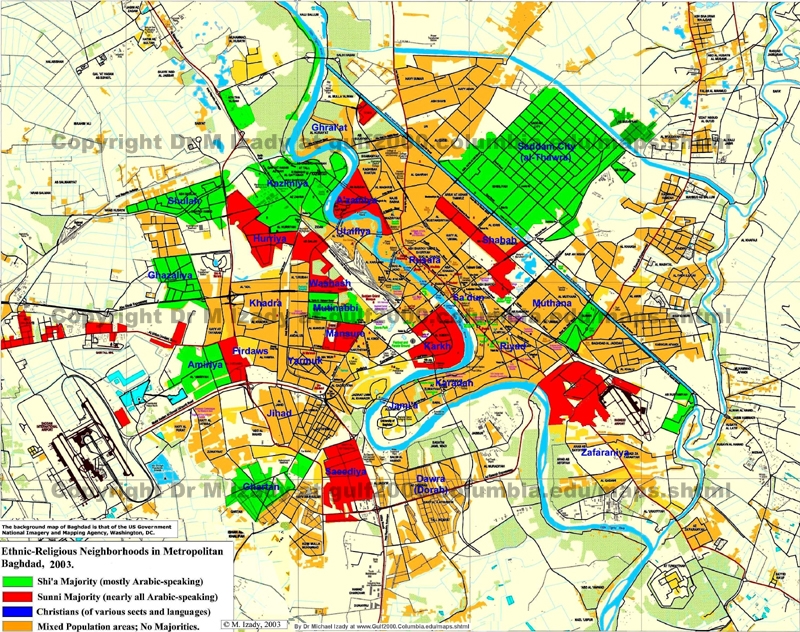
Dr. Michael Izady of Columbia’s School of International and Public Affairs recently gave an interview to the Swiss-based International Relations and Security Network. He presented a series of maps that he put together on Baghdad during Iraq’s civil war. They show the effects of the fighting as the capital went from a mixed Sunni-Shiite city, into a segregated one.

Izady’s first map is from 2003 when the U.S. invasion began. There were majority Sunni and Shiite areas peppered throughout Baghdad. Sadr City in northeast Baghdad was the largest and most well known Shiite area, but there were others such as Amiriya in the west by Baghdad Airport, Ghazaliya in the northwest by Abu Ghraib, and Shula and Kadhimiya in the north. Majority Sunni areas were Hurriya in the north, Washash, Mansur, and Karkh in the central region, Sadiya in the south, and Adhamiya on the eastern bank of the Tigris River. The majority of the capital however was mixed Sunni-Shiite, especially in the central, southern, and northeastern regions.

Baghdad 2003


Green – Shiite majority
Red – Sunni majority
Blue – Christian majority
Yellow – Mixed Sunni-Shiite

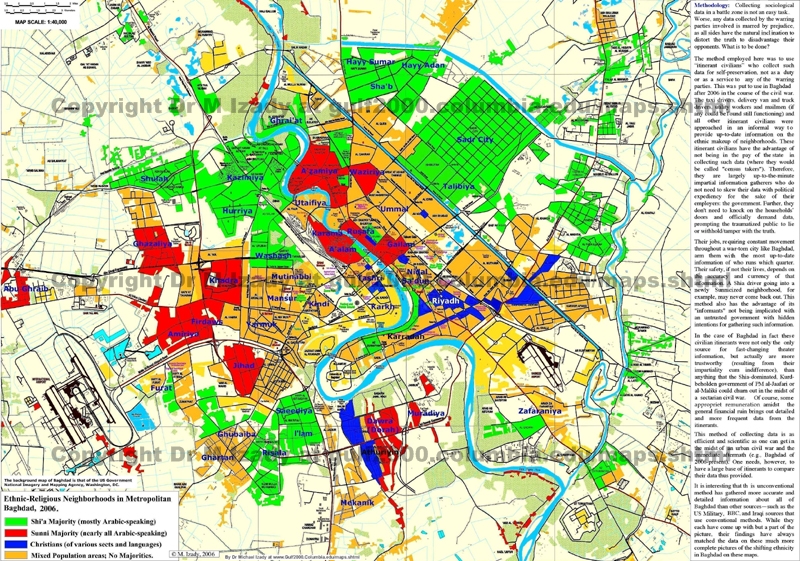
The next map skips ahead to 2006. The February bombing of the Shiite shrine at Samarra in Salahaddin province north of Baghdad in that year is credited as beginning of the sectarian war, and Moqtada al-Sadr’s Mahdi Army is largely blamed for carrying out most of the ethnic cleansing. In actuality, in 2005 the Supreme Islamic Iraqi Council’s Badr Brigade militia took over the Interior Ministry under the government of Prime Minister Ibrahim al-Jaafari, and began setting up death squads and carrying attacks on Sunnis. The Supreme Council also began pushing out Sunnis from the security forces, and replacing them with its followers. The activities of the Badr Brigade were exposed in late 2005 when U.S. forces came across a secret detention facility in the capital holding 169 abused prisoners, some of which were tortured. The Interior Minister Bayan Jabr, a Badr Brigade leader, tried to deny the seriousness of the find.

The 2006 map shows the first changes in the sectarian make-up of the city. These can be seen in the outskirts of the city. Sadiya in the south for example, and Hurriya and Washash on the west bank of the Tigris went from Sunni to Shiite majority. The three neighborhoods directly northwest of Sadr City, Hayy Aden, Sahab, and Hayy Sumer went from being mixed to Shiite. In turn, Amiriya in the west went from Shiite to Sunni, along with Ghazaliya above it, and Jihad went from mixed to Sunni to the south. Karkh in central Baghdad, which surrounds the Green Zone, also went from Sunni to mixed.

Baghdad 2006


Green – Shiite majority
Red – Sunni majority
Blue – Christian majority
Yellow – Mixed Sunni-Shiite

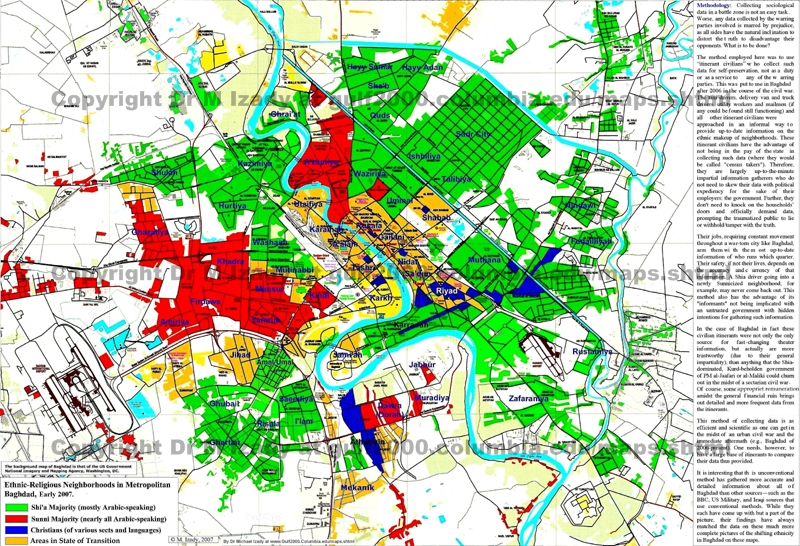
The third map covers early 2007. At that time the sectarian war was still going full throttle. For example, the Brookings Institution’s Iraq Index recorded 3,462 killed in November 2006, 2,914 in December, 3,500 in January 2009, 2,700 in February, and 2,400 in March. By that time the segregation of Baghdad was pretty much complete. Adhamiya was the last large Sunni majority neighborhood left in the western half of the capital. Most Sunnis were now concentrated in a strip of western neighborhoods including Kindi, Mansur, Yarmuk, Khadra, Amiriya, and Ghazaliya, along with a few southern district like Dora and Muradiya. Only central Baghdad around the Tigris River had large numbers of mixed areas left with the northwest, northeast, southwest, and southeast all Shiite majority now.

Baghdad Early 2007

Green – Shiite majority
Red – Sunni majority
Blue – Christian majority
Yellow – Mixed Sunni-Shiite

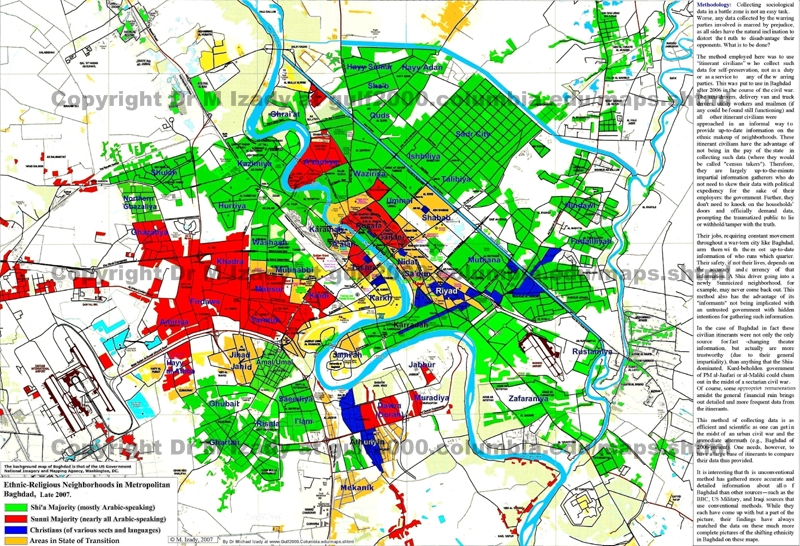
The fourth map is from late 2007. The only real change was along the west bank of the Tigris. There, the southern section of Adhamiya became Shiite, while Resaca and Gaitanis became Sunni majority. During that period, the sectarian fighting was petering out. The Iraq Index counted 1,100 deaths in September 2007; the last time it would record over one thousand deaths in a single month. After that there were 950 killed in October, and 750 in November and December each. The Surge had also led to blast walls being erected around many of the Sunni neighborhoods and the creation of the Sons of Iraq program where the majority of the Sunni insurgency gave up and switched sides to align with the Americans rather than face annihilation at the hands of the Shiite militias, Al Qaeda in Iraq, or the United States. Both of those policies solidified the segregation of Baghdad.

Baghdad Late 2007

Green – Shiite majority
Red – Sunni majority
Blue – Christian majority
Yellow – Mixed Sunni-Shiite

The last map is from mid-2008. There were very few changes by that time. The only noticeable ones were around the Riyad area that went from mixed to Shiite on the western bank of the Tigris across from the Green Zone. By 2008 the sectarian war was over, the insurgency was reduced to largely carrying out terrorist bombings and hit and run attacks, and deaths were dropping.

Baghdad Mid 2008

Green – Shiite majority
Red – Sunni majority
Blue – Christian majority
Yellow – Mixed Sunni-Shiite

Izady believes that the ethnic cleansing of Baghdad by the Shiite militias and the Sons of Iraq movement were the major reasons why the civil war ended. The Badr Brigade and Mahdi Army effectively removed most of the Sunnis to a western strip of the capital, while the Sons of Iraq signaled the collapse of the insurgency. The Surge didn’t fully get underway until mid-2007, and facilitated the reduction of violence and segregation that was already underway. Izady thinks much of the same for Sadr’s August 2007 cease-fire. Again, the fighting was already winding down by then, and Sadr never told his followers to disarm, and many factions had broken away or become Special Groups that were no longer following Sadr’s direction, so there were plenty of militiamen still active. There were just fewer Sunnis to target, and many militia cells turned to exploiting their own Shiite communities instead.

The BBC did a similar set of maps comparing pre-2006 Baghdad to 2007 based upon information from the International Medical Corps. It found a very similar pattern of Shiite expansion in the east and northwest, the vast reduction of mixed neighborhoods, and the concentration of Sunnis in the west. Many other students of the Surge attribute these same factors for the end of the civil war, but just put different emphasis on each point.

The one disputable point that Izady made in his interview with the International Relations and Security Network was when he said he believed that Sunnis were reduced to 12% of Iraq’s population because of the fighting. He said many became refugees in Syria and Jordan. While the exact percentage Sunnis made up of Iraq and Baghdad are disputed, a general number used in sources such as the CIA Factbook is around 30%. How much they made up of Baghdad before the U.S. invasion is an even harder figure to calculate. In the December 2005 national elections however, the Sunni Iraqi Accordance Front and Iraqi National Dialogue Front pulled 22.9% of the vote in the capital, while the Iraqi National List, even though led by a Shiite, former Prime Minister Ilyad Allawi, also draws strongly from Sunnis, got 13.4%. That’s roughly 30% of Baghdad as well. If Izady is to be believed than just over half of the Sunnis fled the country. In 2003 Iraq had a population of around 26 million, if 30% were Sunnis that would be roughly 7.8 million, half of which would be 3.9 million people. The United Nations estimates that there are only 2.5 million refugees however, not all of which are Sunnis. There are other sources that think that Sunnis were only 15-20% of all Iraqis, which would be approximately 3.9million-5.2 million. That would match the refugee numbers much more closely.

Izady’s maps are a valuable resource in charting the changes that Baghdad witnessed after the U.S. invasion. It was and remains the center of power and conflict in the country to this day. The Shiite militias undertook a concerted effort to push Sunnis out of parts of the city beginning in 2005, and largely succeeded as Izady’s graphics show. When the insurgency largely gave up and joined the Sons of Iraq, and the U.S. put up blast walls around many communities, those marked the effective end of the sectarian war. The result is a segregated and Shiite dominated capital, that in a way is symbolic of post-Saddam Iraq as there was displacement across the country, and the Shiite parties are now in firm control of the government, with no real threat from other sects.

SOURCES

BBC, “Baghdad: Mapping the violence,” 2007

CIA, Factbook

Guler, Claudio, “Baghdad Divided,” International Relations and Security Network, 11/9/09

Independent Electoral Commission of Iraq, “Legislation Election of 15 December 2005,” 2006

International Crisis Group, “Shiite Politics In Iraq: The Role Of The Supreme Council,” 11/15/07

Matthews, Dylan and Klein, Ezra, “How Important Was the Surge?” American Prospects, 7/28/08

Murphy, Dan, “New Iraqi leader seeks unity,” Christian Science Monitor, 4/24/06

O’Hanlon, Michael Campbell, Jason, “Iraq Index,” Brookings Institution, 8/20/09

Otterman, Sharon, “IRAQ: The Sunnis,” Council on Foreign Relations, 12/12/03

Wong, Edward, “U.S. Splits With Iraqi Official Over Prisoner Abuse,” New York Times, 11/17/05

Tuesday, November 24, 2009

Problems With Integrating Sons of Iraq Continue

In May 2009 the Iraqi government took full responsibility for the payment of 95,000 Sons of Iraq (SOI). The SOI were put together by the United States when Sunni tribesmen and insurgents felt squeezed by the Shiite militias, Al Qaeda in Iraq, and U.S. forces. The Sunnis were willing to switch sides to forestall their annihilation, and hold on to what they had left. In 2008 Baghdad agreed to take control of the program from the United States, integrating 20% into the security forces, and finding the rest employment with Iraq’s ministries or in the private sector. Since that time, the policy has run into consistent problems. The government has continued with intermittently arresting SOI leaders, there have been problems with paying them, and only around a quarter have found employment.

At the beginning of November 2009, two Sons of Iraq leaders (SOI) were arrested by the security forces. One was the head of the SOI in the Dora neighborhood of Baghdad, and the other was a commander in Baquba in Diyala province. Details on the Diyala arrest were scant, but the authorities said that the SOI leader was arrested for taking part in military operations. The case of Mustafa Kamal Shibeeb of Dora was much better known. In October 2007, Shibeeb led his SOI against Al Qaeda fighters from a rival tribe killing several of them. In 2009 some of the relatives of the dead insurgents went to the police, and got an arrest warrant for Shibeeb. He is also charged with holding and beating 30 suspected insurgents, and killing five of them. Shibeeb was supported not only by the U.S., but a local Iraqi Army unit, in his fight against the authorities. Twice police commandos from the Interior Ministry tried to arrest him in the fall of 2009, and one-time Iraqi soldiers, with the backing of the Americans, blocked them. Shibeeb has also tried to work within the Iraqi justice system by hiring a lawyer, and saying that he would go to court. He has attempted to get the Prime Minister involved as well, by joining one of his Tribal Support Councils. The Baghdad Operations Command, which answers directly to Prime Minister Nouri al-Maliki, ending up ordering a stop to the raids. That didn’t seem to work, as he was ultimately detained in November. Sunni parliamentarians have condemned the arrest, while it’s believed that Interior pursued the case because the victims’ families had tribal connections within the ministry.

This has not been the only time that the government has accepted charges against SOI for killing insurgents. In June 2008 it was reported that the head of the SOI in Amariya, Baghdad was being investigated for killing an Al Qaeda in Iraq leader. In April 2009, an SOI commander in Arab Jabour, a suburb of Baghdad, was arrested for killing Al Qaeda members. SOI members have responded by saying that some of these charges are based upon false information and insurgents who are attempting to undermine them. U.S. officials have told Baghdad to let many of those arrested go, but the government continues detaining them.

Another major problem in the integration of the SOI has been keeping up with their salaries. Since the day that Baghdad agreed to take over the program, they have not always paid the SOI on time. The latest complains came in October 2009, when a unit in Jaweja, southwest of Kirkuk in Tamim, and another in Azamiya, Baghdad said they had not been paid in three months. The U.S. general in charge of military planning in Iraq blamed Iraq’s budget problems for these delays. He said that the government was supposed to make double payments in October to make up for the missed ones. It’s not been reported whether that happened or not.

Finally, finding jobs for the SOI has gone extremely slow. Of the 95,000 SOI fighters that Baghdad took control of this year, only 26% have gotten jobs. The security forces have hired 9,500, 6,800 have gotten jobs in other parts of the government, and 8,800 have gone to work elsewhere. That leaves 69,900 who have not been integrated yet. Out of those, many are simply staying at their posts hoping that the government will come through with their promises. Others have left to find work elsewhere, while still others have probably tried to return to the insurgency out of frustration. It’s unlikely many will take that route as their information is known by the government, which makes it extremely hard for them to operate covertly which is a necessity in any successful guerrilla war, and few have the stomach to return to the fight.

When the Sunni tribes and fighters agreed to join the SOI, they were in effect admitting their defeat. They are now suffering the consequences. Most of them will have to bear with these problems because they have no other choice. Their main benefactors, the Americans, are withdrawing and losing influence. That means they are at the mercy of the Iraqi government, which does have massive bureaucratic and budget problems, but also has shown little enthusiasm for the SOI program since its inception. More stories of arrests and lack of pay are therefore likely.

SOURCES

Ahmed, Caesar, “Prominent member of Awakening movement arrested in Iraq,” Los Angeles Times, 11/10/09

Alsumaria, “Awakening Forces warn of quitting,” 10/8/09

Associated Press, “Budget of Iraqi security forces strained, PM says,” 10/7/09

Aswat al-Iraq, “Sahwa fighters in Haweja demonstrate demanding salaries,” 10/6/09
- “Sahwa official arrested in Diala,” 11/9/09

Parker, Ned, “Awakening leader’s tale illustrates Iraq’s volatility,” Los Angeles Times, 10/18/09
- “The rise and fall of a Sons of Iraq warrior,” Los Angeles Times, 6/29/08

Parker, Ned and Hameed, Saif, “Sunni paramilitary leader released from Iraq jail,” Los Angeles Times, 4/3/09

Rosen, Nir, “An Ugly Peace,” Boston Review, November/December 2008

Rubin, Alissa, “Arrests Deepen Iraqi Sunnis’ Bitterness,” New York Times, 4/12/09

Special Inspector General for Iraq Reconstruction, “Quarterly Report to the United States Congress,” 10/30/09

Friday, November 20, 2009

Nir Rosen’s New Take On Iraq – “An Ugly Peace”

In the November/December 2009 issue of the Boston Review, Nir Rosen has a piece called “An Ugly Peace.” In it, Rosen writes about the new status quo in Iraq that was created by the end of the sectarian war and the U.S. Surge, something that he was reluctant to talk about in previous articles. He writes that while Iraq still has plenty of problems such as sectarianism, there are no real challenges to the power of the Iraqi government, and a state of relative stability is beginning to emerge in the country.

Rosen tries to explain how Iraq has come to this new situation. The major reason to him was that the Shiites won the sectarian war. The Mahdi Army, with the implicit and sometimes explicit support of the Iraqi government and security forces were successful in driving large numbers of Sunnis out of central and southern Iraq. Sunni insurgents were also fighting with Al Qaeda in Iraq. By the time the U.S. began the Surge in 2007, many Sunnis were willing to switch sides and work with the Americans for money in the Sons of Iraq (SOI) program to expel the Islamists. U.S. erected blast walls also formalized the new segregation of Iraqi neighborhoods. The success of the Shiites, also led them to turn on each other. The Mahdi Army for example, devolved into several factions, some of which were no better than gangs that preyed on their own communities. In early 2008, Prime Minister Nouri al-Maliki took advantage of this situation by striking against the Sadrists in Basra and Baghdad, resting control of the streets from them. This helped transform him from a sectarian into a nationalist leader at the front of a newly invigorated Iraqi state.

All of this is generally agreed upon by Iraq observers. What’s new is that Rosen is finally writing about it. This has been a slow transformation. In 2008 for example, he wrote about the Sons of Iraq (SOI) program in an article entitled “The Myth of the Surge” in Rolling Stone that emphasized that the Sons of Iraq were insurgents with blood on their hands, and only a stop-gap measure that was actually increasing violence, and putting off the next battle between Sunnis and Shiites. By April 2009 in “The big sleep” for The National, however, he noted that the Sunnis had actually lost the war, and were done for as a military force. He revealed that back in 2006 Sunni insurgent leaders in Jordan and Syria had told him that they were done for now that the sectarian war had started because they could not beat the numerically superior Shiite militias and Shiite controlled government. Maliki’s arrest of an SOI leader in Fadhil that led to two days of fighting, but no further repercussions also showed that the insurgents were not unified enough to resist the power of the government. In fact, the entire SOI program meant that the former insurgents were publicly known, and denied them the anonymity that would allow them to melt back into the public and return to the insurgency.

Another major change in tone could be seen in Rosen’s opinion of the Mahdi Army. In “Songs for the Mahdi Army” for Mother Jones in December 2008 he wrote about how the Sadrists were a state within a state with their militia and social services. They were a force that could not be ignored, and that they were here to stay, even after the government’s crackdown. By the time of “The Ugly Peace” Rosen was talking about their shortcomings. Whereas before he said that the Mahdi Army attacked Sunnis who were Baathists and militants, now he wrote that the Sadrists were responsible for ethnic cleansing of entire Sunni communities. Sadr had also lost control of parts of his movement, some of which had devolved into gangs. This was a far change from previous reports that gave the impression that Sadrists were everywhere in Shiite communities, the security forces, and the government, and all were loyal followers.

Rosen also seems to have come to the conclusion that Iraq is entering a stage of some type of stability. Back in April 2009 he wrote in “The gathering storm” that while there was no more random violence in Baghdad, that shops were open and customers were out on the streets, that Iraq was rebuilding, and that some displaced and refugees were returning he felt a sense of foreboding of things falling apart once the U.S. withdrew. In “An Ugly Peace” he appears to be arguing that the Iraqis can handle security, and that the Iraqi government is strong enough to stand on its own.

The major problem he sees remaining in Iraq is latent sectarianism. That no longer takes the form of fighting out on the streets, but rather in an emerging Shiite culture in the security forces, and government offices. He found that in almost every Iraqi institution and ministry he went to there were posters of Shiite religious figures hanging from the walls, and Shiite music could be heard. He also mentions the continuing refugee and displaced crisis, corruption and Maliki’s move towards authoritarianism as other issues.

This is what Rosen means by his title. There is an ugly peace in Iraq with the Sadrists having lost their standing, the sectarian war is over, but sectarianism remains, and the Sunnis are thoroughly defeated and divided. The Iraqi state and Prime Minister Maliki are asserting their authority, and face no real challengers. These are all major changes in Rosen’s writing who before emphasized that renewed fighting and conflict were always just around the corner. The major problem is that he knew about many of these changes years ago, but didn’t really write about them until now. Having Sunni insurgent leaders saying that they knew they were going to eventually lose back in 2006 was not reported until 2009. The same is true for the Sadrists. Rosen must have known about their fracturing and loss of standing, but chose not to mention it until the end of this year. The real question is what took him so long to change his tune? Was it that he was so caught up in the moment that he didn’t realize the larger transformations occurring, or did his opposition to the U.S. invasion make him emphasize the resistance and chaos in Iraq to make the Americans look bad?

SOURCES

Rosen, Nir, “An Ugly Peace,” Boston Review, November/December 2009
- “The big sleep,” The National, 4/24/09
- “The gathering storm,” The National, 4/10/09
- “The Myth of the Surge,” Rolling Stone, 3/6/08
- “Songs for the Mahdi Army,” Mother Jones, 12/2/08

Thursday, August 27, 2009

Sons Of Iraq Integration Update

Beginning in September 2008, the United States began transferring control of the Sons of Iraq (SOI) program to Baghdad. The process went in stages with the SOI in Baghdad handed over first, and those in Salahaddin last in April 2009. 88,383 SOI are now on the government’s payroll. Prime Minister Nouri al-Maliki has pledged to give 20% of the SOI jobs in the security forces, and the rest employment in civilian ministries. So far the integration plan has gone in fits and spurts, and does not appear to be on time to meet the goals set by the U.S.

From October 2008 to July 2009 only 6,282 SOI have been given jobs. Of those 4,565 have gone into the security forces, and 1,717 into non-security work. The provincial government in Diyala however announced in early August that it had accepted 8,800 SOI into the workforce. Since the January 2009 elections the Iraqi Accordance Front has controlled Diyala, which has actively allied itself with the SOI there to gain popular support and victory at the ballot box, so it should come as no surprise that so many SOI were taken in there.

In total, 17,423 SOI have gotten jobs since the program was created by the United States during the Surge up to July, with approximately 13,000 joining the Iraqi army and police. From June 2007 to September 2008, before the hand over, 11,141 were accepted by the government with 8,777 getting security jobs and 2,364 other government work. Baghdad has also processed 47,000 questionnaires filled out by the SOI, 3,331 of which were sent to the ministries at the beginning of August.

The U.S. general in charge of the transfer program said that he expected Baghdad to give all 94,000 SOI jobs by the end of 2009. So far however, only around 25% have found employment two-thirds of the way through the year, and there has been a hiring freeze of SOI in the Ministries of Defense and Interior since April because of their budget problems. In its latest report on Iraq to Congress, the Defense Department warned that Baghdad was not on tract to meet its promises.

There have been a number of other problems as well. In March and April 2009 the SOI were not paid because the budget did not originally include their salaries. Even after this mix up was fixed there are still on-going complaints by SOI about not getting paid. This has led to an unknown number of fighters to leave their posts and look for work elsewhere. The government has also carried out a series of arrests of SOI with 41 leaders detained since November 2008 with six released. In May 2009 the SOI and the U.S. registered complaints about this policy and things slowed, but then started again in July. There have also been reports that the SOI have been targeted for kidnappings by local police to be ransomed off, and of families charging SOI members with murdering their insurgent relatives.

Baghdad has always viewed the Sons of Iraq program with ambivalence. The fighters were mostly former insurgents organized by the United States without any role played by the Iraqi government. Shiite politicians have often complained about them being infiltrated by militants, denigrated their role in improving security, and said they are only relevant to the Americans. This lack of concern and the normal bureaucratic delays in the government has held up their integration into the Iraqi government. It’s very unlikely that all of them will get jobs by the end of the year, especially with the country’s budget problems holding up all new hiring. That will mean Washington will have to lobby Maliki to include their pay in the next budget as well. Since Iraq’s parliament takes months to pass anything that could leave the SOI without pay for several months all over again. Even then it seems unlikely that Baghdad has the will or capacity to take in all these former fighters. Ultimately, many will probably have to look for work on their own or end up on the unemployment line.

SOURCES

Aswat al-Iraq, “3,331 files of Sahwa fighters referred to concerned ministries,” 8/2/09
- “8,800 Sahwa council personnel absorbed into Diala’s security apparatus,” 8/9/09

Clark, Dave, “Some US-backed Iraqi militias plotting attacks: VP,” Agence France Presse, 4/14/09

Department of Defense, “Measuring Stability and Security in Iraq,” June 2009

Dolan, Jack and Issa, Sahar, “Iraqi militiamen frustrated that promised jobs haven’t materialized,” McClatchy Newspapers, 5/20/09

Al Jazeera, “Iraq’s unpaid Awakening Council,” 8/8/09

Nordland, Rod, “Arrests of Sunni Leaders Rise in Baghdad,” New York Times, 7/30/09

Nordland, Rod and Rubin, Alissa, “Sunni Fighters Say Iraq Didn’t Keep Job Promises,” New York Times, 3/24/09

Parker, Ned, “Corruption plays key role in Iraqi justice,” Los Angeles Times, 6/29/09

Rasheed, Ahmed and Cocks, Tim, “Some U.S.-backed Iraqi fighters desert posts,” Reuters, 5/6/09

Russo, Claire, “Countdown To Diyala’s Provincial Election: Maliki & The IIP,” Institute for the Study of War, 1/30/09

Santora, Marc, “Iraq Arrests 2 Sunni Leaders, Raising Fears of Violence,” New York Times, 5/19/09

Serwer, Daniel and Parker, Sam, “Maliki’s Iraq between Two Elections,” United States Institute of Peace, May 2009

Special Inspector General for Iraq Reconstruction, “Quarterly Report and Semiannual Report to the United States Congress,” 7/30/09
- “Quarterly Report to the United States Congress,” 4/30/09

Wednesday, May 27, 2009

What If Iraq Goes Bad? Position Paper by Stephen Biddle, Council On Foreign Relations

Stephen Biddle is a senior fellow for defense policy at the Council on Foreign Relations. He has been one of the leading writers on Iraq, and was a consultant to General David Petraeus while he was commander in Iraq. This month, May 2009, he released a new report, “Reversal In Iraq.” In it he goes through four scenarios that might reverse course in Iraq, and then finishes off by saying that the U.S. needs to extend its deployment to make sure the gains made are maintained, and Iraq moves towards stability.

Biddle begins his paper by warning that the advances made in Iraq are fragile. This is something that the U.S. military command in the country has repeatedly said. Biddle believes that Iraq is in the beginning of a negotiated settlement to a civil war. In the 23 cases of similar conflicts that Biddle studied from 1940 to 1992, 10 failed within five years of a cease-fire. That is one reason why Biddle calls for caution. The added difficulty in Iraq is that the peace deals made there were all haphazard. Biddle counts over 200 separate negotiations that involved the U.S. and insurgents, tribes, and militias. In none of them was the Iraqi government involved. Now the country is dealing with the aftermath as most sides still distrust each other, and are trying to feel their way forward. This is by nature an unstable situation, made the more so by the bitterness left over by the sectarian war that raged from 2006-2007. Biddle believes that one little flare up could have unintended consequences and renew the fighting. Fortunately, conditions still favor cease-fires in Iraq.

The first situation that threatens this new status quo is the possible emergence of a strong man. That comes in the form of Prime Minister Nouri al-Maliki. He has been amassing power in his office, and over the central government and security forces. He has also been taking on his opponents. One are the largely Sunni Sons of Iraq (SOI) units put together by the U.S. that are at the heart of many of the cease-fires in the country. Because each neighborhood has its own SOI leader Maliki has been able to pick off selected ones individually. By starting off with the ones that actually had bad backgrounds or committed crimes he has been able to avoid criticism from the United States. That was the case with the beginning of the government’s latest crackdown that began in March 2009 with the arrest of Adel Mashadani, the head of the SOI in the Fadhil area of Baghdad. U.S. forces backed up the Iraqis in the raid and ensuing firefight. The Americans later said that the arrest was legitimate, and repeated the Iraqi charges against him. The U.S. has said little about the subsequent arrests. Biddle is unsure whether Maliki really wants to be an autocrat or whether he is simply an opportunist trying to grab power when a situation presents itself. The problem Biddle sees is that the Prime Minister may overstep himself and lead to renewed fighting. Then again, with the multitude of unorganized Sunni units, Maliki may be able to manage the situation while eliminating the SOI piece by piece.

The most dangerous threat to long-term stability in Iraq is the Kurdish-Arab divide. In disputed areas like Kirkuk there is oil, a history of abuse under the former regime, competing claims for property rights, and a complete unwillingness to budge on any issue. Mosul is a similar situation. This conflict has allowed Al Qaeda in Iraq and other insurgent groups to find sanctuary in the north, while they have largely been forced out of the rest of the country by portraying themselves as the protectors of the Arabs against the Kurds. As reported several times before, Prime Minister Maliki is involved in this dispute as well, trying to align himself with the Sunni Arabs of the north to pressure the Kurds.

Another issue that might lead to renewed conflict in Iraq is a possible spillover from an Israeli attack on Iran. If Israel were to bomb Tehran’s nuclear facilities, that could lead to Shiite militia attacks on U.S. forces in Iraq since the Americans will be blamed for Israel’s actions. This seems the most unlikely of Biddle’s scenarios.

Fourth, a precipitous U.S. withdrawal might undermine all of the advances made in Iraq. Biddle believes that in many civil wars foreign peacekeepers are crucial to maintaining cease-fires. Many U.S. forces are no longer directly involved in combat operations and are now acting just like peacekeepers trying to mediate conflicts, help with reconstruction, providing basic services, etc. Biddle argues that if the U.S. were to leave too soon before real stability is achieved, the new status quo might deteriorate. That could bring in Iraq’s neighbors and bring down the entire region. A problem with this is that Iraq has already gone through a sectarian civil war where foreign countries were supporting different sides, and the conflict did not spread outside of Iraq.

Biddle concludes by calling for a longer stay for U.S. forces in Iraq. Looking at the American experience in Bosnia and Kosovo, he says that 50,000-70,000 American troops should remain in Iraq past the 2011 deadline set by the Status of Forces Agreement (SOFA). He even suggests that the U.S. might renegotiate the deal to allow for this. In the meantime he says that the U.S. should use all of its remaining influence to moderate the actions of Prime Minister Maliki. The U.S. still has sway with financial institutions, international organizations, and offers military assistance to the Iraqis. The problem is U.S. sway in Iraq is diminishing as the Obama administration is committed to withdrawal and Maliki is feeling more independent by the day.

Stephen Biddle has often made this argument. He and many other analysts from American think tanks are worried about what will happen after the U.S. leaves, so therefore they err on the side of caution. This is a view shared by the American commander in Iraq General Ray Odierno and General David Petraeus, the head of the Central Command that has responsibility for the Middle East as well. They originally argued for a 23-month timeline for pulling out U.S. troops. Not being discussed publicly now, but Biddle and his compatriots may get their way. The Iraqi Defense Minister Abdul Qadis Jasim said in 2008 that his forces will not be fully independent and capable of defending Iraq’s borders until 2020. The country is still in the process of buying heavy military equipment. The Air Force for example has no jet fighters, the army no artillery. In April 2009, the head of the Iraqi Air Force said they want to buy 96 F-16 fighters from the U.S. Baghdad has no money for such purchases right now however because of its budget problems. That could push back the 2020 date even further. Since either side can amend the SOFA, it’s very likely that Baghdad will ask a sizeable contingent of Americans to stay in the country past December 2011 until it’s ready to protect its own territory from both internal and external threats. The problem with Biddle’s paper is that there is no telling whether a longer stay will have any affect upon Iraq’s internal politics. Can Maliki be moderated? Can the Arab-Kurdish dispute be resolved? The U.S. hasn’t stopped Maliki’s crackdown on the SOI, and is deferring to the United Nations to resolve disputed territories in the north, and this is with over 100,000 troops in the country. Biddle and others may be misled into thinking that the U.S. has more influence within Iraq that it actually does.

For other reports by Iraq experts see:

Norwegian Institute's Policy Paper On The Way Forward In Iraq

Kenneth Pollack: Too Soon To Wave Victory Flag

Reidar Visser On Obama's Options In Iraq

Withdrawal Instead of Patience As Center of U.S. Strategy In Iraq

Iraq Needs Real Governance Center for Strategic and International Studies Report Says

Cordesman Interview: U.S. Needs To Stay For The Long Haul In Iraq

Council on Foreign Relations-Brookings' Experts Call for Patience In Iraq

Anthony Cordesman, CSIS Report on Iraqi Forces

Council on Foreign Relations and Brookings Institution Experts Voice Their Opinions After Recent Trip To Iraq

Is Iraq Going To End Up Like Eastern Europe?

SOURCES

Alsumaria, “Iraq to purchase F-16 fighters this year,” 4/1/09

Biddle, Stephen, “Reversal in Iraq,” Center for Preventative Action Council on Foreign Relations, May 2009

C-Span Video, “Stephen Biddle, Military Consultant To Gen. David Petraeus,” 9/10/07

Carter, Chelsea, “Falling oil prices stymie Iraq’s security spending,” Associated Press, 3/1/09

Gray, Andrew, "U.S. commanders favor slower Iraq pullout," Reuters, 2/7/09

Londono, Ernesto, “Plunging Oil Prices Force Iraq to Cut Security Jobs,” Washington Post, 5/18/09

Missing Links Blog, “Iraqi forces to be ready by the year 2020, according to plan,” 8/11/08

Nordland, Rod, “Rebellious Sunni Council Disarmed After Clashes, Officials in Baghdad Say,” New York Times, 3/31/09

Reid, Robert, “ANALYSIS: Weekend uprising shows Iraqi tensions,” Associated Press, 3/31/09

Rubin, Alissa and Nordland, Rod, “Troops Arrest an Awakening Council Leader in Iraq, Setting Off Fighting,” New York Times, 3/29/09

New Political Crackdown In Diyala

On May 18, 2009 Interior Ministry forces arrested the head of the Iraqi Accordance Front (IAF) in Diyala Abdul Jabbar al-Khazraji and a Sons of Iraq leader Sheikh Riyad al-Mujami in Baquba, the provincial capitol. They were sent to Baghdad where they are charged with attacks on civilians. The raid was part of Operation Promise of Good II, the latest security crackdown in the province. In April 2009, Iraqi forces had tried to detain four members of the IAF on the day they were to be sworn in as new members of the Diyala provincial council. The U.S. prevented the arrests, and Vice President Tariq al-Hashemi, the leader of the Accordance Front, was also involved. Accordance Front and SOI members said that the government was out to destroy them, and an SOI leader said that dozens had fled and hundreds had quit their posts as a result. As reported before, even the Shiite parties of the Supreme Islamic Iraqi Council, that is part of the ruling coalition in Diyala and Dawa, which is the opposition, have complained about Operation Promise of Good II. All of this has a striking resemblance to the first Promise of Good launched in 2008.

Operation Promise of Good II was begun on May 1, involving 21,000 police as well as elements of the 5th Iraqi Army Division, and two other brigades. The original Promise of Good was announced in June 2008, and eventually included 2 Army divisions, and 15,000-20,000 police. Both times Baghdad said it was going after insurgents, but the offensives quickly turned into political crackdowns on the Sunni parties and SOI of Diyala. In 2008 the security forces had a 5,000-name want list that mostly consisted of SOI members. By the end of August five SOI leaders and hundreds of fighters were arrested, and more had fled. The SOI went to the U.S. for help, but received little assistance. The political nature of the operation was emphasized when three SOI were arrested the day before the deadline to register for the January 2009 provincial elections. They were released the next day, but their detention made them ineligible to run as candidates. The security forces also arrested members of the Iraqi Islamic Party, the leaders of the Accordance Front, who were allied with the SOI. In August 2008 Maliki ordered a raid on the provincial council offices to detain the Diyala security chief and Iraqi Islamic Party member Hussein al-Zubaydi because of his conflict with the Maliki appointed provincial police chief. That constituted the stick of Maliki’s strategy for Diyala. By January 2009 when the government took control of the SOI, Baghdad promised them jobs as a carrot.

Despite Maliki’s effort to break the power of the Sunnis in Diyala, after the provincial elections, the Accordance Front came out on top, and was able to form a coalition with their parliamentary allies the Kurdish Alliance and the Supreme Islamic Iraqi Council’s Diyala Coalition to gain the governorship. This did not go over well with Maliki as his State of Law followers protested, and threatened to go to court over the results.

It seems now that Maliki’s strategy failed to win him election victory he is going back to the stick to deal with Diyala’s Sunnis. The Prime Minister was unable to break the ties between the SOI and the Accordance Front, which led to their winning in the voting. The IAF was then able to outmaneuver the State of Law, and form a ruling coalition to take over the Diyala council. Maliki has therefore turned to arresting the Accordance Front leader, and going back to rounding up SOI members. If Operation Promise Of Good II is like the last one, there will be no mass arrests. Rather warrants will be issued and selected leaders and some rank and file will be rounded up to force the majority to either give into Maliki’s will or flee and quit, thus relieving the government from having to pay them and finding them permanent employment later on.

For more on the situation in Diyala see:

Local Criticism of New Security Operation In Diyala

Old And New Alliances Argue Over Control of Diyala Provincial Council

New And Old Provincial Councils In Diyala Embroiled In Controversy

The Islamic Party's Victory In Diyala

Here Comes The Carrot For Diyala's Sons Of Iraq


SOURCES

Abdullah, Muhammed, “sectarian polarization in diyala,” Niqash, 4/20/09

Ashton, Adam, “Iraqi government to take control of Sunni militia in Diyala,” McClatchy Newspapers, 12/27/08

Aswat al-Iraq, “4 blocs to contest the results of Diala council votes,” 4/12/09
- “Bashaer al-Kheir II will not eliminate gunmen – official,” 5/6/09
- “Dialans have zero trust in Iraqi security forces – MP,” 5/4/09
- “IAF head’s detention is meant for political liquidation – IIP,” 5/19/09
- “Thousands of protesters call to dissolve IHEC-Diala,” 3/1/09
- “Thousands stage demonstrations in Diala,” 4/8/09

Goetze, Katharina and Salman, Daud and Naji, Zaineb, “Could Awakening Fighters Rejoin Insurgency?” Institute for War & Peace Reporting, 10/31/08

Parker, Ned, “Iraq’s Sunnis turn toward the ballot,” Los Angeles Times, 1/31/09

Russo, Claire, “Diyala’s Provincial Election: Maliki & The IIP,” Institute for the Study of War, 1/30/09

Santora, Marc, “Iraq Arrests 2 Sunni Leaders, Raising Fears of Violence,” New York Times, 5/19/09

Sunday, March 29, 2009

Budget Problems Affecting Integration of Sons of Iraq

Almost all of the Sons of Iraq (SOI) have been transferred to Iraqi control now. Only the 10,000 SOI in Salahaddin are left, and they are due to be taken over by Baghdad by April 1. In March the SOI in Ninewa and Tamim were turned over to the government. That meant a total of 81,773 fighters in the eight provinces of Baghdad, Wasit, Babil, Qadisiya, Anbar, Diyala, Ninewa, and Tamim have now been handed over by the Americans, but their future is still uncertain.

The Americans have created an extensive program in conjunction with the government to try to integrate the SOI into the armed forces and other government jobs. Iraqi officials have been registering all of the SOI, and taking down their qualifications and education levels. The U.S. is running almost the entire program. They have set up federal employment centers, which are supposed to be labor pools from which ministries will recruit new workers. The U.S. is also pushing private companies, including American contractors, and tribes to consider hiring SOI. Ones that do are to receive preferential treatment. Finally, the Americans are offering micro-grants to any SOI that want to go into business for themselves or begin farming. The U.S. has also been offering vocational, literacy, and general education courses for the fighters since most ministries require a primary education to be employed. The U.S. has set up a literacy program in Tamim for example, that if successful will be copied throughout the rest of the country.

This entire process is being threatened by the country’s budget problems now. As reported before, Iraq has cut its spending several times before because of the declining price of oil. There is money set aside to pay for the SOI, but the promise of jobs is not guaranteed. Prime Minister Nouri al-Maliki signed Executive Order 118-C that said 20% of the SOI are to be integrated into the security forces, and the remaining 80% are to be given jobs in the ministries. So far, 5,000 have been given positions in the police and 500 in the army. That means only around 7% of those that have registered have found actual employment. Of the other ministries, only Education, Health, and Oil have promised to hire 10,000, 3,000, and 500 SOI as guards respectively. Further hiring is going to be difficult because of the financial problems. Already the Interior Ministry has announced that it will stop expanding the police force for fiscal year 2009-2010. All the other ministries are also supposed to have hiring freezes as well.

To add to this problem is the fact that the SOI are being paid less and late. When Baghdad agreed to take over the first SOI in Baghdad in October 2008 they announced that they were cutting their pay. The Americans had been given them between $400-$600/month. Now they were going to receive $250/month. Some SOI have also begun to complain that the government is late with their payments. The New York Times contacted seven SOI units in Diyala and Baghdad in March 2009 and found that six said they had not been paid for two months.

Some U.S. officials have criticized the pace with which the SOI have been integrated, but now the whole process appears to be on hold. The deputy commander of U.S. forces in Baghdad General Frederick Rudesheim told the Associated Press in mid-March that the hiring of the SOI was going slower than expected. The causes are probably a mix of the notoriously slow Iraqi bureaucracy and political unwillingness on the part of some Shiites to accept the Sunnis fighters, many of which were former insurgents. Added to this is the much larger problem of the country’s budget crisis. There is little money to fund the expansion of any of the ministries and security forces right now, let alone hire almost 100,000 SOIs unless the price of oil increases. As a result, the ultimate plight of many of the SOI may be the unemployment line.

SOURCES

Associated Press, “U.S. troops to remain active in Iraq after pullback,” 3/15/09

Derhally, Massoud, “Iraq Freezes 66,000 New Police Hires, Minister Says,” Bloomberg, 3/22/09

Gamel, Kim, “Iraqi budget woes force security hiring freeze,” Associated Press, 3/20/09

Multi-National Corps-Iraq, “Iraq, Coalition forces developing numerous job opportunities for Sons of Iraq,” 2/25/09
- “Sons of Iraq transfer near completion; focus shifts to job creation,” 3/11/09

Multi-National Division – North, “U.S. military makes last payment to Sons of Iraq,” Multi-National Corps – Iraq, 3/11/09

Nordland, Rod and Rubin, Alissa, “Sunni Fighters Say Iraq Didn’t Keep Job Promises,” New York Times, 3/24/09

Parker, Barry, “Iraq govt to control US-backed Sunni militias by April,” Agence France Presse, 3/12/09

Reuters, “U.S. hands Almost All Sunni Guards To Iraqi Control,” 3/21/09

Sly, Liz, “Iraq plans to cut Sunni fighters’ salaries,” Chicago Tribune, 11/2/08

Special Inspector General for Iraq Reconstruction, “Quarterly Report and Semiannual Report to the United States Congress,” 1/30/09

Wednesday, February 11, 2009

The Islamic Party’s Victory In Diyala

There was a time when many observers believed that the Iraqi Islamic Party (IIP) would be one of the big losers in the January 2009 provincial election. The IIP had broken the Sunni boycott in 2005 and run anyway causing resentment amongst many. The formation of the Anbar Awakening, and then the Sons of Iraq across many of the Sunni areas directly challenged their rule as they had a popular base the IIP lacked. Instead the IIP and its Accordance Front coalition finished first in two provinces in the January balloting, and third in three others, plus a surprising fifth in Basra. One of those victories came in northern Diyala. The turn of events there showed how the IIP was able to turn the Sons of Iraq program to their electoral advantage.

Diyala province is in northern Iraq, and remains one of the most violent in Iraq. The population is roughly 55% Sunni Arabs, 30% Shiite Arabs, and 15% Kurds. In 2005 the Sunnis boycotted the election there allowing an alliance of the Dawa Party and the Supreme Islamic Iraqi Council to take power with twenty of the 41 council seats. The Islamic Party did run there, coming in second with fourteen seats. That led to sectarian fighting and the growth of Al Qaeda in Iraq in Diyala. In April 2006 Abu Musab al-Zarqawi announced Diyala as the center of his Islamic Caliphate. That brought in Shiite militias from Baghdad to fight for their brethren, who began receiving arms and weapons from Iran. The Kurdish peshmerga had also moved into the Khanaqin district shortly after the U.S. invasion.

Things looked bleak in Diyala until 2007. That was the year members of the 1920s Revolution Brigades, and several other insurgent groups, along with the Karki and Shimouri tribes began turning on their former allies Al Qaeda in Iraq. These became the first Sons of Iraq (SOI) units in the province. What was at first seen as a threat by the Islamic Party to their claim to stand for the Sunni population, turned into an opportunity. In February 2007 Hussein al-Zubaydi the head of security in the Diyala provincial council and a member of the Islamic Party volunteered to work with the Americans to help organize the SOI. Zubaydi’s position allowed him to determine the make-up of the SOI. Later, when the U.S. began distributing aid through the SOI, the Islamic Party took advantage of that as well claiming responsibility. Through their maneuverings they were able to co-opt the SOI program, and build up a popular base that they never had before. This put them in a good position heading into the provincial elections that were originally scheduled for 2008.

It was just then that Prime Minister Nouri al-Maliki became concerned about the growth of Sunni power there. In mid-2007 Baghdad created the Diyala Support Council that was supposed to ensure security in the province. It was not connected to the provincial council or security forces however, and worked explicitly to build up support for the Prime Minister. They were given control of recruiting locals into the security forces, which was a major form of patronage at Maliki’s disposal. The purpose of the council was to win over members of the SOI and weaken the Islamic Party’s new base. The U.S. quickly became concerned about the council's activities and complained to Baghdad about it saying that it might destabilize Diyala even more. In late October 2007 for example, the U.S. general in command of northern Iraq complained that Baghdad refused to take in 6,000 Sunnis into the Diyala provincial police. The general said that the Interior Ministry had turned down his request. Of course, the Diyala Support Council was able to deliver names directly to the Ministry and get them hired.

In 2008 Maliki upped the ante in Diyala. In January 2008 Baghdad formed the first Tribal Support Council in the province. Like the Diyala Support Council, the new Tribal Councils were meant to take fighters away from the SOI, create support for Maliki, divide the Sunnis, and weaken the Islamic Party. In July the Prime Minister launched the Omens of Prosperity security offensive there. The operation was aimed as much at the insurgents as the Islamic Party and their Sons of Iraq allies. By the end of August five top SOI leaders had been arrested along with hundreds of their followers, while others had fled the province. In the provincial capital Baquba for example, all of the SOI checkpoints were shut down by August, along with all but one of their offices. Members of the Islamic Party were also rounded and harassed. To underline the political nature of Omens of Prosperity the government arrested three SOI members as they were going to register as candidates for the provincial election. Their arrest made them ineligible to run. The SOI went to the U.S. for help, but they weren’t able to stop Maliki. This was a classic use of the carrot and the stick. At first, Maliki offered SOI jobs through the Diyala and Tribal Support Council programs in return for their support. He then went after those that had not joined him using the Iraqi Army and police.

The Islamic Party headed into the 2009 elections at a seeming disadvantage. There were over forty-five parties and lists running in Diyala, but the four major ones were expected to take most of the votes. Those were the Supreme Islamic Iraqi Council’s Diyala Coalition, Maliki’s Rule of Law List, the Kurdistan Alliance, and the Accordance and Reform Front. The last was led by Ezze Addeen Ibrahim Yaseen Muhammed, and was made up of the Iraqi Islamic Party, the Iraqi Commission for Civil Society, the General Conference of Iraqi People, and the Iraqi Arab Assembly. It also included many members of the SOI. Concerned about their political future the SIIC controlled provincial council called for a delay in the election there for six months in December. That didn’t happen and the Islamic Party’s list began campaigning. That was tough in a province where there are still insurgent pockets. The List’s candidates rarely crossed sectarian lines, and one was kidnapped and killed. The Reform Front was also competing with Tribal Support Councils that were expected to deliver the tribes to Maliki’s list, along with Saleh al-Mutlak, a Sunni independent who was appealing mostly to Baathists.

When January 31, 2009 came along, the Islamic Party came out victorious. Despite the insurgency, and Maliki’s moves 57% of the province’s voters turned out, one of the highest in the country. They gave the Islamic Party’s list 21.1% of the vote, good enough for first place. The Kurdish Alliance came in second with 17.2%, Saleh al-Mutlak’s Iraqi National Project got 15%, while former Interim Prime Minister Ilyad Allawi’s Iraqi National List was fourth at 9.5%. Maliki’s State of Law list came in fifth with 6%. That means the Islamic Party’s List will have to cut deals with at least two others to gain a majority to rule the province.

The Islamic Party’s moves allowed it to take advantage of Iraq’s two provincial elections. In 2005 they ran basically uncontested in Diyala because of the Sunni boycott and came in second place. In 2009 they were able to come in first. Their size, organization, access to money and the media, and the election law, which favored large parties all worked to the IIP’s advantage. More importantly they were able to co-opt the former insurgents that became the Sons of Iraq as they were first being organized in 2007, while surviving Maliki’s crackdown in 2008. The IIP can now claim that they speak for many of Iraq’s Sunnis having done well in two ballots. They have to exert their power in Diyala carefully however, as they will have coalition partners and be ever vigilant of Maliki’s willingness to use the security forces for his political gain.

Early Election Results In Diyala
Iraqi Accordance Front: 21.1%
Kurdish Alliance: 17.2%
Iraqi National Project: 15%
Iraqi National List: 9.5%
State of Law: 6%
Coalition of Diyala: 5.3%
National Reform Party: 4.3%
Independent Free Movement List: 3.1%
National Movement: 2.6%
Fadhila: 2.3%
TURNOUT: 57%

SOURCES

Abdullah, Muhammed, “calls to postpone diyala election,” Niqash, 12/10/08
- “Diyala Sees Early Campaigning,” Niqash, 12/8/08

Alsumaria, “Iraq Awakening Councils in Diyala end strike,” 3/4/08

Dagher, Sam, “Risky US alliances in Iraq,” Christian Science Monitor, 7/17/07

DPA, “Head of Iraqi provincial council calls for elections postponement,” 12/9/08

DVIDS News, “Paramount Sheiks Sign Peace Agreement,” 5/2/07

Farrell, Stephen, “Election: Preliminary Results,” Baghdad Bureau Blog, New York Times, 2/5/09

Garcia-Navarro, Lourdes, “Iraq Paramilitary Group Targeted, Despite Success,” Morning Edition, NPR, 9/4/08
- “Sunni Group Says It’s Being Harassed,” Morning Edition, 9/29/08

Goetze, Katharina and Salman, Daud and Naji, Zaineb, “Could Awakening Fighters Rejoin Insurgency?” Institute for War & Peace Reporting, 10/31/08

Gordon, Michael, “Iraq Hampers U.S. Bid to Widen Sunni Police Role,” New York Times, 10/28/07

Hendawi, Hamza, “Iraq moves against some US-backed Sunni fighters,” Associated Press, 8/18/08

Iraqi News, “Three Support Councils established in Diala,” 1/24/08

Kagan, Kimberly, “The Anbar Awakening: Displacing al Qaeda from Its Stronghold in Western Iraq,” Institute For The Study of War and WeeklyStandard.com, 8/21/06-3/30/07

Kimmons, Sean, “Hashing out their differences,” Stars and Stripes, 8/29/08

Knights, Michael and McCarthy, Eamon, “Provincial Politics in Iraq: Fragmentation or New Awakening?” Washington Institute for Near East Policy, April 2008

Levinson, Charles, “Awakening Councils in hiding as arrests on rise,” USA Today, 9/22/08

Multi-National Corps – Iraq, “Diyala leaders meet to establish tribal support councils (Diyala),” 3/21/08

Niqash, “accord and reform bloc,” 1/28/09

Oppel, Richard, “Iraq Takes Aim at Leaders of U.S.-Tied Sunni Groups,” New York Times, 8/22/08

Parker, Ned, “Baqubah a minefield of Iraqi sectarian tensions,” Los Angeles Times, 12/7/08
Parker, Ned, “Iraq seeks breakup of U.S.-funded Sunni fighters,” Los Angeles Times, 8/23/08

Roggio, Bill, “1920s Revolution Brigades turns on al Qaeda in Diyala,” Long War Journal.org, 6/12/07
- “Operation Omens of Prosperity begins in Diyala,” Long War Journal.org, 7/29/08

Russo, Claire, “Countdown To Diyala’s Provincial Election: Maliki & The IIP,” Institute for the Study of War, 1/30/09
- “The Maliki Government Confronts Diyala,” Institute for the Study of War,” 9/23/08

Shadid, Anthony, “Iraq’s Diyala Province Puts Power of Ballot to the Test,” Washington Post, 2/1/09

Al-Tuawijri, Ali, “Iraq’s anti-Qaeda fighters fear for their future,” Agence France Presse, 9/6/08

Tyson, Ann Scott, “Iraq Is Criticized for Slow Hire of Police,” Washington Post, 10/27/07
- “Sunni Fighters Find Strategic Benefits in Tentative Alliance With U.S.,” Washington Post, 8/9/07
- “Tribal Members Join in Effort To Assist U.S., Iraqi Forces,” Washington Post, 9/30/07

Zavis, Alexandra, “Residents wary as Iraq police blanket Baqubah,” Los Angeles Times, 7/31/08

Saturday, January 10, 2009

Here Comes The Carrot For Diyala’s Sons Of Iraq

On January 4, 2009 Baghdad took over control of Diyala’s Sons of Iraq (SOI) Program. There are between 8,000-9,000 fighters in the province, 80% of which have signed up to receive their paychecks from Baghdad. In turn, the government has agreed to integrate 33% of them into the security forces, and build a vocational training center in Diyala for the rest. This is much higher than the 20% of the Baghdad Sons of Iraq Prime Minister Nouri al-Maliki agreed to allow into the police earlier. As reported before, this comes after the government arrested dozens of SOI in the province and chased many others away. This has caused great animosity between the two sides. On the day the handover ceremony was held for example, two SOI leaders Abu Ali and Abu Taleb said they had warrants hanging over their heads, and were still afraid that the authorities would go after them. Two SOI leaders also passed away under suspicious circumstances in December. Bashir Jawrani died in a hospital after being arrested by the police, while Sattar al Hadidi was gunned down outside of a mosque.

The transfer also comes just before the provincial elections at the end of January. As noted before, the Shiite led provincial council in Diyala has called for a delay in the vote there because they fear that the Sunnis will have a high turnout this year. Many of the SOI in Diyala plan on running in the election. Three SOI members who were hoping to run as candidates were arrested just before the registration deadline in late 2008, which made them ineligible. Dozens of members of the Iraqi Islamic Party have also been detained in Diyala since Baghdad launched a security operation there in July.

After having used the stick against the Diyala SOI, Baghdad may now be turning to the carrot. The Sons of Iraq have been thoroughly intimidated in the province. Many feel persecuted and that the government is out to get them. Now Prime Minister Maliki may be using the other tool at his disposal, the purse to coo them. He has shown them he has the power to lock them up or allow them to continue on with their lives. The U.S. plans on transferring all the SOI in the country to Baghdad this year, so they have nowhere else to turn but the government if they want to continue to be paid. This is the carrot Maliki now has control over to try to ply the Diyala SOI to his will.

For more on the Diyala Sons of Iraq see:

Government Continues Its Crackdown On Diyala Sons Of Iraq

Carrot and The Stick With The Diyala’s Sons Of Iraq, Or Just The Stick?

The End Of The Diyala Sons Of Iraq?

Recent Government And Sons Of Iraq Relations

SOURCES

Ashton, Adam, “Iraqi government to take control of Sunni militia in Diyala,” McClatchy Newspapers, 12/27/08

Gamel, Kim, “US, Iraqis prepare to transfer to govt control of Sunni fighters in volatile Diyala province,” Associated Press, 11/20/08

Goetze, Katharina and Salman, Daud and Naji, Zaineb, “Could Awakening Fighters Rejoin Insurgency?” Institute for War & Peace Reporting, 10/31/08

Heintz, Jim, “Government gets control of Sons of Iraq in Diyala,” Associated Press, 1/4/09

Parker, Ned, “Baqubah a minefield of Iraqi sectarian tensions,” Los Angeles Times, 12/7/08

Sunday, December 28, 2008

Jockeying For Position Before The Provincial Elections In Diyala and Ninewa

Iraq’s provincial elections are just a little over a month away. In Diyala and Ninewa in the northern section of the country, the ruling Shiite and Kurdish parties are trying to fend off a possible surge in voting by Sunnis, who largely boycotted the last regional elections in 2005. As part of this jockeying for position politicians in both provinces have called for a delay in the voting.

In early December 2008 the head of Diyala’s provincial council Ibrahim Hassan Baglan said that the elections should be postponed there. Baglan suggested the balloting be held four to six months later until security can be improved. He claimed that most of the candidates in the province had been threatened, and noted that the military operation that started in July in Diyala was still going on. According to the council chief there were also 26,000 displaced Shiite families from the province that needed to be resettled and compensated by the government before the voting could take place. Baglan said that until that happened, the voting would be unfair because many Sunnis would be able to vote who were Baathists, while the Shiite refugees could not. Baglan made similar statements back on December 5, mentioning that insurgents would also try to influence the election.

Shiites currently control the Diyala provincial council, but Baglan’s comments represent their fear that the Sunnis will play a larger role this time. The Supreme Islamic Iraqi Council holds 20 of the 41 council seats and the governorship. The Kurds hold seven seats, while the Sunnis have the remaining 14. There are now 46 individuals, parties and coalitions registered to run in the 2009 elections. Prime Minister Nouri al-Maliki’s Dawa Party is leading the Rule of Law Coalition, and has also established Tribal Support Councils in Diyala. The Kurds will have six parties, the Patriotic Union of Kurdistan, the Kurdistan Democratic Party, the Kurdistan Islamic Union, the Kurdistan Communist Party, the Drudging Kurdistan Party, and the Kurdistan Socialist Party. The Fadhila Party and the Iraqi National List of former Prime Minister Ilyad Allawi are also competing, while the Sadrists said they would run with independents, although it’s unknown whom these are. On the Sunni side the Iraqi Islamic Party is heading the Accordance And Reform Front. Three insurgent groups are running as the National Movement for Reform and Development. Various Sons of Iraq (SOI) are also appearing on the ballot. Many Sunnis boycotted the last provincial balloting in 2005, so they are hoping to make large gains this time. This is the reason why Baglan is calling for a delay and for refugees to be repatriated, so that the Shiites can hold onto power.

The Sunni parties also claim the government is working against them. Since the security operation in July hundreds of SOI and members of the Islamic Party have been arrested by the Army and police. One example was three SOI fighters who were picked up and then released the day before registration for the elections ended. They were hoping to run as candidates, but their detention made them ineligible. A member of Maliki’s office admitted that the arrests were probably political. This points to the Prime Minister’s increasing use of the security forces to achieve political ends.

Farther north in Ninewa the provincial council also wants to hold off on the election. On December 18, 19 of the 7 council members voted to postpone balloting. The Kurdistan Alliance (KA) made the proposal, and Kurds made all 19 of the pro votes, while the Supreme Islamic Iraqi Council and Islamic Party voted against it. Like Baglan in Diyala, the KA said that there were 45,000 displaced families in Dohuk and Irbil that would not be able to vote if the balloting was held in January. The Kurds said that some had been refugees since 1973, and therefore had never registered to vote. The Election Commission responded the next day saying that only they had the power to change the date of the elections, and that they would take place on time no matter what the provincial council thought.

Like in Diyala, the Sunnis of Ninewa are hoping to have a strong showing after the 2005 boycott, which worries the Kurds. The Iraqi Islamic Party is heading the largest Sunni coalition in the province. Many Sunnis want the disputed city of Mosul to be an Arab one. The Kurds on the other hand have aspirations to annex several northern parts of the province. They have tried to downplay the newly organized Sunnis by calling many of them former Baathists.

The upcoming elections in Diyala and Ninewa could lead to some real change for who runs the provincial councils, while at the same time be just a switch from one major party to another. The Kurds and Shiites that run the two provinces are afraid that the Sunnis will be able to take control of the councils because they largely boycotted the 2005 vote. The call for displaced families to return is an attempt to change the demographics to ensure their continued rule. The Sons of Iraq are a new means to organize Sunnis, and many of them are working with the Islamic Party to run in the elections. If they do win then, it will mean a shift from the major Kurdish and Shiite parties to the main Sunni one. That will empower the Sunnis, while also maintaining the dominance of the large parties that currently control the provincial and national governments. This is one of the major ironies of the upcoming vote. Few independents and new parties are expected to gain any real power. Sunnis need their say, but the Islamic Party has shown little ability to govern. Until they do the results of the 2009 elections may be more symbolic than substantive for their followers.

SOURCES

Abdullah, Muhammed, “calls to postpone diyala election,” Niqash, 12/10/08
- “Diyala Sees Early Campaigning,” Niqash, 12/8/08

Aswat al-Iraq, “Elections in Diala will not be fair, says head of provincial council,” 12/5/08
- “IHEC says elections in Ninewa on time,” 12/19/08
- “KA takes part in Diala elections with 6 parties,” 12/3/08
- “Ninewa council votes for postponing local elections,” 12/18/08

DPA, “Head of Iraqi provincial council calls for elections postponement,” 12/9/08

Goetze, Katharina and Salman, Daud and Naji, Zaineb, “Could Awakening Fighters Rejoin Insurgency?” Institute for War & Peace Reporting, 10/31/08

Parker, Ned, “Baqubah a minefield of Iraqi sectarian tensions,” Los Angeles Times, 12/7/08
- “Iraq looks ahead to provincial, national elections,” Los Angeles Times, 11/5/08

Friday, November 07, 2008

Will Baghdad Pay For the Sons Of Iraq Update

As reported earlier, November 1 was the first day the Iraqi government was suppose to pay for the Baghdad area Sons of Iraq (SOI). They now have responsibility for 49,381 SOI. On September 9, Prime Minister Nouri al-Maliki officially said that the government would integrate 20% of the SOI into the security forces, and the rest would receive government jobs when they became available. When November 1 came, the government announced that it would be reducing the paycheck for the SOI. On average, the Americans have been paying them $300 a month, with SOI leaders receiving between $400-$600. Baghdad now says it will pay all the SOI $250 a month. The United States said that it would not make up the difference between the new and the old pay scale. The SOI of course, were not happy with the change.

The SOI are already convinced that the government will arrest or disband most of them. There are American officers that share their fears. Since April, the government began to arrest a few SOI leaders in Baghdad. Beginning in July, when Maliki launched a military operation in Diyala, SOI there have also been detained and forced to flee. The government has promised the Americans that they will not arrest any SOI in the capital with a warrant that has been issued since May however. There are also many lawsuits against individual SOI members for their time when they were part of the insurgency.

The promised jobs may also be few and far between. On October 31, a day before the hand over, 600 SOI did arrive at the Al Furat Iraqi Police Training Center in Baghdad to begin basic training. Yet, there are many SOI who do not have the education or the discipline to meet the standards to be integrated into the security forces, while the government might use a tight vetting process to keep out others. Even more worrisome, is the promise of government jobs for the other 80%. There is no evidence that Baghdad can provide those, and many analysts doubt whether Maliki’s government has the will or a plan to actually do it anyway. All of this increases the fear that the SOI will return to the insurgency. Others might join gangs. Still more will probably join the 40-60% of Iraqis who are unemployed or underemployed.

SOURCES
Cordesman, Anthony, “Transferring Provinces To Iraqi Control: The Reality And The Risks,” Center for Strategic and International Studies, 9/2/08
Goetze, Katharina and Salman, Daud and Naji, Zaineb, “Could Awakening Fighters Rejoin Insurgency?” Institute for War & Peace Reporting, 10/31/08
Levinson, Charles, “Awakening Councils in hiding as arrests on rise,” USA Today, 9/22/08
Londono, Ernesto, “For U.S. and Sunni Allies, a Turning Point,” Washington Post, 9/30/08
Multi-National Corps – Iraq, “More than 600 SoI arrive for IP training,” 10/31/08
Russo, Claire, “The Maliki Government Confronts Diyala,” Institute for the Study of War,” 9/23/08
Sands, Phil, “Payday vital for stability in ‘triangle of death,’” The National, 10/30/08
Sly, Liz, “Iraq plans to cut Sunni fighters’ salaries,” Chicago Tribune, 11/2/08
Ucko, David, “Upcoming Iraqi Elections Must Consolidate Security Gains of ‘Sons of Iraq,’” World Politics Review, 5/20/08
Zavis, Alexandra, “Residents wary as Iraq police blanket Baqubah,” Los Angeles Times, 7/31/08
- “Sons of Iraq? Or Baghdad’s Sopranos?” Los Angeles Times, 5/20/08

Saturday, November 01, 2008

Wasit Province Turned Over To Iraqi Control

The following commentary originally appeared in Musings On Iraq

Image source: BBC

On Wednesday October 29, Wasit province in southern Iraq was turned over to Iraqi control. It was the 13th of 18 provinces to be handed over to Baghdad. This follows closely after Babil went through a similar process on October 23.

Wasit has a population of 941,800 people, 100% of which are Shiite. The province’s economy is based upon farming, oil, and natural gas. Many of these natural resources are not being exploited however because the government has shown no leadership in developing them. The pace of reconstruction in the province is also slow, and there is little investment. On the positive side, in September 2008, Iraq and Iran signed a free trade agreement, which would includes a border crossing in Wasit. As reported earlier, Iran is Iraq’s largest trade partner, and supplies most of the country’s consumer goods.

The Gathering of Iraqi Elites runs the provincial council, which is part of the Supreme Islamic Iraqi Council (SIIC). The U.S. Provincial Reconstruction Team in the province ranked their governance as “Developing,” the second lowest of five rankings. In terms of running Wasit, the council spent $33.7 million of its $83 million budget, 41% in 2007. That made it the eighth best among Iraq’s 18 provinces in budget execution. As with Baghdad, most of this money has been spent on salaries and expenses, rather than on infrastructure to rebuild the area. The major issue politically today, is the attempt by Prime Minister Nouri al-Maliki to sway voters away from the SIIC to his Dawa party. In September the Prime Minister tried to set up a Tribal Support Council to this end, but the provincial council objected. The next month, Maliki went ahead and formed a council there anyway.

The province is also home to several thousand internally displaced Iraqis. The Special Inspector General for Iraq (SIGIR) reconstruction counted 75,325 in its July 2008 report. The Iraqi Ministry of Displacement and Migration and the International Organization for Migration (IOM) counted 118 families, 708 people, had recently returned to Wasit. In a separate report, the IOM reported that 100 displaced families had left for their home provinces.

Security in Wasit is considered good. SIGIR ranked it the 9th most violent province. The major source of conflict in the area recently was not between insurgents and the government and U.S., but with Moqtada al-Sadr’s Mahdi Army and Iranian-backed Special Groups. Wasit and its capital Kut was part of one of the major routes Iranian operatives used to funnel weapons into Baghdad. In the fall of 2007, the U.S. began expanding its Sons of Iraq program to Wasit, aimed largely at stopping the flow of Iranian supplies and Shiite militias. During the security crackdown in Basra in March 2008, Iraqi forces were also involved in fighting Sadrists in Kut. These operations continued through the summer with senior Sadrists arrested, along with Special Group fighters. The conflict with the Mahdi Army also led to hundreds of local police being fired as suspected followers of Sadr. Iran continues to try to infiltrate the area as three members of the Iranian Revolutionary Guard were just arrested in Kut on October 20, and another one was killed and one detained in separate incident south of Kut on October 24.

Overall, Wasit is relatively secure, but lacks an effective government and economy. There are few attacks, although Special Groups and Iranian agents are still operating there. At the same time, Iran is playing a positive role in the province, with a major trade route running through Kut, that provides essential goods to Iraqis. The ruling SIIC provincial council hasn’t done that good of a job running the area, and they are facing a strong challenge by the Prime Minister’s Dawa party, who is attempting to organize tribes behind him. The province is an example of post-Surge Iraq, where security is still an issue, but economic and political ones are becoming more important.

SOURCES
Ahmed, Farook and Cochrane, Marisa, “Recent Operations against Special Groups and JAM in Central and Southern Iraq,” Institute for the Study of War, 4/7/08
Aswat al-Iraq, “3 Iranian Revolutionary Guards arrested in Wassit,” 10/20/08
- “QRF kills Iranian gunman, detains another in Wassit,” 10/24/08
- “Wassit province refuses to establish support councils,” 9/24/08
Gamel, Kim, “U.S. Expands Anbar Model to Iraq Shiites,” Associated Press, 9/16/07
International Organization for Migration, “IOM Emergency Needs Assessments,” 10/1/08
IraqSlogger.com, “New Tribal Groups Buck Wishes of Wasit Council,” 10/23/08
Jab, Abdul-Razaq, “US military hands southern province over to Iraqis,” Associated Press, 10/29/08
Juhi, Bushra, “Iraq fires 1,300 soldiers and policemen for refusing to fight,” Associated Press, 4/13/08
Kagan, Kimberly, “Iran’s Proxy War against the United States and the Iraqi Government,” Institute for the Study of War, 8/20/07
Middle East Reference, “Governorate elections held in Iraq on 31 January 2005”
Ministry of Displacement and Migration & International Organization for Migration, “Returnee Monitoring and Needs Assessments Tabulation Report,” September 2008
Roggio, Bill, “Iran’s Ramazan Corps and the ratlines into Iraq,” Long War Journal.org, 12/5/07
- “Report: Iraqi security forces preparing operation against Mahdi Army in Maysan,” Long War Journal.org, 6/12/08
- “Report: Sadr to extend cease-fire,” Long War Journal.org, 2/21/08
Special Inspector General for Iraq Reconstruction, “Quarterly and Semiannual Report to the United States Congress,” 7/30/08
Tehran Times, “Iran, Iraq to create 3 free zones,” 9/13/08
 
Clicky Web Analytics