Transparency International is a German based organization that tracks corruption across the world. They recently released their 2009 Corruption Index that ranked and compared 180 countries. Since the U.S. invasion in 2003 Iraq has consistently been in the bottom 25 most corrupt nations. In fact, by 2006 it had dropped to the second or third most corrupt in Transparency International’s list. In the latest Index Iraq actually moved down the list for the second year in a row to be tied for the fourth most corrupt country, along with Sudan. Iraq received a score of 1.5 out of 10. Somalia, 1.1, Afghanistan, 1.3, and Myanmar, 1.4, were at the very bottom.
Iraq’s Ranking In Corruption Index 2003-2009
2003 #20
2004 #17
2005 #22
2006 #3
2007 #2
2008 #3
2009 #4
Iraq’s score placed it at the very bottom of nineteen other countries in the Middle East. Qatar, 7.0, the United Arab Emirates, 6.5, and Israel 6.1, had the best scores. Iraq, 1.5, Iran 1.8, and Yemen 2.1, were at the other end of the spectrum.
Transparency International said that nations like Iraq faced severe challenges to establish solid institutions, transparency, and accountability because of instability. That’s apparent each month as there are constant reports about corruption. In November 2009, for example, the Integrity Committee, one of Iraq’s three main anti-corruption agencies, said that it was planning on going after 455 senior officials, including ministers and governors. In October, Prime Minister Nouri al-Maliki’s brother was arrested at the Dubai International Airport trying to smuggle Iraqi antiquities out of the country. In September, the Integrity Committee released a poll from June 2009 of 3,500 Iraqis that found 79% had to pay bribes at government departments, and 20% offered money to officials. Finally, in August, terrorists allegedly paid up to $10,000 to members of the Iraqi security forces to get two truck bombs through checkpoints to attack government ministries in Baghdad.
As Transparency International’s Indexes have shown over the years, corruption remains a pressing problem for Iraq. It eats away at the public’s confidence in the government, costs hundreds of millions of dollars for a country desperate for cash for rebuilding and development, and effects security and services. Baghdad and Washington often talk about addressing this issue, but according to Transparency International there has been little progress.
SOURCES
AK News, “Integrity Committee to sue 455 senior Officials,” 11/9/09
Benraad, Myriam, “Iraq’s Enduring al-Qaeda Challenge,” Washington Institute for Near East Policy, 11/18/09
Inside Iraq, “Officials take bribes, the Government Makes Reports,” McClatchy Newspapers, 9/30/09
Larsa News, “Maliki’s brother arrested in Dubai Airport while trying to smuggle Iraqi Antiquities,” 10/26/09
O’Hanlon, Michael and Campbell, Jason, “Iraq Index,” Brookings Institution, 11/4/09
Transparency International, “Corruption Perceptions Index 2009,” 11/17/09
Showing posts with label Security forces. Show all posts
Showing posts with label Security forces. Show all posts
Thursday, November 26, 2009


Wednesday, November 25, 2009
Columbia University Charts Sectarian Cleansing of Baghdad
Dr. Michael Izady of Columbia’s School of International and Public Affairs recently gave an interview to the Swiss-based International Relations and Security Network. He presented a series of maps that he put together on Baghdad during Iraq’s civil war. They show the effects of the fighting as the capital went from a mixed Sunni-Shiite city, into a segregated one.
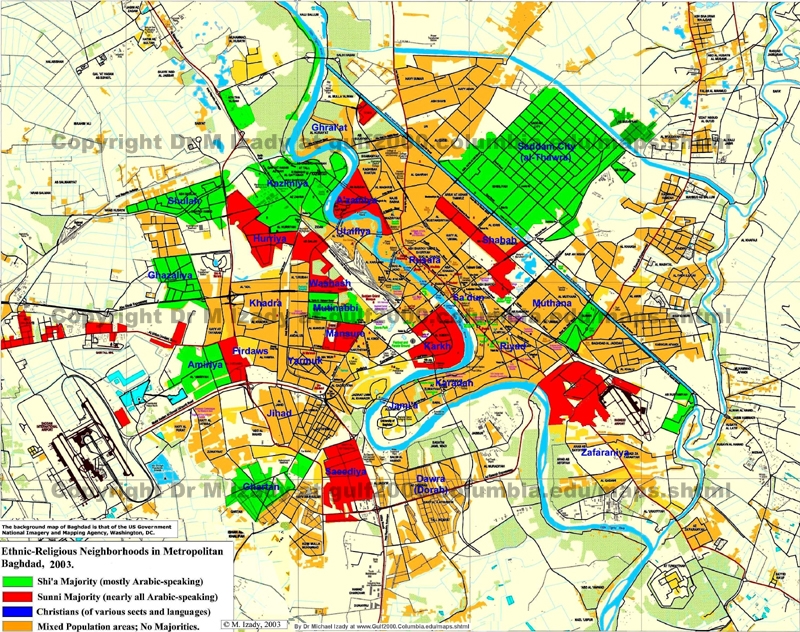
Izady’s first map is from 2003 when the U.S. invasion began. There were majority Sunni and Shiite areas peppered throughout Baghdad. Sadr City in northeast Baghdad was the largest and most well known Shiite area, but there were others such as Amiriya in the west by Baghdad Airport, Ghazaliya in the northwest by Abu Ghraib, and Shula and Kadhimiya in the north. Majority Sunni areas were Hurriya in the north, Washash, Mansur, and Karkh in the central region, Sadiya in the south, and Adhamiya on the eastern bank of the Tigris River. The majority of the capital however was mixed Sunni-Shiite, especially in the central, southern, and northeastern regions.
Baghdad 2003

Green – Shiite majority
Red – Sunni majority
Blue – Christian majority
Yellow – Mixed Sunni-Shiite
The next map skips ahead to 2006. The February bombing of the Shiite shrine at Samarra in Salahaddin province north of Baghdad in that year is credited as beginning of the sectarian war, and Moqtada al-Sadr’s Mahdi Army is largely blamed for carrying out most of the ethnic cleansing. In actuality, in 2005 the Supreme Islamic Iraqi Council’s Badr Brigade militia took over the Interior Ministry under the government of Prime Minister Ibrahim al-Jaafari, and began setting up death squads and carrying attacks on Sunnis. The Supreme Council also began pushing out Sunnis from the security forces, and replacing them with its followers. The activities of the Badr Brigade were exposed in late 2005 when U.S. forces came across a secret detention facility in the capital holding 169 abused prisoners, some of which were tortured. The Interior Minister Bayan Jabr, a Badr Brigade leader, tried to deny the seriousness of the find.
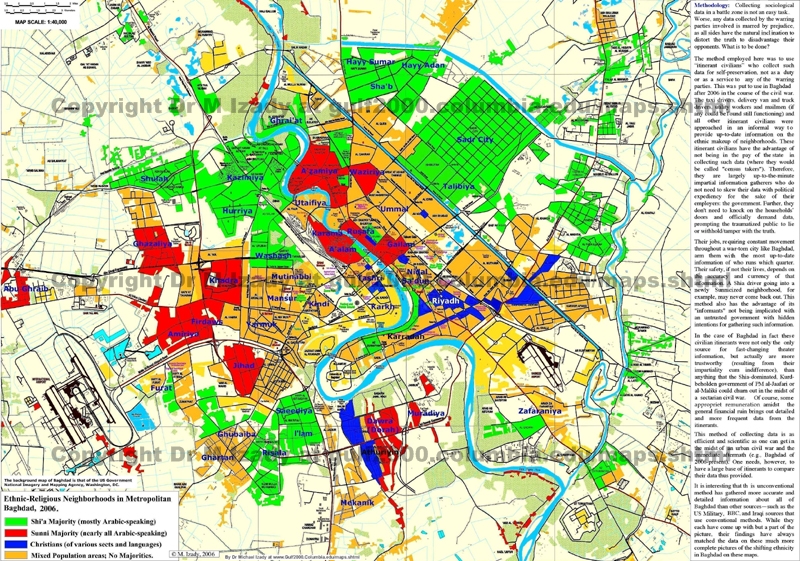
The 2006 map shows the first changes in the sectarian make-up of the city. These can be seen in the outskirts of the city. Sadiya in the south for example, and Hurriya and Washash on the west bank of the Tigris went from Sunni to Shiite majority. The three neighborhoods directly northwest of Sadr City, Hayy Aden, Sahab, and Hayy Sumer went from being mixed to Shiite. In turn, Amiriya in the west went from Shiite to Sunni, along with Ghazaliya above it, and Jihad went from mixed to Sunni to the south. Karkh in central Baghdad, which surrounds the Green Zone, also went from Sunni to mixed.
Baghdad 2006

Green – Shiite majority
Red – Sunni majority
Blue – Christian majority
Yellow – Mixed Sunni-Shiite
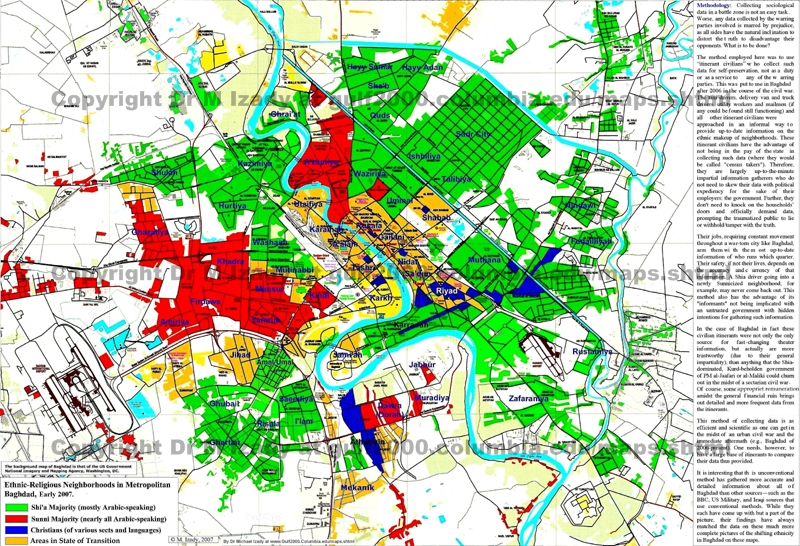
The third map covers early 2007. At that time the sectarian war was still going full throttle. For example, the Brookings Institution’s Iraq Index recorded 3,462 killed in November 2006, 2,914 in December, 3,500 in January 2009, 2,700 in February, and 2,400 in March. By that time the segregation of Baghdad was pretty much complete. Adhamiya was the last large Sunni majority neighborhood left in the western half of the capital. Most Sunnis were now concentrated in a strip of western neighborhoods including Kindi, Mansur, Yarmuk, Khadra, Amiriya, and Ghazaliya, along with a few southern district like Dora and Muradiya. Only central Baghdad around the Tigris River had large numbers of mixed areas left with the northwest, northeast, southwest, and southeast all Shiite majority now.
Baghdad Early 2007

Green – Shiite majority
Red – Sunni majority
Blue – Christian majority
Yellow – Mixed Sunni-Shiite
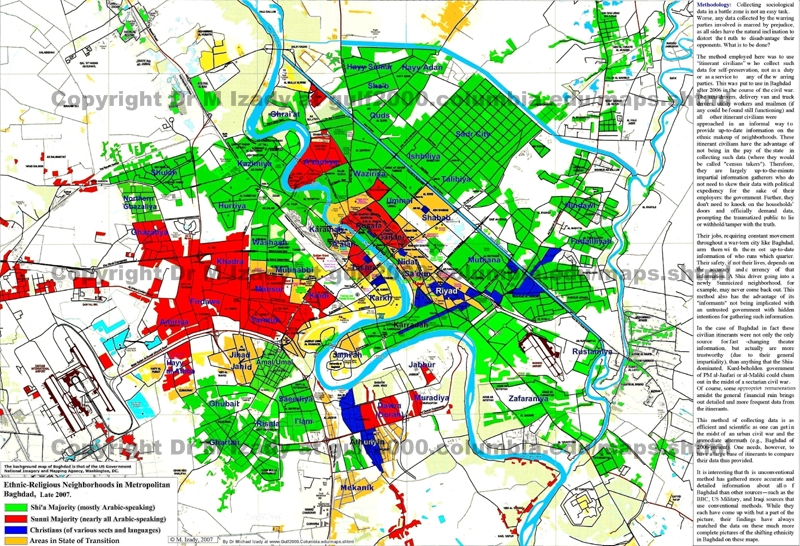
The fourth map is from late 2007. The only real change was along the west bank of the Tigris. There, the southern section of Adhamiya became Shiite, while Resaca and Gaitanis became Sunni majority. During that period, the sectarian fighting was petering out. The Iraq Index counted 1,100 deaths in September 2007; the last time it would record over one thousand deaths in a single month. After that there were 950 killed in October, and 750 in November and December each. The Surge had also led to blast walls being erected around many of the Sunni neighborhoods and the creation of the Sons of Iraq program where the majority of the Sunni insurgency gave up and switched sides to align with the Americans rather than face annihilation at the hands of the Shiite militias, Al Qaeda in Iraq, or the United States. Both of those policies solidified the segregation of Baghdad.
Baghdad Late 2007

Green – Shiite majority
Red – Sunni majority
Blue – Christian majority
Yellow – Mixed Sunni-Shiite
The last map is from mid-2008. There were very few changes by that time. The only noticeable ones were around the Riyad area that went from mixed to Shiite on the western bank of the Tigris across from the Green Zone. By 2008 the sectarian war was over, the insurgency was reduced to largely carrying out terrorist bombings and hit and run attacks, and deaths were dropping.
Baghdad Mid 2008

Green – Shiite majority
Red – Sunni majority
Blue – Christian majority
Yellow – Mixed Sunni-Shiite
Izady believes that the ethnic cleansing of Baghdad by the Shiite militias and the Sons of Iraq movement were the major reasons why the civil war ended. The Badr Brigade and Mahdi Army effectively removed most of the Sunnis to a western strip of the capital, while the Sons of Iraq signaled the collapse of the insurgency. The Surge didn’t fully get underway until mid-2007, and facilitated the reduction of violence and segregation that was already underway. Izady thinks much of the same for Sadr’s August 2007 cease-fire. Again, the fighting was already winding down by then, and Sadr never told his followers to disarm, and many factions had broken away or become Special Groups that were no longer following Sadr’s direction, so there were plenty of militiamen still active. There were just fewer Sunnis to target, and many militia cells turned to exploiting their own Shiite communities instead.
The BBC did a similar set of maps comparing pre-2006 Baghdad to 2007 based upon information from the International Medical Corps. It found a very similar pattern of Shiite expansion in the east and northwest, the vast reduction of mixed neighborhoods, and the concentration of Sunnis in the west. Many other students of the Surge attribute these same factors for the end of the civil war, but just put different emphasis on each point.
The one disputable point that Izady made in his interview with the International Relations and Security Network was when he said he believed that Sunnis were reduced to 12% of Iraq’s population because of the fighting. He said many became refugees in Syria and Jordan. While the exact percentage Sunnis made up of Iraq and Baghdad are disputed, a general number used in sources such as the CIA Factbook is around 30%. How much they made up of Baghdad before the U.S. invasion is an even harder figure to calculate. In the December 2005 national elections however, the Sunni Iraqi Accordance Front and Iraqi National Dialogue Front pulled 22.9% of the vote in the capital, while the Iraqi National List, even though led by a Shiite, former Prime Minister Ilyad Allawi, also draws strongly from Sunnis, got 13.4%. That’s roughly 30% of Baghdad as well. If Izady is to be believed than just over half of the Sunnis fled the country. In 2003 Iraq had a population of around 26 million, if 30% were Sunnis that would be roughly 7.8 million, half of which would be 3.9 million people. The United Nations estimates that there are only 2.5 million refugees however, not all of which are Sunnis. There are other sources that think that Sunnis were only 15-20% of all Iraqis, which would be approximately 3.9million-5.2 million. That would match the refugee numbers much more closely.
Izady’s maps are a valuable resource in charting the changes that Baghdad witnessed after the U.S. invasion. It was and remains the center of power and conflict in the country to this day. The Shiite militias undertook a concerted effort to push Sunnis out of parts of the city beginning in 2005, and largely succeeded as Izady’s graphics show. When the insurgency largely gave up and joined the Sons of Iraq, and the U.S. put up blast walls around many communities, those marked the effective end of the sectarian war. The result is a segregated and Shiite dominated capital, that in a way is symbolic of post-Saddam Iraq as there was displacement across the country, and the Shiite parties are now in firm control of the government, with no real threat from other sects.
SOURCES
BBC, “Baghdad: Mapping the violence,” 2007
CIA, Factbook
Guler, Claudio, “Baghdad Divided,” International Relations and Security Network, 11/9/09
Independent Electoral Commission of Iraq, “Legislation Election of 15 December 2005,” 2006
International Crisis Group, “Shiite Politics In Iraq: The Role Of The Supreme Council,” 11/15/07
Matthews, Dylan and Klein, Ezra, “How Important Was the Surge?” American Prospects, 7/28/08
Murphy, Dan, “New Iraqi leader seeks unity,” Christian Science Monitor, 4/24/06
O’Hanlon, Michael Campbell, Jason, “Iraq Index,” Brookings Institution, 8/20/09
Otterman, Sharon, “IRAQ: The Sunnis,” Council on Foreign Relations, 12/12/03
Wong, Edward, “U.S. Splits With Iraqi Official Over Prisoner Abuse,” New York Times, 11/17/05
Izady’s first map is from 2003 when the U.S. invasion began. There were majority Sunni and Shiite areas peppered throughout Baghdad. Sadr City in northeast Baghdad was the largest and most well known Shiite area, but there were others such as Amiriya in the west by Baghdad Airport, Ghazaliya in the northwest by Abu Ghraib, and Shula and Kadhimiya in the north. Majority Sunni areas were Hurriya in the north, Washash, Mansur, and Karkh in the central region, Sadiya in the south, and Adhamiya on the eastern bank of the Tigris River. The majority of the capital however was mixed Sunni-Shiite, especially in the central, southern, and northeastern regions.
Baghdad 2003
Green – Shiite majority
Red – Sunni majority
Blue – Christian majority
Yellow – Mixed Sunni-Shiite
The next map skips ahead to 2006. The February bombing of the Shiite shrine at Samarra in Salahaddin province north of Baghdad in that year is credited as beginning of the sectarian war, and Moqtada al-Sadr’s Mahdi Army is largely blamed for carrying out most of the ethnic cleansing. In actuality, in 2005 the Supreme Islamic Iraqi Council’s Badr Brigade militia took over the Interior Ministry under the government of Prime Minister Ibrahim al-Jaafari, and began setting up death squads and carrying attacks on Sunnis. The Supreme Council also began pushing out Sunnis from the security forces, and replacing them with its followers. The activities of the Badr Brigade were exposed in late 2005 when U.S. forces came across a secret detention facility in the capital holding 169 abused prisoners, some of which were tortured. The Interior Minister Bayan Jabr, a Badr Brigade leader, tried to deny the seriousness of the find.
The 2006 map shows the first changes in the sectarian make-up of the city. These can be seen in the outskirts of the city. Sadiya in the south for example, and Hurriya and Washash on the west bank of the Tigris went from Sunni to Shiite majority. The three neighborhoods directly northwest of Sadr City, Hayy Aden, Sahab, and Hayy Sumer went from being mixed to Shiite. In turn, Amiriya in the west went from Shiite to Sunni, along with Ghazaliya above it, and Jihad went from mixed to Sunni to the south. Karkh in central Baghdad, which surrounds the Green Zone, also went from Sunni to mixed.
Baghdad 2006
Green – Shiite majority
Red – Sunni majority
Blue – Christian majority
Yellow – Mixed Sunni-Shiite
The third map covers early 2007. At that time the sectarian war was still going full throttle. For example, the Brookings Institution’s Iraq Index recorded 3,462 killed in November 2006, 2,914 in December, 3,500 in January 2009, 2,700 in February, and 2,400 in March. By that time the segregation of Baghdad was pretty much complete. Adhamiya was the last large Sunni majority neighborhood left in the western half of the capital. Most Sunnis were now concentrated in a strip of western neighborhoods including Kindi, Mansur, Yarmuk, Khadra, Amiriya, and Ghazaliya, along with a few southern district like Dora and Muradiya. Only central Baghdad around the Tigris River had large numbers of mixed areas left with the northwest, northeast, southwest, and southeast all Shiite majority now.
Baghdad Early 2007
Green – Shiite majority
Red – Sunni majority
Blue – Christian majority
Yellow – Mixed Sunni-Shiite
The fourth map is from late 2007. The only real change was along the west bank of the Tigris. There, the southern section of Adhamiya became Shiite, while Resaca and Gaitanis became Sunni majority. During that period, the sectarian fighting was petering out. The Iraq Index counted 1,100 deaths in September 2007; the last time it would record over one thousand deaths in a single month. After that there were 950 killed in October, and 750 in November and December each. The Surge had also led to blast walls being erected around many of the Sunni neighborhoods and the creation of the Sons of Iraq program where the majority of the Sunni insurgency gave up and switched sides to align with the Americans rather than face annihilation at the hands of the Shiite militias, Al Qaeda in Iraq, or the United States. Both of those policies solidified the segregation of Baghdad.
Baghdad Late 2007
Green – Shiite majority
Red – Sunni majority
Blue – Christian majority
Yellow – Mixed Sunni-Shiite
The last map is from mid-2008. There were very few changes by that time. The only noticeable ones were around the Riyad area that went from mixed to Shiite on the western bank of the Tigris across from the Green Zone. By 2008 the sectarian war was over, the insurgency was reduced to largely carrying out terrorist bombings and hit and run attacks, and deaths were dropping.
Baghdad Mid 2008

Green – Shiite majority
Red – Sunni majority
Blue – Christian majority
Yellow – Mixed Sunni-Shiite
Izady believes that the ethnic cleansing of Baghdad by the Shiite militias and the Sons of Iraq movement were the major reasons why the civil war ended. The Badr Brigade and Mahdi Army effectively removed most of the Sunnis to a western strip of the capital, while the Sons of Iraq signaled the collapse of the insurgency. The Surge didn’t fully get underway until mid-2007, and facilitated the reduction of violence and segregation that was already underway. Izady thinks much of the same for Sadr’s August 2007 cease-fire. Again, the fighting was already winding down by then, and Sadr never told his followers to disarm, and many factions had broken away or become Special Groups that were no longer following Sadr’s direction, so there were plenty of militiamen still active. There were just fewer Sunnis to target, and many militia cells turned to exploiting their own Shiite communities instead.
The BBC did a similar set of maps comparing pre-2006 Baghdad to 2007 based upon information from the International Medical Corps. It found a very similar pattern of Shiite expansion in the east and northwest, the vast reduction of mixed neighborhoods, and the concentration of Sunnis in the west. Many other students of the Surge attribute these same factors for the end of the civil war, but just put different emphasis on each point.
The one disputable point that Izady made in his interview with the International Relations and Security Network was when he said he believed that Sunnis were reduced to 12% of Iraq’s population because of the fighting. He said many became refugees in Syria and Jordan. While the exact percentage Sunnis made up of Iraq and Baghdad are disputed, a general number used in sources such as the CIA Factbook is around 30%. How much they made up of Baghdad before the U.S. invasion is an even harder figure to calculate. In the December 2005 national elections however, the Sunni Iraqi Accordance Front and Iraqi National Dialogue Front pulled 22.9% of the vote in the capital, while the Iraqi National List, even though led by a Shiite, former Prime Minister Ilyad Allawi, also draws strongly from Sunnis, got 13.4%. That’s roughly 30% of Baghdad as well. If Izady is to be believed than just over half of the Sunnis fled the country. In 2003 Iraq had a population of around 26 million, if 30% were Sunnis that would be roughly 7.8 million, half of which would be 3.9 million people. The United Nations estimates that there are only 2.5 million refugees however, not all of which are Sunnis. There are other sources that think that Sunnis were only 15-20% of all Iraqis, which would be approximately 3.9million-5.2 million. That would match the refugee numbers much more closely.
Izady’s maps are a valuable resource in charting the changes that Baghdad witnessed after the U.S. invasion. It was and remains the center of power and conflict in the country to this day. The Shiite militias undertook a concerted effort to push Sunnis out of parts of the city beginning in 2005, and largely succeeded as Izady’s graphics show. When the insurgency largely gave up and joined the Sons of Iraq, and the U.S. put up blast walls around many communities, those marked the effective end of the sectarian war. The result is a segregated and Shiite dominated capital, that in a way is symbolic of post-Saddam Iraq as there was displacement across the country, and the Shiite parties are now in firm control of the government, with no real threat from other sects.
SOURCES
BBC, “Baghdad: Mapping the violence,” 2007
CIA, Factbook
Guler, Claudio, “Baghdad Divided,” International Relations and Security Network, 11/9/09
Independent Electoral Commission of Iraq, “Legislation Election of 15 December 2005,” 2006
International Crisis Group, “Shiite Politics In Iraq: The Role Of The Supreme Council,” 11/15/07
Matthews, Dylan and Klein, Ezra, “How Important Was the Surge?” American Prospects, 7/28/08
Murphy, Dan, “New Iraqi leader seeks unity,” Christian Science Monitor, 4/24/06
O’Hanlon, Michael Campbell, Jason, “Iraq Index,” Brookings Institution, 8/20/09
Otterman, Sharon, “IRAQ: The Sunnis,” Council on Foreign Relations, 12/12/03
Wong, Edward, “U.S. Splits With Iraqi Official Over Prisoner Abuse,” New York Times, 11/17/05
Wednesday, August 26, 2009
New Iraqi Survey On Security
The latest edition of the Pentagon’s Measuring Stability and Security In Iraq report to Congress includes a public opinion poll of Iraqis done in April 2009 on security. The results showed that Iraqis felt that security in their neighborhood was good, but that they had apprehensions about the rest of the country, and that the Iraqi Security Forces had widespread support.
A majority of respondents said they felt secure in their neighborhoods and provinces, but less so in Iraq in general. 76% said security was calm in their neighborhood, and 60% said the same about security in their province. 90% said that security was the same or better in their neighborhood over the last six months. These numbers were relatively unchanged since August 2008. When asked about Iraq in general however, only 31% said security was calm. This was a 10% increase from August 2008. In November 2007, 23% felt that security was calm in the country. When asked whether they felt safe traveling outside their neighborhood only 42% said yes, largely unchanged since November 2007 when 39% said yes. A majority however, 56%, said they felt that the country was stable. These numbers reflect the new status quo in Iraq. The sectarian war ended in 2007, and the crackdown against the Shiite militias was over by the fall of 2008. That has led to relative stability in most Iraqis’ lives. There is still violence though, which could be the reason why so many are unsure of the security situation across the entire country, and have reservations about leaving their immediate area.
Said security was calm in neighborhood
April 09 76%
Jan. 09 77%
Oct. 08 76%
Aug. 08 73%
Said security was same or better in neighborhood over last 6 months
April 09 90%
Jan. 09 90%
Oct. 08 89%
Aug. 09 91%
Nov. 07 82%
Said security in province was calm
April 09 60%
Jan. 09 57%
Oct. 08 57%
Said security in Iraq was calm
April 09 31%
Jan. 09 29%
Oct. 08 28%
Aug. 08 21%
Nov. 07 23%
Said security was the same or better in Iraq in last 6 months
April 09 86%
Jan. 09 86%
Oct. 08 79%
Nov. 07 81%
Said Iraq was stable
April 09 56%
Jan. 09 51%
Oct. 08 45%
Nov. 07 38%
Said felt safe traveling outside of neighborhood
April 09 42%
Jan. 09 42%
Oct. 08 42%
Aug. 08 37%
Nov. 07 39%
One of the main changes in the security situation in Iraq has been the increasing size and abilities of the Iraqi security forces to conduct day-to-day operations, and the public’s confidence in them. In all the questions about the Iraqi Army and police, respondents had positive views. The same could not be said of the U.S. military that seemed to be considered in low regard, and tribes, militias, and other groups were largely not considered relevant to providing security. 72% said they felt secure around the army, and 75% said they were winning the war against terrorists. In contrast, in November 2007 only 51% said they felt safe around the army, and 52% said they were winning. 66% said they felt secure around the police, and 65% said they were winning against crime. 79% responded that the either the army or police were responsible for security in their neighborhood. The security forces were also trusted more than the local, provincial or national governments. A major change between the April 2009 survey and the October 2008 one was the complete disappearance of trust in militias and armed groups. This is important not only for the development of the Iraqi forces, but for the U.S. withdrawal as well, as security will eventually be turned completely over to Baghdad’s control, and they need the support of the public to operate effectively.
Said they felt secure around Iraqi Army
April 09 72%
Jan. 09 70%
Oct. 08 65%
Nov. 07 51%
Said Iraqi Army was winning battle against terrorists
April 09 75%
Jan. 09 72%
Oct. 08 70%
Nov. 07 52%
Said felt secure around police
April 09 66%
Jan. 09 62%
Oct. 08 61%
Nov. 07 53%
Said police winning against crime
April 09 65%
Jan. 09 61%
Oct. 08 61%
Nov. 07 60%
Who was responsible for security in your neighborhood?
Police 40%
Army 39%
Tribes 6%
Sons of Iraq 3%
Neighbors 2%
Religious leaders 2%
U.S. 2%
Militias 0%
Who did you trust to protect you? – April 09
Army 87%
Police 83%
Provincial government 74%
National government 72%
Local government 66%
U.S. 27%
Who did you trust to protect you? – October 2008
Army 85%
Police 81%
Provincial government 68%
National government 66%
Local government 64%
U.S. 26%
Armed groups 12%
Militias 12%
The Pentagon’s April 2009 survey had roughly the same results as a poll conducted by the international news agencies the BBC, ABC, and Japan’s NHK from March 2009. Both groups found an overwhelming majority of Iraqis felt safe and secure in their neighborhoods, but had questions about the situation in the rest of the country. Respondents in both surveys also said they had confidence in the Iraqi security forces to do their jobs, and felt that they were winning. Both of these polls were taken before the recent wave of bombings however. While overall deaths have gone up and down, the constant attacks and publicity take a psychological toll and could change perceptions. Those create reality for people, and could change opinions about the security situation. If it does, the first victim could be Prime Minister Nouri al-Maliki who is running in the 2010 parliamentary election on the claim that he has brought security and stability to Iraq.
SOURCES
BBC, ABC, NHK, “Iraq Poll February 2009,” 3/16/09
Department of Defense, “Measuring Stability and Security in Iraq,” June 2009
- “Measuring Stability and Security in Iraq,” December 2008
- “Measuring Stability and Security in Iraq,” September 2008
A majority of respondents said they felt secure in their neighborhoods and provinces, but less so in Iraq in general. 76% said security was calm in their neighborhood, and 60% said the same about security in their province. 90% said that security was the same or better in their neighborhood over the last six months. These numbers were relatively unchanged since August 2008. When asked about Iraq in general however, only 31% said security was calm. This was a 10% increase from August 2008. In November 2007, 23% felt that security was calm in the country. When asked whether they felt safe traveling outside their neighborhood only 42% said yes, largely unchanged since November 2007 when 39% said yes. A majority however, 56%, said they felt that the country was stable. These numbers reflect the new status quo in Iraq. The sectarian war ended in 2007, and the crackdown against the Shiite militias was over by the fall of 2008. That has led to relative stability in most Iraqis’ lives. There is still violence though, which could be the reason why so many are unsure of the security situation across the entire country, and have reservations about leaving their immediate area.
Said security was calm in neighborhood
April 09 76%
Jan. 09 77%
Oct. 08 76%
Aug. 08 73%
Said security was same or better in neighborhood over last 6 months
April 09 90%
Jan. 09 90%
Oct. 08 89%
Aug. 09 91%
Nov. 07 82%
Said security in province was calm
April 09 60%
Jan. 09 57%
Oct. 08 57%
Said security in Iraq was calm
April 09 31%
Jan. 09 29%
Oct. 08 28%
Aug. 08 21%
Nov. 07 23%
Said security was the same or better in Iraq in last 6 months
April 09 86%
Jan. 09 86%
Oct. 08 79%
Nov. 07 81%
Said Iraq was stable
April 09 56%
Jan. 09 51%
Oct. 08 45%
Nov. 07 38%
Said felt safe traveling outside of neighborhood
April 09 42%
Jan. 09 42%
Oct. 08 42%
Aug. 08 37%
Nov. 07 39%
One of the main changes in the security situation in Iraq has been the increasing size and abilities of the Iraqi security forces to conduct day-to-day operations, and the public’s confidence in them. In all the questions about the Iraqi Army and police, respondents had positive views. The same could not be said of the U.S. military that seemed to be considered in low regard, and tribes, militias, and other groups were largely not considered relevant to providing security. 72% said they felt secure around the army, and 75% said they were winning the war against terrorists. In contrast, in November 2007 only 51% said they felt safe around the army, and 52% said they were winning. 66% said they felt secure around the police, and 65% said they were winning against crime. 79% responded that the either the army or police were responsible for security in their neighborhood. The security forces were also trusted more than the local, provincial or national governments. A major change between the April 2009 survey and the October 2008 one was the complete disappearance of trust in militias and armed groups. This is important not only for the development of the Iraqi forces, but for the U.S. withdrawal as well, as security will eventually be turned completely over to Baghdad’s control, and they need the support of the public to operate effectively.
Said they felt secure around Iraqi Army
April 09 72%
Jan. 09 70%
Oct. 08 65%
Nov. 07 51%
Said Iraqi Army was winning battle against terrorists
April 09 75%
Jan. 09 72%
Oct. 08 70%
Nov. 07 52%
Said felt secure around police
April 09 66%
Jan. 09 62%
Oct. 08 61%
Nov. 07 53%
Said police winning against crime
April 09 65%
Jan. 09 61%
Oct. 08 61%
Nov. 07 60%
Who was responsible for security in your neighborhood?
Police 40%
Army 39%
Tribes 6%
Sons of Iraq 3%
Neighbors 2%
Religious leaders 2%
U.S. 2%
Militias 0%
Who did you trust to protect you? – April 09
Army 87%
Police 83%
Provincial government 74%
National government 72%
Local government 66%
U.S. 27%
Who did you trust to protect you? – October 2008
Army 85%
Police 81%
Provincial government 68%
National government 66%
Local government 64%
U.S. 26%
Armed groups 12%
Militias 12%
The Pentagon’s April 2009 survey had roughly the same results as a poll conducted by the international news agencies the BBC, ABC, and Japan’s NHK from March 2009. Both groups found an overwhelming majority of Iraqis felt safe and secure in their neighborhoods, but had questions about the situation in the rest of the country. Respondents in both surveys also said they had confidence in the Iraqi security forces to do their jobs, and felt that they were winning. Both of these polls were taken before the recent wave of bombings however. While overall deaths have gone up and down, the constant attacks and publicity take a psychological toll and could change perceptions. Those create reality for people, and could change opinions about the security situation. If it does, the first victim could be Prime Minister Nouri al-Maliki who is running in the 2010 parliamentary election on the claim that he has brought security and stability to Iraq.
SOURCES
BBC, ABC, NHK, “Iraq Poll February 2009,” 3/16/09
Department of Defense, “Measuring Stability and Security in Iraq,” June 2009
- “Measuring Stability and Security in Iraq,” December 2008
- “Measuring Stability and Security in Iraq,” September 2008
Sunday, August 16, 2009
Centerpiece of Iraqi Army Maintenance System On Brink Of Failure
The new Defense Department quarterly report to Congress says that the Taji National Depot is the centerpiece of the maintenance and supply network for the Iraqi security forces. This is part of the American goal to make the Iraqi army and police self-sufficient so that they can carry out their own logistics and repair their own vehicles and equipment. The Pentagon claimed that the Iraqis have made progress at the tactical level in this field, but still need work at the strategic level. A recent memo by Col. Timothy Reese, the head of the U.S. advisory team in Baghdad stated that the Iraqi forces are institutionally incapable of becoming self-sufficient however. His opinion seems to be supported by two recent audits by the Special Inspector General for Iraq Reconstruction (SIGIR), the latest of which dealt with the Taji Depot.
In December 2007, the U.S. military signed a $350 million contract to build and develop the Taji National Maintenance Depot within two years. It was one of the largest contracts given out under the money appropriated for the Iraqi security forces. The contractor was to build the facilities, install the equipment, train Iraqis how to use them, and then eventually turn it over to Iraqi control by the end of 2009. When completed the Taji Depot was to be the main repair facility for the Iraqi forces.
This contract ran into two major problems. First, poor work and lack of supplies meant that many pieces of equipment were not installed, and some areas were unsafe to work in. The U.S. military was in charge of all supply orders, but couldn’t make timely deliveries. Today, the Taji facility is still waiting for parts and equipment to arrive. The U.S. has also failed miserably in providing manuals for the Iraqi students. Of the 115 manuals required for Taji, only two had been translated into Arabic. This obviously led to delays in the training of Iraqis, and the contractor was found to have set overly optimistic goals for how many could complete their lessons in the set amount of time. The company created a plan where Iraqi soldiers would first go to basic training, then spend two weeks in vocational classes, get one week off, return for four weeks of basic maintenance, then go on leave again, to return for the final 26 week, non-stop course. The Iraqi ministries however, never showed any commitment to supply the necessary soldiers to go through training. First, not all the soldiers assigned to Taji had completed basic training, and those who hadn’t were routinely pulled out to complete that task. Second, Iraqis couldn’t stick to the training schedule, and would often leave early before completing their lessons. 46% were said to be absent at any time, and most Iraqis only completed 12-13 weeks of the final 26-week course. More importantly the Iraqi security forces never sent enough soldiers to begin with. The depot dealing with tracked vehicles for example, only had 179 assigned students in July 2009 when 556 were required, and of those sent there, 45 were in basic training. Overall the U.S. military reported that as of July 2009 Taji only had 62% of its assigned Iraqi soldiers. Due to troops going to basic training however, only 33% of those were ever actually at the Taji Depot. The ministries would also sometimes pull soldiers out of the training program so that they could be sent on regular security duties. The contractor ended up trying to work around these problems to finish training, but was largely unsuccessful.
The result is that the Taji Depot is barely able to carry out its assigned tasks of maintaining the Iraqi security forces’ equipment. The U.S. military set a low rate goal, which is the minimum number of jobs the Iraqi Army is supposed to perform to show that they are proficient and productive. SIGIR found that only the low rate goal for transmissions on wheeled vehicles had been met, but even that had problems. The goal was 30 and that was accomplished, but of those, only 7 were tested good. Taji had a low rate goal of 500 jobs on the AK-47 rifle and none had been accomplished. The same thing was true for another rifle type. The low rate goal for the Humvee was 30, but only one of those had been completed.
SIGIR does not believe that the Iraqis will be able to maintain the Taji Depot once it’s turned over to their control on December 31, 2009. The Depot requires 1,037 skilled workers, but only 771 students had graduated by May 31, 2009. Of those, many were ranked as only marginally skilled because they had not completed all their courses. If the Iraqi government wanted enough troops to meet this goal, they would’ve had to send them to Taji by May 21 to start training. That obviously did not happen. Two Iraqi army officials said that the Iraqi military was not involved when the Americans decided to create the Taji Depot. They said it took a year before the U.S. really included the Iraqis in the process. This is a problem noted here before in the general American reconstruction effort in Iraq where the U.S. came in and built what they wanted, without ever really asking the Iraqis what they needed. At the same time, this audit, and another earlier one in April 2009 found that there was no commitment by Iraq to create a self-sufficient security force. Whether it was for maintenance, supply, transportation, or health services, the Iraqis never sent enough troops to go through training, those that did show up often left, and none were held responsible for not finishing. Again, this is similar to the overall experience the U.S. has had with rebuilding Iraq. There are millions of dollars worth of projects in Iraq that Baghdad didn’t want, and are either unwilling or incapable of running. In the end, the SIGIR and U.S. military are committed to turning over Taji at the end of 2009 no matter what. Unless Washington or Baghdad hires a contractor to run it afterwards, that will mean the centerpiece of the Iraqi forces maintenance program will operate at such a low level as to be almost completely useless.
SOURCES
Department of Defense, “Measuring Stability and Security in Iraq,” June 2009
Reese, Col. Timothy, “It’s Time for the US to Declare Victory and Go Home,” July 2009
Special Inspector General for Iraq Reconstruction, “Developing A Depot Maintenance Capability At Taji Hampered By Numerous Problems,” 7/30/09
- “Security Forces Logistics Contract Experienced Certain Cost, Outcome, and Oversight Problems,” 4/26/09
In December 2007, the U.S. military signed a $350 million contract to build and develop the Taji National Maintenance Depot within two years. It was one of the largest contracts given out under the money appropriated for the Iraqi security forces. The contractor was to build the facilities, install the equipment, train Iraqis how to use them, and then eventually turn it over to Iraqi control by the end of 2009. When completed the Taji Depot was to be the main repair facility for the Iraqi forces.
This contract ran into two major problems. First, poor work and lack of supplies meant that many pieces of equipment were not installed, and some areas were unsafe to work in. The U.S. military was in charge of all supply orders, but couldn’t make timely deliveries. Today, the Taji facility is still waiting for parts and equipment to arrive. The U.S. has also failed miserably in providing manuals for the Iraqi students. Of the 115 manuals required for Taji, only two had been translated into Arabic. This obviously led to delays in the training of Iraqis, and the contractor was found to have set overly optimistic goals for how many could complete their lessons in the set amount of time. The company created a plan where Iraqi soldiers would first go to basic training, then spend two weeks in vocational classes, get one week off, return for four weeks of basic maintenance, then go on leave again, to return for the final 26 week, non-stop course. The Iraqi ministries however, never showed any commitment to supply the necessary soldiers to go through training. First, not all the soldiers assigned to Taji had completed basic training, and those who hadn’t were routinely pulled out to complete that task. Second, Iraqis couldn’t stick to the training schedule, and would often leave early before completing their lessons. 46% were said to be absent at any time, and most Iraqis only completed 12-13 weeks of the final 26-week course. More importantly the Iraqi security forces never sent enough soldiers to begin with. The depot dealing with tracked vehicles for example, only had 179 assigned students in July 2009 when 556 were required, and of those sent there, 45 were in basic training. Overall the U.S. military reported that as of July 2009 Taji only had 62% of its assigned Iraqi soldiers. Due to troops going to basic training however, only 33% of those were ever actually at the Taji Depot. The ministries would also sometimes pull soldiers out of the training program so that they could be sent on regular security duties. The contractor ended up trying to work around these problems to finish training, but was largely unsuccessful.
The result is that the Taji Depot is barely able to carry out its assigned tasks of maintaining the Iraqi security forces’ equipment. The U.S. military set a low rate goal, which is the minimum number of jobs the Iraqi Army is supposed to perform to show that they are proficient and productive. SIGIR found that only the low rate goal for transmissions on wheeled vehicles had been met, but even that had problems. The goal was 30 and that was accomplished, but of those, only 7 were tested good. Taji had a low rate goal of 500 jobs on the AK-47 rifle and none had been accomplished. The same thing was true for another rifle type. The low rate goal for the Humvee was 30, but only one of those had been completed.
SIGIR does not believe that the Iraqis will be able to maintain the Taji Depot once it’s turned over to their control on December 31, 2009. The Depot requires 1,037 skilled workers, but only 771 students had graduated by May 31, 2009. Of those, many were ranked as only marginally skilled because they had not completed all their courses. If the Iraqi government wanted enough troops to meet this goal, they would’ve had to send them to Taji by May 21 to start training. That obviously did not happen. Two Iraqi army officials said that the Iraqi military was not involved when the Americans decided to create the Taji Depot. They said it took a year before the U.S. really included the Iraqis in the process. This is a problem noted here before in the general American reconstruction effort in Iraq where the U.S. came in and built what they wanted, without ever really asking the Iraqis what they needed. At the same time, this audit, and another earlier one in April 2009 found that there was no commitment by Iraq to create a self-sufficient security force. Whether it was for maintenance, supply, transportation, or health services, the Iraqis never sent enough troops to go through training, those that did show up often left, and none were held responsible for not finishing. Again, this is similar to the overall experience the U.S. has had with rebuilding Iraq. There are millions of dollars worth of projects in Iraq that Baghdad didn’t want, and are either unwilling or incapable of running. In the end, the SIGIR and U.S. military are committed to turning over Taji at the end of 2009 no matter what. Unless Washington or Baghdad hires a contractor to run it afterwards, that will mean the centerpiece of the Iraqi forces maintenance program will operate at such a low level as to be almost completely useless.
SOURCES
Department of Defense, “Measuring Stability and Security in Iraq,” June 2009
Reese, Col. Timothy, “It’s Time for the US to Declare Victory and Go Home,” July 2009
Special Inspector General for Iraq Reconstruction, “Developing A Depot Maintenance Capability At Taji Hampered By Numerous Problems,” 7/30/09
- “Security Forces Logistics Contract Experienced Certain Cost, Outcome, and Oversight Problems,” 4/26/09
Thursday, June 25, 2009
Iraqis Unwilling To Maintain Their Army
Nearly every official report on Iraq’s security forces notes that they do not have the ability to supply and support themselves. Few if any details however, are ever given on what exactly this means. In April 2009 the Special Inspector General for Iraq Reconstruction (SIGIR) conducted an audit on the U.S. military’s effort to build up the Iraqi Army’s logistics capabilities. The SIGIR found that the Iraqi Defense Ministry has refused to take responsibility of the maintenance program created by the Americans, has not sent soldiers to be trained in these duties, and that the Iraqi Army cannot operate independently as a result.
Beginning in early 2005 the U.S. command in Iraq began working on Iraq’s supply system. The goal was to allow the Iraqi Army to act autonomously without U.S. support. The program focused upon maintenance, supply, transportation, and health services. The plan has gone through six phases, two of which are still operating. In total the program has received $682.2 million in funding, $572.0 million of which has been spent. The orders for the plan were never clear, they have been changed 161 times, there was little oversight, and has not been supported by the Ministry of Defense. The result is that costs have increased $420.5 million, and are expected to go up an additional $60 million until the last order expires in January 2010.
The SIGIR audit focused upon Orders 3, 5 and 6. Order 3 was started in May 2005 and completed in June 2007. It set up ten maintenance facilities, one for each Iraqi Army division. The order was also to provide training for Iraqi soldiers so that they could operate the bases. Order 5 was a follow up to provide training and maintain the ten facilities. It was supposed to end on May 31, 2009, but has been extended to November 30, 2009. Order 6 was for maintenance on 8,500 HUMVEES that were transferred from the Americans forces to the Iraqis. It is due to expire on July 6, 2009, but will be extended until January 6, 2010.
The three orders have faced daunting challenges since they began. On the American side, the U.S. never assigned enough personnel to oversee the orders, which could have led to corruption and waste. Many of the benchmarks were unclear, changed, or never followed. For example, 80% of the Iraqi vehicles were to be operational at all times, but this was never enforced. Order 3 and 5 had no details on how they were to be evaluated as successful or not. The U.S. has also transferred eight of the 10 maintenance facilities to Iraqi control, despite the fact that the Defense Ministry has not accepted responsibility for them. There is no agreed upon process for the handover of these bases, yet they are happening anyway. The Iraqi Army also only sent one class of soldiers to be trained. Many of them lacked the education for the training. That is not uncommon. An on-going Iraqi Army audit has found that 24% of the force is not qualified for their jobs, and that 15% are illiterate. This is mostly blamed on the Americans drive to increase the security forces as quickly as possible, which emphasized quantity over quality. Most of the soldiers that did show up for training complained about not getting paid for weeks, and quit before they were finished. The Defense Ministry has not sent any new soldiers since then. That was the major reason why Order 5 was issued when Order 3 ended, and why the U.S. military is looking to extend Order 5 and 6 as well.
In the end, the Special Inspector General does not believe that the Iraqi Army has improved at all under this program. There is no evidence that the Iraqi forces are any more capable of maintaining their equipment now than when the plan began in 2005. The main reason is that the Defense Ministry has given no support to the effort at all. That leaves the Iraqi armed forces almost completely dependent upon the Americans for their logistics. The two existing programs have already been extended, and will probably be again and again until Baghdad does something about this problem. This will likely be another cause for the U.S. military and the Iraqi government to ask President Obama to maintain a residual force in Iraq after the December 31, 2010 deadline for all combat troops to be withdrawn from Iraq. The Iraqi security forces still don’t have the equipment to protect themselves from outside threats. The SIGIR audit shows that they can’t even sustain their counterinsurgency campaign without the Americans as well.
SOURCES
Arraf, Jane, “Iraqi Army: almost one-quarter lacks minimum qualifications,” Christian Science Monitor, 5/22/09
Department of Defense, “Measuring Stability and Security in Iraq,” March 2009
Special Inspector General for Iraq Reconstruction, “Quarterly Report to the United States Congress,” 4/30/09
- “Security Forces Logistics Contract Experienced Certain Cost, Outcome, and Oversight Problems,” 4/26/09
Beginning in early 2005 the U.S. command in Iraq began working on Iraq’s supply system. The goal was to allow the Iraqi Army to act autonomously without U.S. support. The program focused upon maintenance, supply, transportation, and health services. The plan has gone through six phases, two of which are still operating. In total the program has received $682.2 million in funding, $572.0 million of which has been spent. The orders for the plan were never clear, they have been changed 161 times, there was little oversight, and has not been supported by the Ministry of Defense. The result is that costs have increased $420.5 million, and are expected to go up an additional $60 million until the last order expires in January 2010.
The SIGIR audit focused upon Orders 3, 5 and 6. Order 3 was started in May 2005 and completed in June 2007. It set up ten maintenance facilities, one for each Iraqi Army division. The order was also to provide training for Iraqi soldiers so that they could operate the bases. Order 5 was a follow up to provide training and maintain the ten facilities. It was supposed to end on May 31, 2009, but has been extended to November 30, 2009. Order 6 was for maintenance on 8,500 HUMVEES that were transferred from the Americans forces to the Iraqis. It is due to expire on July 6, 2009, but will be extended until January 6, 2010.
The three orders have faced daunting challenges since they began. On the American side, the U.S. never assigned enough personnel to oversee the orders, which could have led to corruption and waste. Many of the benchmarks were unclear, changed, or never followed. For example, 80% of the Iraqi vehicles were to be operational at all times, but this was never enforced. Order 3 and 5 had no details on how they were to be evaluated as successful or not. The U.S. has also transferred eight of the 10 maintenance facilities to Iraqi control, despite the fact that the Defense Ministry has not accepted responsibility for them. There is no agreed upon process for the handover of these bases, yet they are happening anyway. The Iraqi Army also only sent one class of soldiers to be trained. Many of them lacked the education for the training. That is not uncommon. An on-going Iraqi Army audit has found that 24% of the force is not qualified for their jobs, and that 15% are illiterate. This is mostly blamed on the Americans drive to increase the security forces as quickly as possible, which emphasized quantity over quality. Most of the soldiers that did show up for training complained about not getting paid for weeks, and quit before they were finished. The Defense Ministry has not sent any new soldiers since then. That was the major reason why Order 5 was issued when Order 3 ended, and why the U.S. military is looking to extend Order 5 and 6 as well.
In the end, the Special Inspector General does not believe that the Iraqi Army has improved at all under this program. There is no evidence that the Iraqi forces are any more capable of maintaining their equipment now than when the plan began in 2005. The main reason is that the Defense Ministry has given no support to the effort at all. That leaves the Iraqi armed forces almost completely dependent upon the Americans for their logistics. The two existing programs have already been extended, and will probably be again and again until Baghdad does something about this problem. This will likely be another cause for the U.S. military and the Iraqi government to ask President Obama to maintain a residual force in Iraq after the December 31, 2010 deadline for all combat troops to be withdrawn from Iraq. The Iraqi security forces still don’t have the equipment to protect themselves from outside threats. The SIGIR audit shows that they can’t even sustain their counterinsurgency campaign without the Americans as well.
SOURCES
Arraf, Jane, “Iraqi Army: almost one-quarter lacks minimum qualifications,” Christian Science Monitor, 5/22/09
Department of Defense, “Measuring Stability and Security in Iraq,” March 2009
Special Inspector General for Iraq Reconstruction, “Quarterly Report to the United States Congress,” 4/30/09
- “Security Forces Logistics Contract Experienced Certain Cost, Outcome, and Oversight Problems,” 4/26/09
Thursday, June 18, 2009
Britain Withdraws Combat Troops But Trainers Remain, Could This Be A Blueprint For The U.S.?
On December 23, 2008 Iraq’s parliament passed a bill allowing England and several other members of the Coalition of the Willing to stay in the country until July 2009. The English command set May 31, 2009 as the date they would actually have all combat troops out, and began a quick turnover of facilities to the Iraqis and Americans. With that achieved, London went on to sign an agreement with Baghdad to allow trainers to stay for one more year. Could this be what the U.S. will do when its deadline for withdrawal comes?
Beginning in January 2009, Britain began its pull out from Iraq. Originally 26,000 British took part in the 2003 invasion. That was quickly drawn down to 18,000 by the end of May 2003. A year later there were 8,600, and then 5,500 by May 2007. At the end of 2008 there were around 4,000 English troops still in Iraq. On January 1, 2009 Britain turned over Basra airport to the Iraqis. English troops would remain on the military side of the facility however. By the middle of February it was announced that all of its heavy equipment had been shipped back to England. On March 31, England handed over command of Basra to the Americans. 7,000 U.S. soldiers also moved into Basra to take over many of the jobs the British had previously been doing. At the end of April the English announced that all their combat operations were over. Finally May 31 arrived and all combat troops were pulled out. Within two days London negotiated a deal with Baghdad to allow just under 100 British sailors and five ships to remain in Basra to train the fledgling Iraqi Navy for one-year past the withdrawal deadline.
The Iraq Navy is a small, undermanned, and under equipped force. As of January 2009 there were only 1,898 in the Navy. They are authorized to have 3,596. At the beginning of this year they received 44 small craft, but they lack the personnel, knowledge, and leadership to man all of them. They also have no major ships, although they are to receive two from Italy this year. The British are the main advisors to the Iraqi Navy. Besides the troops in Basra, they have also taken Iraqis to England for further training.
Could the Americans repeat England’s recent experience in Iraq? The British drew down their troops, declared combat operations over, met their deadline to be out by May 2009, and then signed a new agreement to keep trainers in the country for another year. Like the British, the U.S. has also set the end of 2011 as the date that it will be out of Iraq. As reported before, by that time the Iraqi security forces will not be ready to protect the country from external threats. The Iraqi Navy is a perfect example of that as it lacks the personnel and ships to carry out that task right now. When December 31, 2011 approaches then, it’s very likely that both the U.S. and Iraqi military will put pressure on the Obama administration to maintain some kind of U.S. presence in Iraq. It will be up the President then to decide whether keeping perhaps several thousand American advisors in Iraq will break his promise to be out of the country in sixteen months of taking office.
SOURCES
Agence France Presse, “Iraq and Britain agree draft naval deal,” 6/3/09
Ashton, Adam and Hammoudi, Laith, “What are ‘combat troops’? Iraq withdrawal depends on answer,” McClatchy Newspapers, 12/23/08
Aswat al-Iraq, “Britain hands over Basra airport to Iraqi authorities,” 1/1/09
Cordesman, Anthony, “How Soon Is Safe? Iraqi Force Development and ‘Conditions-Based’ US Withdrawals,” 4/20/09
Department of Defense, “Measuring Stability and Security in Iraq,” March 2009
Evans, Michael, “Basra gets better beds and burgers as US takes over from the British,” Times of London, 2/16/09
The National, “British military operations end in Iraq,” 4/30/09
Robertson, Campbell and Cowell, Alan, “U.S. Takes Over as Britain Begins Basra Pullout,” New York Times, 4/1/09
Special Inspector General for Iraq Reconstruction, “Quarterly Report to the United States Congress,” 4/30/09
Times of London, “Q&A: Iraq inquiry,” 3/26/09
Beginning in January 2009, Britain began its pull out from Iraq. Originally 26,000 British took part in the 2003 invasion. That was quickly drawn down to 18,000 by the end of May 2003. A year later there were 8,600, and then 5,500 by May 2007. At the end of 2008 there were around 4,000 English troops still in Iraq. On January 1, 2009 Britain turned over Basra airport to the Iraqis. English troops would remain on the military side of the facility however. By the middle of February it was announced that all of its heavy equipment had been shipped back to England. On March 31, England handed over command of Basra to the Americans. 7,000 U.S. soldiers also moved into Basra to take over many of the jobs the British had previously been doing. At the end of April the English announced that all their combat operations were over. Finally May 31 arrived and all combat troops were pulled out. Within two days London negotiated a deal with Baghdad to allow just under 100 British sailors and five ships to remain in Basra to train the fledgling Iraqi Navy for one-year past the withdrawal deadline.
The Iraq Navy is a small, undermanned, and under equipped force. As of January 2009 there were only 1,898 in the Navy. They are authorized to have 3,596. At the beginning of this year they received 44 small craft, but they lack the personnel, knowledge, and leadership to man all of them. They also have no major ships, although they are to receive two from Italy this year. The British are the main advisors to the Iraqi Navy. Besides the troops in Basra, they have also taken Iraqis to England for further training.
Could the Americans repeat England’s recent experience in Iraq? The British drew down their troops, declared combat operations over, met their deadline to be out by May 2009, and then signed a new agreement to keep trainers in the country for another year. Like the British, the U.S. has also set the end of 2011 as the date that it will be out of Iraq. As reported before, by that time the Iraqi security forces will not be ready to protect the country from external threats. The Iraqi Navy is a perfect example of that as it lacks the personnel and ships to carry out that task right now. When December 31, 2011 approaches then, it’s very likely that both the U.S. and Iraqi military will put pressure on the Obama administration to maintain some kind of U.S. presence in Iraq. It will be up the President then to decide whether keeping perhaps several thousand American advisors in Iraq will break his promise to be out of the country in sixteen months of taking office.
SOURCES
Agence France Presse, “Iraq and Britain agree draft naval deal,” 6/3/09
Ashton, Adam and Hammoudi, Laith, “What are ‘combat troops’? Iraq withdrawal depends on answer,” McClatchy Newspapers, 12/23/08
Aswat al-Iraq, “Britain hands over Basra airport to Iraqi authorities,” 1/1/09
Cordesman, Anthony, “How Soon Is Safe? Iraqi Force Development and ‘Conditions-Based’ US Withdrawals,” 4/20/09
Department of Defense, “Measuring Stability and Security in Iraq,” March 2009
Evans, Michael, “Basra gets better beds and burgers as US takes over from the British,” Times of London, 2/16/09
The National, “British military operations end in Iraq,” 4/30/09
Robertson, Campbell and Cowell, Alan, “U.S. Takes Over as Britain Begins Basra Pullout,” New York Times, 4/1/09
Special Inspector General for Iraq Reconstruction, “Quarterly Report to the United States Congress,” 4/30/09
Times of London, “Q&A: Iraq inquiry,” 3/26/09
Wednesday, June 10, 2009
U.S. Reconstruction In Iraq Coming To An End
U.S. reconstruction in Iraq is coming to an end. The effort to rebuild the country following the 2003 invasion was the largest in American history, with the U.S. budgeting $51 billion for the project. That amount has almost all been spent, and no new large outlays are expected in the future, especially with the U.S. planning on withdrawing. The Special Inspector General for Iraq Reconstruction (SIGIR) believes that most of this money failed to achieve its goals. While the Iraqi security forces were successfully reconstituted, the larger goal of boosting services and the economy of Iraq failed.
Since March 2003 the U.S. has promised $51.0 billion for reconstruction in Iraq. $24.43 billion was for security, and $26.57 for the economy, government, and services. $42.16 billion of the total amount has been obligated for projects, while $37.89 billion was actually spent. Of the remaining $3.01 billion in unspent funds, $2.82 billion is for the Iraqi armed forces and police. The new Obama administration has asked for an additional $700 million, $449 million of which is supposed to go to reconstruction. The White House did not ask for any new money for the Iraqi security forces. Instead, the President wants to extend $1 billion in bridge funds left over from 2008 for that purpose.
The American program was originally aimed at rebuilding Iraq’s infrastructure and building a democracy, but as violence rose in the country, more and more money was appropriated for security. By April 2009 the Iraqi security forces took almost half of the funding at $24.43 billion compared to $11.82 billion for infrastructure like electricity, oil, gas, water, sanitation, transportation, and communications. The SIGIR reported that the rise in attacks in Iraq derailed much of the reconstruction program, delaying projects and adding additional costs.
The U.S. program has not been without success. The one area that the SIGIR believes has seen the best effort is the rebuilding of the Iraqi security forces. They now stand at over 700,000 strong. The Americans have also added 1.2 million cubic meters of sewage treatment capacity, brought up water production to 2.4 million cubic meters of potable water per day, and for three straight quarters electricity production has gone up. Power output is now higher than pre-invasion levels. The problem is since the overthrow of Saddam, demand for services has skyrocketed amongst Iraqis, and the U.S.-funded increases have not kept up. Only around 25% of Iraqis polled say they were satisfied with the sewage system for example.
Today, U.S.-reconstruction is coming to an end, leaving Iraq increasingly in charge. There are no current oil projects on-line for example. There is still $224.39 million going to be spent on electricity however. Now the Iraqi government is the largest source of funding for rebuilding. Its capital budget used for investment has recently gone down from $13.1 billion in 2008 to $12.7 billion this year. Iraq has also never been able to spend all of its money, like the Electricity Ministry that only spent 12% of its budget last year.
Now that Iraqis are taking control, transferring projects is becoming an issue. An April 26, 2009 SIGIR audit found that the U.S. had been turning over projects to Iraqis with no unified plan or process. Many are given to the Iraqi government whether they can handle them or not. Most transfers are also done at the local level, and the information is not passed up to Baghdad or Washington. Of $13.5 billion in projects studied by SIGIR, 72% were handed over to local authorities, and only 13% to the central government. That means neither government has a real idea on what has been done so far. Some of these projects were not even wanted by the Iraqis, and were left unused or were not maintained. The Iraqis in general also don’t have the experience or training in much of the equipment installed by the Americans. For instance, examinations of Iraqi health care facilities found that gear wasn’t always installed and Iraqis didn’t always know how to operate them. The SIGIR is worried that this will mean much of the U.S. investment will be wasted. The U.S. is trying to address this by spending $313.7 million on training and spare parts. That still doesn’t address the larger issue of how the Iraqis will take control of the thousands of projects built by the Americans.
In its review of the U.S. reconstruction effort, the SIGIR believes that much of the U.S. reconstruction project has failed. Iraqis are largely unhappy with the state of the economy, services, and government. Production of many services such as electricity is higher than under Saddam, but it’s only meeting a fraction of demand. The main problem was the lack of security, which was not planned for. That derailed and delayed much of the work. Violence also shifted the focus of the Americans to the point that the security forces received just as much money as building up the economy and government combined. The U.S. also tended to impose their views of what Iraq should have, rather than asking Iraqis what they wanted. Many of the large infrastructure projects therefore were not used properly, left to break down, or were never wanted. Some of the $51 billion budgeted for Iraq has gone to good work, especially the money appropriated by U.S. commanders to local Iraqis. The larger projects however are more of a mixed bag.
Total Outlays By U.S.
Security - $24.43 billion
$21.18 billion obligated
$18.58 billion expended
$3.24 billion unspent
$6.84 billion for equipment and transportation
$5.79 billion for infrastructure
$5.67 billion for training and operations
$2.42 billion for sustainment
$1.72 billion for rule of law
$1.0 billion for other
Infrastructure - $11.82 billion
$11.41 billion obligated
$10.86 billion expended
$553 million unspent
Infrastructure – Electricity - $5.09 billion
$4.98 billion obligated
$4.75 billion spent
Infrastructure – Water and Sanitation - $2.25 billion
$2.17 billion obligated
$2.01 billion spent
Infrastructure – Oil and Gas - $2.05 billion
$1.93 billion obligated
$1.88 billion spent
Infrastructure – Other - $1.31 billion
Infrastructure – Transportation and Communication - $1.12 billion
$1.09 billion obligated
$965 million spent
Governance - $7.02 billion
$5.64 billion spent
$2.38 billion obligated for capacity development
$1.92 billion obligated for democracy and civil society
$1.88 billion obligated for public services
$0.81 billion obligated for humanitarian relief
Economy - $1.47 billion
$1.25 billion spent
SOURCES
Special Inspector General for Iraq Reconstruction, “Asset-Transfer Process for Iraq Reconstruction Projects Lacks Unity and Accountability,” 4/26/09
- “Hard Lessons,” 1/22/09
- “Quarterly Report to the United States Congress,” 4/30/09
Since March 2003 the U.S. has promised $51.0 billion for reconstruction in Iraq. $24.43 billion was for security, and $26.57 for the economy, government, and services. $42.16 billion of the total amount has been obligated for projects, while $37.89 billion was actually spent. Of the remaining $3.01 billion in unspent funds, $2.82 billion is for the Iraqi armed forces and police. The new Obama administration has asked for an additional $700 million, $449 million of which is supposed to go to reconstruction. The White House did not ask for any new money for the Iraqi security forces. Instead, the President wants to extend $1 billion in bridge funds left over from 2008 for that purpose.
The American program was originally aimed at rebuilding Iraq’s infrastructure and building a democracy, but as violence rose in the country, more and more money was appropriated for security. By April 2009 the Iraqi security forces took almost half of the funding at $24.43 billion compared to $11.82 billion for infrastructure like electricity, oil, gas, water, sanitation, transportation, and communications. The SIGIR reported that the rise in attacks in Iraq derailed much of the reconstruction program, delaying projects and adding additional costs.
The U.S. program has not been without success. The one area that the SIGIR believes has seen the best effort is the rebuilding of the Iraqi security forces. They now stand at over 700,000 strong. The Americans have also added 1.2 million cubic meters of sewage treatment capacity, brought up water production to 2.4 million cubic meters of potable water per day, and for three straight quarters electricity production has gone up. Power output is now higher than pre-invasion levels. The problem is since the overthrow of Saddam, demand for services has skyrocketed amongst Iraqis, and the U.S.-funded increases have not kept up. Only around 25% of Iraqis polled say they were satisfied with the sewage system for example.
Today, U.S.-reconstruction is coming to an end, leaving Iraq increasingly in charge. There are no current oil projects on-line for example. There is still $224.39 million going to be spent on electricity however. Now the Iraqi government is the largest source of funding for rebuilding. Its capital budget used for investment has recently gone down from $13.1 billion in 2008 to $12.7 billion this year. Iraq has also never been able to spend all of its money, like the Electricity Ministry that only spent 12% of its budget last year.
Now that Iraqis are taking control, transferring projects is becoming an issue. An April 26, 2009 SIGIR audit found that the U.S. had been turning over projects to Iraqis with no unified plan or process. Many are given to the Iraqi government whether they can handle them or not. Most transfers are also done at the local level, and the information is not passed up to Baghdad or Washington. Of $13.5 billion in projects studied by SIGIR, 72% were handed over to local authorities, and only 13% to the central government. That means neither government has a real idea on what has been done so far. Some of these projects were not even wanted by the Iraqis, and were left unused or were not maintained. The Iraqis in general also don’t have the experience or training in much of the equipment installed by the Americans. For instance, examinations of Iraqi health care facilities found that gear wasn’t always installed and Iraqis didn’t always know how to operate them. The SIGIR is worried that this will mean much of the U.S. investment will be wasted. The U.S. is trying to address this by spending $313.7 million on training and spare parts. That still doesn’t address the larger issue of how the Iraqis will take control of the thousands of projects built by the Americans.
In its review of the U.S. reconstruction effort, the SIGIR believes that much of the U.S. reconstruction project has failed. Iraqis are largely unhappy with the state of the economy, services, and government. Production of many services such as electricity is higher than under Saddam, but it’s only meeting a fraction of demand. The main problem was the lack of security, which was not planned for. That derailed and delayed much of the work. Violence also shifted the focus of the Americans to the point that the security forces received just as much money as building up the economy and government combined. The U.S. also tended to impose their views of what Iraq should have, rather than asking Iraqis what they wanted. Many of the large infrastructure projects therefore were not used properly, left to break down, or were never wanted. Some of the $51 billion budgeted for Iraq has gone to good work, especially the money appropriated by U.S. commanders to local Iraqis. The larger projects however are more of a mixed bag.
Total Outlays By U.S.
Security - $24.43 billion
$21.18 billion obligated
$18.58 billion expended
$3.24 billion unspent
$6.84 billion for equipment and transportation
$5.79 billion for infrastructure
$5.67 billion for training and operations
$2.42 billion for sustainment
$1.72 billion for rule of law
$1.0 billion for other
Infrastructure - $11.82 billion
$11.41 billion obligated
$10.86 billion expended
$553 million unspent
Infrastructure – Electricity - $5.09 billion
$4.98 billion obligated
$4.75 billion spent
Infrastructure – Water and Sanitation - $2.25 billion
$2.17 billion obligated
$2.01 billion spent
Infrastructure – Oil and Gas - $2.05 billion
$1.93 billion obligated
$1.88 billion spent
Infrastructure – Other - $1.31 billion
Infrastructure – Transportation and Communication - $1.12 billion
$1.09 billion obligated
$965 million spent
Governance - $7.02 billion
$5.64 billion spent
$2.38 billion obligated for capacity development
$1.92 billion obligated for democracy and civil society
$1.88 billion obligated for public services
$0.81 billion obligated for humanitarian relief
Economy - $1.47 billion
$1.25 billion spent
SOURCES
Special Inspector General for Iraq Reconstruction, “Asset-Transfer Process for Iraq Reconstruction Projects Lacks Unity and Accountability,” 4/26/09
- “Hard Lessons,” 1/22/09
- “Quarterly Report to the United States Congress,” 4/30/09
Thursday, June 04, 2009
How Long Will The U.S. Be In Iraq?
In late May 2009 General George Casey, the U.S. Army Chief of Staff said that the United States could be in Iraq for the next ten years. American forces could actually stay longer. Under the Status of Forces Agreement (SOFA) U.S. troops are to be out of Iraq by the end of 2011. Iraq’s security forces however, will not be able to defend the country by then, most likely leading Baghdad to ask the U.S. to leave behind a residual force to protect Iraq from external threats until the government is able to fulfill its duties.
At the end of February 2009 President Barak Obama announced his withdrawal plan from Iraq. He said that the U.S. drawdown would follow the SOFA signed between the Bush White House and Baghdad. That called for U.S. combat troops to be out of Iraq’s cities and towns by June 30, 2009. They would then relocate to major bases, some of which are going to be conveniently designated outside of city borders like Camp Victory and Forward Operation Base Falcon, both within Baghdad. There are also plans for Prime Minister Nouri al-Maliki’s government to ask the U.S. to stay in selected joint security stations in the capital, Mosul, and perhaps a few other cities. U.S. forces would then go down from about 140,000 to 128,000 by September 2009. They would stay at that level until Iraq’s parliamentary elections are completed. Originally those were planned for the end of this year, but have now been pushed back to January 30, 2010. Based upon conditions in Iraq, Americans troops would then go down to around 50,000 by the end of August 2010, but that now may be delayed because of the change in schedule for the balloting. The 50,000 would be tasked with advising Iraqi troops, conducting anti-terrorist operations, providing security to U.S. civilians and reconstruction teams, as well as protecting supply convoys. By December 31, 2011 those remaining troops are to be withdrawn. There is one major problem with this plan, Iraqi forces will not be able to protect the country by that date.
The Iraqi army and police have gone through a massive expansion, but still have many years to go. There are now 725,691 in the Iraqi security forces. Their development has been uneven, and there are still plenty of problems to overcome. One of the most important is the fact that the armed forces do not have the heavy weapons such as jetfighters, artillery, and boats, to defend the country from external threats. Originally, the Iraqi Defense Ministry had pegged 2020 as the date they would be capable of national defense. However, because of the country’s financial problems with the drop in oil prices these ideas have now been put on hold. There will be no expansion of the Iraqi Army or major purchases of weapons this year. The Iraqi Air Force wanted to buy 96 F-16 fighters from the United States by 2020. Baghdad doesn’t have the money for that. They don’t even have the funds to maintain what they have now. The U.S. donated 5,000 Humvees to the Iraqi forces, and are expected to turn over another 4,000 as part of the withdrawal. The Americans told the Defense Ministry that they needed $68 million for spare parts to keep up these vehicles, but only $1 million was appropriated. The Iraqis are salvaging spare parts from broken down Humvees to keep others still running as a result.
President Obama and the Iraqi government will have the ultimate decision as to whether the U.S. will stay past 2011. The President has said he doesn’t plan on asking Iraq to let the Americans stay after that deadline, but at the same time he has been very open to the advice of his military commanders. When deciding on the withdrawal timeline he picked the middle path between his promise of getting U.S. troops out in 16 months and the U.S. military command in Iraq’s wish to take 23 months. It would be hard to believe that they won’t advocate staying longer in Iraq if the government can’t protect its air, sea, and borders yet. Baghdad is said to have a similar opinion. Many things can happen between now and 2011, but the way it stands now it looks like the U.S. will be in Iraq for several more years after that date.
SOURCES
Adas, Basil, “US launches plan to boost Iraqi army’s capability,” Gulf News, 9/24/08
Agence France Presse, “Iraq sets election date,” 5/18/09
Ahmed, Hamid, “Iraqi leader calls for anti-corruption campaign,” Associated Press, 5/9/09
Alsumaria, “Iraq to purchase F-16 fighters this year,” 4/1/09
Arraf, Jane, “Can Iraq go it alone?” Christian Science Monitor, 4/21/09
- “Iraqi Army: almost one-quarter lacks minimum qualifications,” Christian Science Monitor, 5/22/09b
- “To meet June deadline, US and Iraqis redraw city borders,” Christian Science Monitor, 5/19/09
Associated Press, “Army chief: U.S. troops could be in Iraq for 10 years,” 5/27/09
Barnes, Julian, “Compromise on Iraq withdrawal timeline appears near,” Los Angeles Times, 2/25/09
- “Obama sees most troops out of Iraq by Aug. 31, 2010,” Los Angeles Times, 2/28/09
BBC, “Iraq sets election date of January 2010,” 5/18/09
Carter, Chelsea, “New threat for Iraqi military: Drop in oil prices,” Associated Press, 5/13/09
Cloud, David, “Inside Obama’s Iraq decision,” Politico, 2/27/09
Haynes, Deborah, “Kurdish Prime Minister predicts US troops will remain in Iraq until 2020,” Times of London, 10/24/08
Londono, Ernesto, “Plunging Oil Prices Force Iraq to Cut Security Jobs,” Washington Post, 5/18/09
Missing Links Blog, “Iraqi forces to be ready by the year 2020, according to plan,” 8/11/08
Nordland, Rod, “Exceptions to Iraq Deadline Are Proposed,” New York Times, 4/27/09
Shanker, Thom, “Minister Sees Need for U.S. Help in Iraq Until 2018,” New York Times, 1/15/08
Special Inspector General for Iraq Reconstruction, “Quarterly Report to the United States Congress,” 4/30/09
United States Government Accountability Office, “IRAQ Key Issues for Congressional Oversight,” March 2009
At the end of February 2009 President Barak Obama announced his withdrawal plan from Iraq. He said that the U.S. drawdown would follow the SOFA signed between the Bush White House and Baghdad. That called for U.S. combat troops to be out of Iraq’s cities and towns by June 30, 2009. They would then relocate to major bases, some of which are going to be conveniently designated outside of city borders like Camp Victory and Forward Operation Base Falcon, both within Baghdad. There are also plans for Prime Minister Nouri al-Maliki’s government to ask the U.S. to stay in selected joint security stations in the capital, Mosul, and perhaps a few other cities. U.S. forces would then go down from about 140,000 to 128,000 by September 2009. They would stay at that level until Iraq’s parliamentary elections are completed. Originally those were planned for the end of this year, but have now been pushed back to January 30, 2010. Based upon conditions in Iraq, Americans troops would then go down to around 50,000 by the end of August 2010, but that now may be delayed because of the change in schedule for the balloting. The 50,000 would be tasked with advising Iraqi troops, conducting anti-terrorist operations, providing security to U.S. civilians and reconstruction teams, as well as protecting supply convoys. By December 31, 2011 those remaining troops are to be withdrawn. There is one major problem with this plan, Iraqi forces will not be able to protect the country by that date.
The Iraqi army and police have gone through a massive expansion, but still have many years to go. There are now 725,691 in the Iraqi security forces. Their development has been uneven, and there are still plenty of problems to overcome. One of the most important is the fact that the armed forces do not have the heavy weapons such as jetfighters, artillery, and boats, to defend the country from external threats. Originally, the Iraqi Defense Ministry had pegged 2020 as the date they would be capable of national defense. However, because of the country’s financial problems with the drop in oil prices these ideas have now been put on hold. There will be no expansion of the Iraqi Army or major purchases of weapons this year. The Iraqi Air Force wanted to buy 96 F-16 fighters from the United States by 2020. Baghdad doesn’t have the money for that. They don’t even have the funds to maintain what they have now. The U.S. donated 5,000 Humvees to the Iraqi forces, and are expected to turn over another 4,000 as part of the withdrawal. The Americans told the Defense Ministry that they needed $68 million for spare parts to keep up these vehicles, but only $1 million was appropriated. The Iraqis are salvaging spare parts from broken down Humvees to keep others still running as a result.
President Obama and the Iraqi government will have the ultimate decision as to whether the U.S. will stay past 2011. The President has said he doesn’t plan on asking Iraq to let the Americans stay after that deadline, but at the same time he has been very open to the advice of his military commanders. When deciding on the withdrawal timeline he picked the middle path between his promise of getting U.S. troops out in 16 months and the U.S. military command in Iraq’s wish to take 23 months. It would be hard to believe that they won’t advocate staying longer in Iraq if the government can’t protect its air, sea, and borders yet. Baghdad is said to have a similar opinion. Many things can happen between now and 2011, but the way it stands now it looks like the U.S. will be in Iraq for several more years after that date.
SOURCES
Adas, Basil, “US launches plan to boost Iraqi army’s capability,” Gulf News, 9/24/08
Agence France Presse, “Iraq sets election date,” 5/18/09
Ahmed, Hamid, “Iraqi leader calls for anti-corruption campaign,” Associated Press, 5/9/09
Alsumaria, “Iraq to purchase F-16 fighters this year,” 4/1/09
Arraf, Jane, “Can Iraq go it alone?” Christian Science Monitor, 4/21/09
- “Iraqi Army: almost one-quarter lacks minimum qualifications,” Christian Science Monitor, 5/22/09b
- “To meet June deadline, US and Iraqis redraw city borders,” Christian Science Monitor, 5/19/09
Associated Press, “Army chief: U.S. troops could be in Iraq for 10 years,” 5/27/09
Barnes, Julian, “Compromise on Iraq withdrawal timeline appears near,” Los Angeles Times, 2/25/09
- “Obama sees most troops out of Iraq by Aug. 31, 2010,” Los Angeles Times, 2/28/09
BBC, “Iraq sets election date of January 2010,” 5/18/09
Carter, Chelsea, “New threat for Iraqi military: Drop in oil prices,” Associated Press, 5/13/09
Cloud, David, “Inside Obama’s Iraq decision,” Politico, 2/27/09
Haynes, Deborah, “Kurdish Prime Minister predicts US troops will remain in Iraq until 2020,” Times of London, 10/24/08
Londono, Ernesto, “Plunging Oil Prices Force Iraq to Cut Security Jobs,” Washington Post, 5/18/09
Missing Links Blog, “Iraqi forces to be ready by the year 2020, according to plan,” 8/11/08
Nordland, Rod, “Exceptions to Iraq Deadline Are Proposed,” New York Times, 4/27/09
Shanker, Thom, “Minister Sees Need for U.S. Help in Iraq Until 2018,” New York Times, 1/15/08
Special Inspector General for Iraq Reconstruction, “Quarterly Report to the United States Congress,” 4/30/09
United States Government Accountability Office, “IRAQ Key Issues for Congressional Oversight,” March 2009
Wednesday, April 22, 2009
Center For Strategic And International Studies Briefing On Iraq
In early April 2009 Anthony Cordesman, one of the top military analysts on Iraq, of the Center for Strategic and International Studies, released the latest version of his briefing on the war, “The Changing Situation in Iraq: A Progress Report.” Cordesman comes from the camp of American think tank writers who believes that the U.S. needs to stay long-term in Iraq to ensure its stability. Under the Status of Forces Agreement (SOFA) however, Iraq’s military presence will end in 2011. This comes at a time when Iraq is facing a plethora of new issues including elections, power sharing, and a financial crisis, along with continuing violence. There is no telling whether the Iraq government will be able to maneuver through these problems, which means that the U.S. will have a lot to work on while they still have substantial forces in the country.
Iraq is a different place from what it was just a few years ago. A recent public opinion poll by ABC, NHK, and BBC from February 2009 detailed here shows that most Iraqis are feeling positive about their future. When asked how things were going in their life 65% said they were good compared to 35% who said that it was bad. This was the highest positive response since the poll was started back in 2005. Then 71% said things were going well in Iraq. After that the numbers dropped to 39% in February and August 2007, before climbing back up to 54% in March 2008. When asked how the entire country was doing at the time 58% said it was doing well in February 2009 compared to 43% in March 2008, 22% in August 2007, 35% in February 2007, and 44% in 2005. At the same time military and security issues dropped from being the most important issue at 58% in August 2007 to 33% in March 2008 to 22% by February 2009. Economic issues now predominate at 67% in February 2009. These match similar results found by polls coducted by the State and Defense Departments. As attacks and deaths have decreased since their peak during the sectarian war of 2006-2007 Iraqis are feeling better about their lives and the future of the country, while hoping that the economy, services, and government improve.
That doesn’t mean that security is not still a concern. Cordesman believes that Iraq could see violence for the next 4-5 years. He warns that Al Qaeda in Iraq, the Sunni insurgency, and the Shiiite militias are down, but not out. In March 2009 Interior Minister Jawad Bolani warned that there were still Al Qaeda sleeper cells in the country, and the recent spate of bombings shows that militants are still active in the country. What has changed is the number and intensity of the fighting. Attacks are now down to 2004 levels. Most of those are concentrated in just four provinces, Baghdad, Diyala, Ninewa and Salahaddin, whereas before they were across the entire nation. The February 2009 poll found that Iraqis are experiencing one-third less violence than they did in August 2008. IEDs and suicide attacks still persist, but crime, corruption, and the lack of rule of law are becoming more important.
The political arena is where most of Iraq’s rivalries and struggles are now taking place. Cordesman argues that the January 2009 provincial elections were the beginning of a political transition in Iraq. The balloting was important because it showed Iraqis that their votes counted as almost all of the ruling parties were replaced. It also raised expectations that the incoming councils would be more accountable, perform better, and provide services. The problem is that almost all of the provincial councils will require a coalition to rule. Some of these will not be stable and may break into factions. New politicians also don’t automatically mean better governance.
Cordesman noticed several trends in the provincial balloting that are different than other commentaries on them. First Arab nationalism rather than Iraqi nationalism was a winning theme. Prime Minister Nouri al-Maliki’s State of Law list and new parties like al-Hadbaa in Ninewa ran on this platform championing a strong central government, but general opposition to the Kurds. As a result, they were the biggest losers. There were many reports that the election was a defeat for the religious parties and a move towards secularism, but Cordesman believes it was actually ones promising technocrats and better management that were successful. Maliki of course was the biggest winner, having rode into the voting with a 70% approval rating. Even his standing amongst Sunnis increased from 10% in February 2008 to 33% before the election. Maliki’s State of Law List won in Baghdad and across the south except for Karbala as a result. The Iraqi Islamic Party and and the Sadrists also did well despite some writing them off. The Sadrists will play an important role in coalitions in the south, while the Sunnis got greater representation after having boycotted the 2005 provincial vote.
The election also brought out the on-going struggle for control of the south and leadership of the Shiites. After the 2005 elections the Supreme Council was dominant. They suffered a crushing defeat after they claimed they would win Najaf, Babil, Qadisiyah, and Dhi Qar, and be the largest bloc in the rest of the south. They ran on a religious and federalist platform that was largely rejected for Maliki’s call for good governance and strong control.
More problematic is the increasing Arab-Kurdish divide. Only 44% of Iraqis say that relations between the two groups are good. In the provincial elections the Kurds lost control of Ninewa and Salahaddin. That will probably mean that there will be more tension there. This is already being seen in Ninewa where the Kurds are boycotting the al-Hadbaa headed council. The issue also threatens the unity of the Iraqi security forces. In the summer of 2008 for example, when Maliki sent the Iraqi Army into the Khanaqin district of Diyala a Kurdish battalion commander and 200 of his soldiers in Ninewa deserted and went to Irbil in Kurdistan in protest. A Kurdish brigade in Diyala also refused to take orders from the central government at that time. The fact that the insurgency is now largely based in the north in those exact same provinces is only making the matter worse. Kurdistan President Massoud Barzani has not helped the situation either as he has made monthly attacks on Baghdad and Maliki. The U.S. believes that this is the number one source of instability in the country, and could lead to new violence in the future.
The provincial elections were just the opening salvo of these two struggles. Cordesman thinks that they will continue up to and after the parliamentary elections. They are scheduled for December 2009, but it could take up to six months afterwards for a new government to be formed and take office. There is also the added issue of dissatisfaction with Maliki’s rise to power. Some think that he has too much strength. The Prime Minister has direct control over the special forces and counterterrorism units for example. These fears could be moderated by the necessity for coalitions to rule. Maliki will have to have a Sunni party in this alliance, and might also join with the Iraqi National List of former Prime Minister Ilyad Allawi. On the other hand, Maliki may reject compromising with his foes if he comes out victorious. None of these problems is really being address, but are rather being exploited by political parties for votes and support.
On top of all this Iraq is running into a budget crisis. This will affect all the other problems in the country. Cordesman argues that money was one of the main things that held Iraq together over the last couple years. Each year Iraq’s budget increased as oil prices rose. This money was distributed to the various ministries, each of which is controlled by a different political party, and used for patronage and to garner support. Now Iraq is expected to run a $24 billion deficit in the 2009-2010 fiscal year, and a $13 billion one in 2010-2011. Security will be affected as the Interior Ministry announced that it is having a hiring freeze, and is canceling its plan to hire 66,000 new police. This will also hold up crime prevention and the establishment of rule of law, which are increasingly becoming important to the Iraqi public. The rest of the armed forces will also not be able to buy new equipment and weapons. While the Iraqi forces are getting better at counterinsurgency operations, Cordesman believes that they are still 3-5 years away from being able to defend their own country from other nations. Some U.S. commanders are worried that the U.S. will leave Iraq before the Iraqi forces are capable. U.S. advisors will still remain with Iraqi units after the June 2009 deadline to be out of Iraq’s cities, and have until 2011 to conduct training operations. The Iraqis can also extend those dates if they want.
With better security and new elections Iraqis are also expecting better services. This too will be slowed down by the budget problems. The political divisions have slowed developing Iraq’s oil resources, and many Iraqis are opposed to foreign companies doing business in the country fearing exploitation. The government is also the largest employer in the country. The budget deficit will mean few new hires. Salaries and pensions that form the backbone of the operational budget take up 90% of spending, leaving only 10% for development and investment, known as the capital budget. The amount of money Iraq has been able to spend overall has increased each year since 2005, but capital budget expenditures remain anemic. In 2007 Iraqi spent 80% of its $29 billion operational budget, but only 28% of its $12 billion capital budget. That increased to 39% of the $24 billion capital budget in 2008. That year the core ministries that raise revenues and provide services only spent 23% of their $16 billion capital budget.
Foreign investment has also been slow due to laborious government regulations. The World Bank’s 2009 Ease of Doing Business Report for example, ranked Iraq 152 out of 181 countries in ease of investment. That was down six spots from 2008. The 2006 National Investment Law doesn’t have a means to implement it, the National Investment Commission doesn’t have a chair, and the provincial investment commissions are weak. Kurdistan is the only region of the country that has large-scale investment coming in at about $15 billion. The country overall still needs billions of dollars to reach its targets for oil, electricity, and water production. That’s not likely to come any time soon.
Cordesman finishes by saying that real success in Iraq requires political reconciliation. While he provides a checklist of the benchmarks set by the American Congress during the Surge on key legislation, he seems more concerned about the actual actions of Iraq’s political parties. There the struggle for power is intensifying with the elections. That could last for years. Not only are the Shiite parties competing with each other, but the Sunnis still lack strong leadership, and the Arab-Kurdish dispute is only growing in intensity. At the same time, with violence down, average Iraqis are thinking more positive about their current and future situation. According to the February 2009 public opinion poll 59% of Sunnis and Shiites say relations between them are good. That’s up from 48% in 2008. At the same time, only 33% of Sunnis say they feel safe in their neighborhoods compared to 67% of Shiites and 85% of Kurds. That reflects the fact that the Sunnis were the losers politically with the fall of Saddam Hussein, and were then defeated by the Shiites in the sectarian war. Economic issues are also coming to the fore at just the time that the country is running out of money with the collapse of oil prices. As stated before, Cordesman is one of many American think tankers that believes Americans need to stay for the long-term in Iraq until its problems are solved. In practice that means an open ended commitment, and Cordesman’s report is part of that argument as it outlines the myriad issues facing the country that are not going to be resolved anytime soon. Cordesman does now seems to have come to terms with the fact that American forces will be out by the end of 2011 with the Status of Forces Agreement. That means that while American military forces will eventually be out, U.S. diplomats will still be working there for years.
SOURCES
Abouzeid, Rania, “Arabs-Kurd Tensions Could Threaten Iraq’s Peace,” Time, 3/24/09
BBC, ABC, NHK, “Iraq Poll February 2009,” 3/16/09
Cordesman, Anthony, “The Changing Situation in Iraq: A Progress Report,” Center for Strategic and International Studies, 4/1/09
Derhally, Massoud, “Iraq Freezes 66,000 New Police Hires, Minister Says,” Bloomberg, 3/22/09
Gamel, Kim, “Iraqi budget woes force security hiring freeze,” Associated Press, 3/20/09
Zelikow, Philip, “The new strategic situation in Iraq,” Foreign Policy Online, 2/9/09
Iraq is a different place from what it was just a few years ago. A recent public opinion poll by ABC, NHK, and BBC from February 2009 detailed here shows that most Iraqis are feeling positive about their future. When asked how things were going in their life 65% said they were good compared to 35% who said that it was bad. This was the highest positive response since the poll was started back in 2005. Then 71% said things were going well in Iraq. After that the numbers dropped to 39% in February and August 2007, before climbing back up to 54% in March 2008. When asked how the entire country was doing at the time 58% said it was doing well in February 2009 compared to 43% in March 2008, 22% in August 2007, 35% in February 2007, and 44% in 2005. At the same time military and security issues dropped from being the most important issue at 58% in August 2007 to 33% in March 2008 to 22% by February 2009. Economic issues now predominate at 67% in February 2009. These match similar results found by polls coducted by the State and Defense Departments. As attacks and deaths have decreased since their peak during the sectarian war of 2006-2007 Iraqis are feeling better about their lives and the future of the country, while hoping that the economy, services, and government improve.
That doesn’t mean that security is not still a concern. Cordesman believes that Iraq could see violence for the next 4-5 years. He warns that Al Qaeda in Iraq, the Sunni insurgency, and the Shiiite militias are down, but not out. In March 2009 Interior Minister Jawad Bolani warned that there were still Al Qaeda sleeper cells in the country, and the recent spate of bombings shows that militants are still active in the country. What has changed is the number and intensity of the fighting. Attacks are now down to 2004 levels. Most of those are concentrated in just four provinces, Baghdad, Diyala, Ninewa and Salahaddin, whereas before they were across the entire nation. The February 2009 poll found that Iraqis are experiencing one-third less violence than they did in August 2008. IEDs and suicide attacks still persist, but crime, corruption, and the lack of rule of law are becoming more important.
The political arena is where most of Iraq’s rivalries and struggles are now taking place. Cordesman argues that the January 2009 provincial elections were the beginning of a political transition in Iraq. The balloting was important because it showed Iraqis that their votes counted as almost all of the ruling parties were replaced. It also raised expectations that the incoming councils would be more accountable, perform better, and provide services. The problem is that almost all of the provincial councils will require a coalition to rule. Some of these will not be stable and may break into factions. New politicians also don’t automatically mean better governance.
Cordesman noticed several trends in the provincial balloting that are different than other commentaries on them. First Arab nationalism rather than Iraqi nationalism was a winning theme. Prime Minister Nouri al-Maliki’s State of Law list and new parties like al-Hadbaa in Ninewa ran on this platform championing a strong central government, but general opposition to the Kurds. As a result, they were the biggest losers. There were many reports that the election was a defeat for the religious parties and a move towards secularism, but Cordesman believes it was actually ones promising technocrats and better management that were successful. Maliki of course was the biggest winner, having rode into the voting with a 70% approval rating. Even his standing amongst Sunnis increased from 10% in February 2008 to 33% before the election. Maliki’s State of Law List won in Baghdad and across the south except for Karbala as a result. The Iraqi Islamic Party and and the Sadrists also did well despite some writing them off. The Sadrists will play an important role in coalitions in the south, while the Sunnis got greater representation after having boycotted the 2005 provincial vote.
The election also brought out the on-going struggle for control of the south and leadership of the Shiites. After the 2005 elections the Supreme Council was dominant. They suffered a crushing defeat after they claimed they would win Najaf, Babil, Qadisiyah, and Dhi Qar, and be the largest bloc in the rest of the south. They ran on a religious and federalist platform that was largely rejected for Maliki’s call for good governance and strong control.
More problematic is the increasing Arab-Kurdish divide. Only 44% of Iraqis say that relations between the two groups are good. In the provincial elections the Kurds lost control of Ninewa and Salahaddin. That will probably mean that there will be more tension there. This is already being seen in Ninewa where the Kurds are boycotting the al-Hadbaa headed council. The issue also threatens the unity of the Iraqi security forces. In the summer of 2008 for example, when Maliki sent the Iraqi Army into the Khanaqin district of Diyala a Kurdish battalion commander and 200 of his soldiers in Ninewa deserted and went to Irbil in Kurdistan in protest. A Kurdish brigade in Diyala also refused to take orders from the central government at that time. The fact that the insurgency is now largely based in the north in those exact same provinces is only making the matter worse. Kurdistan President Massoud Barzani has not helped the situation either as he has made monthly attacks on Baghdad and Maliki. The U.S. believes that this is the number one source of instability in the country, and could lead to new violence in the future.
The provincial elections were just the opening salvo of these two struggles. Cordesman thinks that they will continue up to and after the parliamentary elections. They are scheduled for December 2009, but it could take up to six months afterwards for a new government to be formed and take office. There is also the added issue of dissatisfaction with Maliki’s rise to power. Some think that he has too much strength. The Prime Minister has direct control over the special forces and counterterrorism units for example. These fears could be moderated by the necessity for coalitions to rule. Maliki will have to have a Sunni party in this alliance, and might also join with the Iraqi National List of former Prime Minister Ilyad Allawi. On the other hand, Maliki may reject compromising with his foes if he comes out victorious. None of these problems is really being address, but are rather being exploited by political parties for votes and support.
On top of all this Iraq is running into a budget crisis. This will affect all the other problems in the country. Cordesman argues that money was one of the main things that held Iraq together over the last couple years. Each year Iraq’s budget increased as oil prices rose. This money was distributed to the various ministries, each of which is controlled by a different political party, and used for patronage and to garner support. Now Iraq is expected to run a $24 billion deficit in the 2009-2010 fiscal year, and a $13 billion one in 2010-2011. Security will be affected as the Interior Ministry announced that it is having a hiring freeze, and is canceling its plan to hire 66,000 new police. This will also hold up crime prevention and the establishment of rule of law, which are increasingly becoming important to the Iraqi public. The rest of the armed forces will also not be able to buy new equipment and weapons. While the Iraqi forces are getting better at counterinsurgency operations, Cordesman believes that they are still 3-5 years away from being able to defend their own country from other nations. Some U.S. commanders are worried that the U.S. will leave Iraq before the Iraqi forces are capable. U.S. advisors will still remain with Iraqi units after the June 2009 deadline to be out of Iraq’s cities, and have until 2011 to conduct training operations. The Iraqis can also extend those dates if they want.
With better security and new elections Iraqis are also expecting better services. This too will be slowed down by the budget problems. The political divisions have slowed developing Iraq’s oil resources, and many Iraqis are opposed to foreign companies doing business in the country fearing exploitation. The government is also the largest employer in the country. The budget deficit will mean few new hires. Salaries and pensions that form the backbone of the operational budget take up 90% of spending, leaving only 10% for development and investment, known as the capital budget. The amount of money Iraq has been able to spend overall has increased each year since 2005, but capital budget expenditures remain anemic. In 2007 Iraqi spent 80% of its $29 billion operational budget, but only 28% of its $12 billion capital budget. That increased to 39% of the $24 billion capital budget in 2008. That year the core ministries that raise revenues and provide services only spent 23% of their $16 billion capital budget.
Foreign investment has also been slow due to laborious government regulations. The World Bank’s 2009 Ease of Doing Business Report for example, ranked Iraq 152 out of 181 countries in ease of investment. That was down six spots from 2008. The 2006 National Investment Law doesn’t have a means to implement it, the National Investment Commission doesn’t have a chair, and the provincial investment commissions are weak. Kurdistan is the only region of the country that has large-scale investment coming in at about $15 billion. The country overall still needs billions of dollars to reach its targets for oil, electricity, and water production. That’s not likely to come any time soon.
Cordesman finishes by saying that real success in Iraq requires political reconciliation. While he provides a checklist of the benchmarks set by the American Congress during the Surge on key legislation, he seems more concerned about the actual actions of Iraq’s political parties. There the struggle for power is intensifying with the elections. That could last for years. Not only are the Shiite parties competing with each other, but the Sunnis still lack strong leadership, and the Arab-Kurdish dispute is only growing in intensity. At the same time, with violence down, average Iraqis are thinking more positive about their current and future situation. According to the February 2009 public opinion poll 59% of Sunnis and Shiites say relations between them are good. That’s up from 48% in 2008. At the same time, only 33% of Sunnis say they feel safe in their neighborhoods compared to 67% of Shiites and 85% of Kurds. That reflects the fact that the Sunnis were the losers politically with the fall of Saddam Hussein, and were then defeated by the Shiites in the sectarian war. Economic issues are also coming to the fore at just the time that the country is running out of money with the collapse of oil prices. As stated before, Cordesman is one of many American think tankers that believes Americans need to stay for the long-term in Iraq until its problems are solved. In practice that means an open ended commitment, and Cordesman’s report is part of that argument as it outlines the myriad issues facing the country that are not going to be resolved anytime soon. Cordesman does now seems to have come to terms with the fact that American forces will be out by the end of 2011 with the Status of Forces Agreement. That means that while American military forces will eventually be out, U.S. diplomats will still be working there for years.
SOURCES
Abouzeid, Rania, “Arabs-Kurd Tensions Could Threaten Iraq’s Peace,” Time, 3/24/09
BBC, ABC, NHK, “Iraq Poll February 2009,” 3/16/09
Cordesman, Anthony, “The Changing Situation in Iraq: A Progress Report,” Center for Strategic and International Studies, 4/1/09
Derhally, Massoud, “Iraq Freezes 66,000 New Police Hires, Minister Says,” Bloomberg, 3/22/09
Gamel, Kim, “Iraqi budget woes force security hiring freeze,” Associated Press, 3/20/09
Zelikow, Philip, “The new strategic situation in Iraq,” Foreign Policy Online, 2/9/09
Thursday, April 16, 2009
Falling Oil Revenues, and Uneven Production
Iraq is facing the worst of two worlds. The price for Iraqi oil has dropped dramatically, while it has not become a steady producer. The Oil Ministry recently announced that oil revenues were down over 50% in the first three months of 2009 compared to the same time period in 2008. At the same time petroleum production and exports have continued to fluctuate up and down.
At the beginning of April 2009 the Oil Ministry announced a dramatic drop in oil profits. In the first three months of 2009 it made $6.57 billion. That was a 57.6% decrease from the same period in 2008 when the country earned $15.49 billion. Iraq did make more in March than it did the previous months. In January 2009 Iraq made $2.15 billion, followed by $1.7 billion in February, and $2.5 billion in March. The average price of Iraqi crude has also inched up from $34.57 in December 2008 to $38.06 in February. That's still far from the highest price of $113.81 reached in July 2008, and not even up to the November 2008 price of $43.54.
Iraq Oil Revenues
March 09 | $2.5 bil |
Feb. 09 | $1.7 bil |
Jan. 09 | $2.15 |
Dec. 08 | $1.9 bil |
Nov. 08 | $2.2 bil |
Oct. 08 |
An additional problem is that Iraq is still not a consistent oil producer or exporter. While yearly averages of production and exports have grown since 2005, the monthly numbers are still up and down. In January 2009 for example, Iraq produced an average of 2.15 million barrels per day (mbd) and exported 1.89 mbd. The next month production went up to 2.32 mbd, but exports dropped to 1.69 mpd. In March production, 2.38 mbd, and exports, 1.93 mbd, increased. In comparison, Iraq exported 1.93 mbd for the first three months of 2008, and went as high as 1.96 mpd in May and June of that year. The other months' exports were lower. Production and exports have stayed within the same range since the fall of 2007. These fluctuations have contributed to the changing revenues.
Monthly Averages of Iraqi Oil Production/Exports in Millions of Barrels Per Day 2003 2004 2005 2006 2007 2008 2009 Jan. 2.44/1.537 2.1/1.367 1.73/1.05 1.66/1.3 2.24/1.93 2.15/1.89 Feb. 2.276/1.382 2.1/1.431 1.83/1.47 2.08/1.5 2.39/1.93 2.32/1.69 March 2.435/1.825 2.09/1.394 2.1/1.32 2.08/1.58 2.38/1.93 2.38/1.93 April 2.384/1.804 2.14/1.398 2.14/1.6 2.14/1.5 2.4/1.88 May 0.3/0.0 1.887/1.38 2.1/1.308 2.13/1.51 2.03/1.64 2.6/1.96 June 0.675/0.2 2.295/1.1488 2.17/1.377 2.3/1.67 2.0/1.47 2.52/1.96 July 0.925/0.322 2.2/1.406 2.17/1.55 2.22/1.68 2.07/1.71 2.54/1.85 Aug. 1.445/0.646 2.122/1.114 2.16/1.504 2.24/1.68 1.91/1.69 2.5/1.7 Sep. 1.722/0.983 2.514/1.703 2.11/1.6 2.234/1.65 2.3/1.9 2.37/1.65 Oct. 2.055/1.149 2.45/1.542 1.91/1.239 2.26/1.55 2.34/1.91 2.37/1.69 Nov. 2.1/1.524 1.95/1.32 1.98/1.168 2.1/1.44 2.38/1.88 2.4/1.88 Dec. 2.3/1.541 2.16/1.52 1.92/1.071 2.15/1.45 2.42/1.93 2.35/1.73 Yr. Avg. 1.44/0.795 2.25/1.47 2.079/1.36 2.11/1.5 2.11/1.66 2.42/1.84 2.28/1.83
As reported before, the Oil Ministry is desperately trying to boost production to keep money flowing. This includes issuing tenders for 100 new wells and installations. Oil Minister Hussain al-Shahristani is hoping those will increase output by 300,000-500,000 barrels per day by the end of the year. At the same time, the Ministry is moving ahead with its long-term contracts as well. That still would not bring Iraq up to pre-invasion levels. In 2001 Iraq was producing 2.6 million barrels a day. Production at the North Oil Company is about 600,000 barrels per day, 2/3 of the production before 2003, while the South Oil Company's output has declined by around 200,000 barrels per day over the last several months.
Iraq's budget and ministries are feeling the immediate effects of both declining oil prices and inconsistent production. The Electricity Ministry asked for $1 billion in the 2009 budget, but only got $400 million. As a result its had to cut $600 million in contracts with General Electric, France's Alstom, Germany's MAN AG, and South Korea's Hyndai. It had plans to boost power production by 2,000 megawatts this year, but that has been drawn back to only 600 megawatts. Iraq's cities were due to get $5 billion for development, but that has been cut 60%. Baghdad was going to get $600 million for that, but now will only get $340 million. It had planned two sewage projects in 2009 and two in 2010, but now is only going to go through with one this year, and two next. The Water Ministry is also canceling work to dredge canals. All government ministries are having a hiring freeze. The Interior Ministry stopped adding new police in December 2008. That's put a halt to integrating the Sons of Iraq. The Defense Ministry will also not be able to buy new weapons systems and other equipment.
From 2007-2008 Iraq was flowing in oil money. Those huge profits have now largely disappeared. The country's growing, but still inconsistent exports is now a larger issue, as every barrel is needed to keep up revenues. The Oil Ministry wants to boost exports to 2 million barrels a day this year, but has not been able to achieve that since 2005. With better security that might now be a possibility, but that still won't bring in enough to meet the government's needs with crude prices still low. That puts Baghdad in a precarious situation as it has rising expectations, especially after the January 2009 provincial elections, but will have to now cut some services.
SOURCES
Associated Press, "Iraq Reports Increase in Oil Exports in December, but Revenues Drop," 1/26/09
- "Iraq's oil revenues fall 25%," 12/23/08
Ali Fathi, Saadallah, "Major bottlenecks in Iraq's oil refinery sector," Gulf News, 4/5/09
Gamel, Kim, "Iraqi budget woes force security hiring freeze," Associated Press, 3/20/09
Kamal, Fatima, "Nine foreign firms win service contracts to develop 11 oil fields in Iraq," Azzaman, 4/7/09
Lando, Ben, "Iraq oil exports drop in February," Iraq Oil Report, 3/25/09
O'Hanlon, Michael Campbell, Jason, "Iraq Index," Brookings Institution, 4/2/09
Radio Free Europe/Radio Liberty, "Iraqi Water Projects Affected By Budget Cuts," 4/2/09
Reuters, "Iraq's Faltering Oil Revenues Hurt Public Services," 3/31/09
Salaheddin, Sinan, "OIl Ministry: Iraq's oil revenues drop," Associated Press, 4/5/09
Special Inspector General for Iraq Reconstruction, "Quarterly Report and Semiannual Report to the United States Congress," 1/30/09
Subscribe to:
Posts (Atom)


