On October 1, 2009 Prime Minister Nouri al-Maliki officially announced his State of Law list that would compete in the 2010 parliamentary elections. Almost every Western report on his coalition mentioned how broad it was, that it was non-sectarian, and how the Prime Minister was running a nationalist campaign. Recently however, Maliki has been emphasizing sectarian politics by warning of the return of Baathists.
On November 12, 2009 for example, Maliki went to a meeting of tribal leaders in Sadr City, Baghdad and said that Iraq’s enemies were trying to undermine the political process during the elections. Three days later he was more specific when he said that Baathists were trying to use the 2010 vote to get back into power, and that he would never let that happen. Then on November 16 at a press conference Maliki said that Baathists would not be allowed to participate in the upcoming elections in any form, and that all talks with them by the government were banned. Maliki has been emphasizing the Baathist threat to Iraq since the August 2009 Baghdad bombings, which he blamed on former regime elements in Syria. In fact, the government aired a new set of video taped confessions on November 22 of three men who claimed they were Baath party members who carried out the October 25, 2009 attacks on Iraq’s Ministry of Justice and Baghdad provincial council offices. In Iraqi politics, whenever Shiite politicians mention Baathists they are talking about the threat of Sunnis returning to power, just as talk about Iranian influence by Sunnis is about Shiite rule.
Maliki’s rhetoric has angered one of his State of Law coalition partners, Sheikh Ali Hatem Sulaiman. He is the head of the Al-Anbar Tribal Council and the Flags of Iraq Party, and was one of the leaders of the Awakening movement there. The sheikh said that those who keep talking about Baathists sound like a broken record, and that Baathists should be able to participate in elections as long as they don’t have any charges against them. He finished by saying that if Baathists were to be truly banned from Iraqi politics, than half of the Sunnis in Anbar would not be able to participate. This is significant because Sheikh Sulaiman was the only notable Sunni politician Maliki was able to draw into his list. He is a minor player however as his party wasn’t able to win a single seat in Anbar in the 2009 elections, and Maliki’s Dawa Party is firmly in the lead of the coalition.
Of more interest is the fact that Ammar al-Hakim, the leader of the Supreme Islamic Iraqi Council and member of the Iraqi National Alliance issued a statement saying that Baathists should be able to take part in Iraqi politics as long as they didn’t have blood on their hands. The Supreme Council has always been one of the most ardent proponents of using the Baathist card against any moves towards reconciliation with Sunnis, and only recently called for the banning of Baathists from the 2010 vote as well. His release was almost certainly a response to Maliki’s comments as the National Alliance is the State of Law’s main challenger.
At the other end of the spectrum, the Sadrists, the other major players in the National Alliance, both attacked Maliki and supported him at the same time. First, a Sadrist parliamentarian said that the authorities faked the November 22 confessions of the alleged bombers. At the same time, Moqtada al-Sadr, echoing the Prime Minister, said that there could never be reconciliation with the Baathists. This shows both that Maliki’s attempt to play sectarian politics with the Baghdad attacks is widely questioned within Iraq, while talking about Baathists still resonates in Shiite politics.
The Prime Minister’s emphasis upon the Baathist threat could be a sign of his foreboding about the coming election. While Maliki is still the most popular politician in Iraq, the August and October 2009 ministry bombings in Baghdad have hurt his claim that he has brought security and stability to the country, so bringing up Baathists is a way for him to defer blame. He also has not been able to bring in any new significant partners into his coalition. Some believe that that his announcements are aimed at his potential rivals, specifically the Iraqi National Movement of former Prime Minister Ilyad Allawi, parliamentarian Saleh al-Mutlaq of the National Dialogue Council, and Vice President Tariq al-Hashemi. Finally, a return to sectarian politics may be a way for him to firm up his base with Shiites, and distract them from more pressing issues like the continued lack of services and corruption in the government.
SOURCES
Ali, Ahmed, “Iraq’s Elections Challenge: A Shifting Political Landscape,” Washington Institute for Near East Policy, 11/20/09
Alsumaria, “Maliki warns of enemies ahead of elections,” 11/12/09
Aswat al-Iraq, “PM warns of Baathists’ infiltration through election,” 11/15/09
Chon, Gina, “Maliki Coalition Tries to Bridge Iraq’s Deep Sectarian Divisions,” Wall Street Journal, 10/2/09
Al-Dulaimy, Mohammed, “Maliki unveils new national, nonsectarian Iraqi party,” McClatchy Newspapers, 10/1/09
Al-Hayat, Elaph, “In Surprise Statement, Al-Hakim Calls for Involving Ba-athists in Iraqi Political Process,” MEMRI Blog, 11/20/09
Karadshesh, Jomana, “Alleged Baath members confess in videos to Iraq attacks,” CNN, 11/23/09
Myers, Steven Lee, “Iraqi Leader Creates Broad Coalition,” New York Times, 10/1/09
Roads To Iraq, “Ba’ath Party and the election – intro,” 11/24/09
- “Ba’ath Party and the election 1,” 11/24/09
- “Disagreement among the “State of Law” and The political-football crisis,” 11/17/09
Al Sabah, “PMi: No talk with Ba’athists,” 11/17/09
Shadid, Anthony, “Maliki Creates Coalition To Compete in Iraqi Vote,” Washington Post, 10/2/09
Showing posts with label Supreme Islamic Iraqi Council. Show all posts
Showing posts with label Supreme Islamic Iraqi Council. Show all posts
Tuesday, December 01, 2009


Sunday, November 29, 2009
VP Hashemi Shoots Himself In The Foot With Veto Of Iraqi Election Law
On November 8, 2009 Iraq’s parliament finally passed an election bill after weeks of delay. Ten days later Vice President Tarqi al-Hashemi vetoed it. Hashemi objected to the fact that Iraq’s refugees, the majority of which are Sunnis, would have their votes go towards only eight compensatory seats that would also be shared with smaller parties that didn’t get enough votes at the provincial level, but did well nationally. The Iraqi Election Commission says that there should be one seat in parliament for every 100,000 people, and it’s generally believed that there are at least 2 million Iraqi refugees. The problem was that the Vice President tried to portray his act as a line-item veto, demanding a change in the number of seats set aside for refugees, while claiming that the rest of the bill should not be touched. This is not allowed under Iraqi law however. What his veto did in effect, was open the election bill to the demands of other parties that undermined his own goals.
As reported before, the Kurdish Alliance in parliament objected to the proposed increase in the parliamentary seats from 275 to 323 because the three Kurdish provinces got few to no new seats. Kurdistan Regional Government President Massoud Barzani even went as far as to threaten a Kurdish boycott unless the arrangements were changed. By vetoing the election bill, Hashemi empowered the Kurds to negotiate this very issue.
They aligned with the two major Shiite blocks, the Prime Minister’s State of Law and the Supreme Islamic Iraqi Council, to pass an amendment on November 23 to the election bill. It skips Hashemi’s request for an increase in seats for refugees, by counting their votes as part of the provinces they were originally from, and rearranges the parliamentary seat allocations by province by using older 2005 statistics with a 2.8% increase for recent population growth, rather than 2009 numbers. Using the 2009 figures, Sunni provinces such as Ninewa were due for large increases in seats, but those will now go the Kurds instead. This suits the Shiite parties as well that were not enthusiastic about any extra seats in Sunni provinces.
Vice President Hashemi’s veto has thus backfired. He not only didn’t get the increases he requested for refugees, but the amendment reduces Sunni chances to get a larger say in parliament. When the changes were voted on members of the Iraqi Accordance Front, former Prime Minister Ilyad Allawi’s Iraqi National List, and some Sadrists walked out. This will likely lead to another veto by Hashemi. The head of the Iraqi Election Commission said on November 19 that elections would be delayed because they can’t happen at the end of January 2010 as planned because that would coincide with Shiite religious ceremonies, while the constitution says that voting must be held no later than January 31. What is probably going to happen is that parliament will attempt to overturn Hashemi’s second expected veto, they need a three-fifths vote and the bill will become law, balloting will be held in February, and a caretaker government will have to be announced in the meantime. This all shows that Iraq is barely a country of laws as its politicians rarely if ever meet any deadlines, whether they’re self-imposed or in the constitution.
SOURCES
Arraf, Jane, “Iraq election official: Even if Kurdish boycott averted, January deadline impossible,” Christian Science Monitor, 11/20/09
Bakri, Nada, “Iraq’s parliament approves amended election law,” Washinogton Post, 11/23/09
Ibrahim, Waleed, “Iraqi parliament fails to reach election deal,” Reuters, 11/22/09
Londono, Ernesto, and Mizher, Qais, “Iraqi parliament passes election law after reaching deal on Kirkuk,” Washington Post, 11/9/09
Nordland, Rod, “Veto of Iraq’s Election Law Could Force Delay in Vote,” New York Times, 11/19/09
Roads To Iraq, “What happened today?” 11/23/09
Visser, Reidar, “Constitutional Disintegration,” Iraq And Gulf Analysis, 11/19/09
- “The Hashemi Veto Backfires, Parliament Ups the Ante,” Iraq and Gulf Analysis, 11/23/09
As reported before, the Kurdish Alliance in parliament objected to the proposed increase in the parliamentary seats from 275 to 323 because the three Kurdish provinces got few to no new seats. Kurdistan Regional Government President Massoud Barzani even went as far as to threaten a Kurdish boycott unless the arrangements were changed. By vetoing the election bill, Hashemi empowered the Kurds to negotiate this very issue.
They aligned with the two major Shiite blocks, the Prime Minister’s State of Law and the Supreme Islamic Iraqi Council, to pass an amendment on November 23 to the election bill. It skips Hashemi’s request for an increase in seats for refugees, by counting their votes as part of the provinces they were originally from, and rearranges the parliamentary seat allocations by province by using older 2005 statistics with a 2.8% increase for recent population growth, rather than 2009 numbers. Using the 2009 figures, Sunni provinces such as Ninewa were due for large increases in seats, but those will now go the Kurds instead. This suits the Shiite parties as well that were not enthusiastic about any extra seats in Sunni provinces.
Vice President Hashemi’s veto has thus backfired. He not only didn’t get the increases he requested for refugees, but the amendment reduces Sunni chances to get a larger say in parliament. When the changes were voted on members of the Iraqi Accordance Front, former Prime Minister Ilyad Allawi’s Iraqi National List, and some Sadrists walked out. This will likely lead to another veto by Hashemi. The head of the Iraqi Election Commission said on November 19 that elections would be delayed because they can’t happen at the end of January 2010 as planned because that would coincide with Shiite religious ceremonies, while the constitution says that voting must be held no later than January 31. What is probably going to happen is that parliament will attempt to overturn Hashemi’s second expected veto, they need a three-fifths vote and the bill will become law, balloting will be held in February, and a caretaker government will have to be announced in the meantime. This all shows that Iraq is barely a country of laws as its politicians rarely if ever meet any deadlines, whether they’re self-imposed or in the constitution.
SOURCES
Arraf, Jane, “Iraq election official: Even if Kurdish boycott averted, January deadline impossible,” Christian Science Monitor, 11/20/09
Bakri, Nada, “Iraq’s parliament approves amended election law,” Washinogton Post, 11/23/09
Ibrahim, Waleed, “Iraqi parliament fails to reach election deal,” Reuters, 11/22/09
Londono, Ernesto, and Mizher, Qais, “Iraqi parliament passes election law after reaching deal on Kirkuk,” Washington Post, 11/9/09
Nordland, Rod, “Veto of Iraq’s Election Law Could Force Delay in Vote,” New York Times, 11/19/09
Roads To Iraq, “What happened today?” 11/23/09
Visser, Reidar, “Constitutional Disintegration,” Iraq And Gulf Analysis, 11/19/09
- “The Hashemi Veto Backfires, Parliament Ups the Ante,” Iraq and Gulf Analysis, 11/23/09
Wednesday, November 25, 2009
Columbia University Charts Sectarian Cleansing of Baghdad
Dr. Michael Izady of Columbia’s School of International and Public Affairs recently gave an interview to the Swiss-based International Relations and Security Network. He presented a series of maps that he put together on Baghdad during Iraq’s civil war. They show the effects of the fighting as the capital went from a mixed Sunni-Shiite city, into a segregated one.
Izady’s first map is from 2003 when the U.S. invasion began. There were majority Sunni and Shiite areas peppered throughout Baghdad. Sadr City in northeast Baghdad was the largest and most well known Shiite area, but there were others such as Amiriya in the west by Baghdad Airport, Ghazaliya in the northwest by Abu Ghraib, and Shula and Kadhimiya in the north. Majority Sunni areas were Hurriya in the north, Washash, Mansur, and Karkh in the central region, Sadiya in the south, and Adhamiya on the eastern bank of the Tigris River. The majority of the capital however was mixed Sunni-Shiite, especially in the central, southern, and northeastern regions.
Baghdad 2003

Green – Shiite majority
Red – Sunni majority
Blue – Christian majority
Yellow – Mixed Sunni-Shiite
The next map skips ahead to 2006. The February bombing of the Shiite shrine at Samarra in Salahaddin province north of Baghdad in that year is credited as beginning of the sectarian war, and Moqtada al-Sadr’s Mahdi Army is largely blamed for carrying out most of the ethnic cleansing. In actuality, in 2005 the Supreme Islamic Iraqi Council’s Badr Brigade militia took over the Interior Ministry under the government of Prime Minister Ibrahim al-Jaafari, and began setting up death squads and carrying attacks on Sunnis. The Supreme Council also began pushing out Sunnis from the security forces, and replacing them with its followers. The activities of the Badr Brigade were exposed in late 2005 when U.S. forces came across a secret detention facility in the capital holding 169 abused prisoners, some of which were tortured. The Interior Minister Bayan Jabr, a Badr Brigade leader, tried to deny the seriousness of the find.
The 2006 map shows the first changes in the sectarian make-up of the city. These can be seen in the outskirts of the city. Sadiya in the south for example, and Hurriya and Washash on the west bank of the Tigris went from Sunni to Shiite majority. The three neighborhoods directly northwest of Sadr City, Hayy Aden, Sahab, and Hayy Sumer went from being mixed to Shiite. In turn, Amiriya in the west went from Shiite to Sunni, along with Ghazaliya above it, and Jihad went from mixed to Sunni to the south. Karkh in central Baghdad, which surrounds the Green Zone, also went from Sunni to mixed.
Baghdad 2006

Green – Shiite majority
Red – Sunni majority
Blue – Christian majority
Yellow – Mixed Sunni-Shiite
The third map covers early 2007. At that time the sectarian war was still going full throttle. For example, the Brookings Institution’s Iraq Index recorded 3,462 killed in November 2006, 2,914 in December, 3,500 in January 2009, 2,700 in February, and 2,400 in March. By that time the segregation of Baghdad was pretty much complete. Adhamiya was the last large Sunni majority neighborhood left in the western half of the capital. Most Sunnis were now concentrated in a strip of western neighborhoods including Kindi, Mansur, Yarmuk, Khadra, Amiriya, and Ghazaliya, along with a few southern district like Dora and Muradiya. Only central Baghdad around the Tigris River had large numbers of mixed areas left with the northwest, northeast, southwest, and southeast all Shiite majority now.
Baghdad Early 2007

Green – Shiite majority
Red – Sunni majority
Blue – Christian majority
Yellow – Mixed Sunni-Shiite
The fourth map is from late 2007. The only real change was along the west bank of the Tigris. There, the southern section of Adhamiya became Shiite, while Resaca and Gaitanis became Sunni majority. During that period, the sectarian fighting was petering out. The Iraq Index counted 1,100 deaths in September 2007; the last time it would record over one thousand deaths in a single month. After that there were 950 killed in October, and 750 in November and December each. The Surge had also led to blast walls being erected around many of the Sunni neighborhoods and the creation of the Sons of Iraq program where the majority of the Sunni insurgency gave up and switched sides to align with the Americans rather than face annihilation at the hands of the Shiite militias, Al Qaeda in Iraq, or the United States. Both of those policies solidified the segregation of Baghdad.
Baghdad Late 2007

Green – Shiite majority
Red – Sunni majority
Blue – Christian majority
Yellow – Mixed Sunni-Shiite
The last map is from mid-2008. There were very few changes by that time. The only noticeable ones were around the Riyad area that went from mixed to Shiite on the western bank of the Tigris across from the Green Zone. By 2008 the sectarian war was over, the insurgency was reduced to largely carrying out terrorist bombings and hit and run attacks, and deaths were dropping.
Baghdad Mid 2008

Green – Shiite majority
Red – Sunni majority
Blue – Christian majority
Yellow – Mixed Sunni-Shiite
Izady believes that the ethnic cleansing of Baghdad by the Shiite militias and the Sons of Iraq movement were the major reasons why the civil war ended. The Badr Brigade and Mahdi Army effectively removed most of the Sunnis to a western strip of the capital, while the Sons of Iraq signaled the collapse of the insurgency. The Surge didn’t fully get underway until mid-2007, and facilitated the reduction of violence and segregation that was already underway. Izady thinks much of the same for Sadr’s August 2007 cease-fire. Again, the fighting was already winding down by then, and Sadr never told his followers to disarm, and many factions had broken away or become Special Groups that were no longer following Sadr’s direction, so there were plenty of militiamen still active. There were just fewer Sunnis to target, and many militia cells turned to exploiting their own Shiite communities instead.
The BBC did a similar set of maps comparing pre-2006 Baghdad to 2007 based upon information from the International Medical Corps. It found a very similar pattern of Shiite expansion in the east and northwest, the vast reduction of mixed neighborhoods, and the concentration of Sunnis in the west. Many other students of the Surge attribute these same factors for the end of the civil war, but just put different emphasis on each point.
The one disputable point that Izady made in his interview with the International Relations and Security Network was when he said he believed that Sunnis were reduced to 12% of Iraq’s population because of the fighting. He said many became refugees in Syria and Jordan. While the exact percentage Sunnis made up of Iraq and Baghdad are disputed, a general number used in sources such as the CIA Factbook is around 30%. How much they made up of Baghdad before the U.S. invasion is an even harder figure to calculate. In the December 2005 national elections however, the Sunni Iraqi Accordance Front and Iraqi National Dialogue Front pulled 22.9% of the vote in the capital, while the Iraqi National List, even though led by a Shiite, former Prime Minister Ilyad Allawi, also draws strongly from Sunnis, got 13.4%. That’s roughly 30% of Baghdad as well. If Izady is to be believed than just over half of the Sunnis fled the country. In 2003 Iraq had a population of around 26 million, if 30% were Sunnis that would be roughly 7.8 million, half of which would be 3.9 million people. The United Nations estimates that there are only 2.5 million refugees however, not all of which are Sunnis. There are other sources that think that Sunnis were only 15-20% of all Iraqis, which would be approximately 3.9million-5.2 million. That would match the refugee numbers much more closely.
Izady’s maps are a valuable resource in charting the changes that Baghdad witnessed after the U.S. invasion. It was and remains the center of power and conflict in the country to this day. The Shiite militias undertook a concerted effort to push Sunnis out of parts of the city beginning in 2005, and largely succeeded as Izady’s graphics show. When the insurgency largely gave up and joined the Sons of Iraq, and the U.S. put up blast walls around many communities, those marked the effective end of the sectarian war. The result is a segregated and Shiite dominated capital, that in a way is symbolic of post-Saddam Iraq as there was displacement across the country, and the Shiite parties are now in firm control of the government, with no real threat from other sects.
SOURCES
BBC, “Baghdad: Mapping the violence,” 2007
CIA, Factbook
Guler, Claudio, “Baghdad Divided,” International Relations and Security Network, 11/9/09
Independent Electoral Commission of Iraq, “Legislation Election of 15 December 2005,” 2006
International Crisis Group, “Shiite Politics In Iraq: The Role Of The Supreme Council,” 11/15/07
Matthews, Dylan and Klein, Ezra, “How Important Was the Surge?” American Prospects, 7/28/08
Murphy, Dan, “New Iraqi leader seeks unity,” Christian Science Monitor, 4/24/06
O’Hanlon, Michael Campbell, Jason, “Iraq Index,” Brookings Institution, 8/20/09
Otterman, Sharon, “IRAQ: The Sunnis,” Council on Foreign Relations, 12/12/03
Wong, Edward, “U.S. Splits With Iraqi Official Over Prisoner Abuse,” New York Times, 11/17/05
Izady’s first map is from 2003 when the U.S. invasion began. There were majority Sunni and Shiite areas peppered throughout Baghdad. Sadr City in northeast Baghdad was the largest and most well known Shiite area, but there were others such as Amiriya in the west by Baghdad Airport, Ghazaliya in the northwest by Abu Ghraib, and Shula and Kadhimiya in the north. Majority Sunni areas were Hurriya in the north, Washash, Mansur, and Karkh in the central region, Sadiya in the south, and Adhamiya on the eastern bank of the Tigris River. The majority of the capital however was mixed Sunni-Shiite, especially in the central, southern, and northeastern regions.
Baghdad 2003
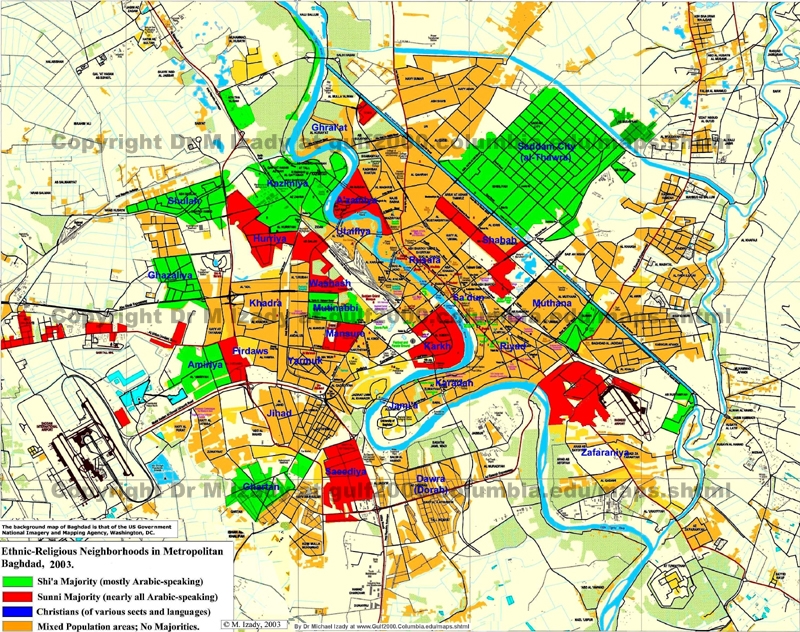
Green – Shiite majority
Red – Sunni majority
Blue – Christian majority
Yellow – Mixed Sunni-Shiite
The next map skips ahead to 2006. The February bombing of the Shiite shrine at Samarra in Salahaddin province north of Baghdad in that year is credited as beginning of the sectarian war, and Moqtada al-Sadr’s Mahdi Army is largely blamed for carrying out most of the ethnic cleansing. In actuality, in 2005 the Supreme Islamic Iraqi Council’s Badr Brigade militia took over the Interior Ministry under the government of Prime Minister Ibrahim al-Jaafari, and began setting up death squads and carrying attacks on Sunnis. The Supreme Council also began pushing out Sunnis from the security forces, and replacing them with its followers. The activities of the Badr Brigade were exposed in late 2005 when U.S. forces came across a secret detention facility in the capital holding 169 abused prisoners, some of which were tortured. The Interior Minister Bayan Jabr, a Badr Brigade leader, tried to deny the seriousness of the find.
The 2006 map shows the first changes in the sectarian make-up of the city. These can be seen in the outskirts of the city. Sadiya in the south for example, and Hurriya and Washash on the west bank of the Tigris went from Sunni to Shiite majority. The three neighborhoods directly northwest of Sadr City, Hayy Aden, Sahab, and Hayy Sumer went from being mixed to Shiite. In turn, Amiriya in the west went from Shiite to Sunni, along with Ghazaliya above it, and Jihad went from mixed to Sunni to the south. Karkh in central Baghdad, which surrounds the Green Zone, also went from Sunni to mixed.
Baghdad 2006
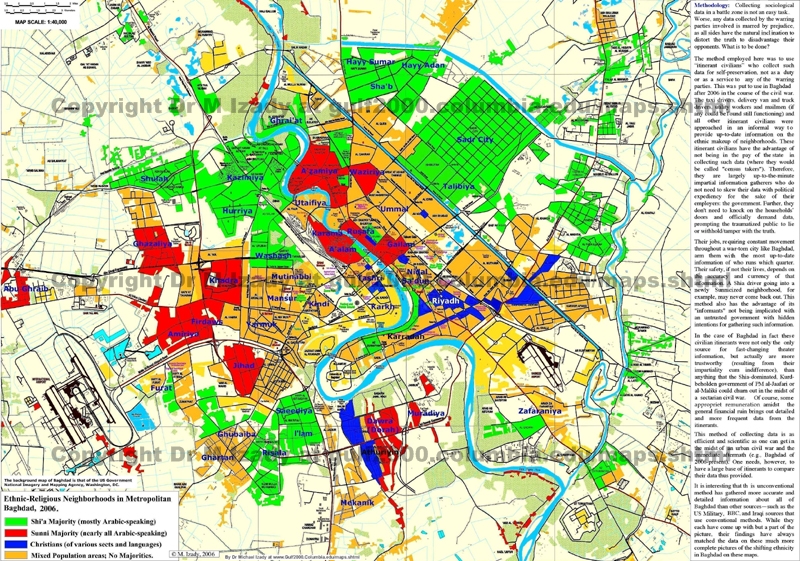
Green – Shiite majority
Red – Sunni majority
Blue – Christian majority
Yellow – Mixed Sunni-Shiite
The third map covers early 2007. At that time the sectarian war was still going full throttle. For example, the Brookings Institution’s Iraq Index recorded 3,462 killed in November 2006, 2,914 in December, 3,500 in January 2009, 2,700 in February, and 2,400 in March. By that time the segregation of Baghdad was pretty much complete. Adhamiya was the last large Sunni majority neighborhood left in the western half of the capital. Most Sunnis were now concentrated in a strip of western neighborhoods including Kindi, Mansur, Yarmuk, Khadra, Amiriya, and Ghazaliya, along with a few southern district like Dora and Muradiya. Only central Baghdad around the Tigris River had large numbers of mixed areas left with the northwest, northeast, southwest, and southeast all Shiite majority now.
Baghdad Early 2007
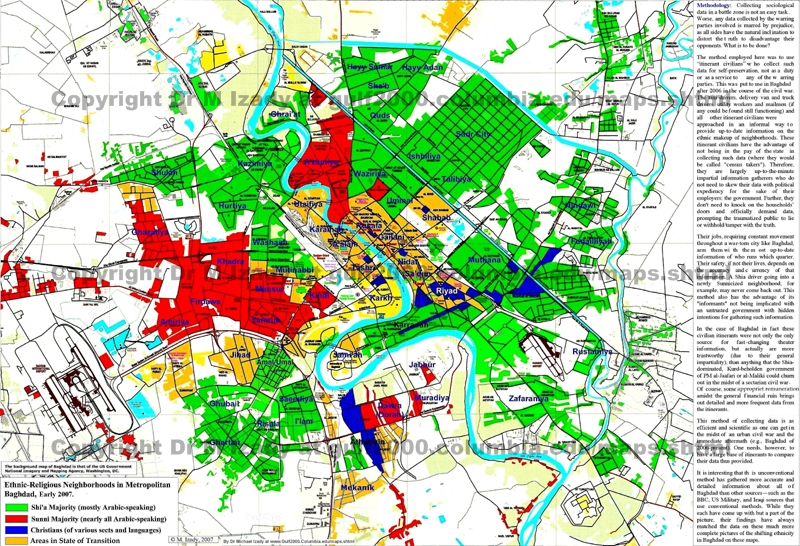
Green – Shiite majority
Red – Sunni majority
Blue – Christian majority
Yellow – Mixed Sunni-Shiite
The fourth map is from late 2007. The only real change was along the west bank of the Tigris. There, the southern section of Adhamiya became Shiite, while Resaca and Gaitanis became Sunni majority. During that period, the sectarian fighting was petering out. The Iraq Index counted 1,100 deaths in September 2007; the last time it would record over one thousand deaths in a single month. After that there were 950 killed in October, and 750 in November and December each. The Surge had also led to blast walls being erected around many of the Sunni neighborhoods and the creation of the Sons of Iraq program where the majority of the Sunni insurgency gave up and switched sides to align with the Americans rather than face annihilation at the hands of the Shiite militias, Al Qaeda in Iraq, or the United States. Both of those policies solidified the segregation of Baghdad.
Baghdad Late 2007
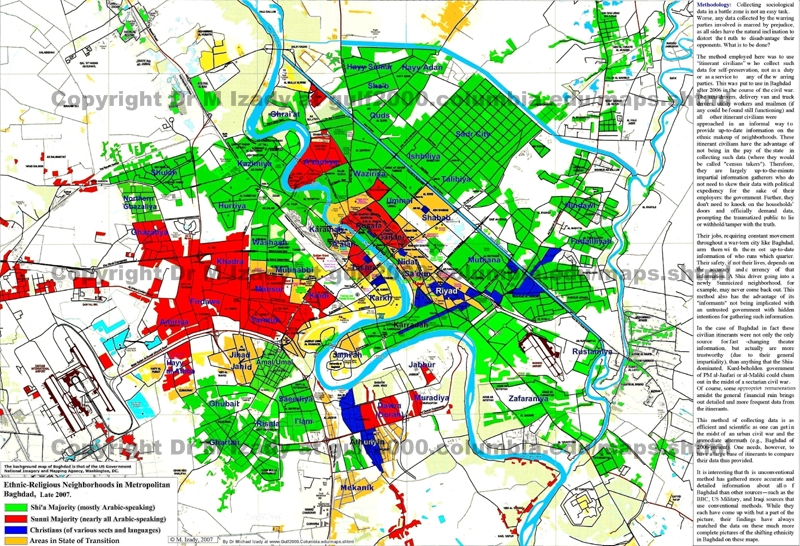
Green – Shiite majority
Red – Sunni majority
Blue – Christian majority
Yellow – Mixed Sunni-Shiite
The last map is from mid-2008. There were very few changes by that time. The only noticeable ones were around the Riyad area that went from mixed to Shiite on the western bank of the Tigris across from the Green Zone. By 2008 the sectarian war was over, the insurgency was reduced to largely carrying out terrorist bombings and hit and run attacks, and deaths were dropping.
Baghdad Mid 2008

Green – Shiite majority
Red – Sunni majority
Blue – Christian majority
Yellow – Mixed Sunni-Shiite
Izady believes that the ethnic cleansing of Baghdad by the Shiite militias and the Sons of Iraq movement were the major reasons why the civil war ended. The Badr Brigade and Mahdi Army effectively removed most of the Sunnis to a western strip of the capital, while the Sons of Iraq signaled the collapse of the insurgency. The Surge didn’t fully get underway until mid-2007, and facilitated the reduction of violence and segregation that was already underway. Izady thinks much of the same for Sadr’s August 2007 cease-fire. Again, the fighting was already winding down by then, and Sadr never told his followers to disarm, and many factions had broken away or become Special Groups that were no longer following Sadr’s direction, so there were plenty of militiamen still active. There were just fewer Sunnis to target, and many militia cells turned to exploiting their own Shiite communities instead.
The BBC did a similar set of maps comparing pre-2006 Baghdad to 2007 based upon information from the International Medical Corps. It found a very similar pattern of Shiite expansion in the east and northwest, the vast reduction of mixed neighborhoods, and the concentration of Sunnis in the west. Many other students of the Surge attribute these same factors for the end of the civil war, but just put different emphasis on each point.
The one disputable point that Izady made in his interview with the International Relations and Security Network was when he said he believed that Sunnis were reduced to 12% of Iraq’s population because of the fighting. He said many became refugees in Syria and Jordan. While the exact percentage Sunnis made up of Iraq and Baghdad are disputed, a general number used in sources such as the CIA Factbook is around 30%. How much they made up of Baghdad before the U.S. invasion is an even harder figure to calculate. In the December 2005 national elections however, the Sunni Iraqi Accordance Front and Iraqi National Dialogue Front pulled 22.9% of the vote in the capital, while the Iraqi National List, even though led by a Shiite, former Prime Minister Ilyad Allawi, also draws strongly from Sunnis, got 13.4%. That’s roughly 30% of Baghdad as well. If Izady is to be believed than just over half of the Sunnis fled the country. In 2003 Iraq had a population of around 26 million, if 30% were Sunnis that would be roughly 7.8 million, half of which would be 3.9 million people. The United Nations estimates that there are only 2.5 million refugees however, not all of which are Sunnis. There are other sources that think that Sunnis were only 15-20% of all Iraqis, which would be approximately 3.9million-5.2 million. That would match the refugee numbers much more closely.
Izady’s maps are a valuable resource in charting the changes that Baghdad witnessed after the U.S. invasion. It was and remains the center of power and conflict in the country to this day. The Shiite militias undertook a concerted effort to push Sunnis out of parts of the city beginning in 2005, and largely succeeded as Izady’s graphics show. When the insurgency largely gave up and joined the Sons of Iraq, and the U.S. put up blast walls around many communities, those marked the effective end of the sectarian war. The result is a segregated and Shiite dominated capital, that in a way is symbolic of post-Saddam Iraq as there was displacement across the country, and the Shiite parties are now in firm control of the government, with no real threat from other sects.
SOURCES
BBC, “Baghdad: Mapping the violence,” 2007
CIA, Factbook
Guler, Claudio, “Baghdad Divided,” International Relations and Security Network, 11/9/09
Independent Electoral Commission of Iraq, “Legislation Election of 15 December 2005,” 2006
International Crisis Group, “Shiite Politics In Iraq: The Role Of The Supreme Council,” 11/15/07
Matthews, Dylan and Klein, Ezra, “How Important Was the Surge?” American Prospects, 7/28/08
Murphy, Dan, “New Iraqi leader seeks unity,” Christian Science Monitor, 4/24/06
O’Hanlon, Michael Campbell, Jason, “Iraq Index,” Brookings Institution, 8/20/09
Otterman, Sharon, “IRAQ: The Sunnis,” Council on Foreign Relations, 12/12/03
Wong, Edward, “U.S. Splits With Iraqi Official Over Prisoner Abuse,” New York Times, 11/17/05
Friday, October 16, 2009
Ayatollah Sistani’s Influence On The Open/Closed List Voting System Debate In Iraq
Iraq’s parliament missed its October 15, 2009 deadline to come up with a new election law for the January 2010 vote. There are two major issues holding up the bill. First, is the issue of how balloting will take place in Tamim province, home of the disputed city of Kirkuk. The second is whether the country will use an open or closed list voting system. In 2005, Iraq used a closed list system where voters could only pick from lists, which are coalitions, and parties. That gave more control to party bosses who got to choose the politicians that would actually take power. In the January 2009 provincial elections, Iraq used an open list, where people could select either lists or individual candidates. That gave more influence to the voters.
When debate first began on what kind of system was to be adopted for 2010, reports said that many politicians were pushing for a closed list. Those included members of the Supreme Islamic Iraqi Council (SIIC), and the two ruling Kurdish parties, the Kurdistan Democratic Party (KDP) and the Patriotic Union of Kurdistan (PUK). Prime Minister Nouri al-Maliki was an early opponent.
The entire discussion changed at the beginning of October 2009 when a false story was spread about Grand Ayatollah Ali al-Sistani and the voting system. On October 5, it was reported that Ayatollah Sistani would urge a boycott of the 2010 election if parliament did not adopt an open list. That story was quickly denied by Sistani’s office, and Maliki was accused of spreading the rumor since so many of his opponents were for the closed list. The report had its affect however, as almost all of Iraq’s leading politicians and parties have now publicly come out for the open list. On October 6, the Sadrists said they would hold a walk out if parliament held a vote on a closed list. The next day, Vice Presidents Adel Abd Mahdi of the Supreme Council and Tariq al-Hashemi, formerly of the Iraqi Islamic Party, held a joint press conference where they too said they supported an open list. The day after that, the head of the SIIC, Ammar al-Hakim, also came out against the closed list. Finally, on October 10, the Constitution Part of Interior Minister Jawad Bolani, held a demonstration in Basra in support of Sistani’s call for an open list.
If Maliki’s office did spread the false rumor about Sistani and a boycott, then it served its purpose. Most of the major Arab leaders in Iraq are now talking about an open list system. It’s yet to be seen whether this is all just rhetoric or a real sea change in Iraqi politics. The truth will be revealed when parliament passed a new election bill.
SOURCES
Alsumaria, “Sadrists firmly reject closed list system,” 10/7/09
- “Sistani aide: Closed list affects democracy,” 10/7/09
Aswat al-Iraq, “Elections draft law completed without agreeing on Kirkuk – MP,” 7/15/09
- “Iraqi Constitutional Party demonstrates for open-slate election,” 10/10/09
- “National blocs want to adopt closed-list system during elections,” 7/3/09
- “Sadrists threaten to walk out of session if vote on closed-list system is held,” 10/6/09
- “SIIC chief asserts adopting open-list system in elections,” 10/8/09
- “Sistani denies boycotting elections in case adopting close-list system,” 10/5/09
- “Vice presidents stress importance of adopting open-list system,” 10/7/09
Gwertzman, Bernard, “Iraq at Crossroads Amid U.S. Disengagement,” Council on Foreign Relations, 6/30/09
Pollack, Kenneth, “The Battle for Baghdad,” The National Interest, September/October 2009
Radio Free Europe/Radio Liberty, “Iraqi Election Commission Urges Vote Law’s Approval,” 10/7/09
Roads To Iraq, “Election conflict puts Sistani in the middle,” 10/6/09
Synovitz, Ron, “Kurdish-Arab Power Struggle Leads To Calls For Iraq Census Delay,” Radio Free Europe/Radio Liberty, 8/30/09
Zahra, Hassan Abdul, “Iraq’s top Shiite cleric may urge vote boycott,” Agence France Presse, 10/5/09
When debate first began on what kind of system was to be adopted for 2010, reports said that many politicians were pushing for a closed list. Those included members of the Supreme Islamic Iraqi Council (SIIC), and the two ruling Kurdish parties, the Kurdistan Democratic Party (KDP) and the Patriotic Union of Kurdistan (PUK). Prime Minister Nouri al-Maliki was an early opponent.
The entire discussion changed at the beginning of October 2009 when a false story was spread about Grand Ayatollah Ali al-Sistani and the voting system. On October 5, it was reported that Ayatollah Sistani would urge a boycott of the 2010 election if parliament did not adopt an open list. That story was quickly denied by Sistani’s office, and Maliki was accused of spreading the rumor since so many of his opponents were for the closed list. The report had its affect however, as almost all of Iraq’s leading politicians and parties have now publicly come out for the open list. On October 6, the Sadrists said they would hold a walk out if parliament held a vote on a closed list. The next day, Vice Presidents Adel Abd Mahdi of the Supreme Council and Tariq al-Hashemi, formerly of the Iraqi Islamic Party, held a joint press conference where they too said they supported an open list. The day after that, the head of the SIIC, Ammar al-Hakim, also came out against the closed list. Finally, on October 10, the Constitution Part of Interior Minister Jawad Bolani, held a demonstration in Basra in support of Sistani’s call for an open list.
If Maliki’s office did spread the false rumor about Sistani and a boycott, then it served its purpose. Most of the major Arab leaders in Iraq are now talking about an open list system. It’s yet to be seen whether this is all just rhetoric or a real sea change in Iraqi politics. The truth will be revealed when parliament passed a new election bill.
SOURCES
Alsumaria, “Sadrists firmly reject closed list system,” 10/7/09
- “Sistani aide: Closed list affects democracy,” 10/7/09
Aswat al-Iraq, “Elections draft law completed without agreeing on Kirkuk – MP,” 7/15/09
- “Iraqi Constitutional Party demonstrates for open-slate election,” 10/10/09
- “National blocs want to adopt closed-list system during elections,” 7/3/09
- “Sadrists threaten to walk out of session if vote on closed-list system is held,” 10/6/09
- “SIIC chief asserts adopting open-list system in elections,” 10/8/09
- “Sistani denies boycotting elections in case adopting close-list system,” 10/5/09
- “Vice presidents stress importance of adopting open-list system,” 10/7/09
Gwertzman, Bernard, “Iraq at Crossroads Amid U.S. Disengagement,” Council on Foreign Relations, 6/30/09
Pollack, Kenneth, “The Battle for Baghdad,” The National Interest, September/October 2009
Radio Free Europe/Radio Liberty, “Iraqi Election Commission Urges Vote Law’s Approval,” 10/7/09
Roads To Iraq, “Election conflict puts Sistani in the middle,” 10/6/09
Synovitz, Ron, “Kurdish-Arab Power Struggle Leads To Calls For Iraq Census Delay,” Radio Free Europe/Radio Liberty, 8/30/09
Zahra, Hassan Abdul, “Iraq’s top Shiite cleric may urge vote boycott,” Agence France Presse, 10/5/09
Wednesday, September 30, 2009
More On Allawi-National Alliance Talks
Contradictory stories are swirling over whether former Interim Prime Minister Ilyad Allawi will join the new Iraqi National Alliance (INA). On Wednesday September 23, 2009 Allawi publicly denied that he had been talking with the National Alliance. The Iraq Pundit Blog also seems to think that the story is all rumors. Niqash however, talked with both a member from Allawi’s Iraqi National List and the Supreme Islamic Iraqi Council, and they both said that the new coalition would be announced soon.
The main motivation for Allawi to join the National Alliance is to become prime minister again, a promise he has supposedly gotten from them. After the Supreme Council failed to bring Prime Minister Nouri al-Maliki into the INA, they then turned to Allawi as a replacement candidate to try to unseat Maliki. Allawi also allegedly secretly went to Iran in August 2009 and got their blessing to become prime minister. According to Al-Quds Al-Arabi, Iran was putting heavy pressure on Maliki to join the new alliance, and when he refused, they threatened him by saying that he would be blocked from returning to his office. This is obviously their reason for backing Allawi if these rumors become true.
SOURCES
Iraq Pundit, “Bad News Papers,” 9/24/09
Ramzi, Kholoud, “shia coalition seeks allawi alliance,” Niqash, 9/25/09
Roads To Iraq, “Iran’s final warning to Maliki,” 9/24/09
The main motivation for Allawi to join the National Alliance is to become prime minister again, a promise he has supposedly gotten from them. After the Supreme Council failed to bring Prime Minister Nouri al-Maliki into the INA, they then turned to Allawi as a replacement candidate to try to unseat Maliki. Allawi also allegedly secretly went to Iran in August 2009 and got their blessing to become prime minister. According to Al-Quds Al-Arabi, Iran was putting heavy pressure on Maliki to join the new alliance, and when he refused, they threatened him by saying that he would be blocked from returning to his office. This is obviously their reason for backing Allawi if these rumors become true.
SOURCES
Iraq Pundit, “Bad News Papers,” 9/24/09
Ramzi, Kholoud, “shia coalition seeks allawi alliance,” Niqash, 9/25/09
Roads To Iraq, “Iran’s final warning to Maliki,” 9/24/09
Sunday, September 27, 2009
Allawi To Join National Alliance?
The Arab press is reporting that former Prime Minister Ilyad Allawi has either agreed to or is in the process of joining the new Iraqi National Alliance (INA) put together by the main Shiite parties such as the Supreme Islamic Iraqi Council (SIIC) and the Sadrists. While members of the SIIC are publicly denying it, Allawi has supposedly agreed to join the coalition in return for being their candidate for Prime Minister. Although this would seem to be an alliance of complete opposites, since Allawi appeals to many Sunnis and former regime members and the SIIC and Sadrists are opposed to the return of Baathists, what they have in common is a desire to block Prime Minister Nouri al-Maliki from returning to the top position in Iraq.
Some stories say that the inclusion of Allawi divided the National Alliance. The Sadrists conducted the negotiations, which the Supreme Council was opposed to because they were talking with Maliki. The Supreme Council and the Prime Minister’s Dawa were supposedly deep into talks with the latter even giving up the demand that Maliki be the Alliance’s only candidate for prime minister. Recently for example, the new head of the SIIC, Ammar al-Hakim gave a speech keeping the door open for Maliki to join the INA. This was part of a larger struggle for leadership of the Alliance between the two factions.
The National Alliance still has additional moves ahead and needs to define itself. First, they seem to be planning a raid on Dawa members, hoping to draw some away from Maliki. Second, Allawi will probably have to compete with Vice President Adel Abdul Mahdi for the nomination of prime minister. Third, the INA has no platform. The only thing they have in common is opposition to Maliki, but that’s not something they can openly run on. In fact, if Allawi does ultimately join the coalition, it’s likely to muddle their message even more since it would include both secularists and Islamists, centralists and federalists, critics and friends of the Kurds, opponents and sympathizers with the Baathists, etc.
SOURCES
?, “Source in the “coalition” is likely to hold a preliminary deal with Allawi’s list to reduce the chances of winning the list of al-Maliki,” 9/22/09
Ahmed, Hamid, “Iraqi Shiite leader appeals for unity before vote,” Associated Press, 9/21/09
Roads To Iraq, “Iraqi pre-election political map – The Shiites scene,” 9/21/09
Visser, Reidar, “Why an Allawi-Hakim Alliance would Mean Retrogression in Iraq,” Iraq and Gulf Analysis, 9/21/09
Al-Zawraa Media Network, “Supreme Council denies Allawi’s nomination to lead the next government for joining the coalition,” 9/22/09
Some stories say that the inclusion of Allawi divided the National Alliance. The Sadrists conducted the negotiations, which the Supreme Council was opposed to because they were talking with Maliki. The Supreme Council and the Prime Minister’s Dawa were supposedly deep into talks with the latter even giving up the demand that Maliki be the Alliance’s only candidate for prime minister. Recently for example, the new head of the SIIC, Ammar al-Hakim gave a speech keeping the door open for Maliki to join the INA. This was part of a larger struggle for leadership of the Alliance between the two factions.
The National Alliance still has additional moves ahead and needs to define itself. First, they seem to be planning a raid on Dawa members, hoping to draw some away from Maliki. Second, Allawi will probably have to compete with Vice President Adel Abdul Mahdi for the nomination of prime minister. Third, the INA has no platform. The only thing they have in common is opposition to Maliki, but that’s not something they can openly run on. In fact, if Allawi does ultimately join the coalition, it’s likely to muddle their message even more since it would include both secularists and Islamists, centralists and federalists, critics and friends of the Kurds, opponents and sympathizers with the Baathists, etc.
SOURCES
?, “Source in the “coalition” is likely to hold a preliminary deal with Allawi’s list to reduce the chances of winning the list of al-Maliki,” 9/22/09
Ahmed, Hamid, “Iraqi Shiite leader appeals for unity before vote,” Associated Press, 9/21/09
Roads To Iraq, “Iraqi pre-election political map – The Shiites scene,” 9/21/09
Visser, Reidar, “Why an Allawi-Hakim Alliance would Mean Retrogression in Iraq,” Iraq and Gulf Analysis, 9/21/09
Al-Zawraa Media Network, “Supreme Council denies Allawi’s nomination to lead the next government for joining the coalition,” 9/22/09
Saturday, September 26, 2009
Update On Political Maneuvers Before 2010 Elections
Iraqi political parties and figures continue to make new coalitions and conduct negotiations with each other in preparation for the January 2010 parliamentary elections. The two major coalitions, Prime Minister Nouri al-Maliki’s State of Law and the new Iraqi National Alliance are both seeking a wide variety of new partners, some completely unexpected, which might engulf the smaller lists.
First, the new head of the Supreme Islamic Iraqi Council (SIIC) Ammar al-Hakim gave a sermon on September 21, 2009 during the Eid al-Fitr holiday aimed at bringing Maliki into the Iraqi National Alliance. Hakim said that the coalition was working to bring in new members and widen its base, and that he supported the Prime Minister’s call for an international tribunal to investigate the August bombings in Baghdad. Hakim also promised better delivery of water and electricity if his list won, something that Maliki is also running on. If the Prime Minister joined the National Alliance, it would become the largest and most popular list in the country, which could muster a plurality of the votes. Maliki however, is intent on running on his own, since the Alliance would not give in to his demands to be their only candidate for Prime Minister.
The National Alliance and Maliki are also competing over the loyalty of former speaker of parliament Mahmoud al-Mashhadani and his Independent National Trend. Mashhadani, an independent Sunni, was the first well-known politician to say that he would run with Maliki. Mashhadani has since said he is reconsidering that move, and is now being courted by the National Alliance.
In a completely unexpected move, former Prime Minister Ilyad Allawi of the Iraqi National List is now flirting with the National Alliance. Allawi is currently aligned with parliamentary Saleh al-Mutlaq in what could be called the neo-Baathists since they are secular, nationalists that appeal to many former regime elements. If Allawi were to join the National Alliance, and they accepted him, it would show that they only care about power and nothing else. There is already no ideological coherence to the list as is. The Sadrists and former Prime Minister Ibrahim al-Jaafari for example, preach nationalism, a strong central government, and are critical of the ruling Kurdish parties. The SIIC on the other hand, are proponents of federalism and the closest allies of the Kurds in the country. The Sadrists and Supreme Council do agree on excluding Baathist from government, and yet that is exactly who Allawi appeals to. If he agreed to join his Iraqi National List would probably break apart, and he would be overwhelmed by the larger parties in return for a nominal ministership.
In Anbar, Sheikh Ahmad Abu Risha has formed a new coalition called the Iraqi Unity List. It mostly consists of small tribal groups, but pulled a coup in bringing in the Constitution Party of Interior Minister Jawad Bolani. Both the National Alliance and Maliki have talked with the Minister, and many think Bolani was going to run for prime minister. Abu Risha has been flirting about running with Maliki for months now however, so that could mean Bolani does not aspire to the top spot in Iraq.
Overall, the fracturing of the Sunnis into smaller parties, may mean that they will be overwhelmed by the larger Shiite ones. Former head of the Iraqi Islamic Party Vice President Tariq al-Hashemi for example, may run with Maliki. All of the leading Anbar sheikhs are trying to make ties with Shiites as well. Like Allawi, they may gain a few nominal ministerial positions, but be subordinate to the Shiite parties.
SOURCES
Ahmed, Hamid, “Iraqi Shiite leader appeals for unity before vote,” Associated Press, 9/21/09
Alsumaria, “New coalitions arise ahead of Iraq elections,” 9/12/09
Aswat al-Iraq, “National Current may reconsider alliance with State of Law,” 9/19/09
Najm, Hayder, “al-maliki faces shia election threat,” Niqash, 9/15/09
Roads To Iraq, “Iraq pre-election political map – The Sunni scene,” 9/19/09
Visser, Reidar, “Why an Allawi-Hakim Alliance would Mean Retrogression in Iraq,” Iraq and Gulf Analysis, 9/21/09
First, the new head of the Supreme Islamic Iraqi Council (SIIC) Ammar al-Hakim gave a sermon on September 21, 2009 during the Eid al-Fitr holiday aimed at bringing Maliki into the Iraqi National Alliance. Hakim said that the coalition was working to bring in new members and widen its base, and that he supported the Prime Minister’s call for an international tribunal to investigate the August bombings in Baghdad. Hakim also promised better delivery of water and electricity if his list won, something that Maliki is also running on. If the Prime Minister joined the National Alliance, it would become the largest and most popular list in the country, which could muster a plurality of the votes. Maliki however, is intent on running on his own, since the Alliance would not give in to his demands to be their only candidate for Prime Minister.
The National Alliance and Maliki are also competing over the loyalty of former speaker of parliament Mahmoud al-Mashhadani and his Independent National Trend. Mashhadani, an independent Sunni, was the first well-known politician to say that he would run with Maliki. Mashhadani has since said he is reconsidering that move, and is now being courted by the National Alliance.
In a completely unexpected move, former Prime Minister Ilyad Allawi of the Iraqi National List is now flirting with the National Alliance. Allawi is currently aligned with parliamentary Saleh al-Mutlaq in what could be called the neo-Baathists since they are secular, nationalists that appeal to many former regime elements. If Allawi were to join the National Alliance, and they accepted him, it would show that they only care about power and nothing else. There is already no ideological coherence to the list as is. The Sadrists and former Prime Minister Ibrahim al-Jaafari for example, preach nationalism, a strong central government, and are critical of the ruling Kurdish parties. The SIIC on the other hand, are proponents of federalism and the closest allies of the Kurds in the country. The Sadrists and Supreme Council do agree on excluding Baathist from government, and yet that is exactly who Allawi appeals to. If he agreed to join his Iraqi National List would probably break apart, and he would be overwhelmed by the larger parties in return for a nominal ministership.
In Anbar, Sheikh Ahmad Abu Risha has formed a new coalition called the Iraqi Unity List. It mostly consists of small tribal groups, but pulled a coup in bringing in the Constitution Party of Interior Minister Jawad Bolani. Both the National Alliance and Maliki have talked with the Minister, and many think Bolani was going to run for prime minister. Abu Risha has been flirting about running with Maliki for months now however, so that could mean Bolani does not aspire to the top spot in Iraq.
Overall, the fracturing of the Sunnis into smaller parties, may mean that they will be overwhelmed by the larger Shiite ones. Former head of the Iraqi Islamic Party Vice President Tariq al-Hashemi for example, may run with Maliki. All of the leading Anbar sheikhs are trying to make ties with Shiites as well. Like Allawi, they may gain a few nominal ministerial positions, but be subordinate to the Shiite parties.
SOURCES
Ahmed, Hamid, “Iraqi Shiite leader appeals for unity before vote,” Associated Press, 9/21/09
Alsumaria, “New coalitions arise ahead of Iraq elections,” 9/12/09
Aswat al-Iraq, “National Current may reconsider alliance with State of Law,” 9/19/09
Najm, Hayder, “al-maliki faces shia election threat,” Niqash, 9/15/09
Roads To Iraq, “Iraq pre-election political map – The Sunni scene,” 9/19/09
Visser, Reidar, “Why an Allawi-Hakim Alliance would Mean Retrogression in Iraq,” Iraq and Gulf Analysis, 9/21/09
Wednesday, September 23, 2009
New Draft Election Law Sent to Iraqi Parliament
On September 12, 2009 Iraq’s cabinet sent a draft election law to the Iraqi parliament for the January 2010 balloting. The new law is a revision of the 2005 bill with one major change it includes an open list voting system. In the 2005 elections Iraq had a closed list where voters only got to choose from parties and coalitions. Party bosses selected the actual politicians. In the 2009 provincial elections, Iraq switched to an open list where people were allowed to vote for either lists or candidates. The one major drawback of the new procedure was that if one politician received a large number of votes, they could only earn one seat, and the rest were considered wasted ballots. That occurred this year when independent Shiite Yousef al-Habboubi won the vote in Karbala with 17% compared to 8% for the second and third place finishers, but because he ran alone only got one seat out of 27. Afterward, he had to settle for deputy governor as the larger parties put together the ruling coalition and took the top positions in the province.
Arguments over a closed or open list have also been caught up in the larger political struggle in Iraq between Prime Minister Nouri al-Maliki and his detractors. The new Iraqi National Alliance made up of the Supreme Islamic Iraqi Council, the Sadrists, and former Prime Minister Ibrahim al-Jaafari have been pushing for a closed list because it benefits the large parties, while the Prime Minister supports an open list. This rivalry will now play out in parliament as it discusses the draft election law.
SOURCES
Najm, Hayder, “al-maliki faces shia election threat,” Niqash, 9/15/09
Reuters, “Iraq cabinet approves draft elections law,” 9/12/09
Rubin, Alissa, "Dark horse wins over one Iraqi city: Karbala," International Herald Tribune, 2/6/09
Serwer, Daniel and Parker, Sam, “Maliki’s Iraq between Two Elections,” United States Institute of Peace, May 2009
Arguments over a closed or open list have also been caught up in the larger political struggle in Iraq between Prime Minister Nouri al-Maliki and his detractors. The new Iraqi National Alliance made up of the Supreme Islamic Iraqi Council, the Sadrists, and former Prime Minister Ibrahim al-Jaafari have been pushing for a closed list because it benefits the large parties, while the Prime Minister supports an open list. This rivalry will now play out in parliament as it discusses the draft election law.
SOURCES
Najm, Hayder, “al-maliki faces shia election threat,” Niqash, 9/15/09
Reuters, “Iraq cabinet approves draft elections law,” 9/12/09
Rubin, Alissa, "Dark horse wins over one Iraqi city: Karbala," International Herald Tribune, 2/6/09
Serwer, Daniel and Parker, Sam, “Maliki’s Iraq between Two Elections,” United States Institute of Peace, May 2009
Wednesday, September 09, 2009
The U.S. Needs To Save Iraq From Itself Says Analyst
Kenneth Pollack of the Brookings Institution has been one of the long-time American commentators on Iraq. He recently wrote a piece for The National Interest journal entitled “The Battle for Baghdad". In it he argues that Iraqis, left to their own devices will destroy the gains made in Iraq since the Surge. He warns that the older political parties that took over after the 2003 invasion are still clinging to power, and are willing to bring down Iraqi democracy to maintain their positions. According to Pollack the only thing standing in the way of this happening is the United States. Even that is endangered because of the moves of Prime Minister Nouri al-Maliki. Like most of his think tank counterparts, Pollack is arguing for a long-term American diplomatic and military presence in Iraq to act as peacekeepers and mediators. Without them Pollack believes that Iraqis will only think about their own short-term interests to the detriment of the country.
Pollack begins with two conversations he had with Iraq politicians after the January 2009 provincial elections. The first was with a group that was opposed to Prime Minister Nouri al-Maliki. They started off assuring Pollack that they had enough supporters for a no confidence vote against the Prime Minister in parliament, but in the end they admitted that Abdul Aziz al-Hakim of the Supreme Islamic Iraqi Council opposed this idea because it would go against the recent balloting that was in Maliki’s favor. The absence of Hakim’s support was considered a deal breaker. This represents one dynamic of the post sectarian war status quo in Iraq where many of the disputes are now political, and groups abide by the broad rules of the constitution and electoral system. On the other hand, Pollack met with a group of Dawa officials who were sure that Maliki would win in the 2010 parliamentary vote after his victory in 2009. They said the Prime Minister would run on services and security, and blame his opponents for any setbacks, something that’s actually happened recently. On the other hand when these politicians were asked about Maliki creating extra-judicial bodies and going outside standard procedures in the government they attempted to dodge the issues by saying that this was necessary because Iraq’s bureaucracy didn’t work and different political parties controlled the ministries and often didn’t listen to Maliki. This represented the other side of Iraq’s system where many believe that the Prime Minister is acting like leaders of the past and centralizing all authority around himself, which could intentionally or not lead to autocratic rule. To Pollack, this is the ying and the yang of Iraq. On the one hand democracy is taking root however precariously, on the other hand, there are plenty of forces in the country that threaten it.
There are two other issues that Pollack worries about. One is that Iraqi nationalism is making a comeback. This is helping to heal some of the wounds between Sunnis and Shiites created during the sectarian war. On the other hand, Iraqi nationalism is often interpreted as being solely Arab in character and anti-Kurdish. Maliki is playing on this by attempting to militarily confront the Kurds across the disputed territories in the north. There have been several times this has almost turned into shooting, only averted by the presence of U.S. forces. Pollack wonders if Maliki actually resents this outside interference, because he may want a confrontation with the Kurds so that he can rally the Arab public around him. Second, are the old Iraqi parties that have ruled Iraq since the 2005 elections. While he doesn’t name them, he is implying the Supreme Council, the Kurdistan Democratic Party, the Patriotic Union of Kurdistan, and the Iraqi Accordance Front, all of which either controlled their own militia or had contacts with the insurgency, and used these armed factions to gain political power. Pollack believes that these groups are trying to cling to power, and will do whatever it takes to do so. In the 2010 election for example, they are pushing for a closed list voting system where the electorate only gets to pick from coalitions instead of individuals because this gives party bosses, rather than the public, control over the politicians and government. Pollack thinks both of these are threats to stability and democracy, because Maliki and the old guard parties are only thinking about their own personal gain rather than the future of the country.
Pollack’s solution to all of these problems is a long-term American presence in Iraq. According to him, the U.S. needs to stay to provide support to the government and mediate conflicts. Only the U.S. he writes can help solve the problems between Baghdad and Kurdistan over disputed areas like Kirkuk and federalism. The U.S. needs to make sure that Iraqi prisoners and the Sons of Iraq are treated well. The U.S. needs to push the government to protect minorities. The U.S. needs to pressure Baghdad to increase its capacity and improve the bureaucracy. The Americans need to make sure that party bosses don’t take over the elections, and push for a closed list voting system. The U.S. needs to deal with Maliki’s attempt to centralize power, and corruption. In a nutshell, Pollack believes the U.S. is the only party in Iraq that will think about Iraq. The main lever of influence the U.S. has to achieve this laundry list of items is aid. U.S. advisors still partner with Iraqi units, the security forces are dependent upon the Americans for maintenance and supply, the Iraqi government has U.S. advisors throughout, the Provincial Reconstruction Teams are essential parts of the rebuilding provinces out in the governorates, and the U.S. still provides a large amount of economic aid and advice. All of this assistance needs to be made conditional based upon Baghdad’s compliance with the long list of reforms listed above. This is something many other American think tank writers have argued for over the last few years.
There is one major impediment to overcome to actually achieving this according to Pollack, Prime Minister Maliki. The Prime Minister seems to have an inflated sense of the capabilities of the Iraqi security forces and is playing politics with the U.S. presence. Maliki thinks that the Iraqi forces are going to be ready sooner rather than later so he wants to cut many of the public ties with the U.S. like joint patrols with U.S. forces and the blast walls in Baghdad. More importantly he is pushing for a referendum on the Status of Forces Agreement (SOFA) to coincide with the 2010 parliamentary vote. This will give Maliki a powerful tool to run on so he can portray himself as the leader that got the Americans to leave Iraq. He can also use it against his opposition since many support a longer stay for U.S. forces to protect against Maliki’s excesses. If the Iraqi public votes down the SOFA, a definite possibility, than Pollack is afraid U.S. influence will end that election day. A main priority then should be Washington lobbying Maliki to move the referendum to some other time.
Therein lies a major problem with Pollack and others who take this line of argument for a long-term U.S. role in Iraq. There is no real reason for Maliki to change the referendum date because holding it the same time as national balloting will benefit him the most. He has already given up many forms of American military assistance since the June 30, 2009 withdrawal from Iraq’s cities, and that is the greatest piece of leverage the U.S. holds. Iraqi domestic politics is a much greater force now than U.S. influence. The White House therefore, could make all kinds of assistance conditional, and the Iraqis might still not listen. Iraq may turn out to be the prodigal son for the United States, but Pollack and others can’t seem to let go. Ultimately, they seem afraid of Iraqis running their own affairs. Pollack in “The Battle for Baghdad” just happens to be the most explicit in voicing this opinion.
SOURCES
Biddle, Stephen, “Reversal in Iraq,” Center for Preventative Action Council on Foreign Relations, May 2009
Cordesman, Anthony, “Iraq: A Time To Stay?” Center for Strategic and International Studies, 7/30/09
DPA, “Al-Maliki courts Iraqi Sunni tribal leaders,” 8/11/09
Nagl, John and Burton, Brian, “After the Fire: Shaping the Future U.S. Relationship with Iraq,” Center for a New American Security, June 2009
Nordland, Rod, “Bombs Hurt Maliki Case That Iraq Can Guard Itself,” New York Times, 8/21/09
Pollack, Kenneth, “The Battle for Baghdad,” The National Interest, September/October 2009
Pollack begins with two conversations he had with Iraq politicians after the January 2009 provincial elections. The first was with a group that was opposed to Prime Minister Nouri al-Maliki. They started off assuring Pollack that they had enough supporters for a no confidence vote against the Prime Minister in parliament, but in the end they admitted that Abdul Aziz al-Hakim of the Supreme Islamic Iraqi Council opposed this idea because it would go against the recent balloting that was in Maliki’s favor. The absence of Hakim’s support was considered a deal breaker. This represents one dynamic of the post sectarian war status quo in Iraq where many of the disputes are now political, and groups abide by the broad rules of the constitution and electoral system. On the other hand, Pollack met with a group of Dawa officials who were sure that Maliki would win in the 2010 parliamentary vote after his victory in 2009. They said the Prime Minister would run on services and security, and blame his opponents for any setbacks, something that’s actually happened recently. On the other hand when these politicians were asked about Maliki creating extra-judicial bodies and going outside standard procedures in the government they attempted to dodge the issues by saying that this was necessary because Iraq’s bureaucracy didn’t work and different political parties controlled the ministries and often didn’t listen to Maliki. This represented the other side of Iraq’s system where many believe that the Prime Minister is acting like leaders of the past and centralizing all authority around himself, which could intentionally or not lead to autocratic rule. To Pollack, this is the ying and the yang of Iraq. On the one hand democracy is taking root however precariously, on the other hand, there are plenty of forces in the country that threaten it.
There are two other issues that Pollack worries about. One is that Iraqi nationalism is making a comeback. This is helping to heal some of the wounds between Sunnis and Shiites created during the sectarian war. On the other hand, Iraqi nationalism is often interpreted as being solely Arab in character and anti-Kurdish. Maliki is playing on this by attempting to militarily confront the Kurds across the disputed territories in the north. There have been several times this has almost turned into shooting, only averted by the presence of U.S. forces. Pollack wonders if Maliki actually resents this outside interference, because he may want a confrontation with the Kurds so that he can rally the Arab public around him. Second, are the old Iraqi parties that have ruled Iraq since the 2005 elections. While he doesn’t name them, he is implying the Supreme Council, the Kurdistan Democratic Party, the Patriotic Union of Kurdistan, and the Iraqi Accordance Front, all of which either controlled their own militia or had contacts with the insurgency, and used these armed factions to gain political power. Pollack believes that these groups are trying to cling to power, and will do whatever it takes to do so. In the 2010 election for example, they are pushing for a closed list voting system where the electorate only gets to pick from coalitions instead of individuals because this gives party bosses, rather than the public, control over the politicians and government. Pollack thinks both of these are threats to stability and democracy, because Maliki and the old guard parties are only thinking about their own personal gain rather than the future of the country.
Pollack’s solution to all of these problems is a long-term American presence in Iraq. According to him, the U.S. needs to stay to provide support to the government and mediate conflicts. Only the U.S. he writes can help solve the problems between Baghdad and Kurdistan over disputed areas like Kirkuk and federalism. The U.S. needs to make sure that Iraqi prisoners and the Sons of Iraq are treated well. The U.S. needs to push the government to protect minorities. The U.S. needs to pressure Baghdad to increase its capacity and improve the bureaucracy. The Americans need to make sure that party bosses don’t take over the elections, and push for a closed list voting system. The U.S. needs to deal with Maliki’s attempt to centralize power, and corruption. In a nutshell, Pollack believes the U.S. is the only party in Iraq that will think about Iraq. The main lever of influence the U.S. has to achieve this laundry list of items is aid. U.S. advisors still partner with Iraqi units, the security forces are dependent upon the Americans for maintenance and supply, the Iraqi government has U.S. advisors throughout, the Provincial Reconstruction Teams are essential parts of the rebuilding provinces out in the governorates, and the U.S. still provides a large amount of economic aid and advice. All of this assistance needs to be made conditional based upon Baghdad’s compliance with the long list of reforms listed above. This is something many other American think tank writers have argued for over the last few years.
There is one major impediment to overcome to actually achieving this according to Pollack, Prime Minister Maliki. The Prime Minister seems to have an inflated sense of the capabilities of the Iraqi security forces and is playing politics with the U.S. presence. Maliki thinks that the Iraqi forces are going to be ready sooner rather than later so he wants to cut many of the public ties with the U.S. like joint patrols with U.S. forces and the blast walls in Baghdad. More importantly he is pushing for a referendum on the Status of Forces Agreement (SOFA) to coincide with the 2010 parliamentary vote. This will give Maliki a powerful tool to run on so he can portray himself as the leader that got the Americans to leave Iraq. He can also use it against his opposition since many support a longer stay for U.S. forces to protect against Maliki’s excesses. If the Iraqi public votes down the SOFA, a definite possibility, than Pollack is afraid U.S. influence will end that election day. A main priority then should be Washington lobbying Maliki to move the referendum to some other time.
Therein lies a major problem with Pollack and others who take this line of argument for a long-term U.S. role in Iraq. There is no real reason for Maliki to change the referendum date because holding it the same time as national balloting will benefit him the most. He has already given up many forms of American military assistance since the June 30, 2009 withdrawal from Iraq’s cities, and that is the greatest piece of leverage the U.S. holds. Iraqi domestic politics is a much greater force now than U.S. influence. The White House therefore, could make all kinds of assistance conditional, and the Iraqis might still not listen. Iraq may turn out to be the prodigal son for the United States, but Pollack and others can’t seem to let go. Ultimately, they seem afraid of Iraqis running their own affairs. Pollack in “The Battle for Baghdad” just happens to be the most explicit in voicing this opinion.
SOURCES
Biddle, Stephen, “Reversal in Iraq,” Center for Preventative Action Council on Foreign Relations, May 2009
Cordesman, Anthony, “Iraq: A Time To Stay?” Center for Strategic and International Studies, 7/30/09
DPA, “Al-Maliki courts Iraqi Sunni tribal leaders,” 8/11/09
Nagl, John and Burton, Brian, “After the Fire: Shaping the Future U.S. Relationship with Iraq,” Center for a New American Security, June 2009
Nordland, Rod, “Bombs Hurt Maliki Case That Iraq Can Guard Itself,” New York Times, 8/21/09
Pollack, Kenneth, “The Battle for Baghdad,” The National Interest, September/October 2009
Monday, August 31, 2009
The Passing Of Abdul Aziz al-Hakim
August 26, 2009 saw the passing of Abdul Aziz al-Hakim, the leader of the Supreme Islamic Iraqi Council (SIIC). Hakim was a symbol of Iraqi politics immediately after the 2003-invasion. He was an opportunist and pragmatist who was willing to align himself with various groups to gain power. He was widely successful in the early years following the overthrow of Saddam, but then his star began to fade in 2007.
The SIIC has its roots in the Dawa Party and Tehran. In the 1950s, Ayatollah Muhammad Baqr al-Sadr and Ayatollah Mohsen al-Hakim created the Dawa Party rallying Shiites to the cause of an Islamic state. Hakim eventually left Dawa, and in the 1980s fled to Iran during the Iran-Iraq War with his two sons, Mohammed Baqr al-Hakim and Abdul Aziz al-Hakim. In 1982 Tehran formed the Supreme Council for Islamic Revolution in Iraq to counter the Dawa Party, and assert more influence over the Iraqi opposition. The Hakims in turn, pledged allegiance to Ayatollah Khomeini and the Iranian Revolution. In 1983 Iran created the Badr Brigade, which was an official arm of the Iranian Revolutionary Guards’ Qods Force. It fought on the Iranian side in the Iran-Iraq War, and recruited amongst Iraqi prisoners of war. After the Gulf War, Badr moved into southern Iraq and tried to unsuccessfully take over the Shiite uprising. These origins were always a major problem for the SIIC as many Iraqis resented the Hakims fleeing to Iran, their role in the Iran-Iraq War and the 1991 uprisings, and their pro-Khomeini stance.
Despite their Iranian origins, the Hakims were always pragmatic opportunists who would ally with any group that would give them a better chance at gaining power in Iraq. Beginning in the late-1980s they started quiet relations with the United States. In 1992 they joined the Iraqi National Congress, and its leader Ahmad Chalabi, was able to garner Washington’s support for the SIIC as the major Shiite party they would work with after the invasion. They also worked closely with the ruling Kurdish parties, the Patriotic Union of Kurdistan (PUK) and the Kurdistan Democratic Party (KDP), to plan for a post-Saddam Iraq. The three had forged ties when they all fought on the Iranian side in the Iran-Iraq War.
When the 2003 invasion of Iraq occurred, the SIIC was able to sweep into power and assume a larger position than they had support. First, they took over a series of cities like Kut, Khanaqin, Baquba, Basra, Najaf, and Karbala because of the vacuum left from Saddam’s overthrow. They also sank early attempts to include internal Iraqi leaders in any new government put together by the U.S. They quickly aligned themselves with Grand Ayatollah Ali al-Sistani as well to gain legitimacy and standing, and supported his call for elections to determine a new government and constitution, knowing that would benefit themselves since Iraq had a Shiite majority. Abdul al-Aziz al-Hakim ended up joining the Iraqi Governing Council, and assumed the leadership of the SIIC, when his brother Ayatollah Mohammed al-Hakim was killed in a car bombing in August 2003.
Beginning in 2005 Hakim and the SIIC were able to put together a string of ringing victories after the U.S. handed back sovereignty to Iraq. The SIIC was the driving force behind the United Iraqi Alliance in the 2005 elections, which came away with the most votes. It also joined with the Kurds to push through a new constitution, and together the SIIC, PUK, and KDP were the ruling coalitions behind the Ibrahim al-Jaafari and Nouri al-Maliki governments. The SIIC also took over the Interior Ministry under Jaafari, got their Badr Brigade integrated into the security forces, and set up death squads to begin the ethnic cleansing of Sunnis from Baghdad. In August 2005 they began promoting federalism, and a nine-province southern Shiite autonomous region. In 2006, the U.S. came to rely upon the SIIC to counter the Sadrists, who were their greatest rivals. The two had been having a long-running battle across southern Iraq. The SIIC was able to gain these victories because they were better organized than their rivals, the Sunnis and Sadrists boycotted the first two elections in 2005, and both Washington and Tehran supported them.
In 2007, the SIIC’s fortunes began to change. First, their call for an autonomous region proved to create more problems than good since many Shiites rejected the idea. The SIIC also controlled most of the southern provinces, and did a poor job governing and providing services. Third, the Hakim’s base was the middle class and merchants, who began to flee the country during the sectarian war. Fourth, the SIIC was never able to shake their image as tools of Tehran. To counter this the party tried to remake itself, dropping “Revolutionary” from their name becoming the Supreme Islamic Iraqi Council, claimed that they supported Ayatollah Sistani rather than Ayatollah Ali Khamanei in Iran, and said they had disbanded their militia the Badr Brigade, which they then called a social and political group. They also tried to provide social services to gain support amongst the poor, a move led by Abdul Hakim’s son, Ammar al-Hakim, who was being groomed as the successor to his father.
In 2008 and 2009 things got worse. Prime Minister Maliki began distancing himself from the SIIC by creating his own popular base with the Tribal Support Councils. Maliki also came out against federalism in both northern and southern Iraq, and called for a strong central government. In turn, the SIIC, KDP, and PUK talked about having a no confidence vote against the Prime Minister in December 2008, but they couldn’t decide upon a successor and were hoping that Maliki would trip up, and ruin his image. In the 2009 provincial elections, Maliki ran his own State of Law List against the SIIC, who was soundly beaten across the south and Baghdad. Despite these setbacks, Hakim tried to mend fences with Maliki by lobbying him to join a new version of the United Iraqi Alliance to run in the 2010 parliamentary balloting. This failed to materialize, as the Prime Minister wanted to lead the new list, something Hakim and the other parties refused to agree upon.
By the time of Hakim’s death, the SIIC was a shell of its former self. After the sweeping victories in 2005, the Supreme Council is now fading, and desperately trying to remake itself once again to return to power. They now talk about national unity, but they are remembered for their Iranian roots and pro-federalist stance. The death of Hakim could also lead to a power struggle within the organization. While Hakim’s son, Ammar, was the anointed successor, there are a number of possible rivals in the old guard like the head of the Badr Organization Hadi al-Ameri, Finance Minister Bayan Jabr, and Vice President Adel Abd al-Mahdi. The SIIC may be at a crossroads, lacking popular support and strong leadership with Hakim’s passing.
SOURCES
Abedin, Mahan, “The Supreme Council for the Islamic Revolution in Iraq (SCIRI),” Middle East Intelligence Bulletin, October 2003
Dagher, Sam, “Rising player with a vision for Shiite Iraq,” Christian Science Monitor, 11/20/07
Elkhamri, Mounir, “Iran’s Contribution to the Civil War in Iraq,” Jamestown Foundation, January 2007
Felter, Joseph and Fishman, Brian, “Iranian Strategy in Iraq, Politics and ‘Other Means,’” Combating Terrorism Center at West Point, 10/13/08
Kemp, Geoffrey, “Iran and Iraq The Shia Connection, Soft Power, and the Nuclear Factor,” United States Institute of Peace, November 2005
International Crisis Group, “Shiite Politics In Iraq: The Role Of The Supreme Council,” 11/15/07
Packer, George, “War After The War,” New Yorker, 11/24/03
Raghavan, Sudarsan, “Shiite Clerics’ Rivalry Deepens In Fragile Iraq,” Washington Post, 12/21/06
- “Shiite Contest Sharpens In Iraq,” Washington Post, 12/26/07
Ramzi, Kholoud, “daawa-siic conflict splits Shiite unity,” Niqash,” 11/27/08
Santora, Marc, “Shiite Power Broker Dies, in Blow to Iraqi Party,” New York Times, 8/26/09
Semple, Kirk, “Heavy battle between shiite militias reveals deep split in ruling coalition,” San Francisco Chronicle, 10/22/06
Serwer, Daniel and Parker, Sam, “Maliki’s Iraq between Two Elections,” United States Institute of Peace, May 2009
Visser, Reidar, “Abd al-Aziz al-Hakim Dies in Tehran,” Historiae.org, 8/26/09
Walt, Vivienne, “U.S. Ally: Shiite leader preached unity before attack,” San Francisco Chronicle, 8/30/03
The SIIC has its roots in the Dawa Party and Tehran. In the 1950s, Ayatollah Muhammad Baqr al-Sadr and Ayatollah Mohsen al-Hakim created the Dawa Party rallying Shiites to the cause of an Islamic state. Hakim eventually left Dawa, and in the 1980s fled to Iran during the Iran-Iraq War with his two sons, Mohammed Baqr al-Hakim and Abdul Aziz al-Hakim. In 1982 Tehran formed the Supreme Council for Islamic Revolution in Iraq to counter the Dawa Party, and assert more influence over the Iraqi opposition. The Hakims in turn, pledged allegiance to Ayatollah Khomeini and the Iranian Revolution. In 1983 Iran created the Badr Brigade, which was an official arm of the Iranian Revolutionary Guards’ Qods Force. It fought on the Iranian side in the Iran-Iraq War, and recruited amongst Iraqi prisoners of war. After the Gulf War, Badr moved into southern Iraq and tried to unsuccessfully take over the Shiite uprising. These origins were always a major problem for the SIIC as many Iraqis resented the Hakims fleeing to Iran, their role in the Iran-Iraq War and the 1991 uprisings, and their pro-Khomeini stance.
Despite their Iranian origins, the Hakims were always pragmatic opportunists who would ally with any group that would give them a better chance at gaining power in Iraq. Beginning in the late-1980s they started quiet relations with the United States. In 1992 they joined the Iraqi National Congress, and its leader Ahmad Chalabi, was able to garner Washington’s support for the SIIC as the major Shiite party they would work with after the invasion. They also worked closely with the ruling Kurdish parties, the Patriotic Union of Kurdistan (PUK) and the Kurdistan Democratic Party (KDP), to plan for a post-Saddam Iraq. The three had forged ties when they all fought on the Iranian side in the Iran-Iraq War.
When the 2003 invasion of Iraq occurred, the SIIC was able to sweep into power and assume a larger position than they had support. First, they took over a series of cities like Kut, Khanaqin, Baquba, Basra, Najaf, and Karbala because of the vacuum left from Saddam’s overthrow. They also sank early attempts to include internal Iraqi leaders in any new government put together by the U.S. They quickly aligned themselves with Grand Ayatollah Ali al-Sistani as well to gain legitimacy and standing, and supported his call for elections to determine a new government and constitution, knowing that would benefit themselves since Iraq had a Shiite majority. Abdul al-Aziz al-Hakim ended up joining the Iraqi Governing Council, and assumed the leadership of the SIIC, when his brother Ayatollah Mohammed al-Hakim was killed in a car bombing in August 2003.
Beginning in 2005 Hakim and the SIIC were able to put together a string of ringing victories after the U.S. handed back sovereignty to Iraq. The SIIC was the driving force behind the United Iraqi Alliance in the 2005 elections, which came away with the most votes. It also joined with the Kurds to push through a new constitution, and together the SIIC, PUK, and KDP were the ruling coalitions behind the Ibrahim al-Jaafari and Nouri al-Maliki governments. The SIIC also took over the Interior Ministry under Jaafari, got their Badr Brigade integrated into the security forces, and set up death squads to begin the ethnic cleansing of Sunnis from Baghdad. In August 2005 they began promoting federalism, and a nine-province southern Shiite autonomous region. In 2006, the U.S. came to rely upon the SIIC to counter the Sadrists, who were their greatest rivals. The two had been having a long-running battle across southern Iraq. The SIIC was able to gain these victories because they were better organized than their rivals, the Sunnis and Sadrists boycotted the first two elections in 2005, and both Washington and Tehran supported them.
In 2007, the SIIC’s fortunes began to change. First, their call for an autonomous region proved to create more problems than good since many Shiites rejected the idea. The SIIC also controlled most of the southern provinces, and did a poor job governing and providing services. Third, the Hakim’s base was the middle class and merchants, who began to flee the country during the sectarian war. Fourth, the SIIC was never able to shake their image as tools of Tehran. To counter this the party tried to remake itself, dropping “Revolutionary” from their name becoming the Supreme Islamic Iraqi Council, claimed that they supported Ayatollah Sistani rather than Ayatollah Ali Khamanei in Iran, and said they had disbanded their militia the Badr Brigade, which they then called a social and political group. They also tried to provide social services to gain support amongst the poor, a move led by Abdul Hakim’s son, Ammar al-Hakim, who was being groomed as the successor to his father.
In 2008 and 2009 things got worse. Prime Minister Maliki began distancing himself from the SIIC by creating his own popular base with the Tribal Support Councils. Maliki also came out against federalism in both northern and southern Iraq, and called for a strong central government. In turn, the SIIC, KDP, and PUK talked about having a no confidence vote against the Prime Minister in December 2008, but they couldn’t decide upon a successor and were hoping that Maliki would trip up, and ruin his image. In the 2009 provincial elections, Maliki ran his own State of Law List against the SIIC, who was soundly beaten across the south and Baghdad. Despite these setbacks, Hakim tried to mend fences with Maliki by lobbying him to join a new version of the United Iraqi Alliance to run in the 2010 parliamentary balloting. This failed to materialize, as the Prime Minister wanted to lead the new list, something Hakim and the other parties refused to agree upon.
By the time of Hakim’s death, the SIIC was a shell of its former self. After the sweeping victories in 2005, the Supreme Council is now fading, and desperately trying to remake itself once again to return to power. They now talk about national unity, but they are remembered for their Iranian roots and pro-federalist stance. The death of Hakim could also lead to a power struggle within the organization. While Hakim’s son, Ammar, was the anointed successor, there are a number of possible rivals in the old guard like the head of the Badr Organization Hadi al-Ameri, Finance Minister Bayan Jabr, and Vice President Adel Abd al-Mahdi. The SIIC may be at a crossroads, lacking popular support and strong leadership with Hakim’s passing.
SOURCES
Abedin, Mahan, “The Supreme Council for the Islamic Revolution in Iraq (SCIRI),” Middle East Intelligence Bulletin, October 2003
Dagher, Sam, “Rising player with a vision for Shiite Iraq,” Christian Science Monitor, 11/20/07
Elkhamri, Mounir, “Iran’s Contribution to the Civil War in Iraq,” Jamestown Foundation, January 2007
Felter, Joseph and Fishman, Brian, “Iranian Strategy in Iraq, Politics and ‘Other Means,’” Combating Terrorism Center at West Point, 10/13/08
Kemp, Geoffrey, “Iran and Iraq The Shia Connection, Soft Power, and the Nuclear Factor,” United States Institute of Peace, November 2005
International Crisis Group, “Shiite Politics In Iraq: The Role Of The Supreme Council,” 11/15/07
Packer, George, “War After The War,” New Yorker, 11/24/03
Raghavan, Sudarsan, “Shiite Clerics’ Rivalry Deepens In Fragile Iraq,” Washington Post, 12/21/06
- “Shiite Contest Sharpens In Iraq,” Washington Post, 12/26/07
Ramzi, Kholoud, “daawa-siic conflict splits Shiite unity,” Niqash,” 11/27/08
Santora, Marc, “Shiite Power Broker Dies, in Blow to Iraqi Party,” New York Times, 8/26/09
Semple, Kirk, “Heavy battle between shiite militias reveals deep split in ruling coalition,” San Francisco Chronicle, 10/22/06
Serwer, Daniel and Parker, Sam, “Maliki’s Iraq between Two Elections,” United States Institute of Peace, May 2009
Visser, Reidar, “Abd al-Aziz al-Hakim Dies in Tehran,” Historiae.org, 8/26/09
Walt, Vivienne, “U.S. Ally: Shiite leader preached unity before attack,” San Francisco Chronicle, 8/30/03
Friday, August 28, 2009
New National Iraqi Alliance
On August 24, 2009 the new Iraqi National Alliance was announced. This was the long-awaited revised version of the United Iraqi Alliance, which was the largest vote getter in the 2005 elections. The new grouping includes the Supreme Islamic Iraqi Council (SIIC), the Sadrists, former Prime Minister Ibrahim al-Jaafari’s National Reform Party, the Dawa-Iraq Party, and two Sunni figures, Sheikh Hamid al-Hayes of the Anbar Salvation Council and Khalid Abd al-Wahhab al-Mulla from Basra. It appears that the new list was unable to convince the Fadhila Party to join. In July 2009 they said they would not, and in August claimed they were going to form their own list, the Alliance for Integrity and Development. More importantly, the National Alliance did not include Prime Minster Nouri al-Maliki’s Dawa Party.
Dawa was said to be involved in negotiations right up to the last minute of the press conference of the new list, but couldn’t get their demands met. Maliki was asking for a majority of seats in the alliance and a promise that he would be their sole candidate to be prime minister, which the other parties objected to. The National Alliance however did leave the door open to Maliki joining the list at a later date.
As reported before, Maliki’s main reason for flirting with rejoining the alliance after running separately with his own State of Law List in the 2009 provincial balloting, was to secure the top post in the country. While Maliki was considered the biggest winner in the 2009 election, a breakdown of the results show that he was in no position to hold onto the prime ministership if he ran alone again. Of the fourteen provinces that held elections, Maliki’s State of Law only won majorities in two, Baghdad and Basra, and even then, came away with 38% and 37% of the vote respectively. Overall, State of Law won 15.1% of the ballots and took 27.5% of the 440 seats up for grabs. That was hardly a hold on the electorate to ensure that he be re-elected. In comparison, the new National Alliance members walked away with 17.1% of the vote and 27.7% of the seats.
January 2009 Provincial Election Results Comparison
Maliki’s State of Law: 15.1% of vote, 121 seats, 27.5%
SIIC’s Al-Mihrab Martyr List: 6.6% of vote, 58 seats, 13.1%
Sadrists’ Independent Free Movement List: 6.3% of vote, 41 seats, 9.3%
Jaafari’s National Reform Party: 4.2% of vote, 23 seats, 5.2%
Iraqi National Alliance members together: 17.1% of vote, 122 seats, 27.7%
This leaves the Prime Minister in a quandary because there are few other major parties left for him to align with. The Fadhila Party and Dawa have not gotten along. The State of Law List did not include it in any of its ruling coalitions after the 2009 provincial elections, and Fadhila had a poor showing in the voting. Sheikh Ahmed Abu Risha of the Awakening and National Independents List has repeatedly expressed a desire to run with Maliki in 2010. The al-Hadbaa Party of Ninewa, the Change List in Kurdistan, and Mithal al-Alusi’s Ummah Party may also be new partners. Those together would still probably not deliver a plurality of the vote. Maliki flirted with allying with parliamentarian Saleh al-Mutlaq’s National Dialogue Front after the 2009 balloting, but was attacked for it by the other Shiite parties who claimed Mutlaq was a Baathist. Mutlaq is now in discussions with former speaker of parliament Mahmoud al-Mashhadani of the National Dialogue Council, Vice President Tariq Hashemi of the Iraqi Islamic Party, former Prime Miniser Ilyad Allawi of the Iraqi National List, and Interior Minister Jawad al-Bolani of the Constitution Party to form a new alliance. Bolani is said to be a candidate for prime minister, so it’s unlikely that Maliki would want to work with this grouping. After that there are only a plethora of smaller parties that tend to have very localized support.
Iraqi politics are in a state of flux. The Shiites along with the other ethnosectarian groups are fragmenting into smaller parties as the 2009 elections showed. This makes it much harder to form winning coalitions. Maliki may have to cobble together an ad hoc group of parties and hope for the best if he wants to be prime minister again. Even if he ran with the National Iraqi Alliance there was no guarantee he would hold onto the spot as the SIIC was only hoping to ride Maliki’s coattails back into power and then drop him afterwards. After the 2010 vote is completed and negotiations begin for a ruling coalition, the Prime Minister will also have to contend with the fact that the Kurdish Democratic Party (KDP) and Patriotic Union of Kurdistan (KDP) alliance is set against him, along with many in the Islamic Party. No matter what then, Maliki is facing an uphill battle after his spate of military and political victories in 2008 and 2009.
SOURCES
Alsumaria, “New Iraq political coalition in the offing,” 8/24/09
Associated Press, “New Shiite alliance excludes Iraqi prime minister,” 8/24/09
Aswat al-Iraq, “Fadhila party announces new alliance for next elections,” 8/10/09
- “Sunni leader envisions alliance with Maliki in next polls,” 7/26/09
Domergue, Jeremy and Cochrane, Marisa, “Balancing Maliki,” Institute for Understanding War, June 2009
Fox News, “Iraqi Clan Leader May Hold Key to Lasting Political Stability After U.S. Exit,” 4/4/09
Iraq The Model, “Accord Front Collapses, Sunni Tribes Seek Shiite Allies,” 8/15/09
- “Maliki promises a crackdown that could reach political figures,” 8/23/09
Kazimi, Nibras, “Announcing the ‘New’ UIA,” Talisman Gate, 8/24/09
- “Iraq: Alliances Galore,” Hudson Institute, 7/17/09
- “Iraq: Rumors Swirl,” Hudson Institute, 8/6/09
Londono, Ernesto, “Iraqi Shiite Parties Form Coalition Without Maliki,” Washington Post, 8/24/09
Myers, Steven Lee, “Iraqi Shiite Leaders Create Alliance, Minus Maliki,” New York times, 8/24/09
Parker, Ned, “Maliki remakes himself ahead of elections,” Los Angeles Times, 7/21/09
Parker, Ned and Salman, Raheem, “In Basra, political skirmishing heats up as elections near,” Los Angeles Times, 12/28/08
Shadid, Anthony, “In Iraq, Political Ambiguity,” Washington Post, 4/4/09
Visser, Reidar, “After Sadr-Badr Compromise in Tehran, the Iraqi National Alliance (INA) Is Declared,” Historiae.org, 8/24/09
- “Claiming Nothing Has Really Changed, Fadila Rejects the Offer to Rejoin a ‘Reformed’ UIA,” Historiae.org, 7/17/09
Dawa was said to be involved in negotiations right up to the last minute of the press conference of the new list, but couldn’t get their demands met. Maliki was asking for a majority of seats in the alliance and a promise that he would be their sole candidate to be prime minister, which the other parties objected to. The National Alliance however did leave the door open to Maliki joining the list at a later date.
As reported before, Maliki’s main reason for flirting with rejoining the alliance after running separately with his own State of Law List in the 2009 provincial balloting, was to secure the top post in the country. While Maliki was considered the biggest winner in the 2009 election, a breakdown of the results show that he was in no position to hold onto the prime ministership if he ran alone again. Of the fourteen provinces that held elections, Maliki’s State of Law only won majorities in two, Baghdad and Basra, and even then, came away with 38% and 37% of the vote respectively. Overall, State of Law won 15.1% of the ballots and took 27.5% of the 440 seats up for grabs. That was hardly a hold on the electorate to ensure that he be re-elected. In comparison, the new National Alliance members walked away with 17.1% of the vote and 27.7% of the seats.
January 2009 Provincial Election Results Comparison
Maliki’s State of Law: 15.1% of vote, 121 seats, 27.5%
SIIC’s Al-Mihrab Martyr List: 6.6% of vote, 58 seats, 13.1%
Sadrists’ Independent Free Movement List: 6.3% of vote, 41 seats, 9.3%
Jaafari’s National Reform Party: 4.2% of vote, 23 seats, 5.2%
Iraqi National Alliance members together: 17.1% of vote, 122 seats, 27.7%
This leaves the Prime Minister in a quandary because there are few other major parties left for him to align with. The Fadhila Party and Dawa have not gotten along. The State of Law List did not include it in any of its ruling coalitions after the 2009 provincial elections, and Fadhila had a poor showing in the voting. Sheikh Ahmed Abu Risha of the Awakening and National Independents List has repeatedly expressed a desire to run with Maliki in 2010. The al-Hadbaa Party of Ninewa, the Change List in Kurdistan, and Mithal al-Alusi’s Ummah Party may also be new partners. Those together would still probably not deliver a plurality of the vote. Maliki flirted with allying with parliamentarian Saleh al-Mutlaq’s National Dialogue Front after the 2009 balloting, but was attacked for it by the other Shiite parties who claimed Mutlaq was a Baathist. Mutlaq is now in discussions with former speaker of parliament Mahmoud al-Mashhadani of the National Dialogue Council, Vice President Tariq Hashemi of the Iraqi Islamic Party, former Prime Miniser Ilyad Allawi of the Iraqi National List, and Interior Minister Jawad al-Bolani of the Constitution Party to form a new alliance. Bolani is said to be a candidate for prime minister, so it’s unlikely that Maliki would want to work with this grouping. After that there are only a plethora of smaller parties that tend to have very localized support.
Iraqi politics are in a state of flux. The Shiites along with the other ethnosectarian groups are fragmenting into smaller parties as the 2009 elections showed. This makes it much harder to form winning coalitions. Maliki may have to cobble together an ad hoc group of parties and hope for the best if he wants to be prime minister again. Even if he ran with the National Iraqi Alliance there was no guarantee he would hold onto the spot as the SIIC was only hoping to ride Maliki’s coattails back into power and then drop him afterwards. After the 2010 vote is completed and negotiations begin for a ruling coalition, the Prime Minister will also have to contend with the fact that the Kurdish Democratic Party (KDP) and Patriotic Union of Kurdistan (KDP) alliance is set against him, along with many in the Islamic Party. No matter what then, Maliki is facing an uphill battle after his spate of military and political victories in 2008 and 2009.
SOURCES
Alsumaria, “New Iraq political coalition in the offing,” 8/24/09
Associated Press, “New Shiite alliance excludes Iraqi prime minister,” 8/24/09
Aswat al-Iraq, “Fadhila party announces new alliance for next elections,” 8/10/09
- “Sunni leader envisions alliance with Maliki in next polls,” 7/26/09
Domergue, Jeremy and Cochrane, Marisa, “Balancing Maliki,” Institute for Understanding War, June 2009
Fox News, “Iraqi Clan Leader May Hold Key to Lasting Political Stability After U.S. Exit,” 4/4/09
Iraq The Model, “Accord Front Collapses, Sunni Tribes Seek Shiite Allies,” 8/15/09
- “Maliki promises a crackdown that could reach political figures,” 8/23/09
Kazimi, Nibras, “Announcing the ‘New’ UIA,” Talisman Gate, 8/24/09
- “Iraq: Alliances Galore,” Hudson Institute, 7/17/09
- “Iraq: Rumors Swirl,” Hudson Institute, 8/6/09
Londono, Ernesto, “Iraqi Shiite Parties Form Coalition Without Maliki,” Washington Post, 8/24/09
Myers, Steven Lee, “Iraqi Shiite Leaders Create Alliance, Minus Maliki,” New York times, 8/24/09
Parker, Ned, “Maliki remakes himself ahead of elections,” Los Angeles Times, 7/21/09
Parker, Ned and Salman, Raheem, “In Basra, political skirmishing heats up as elections near,” Los Angeles Times, 12/28/08
Shadid, Anthony, “In Iraq, Political Ambiguity,” Washington Post, 4/4/09
Visser, Reidar, “After Sadr-Badr Compromise in Tehran, the Iraqi National Alliance (INA) Is Declared,” Historiae.org, 8/24/09
- “Claiming Nothing Has Really Changed, Fadila Rejects the Offer to Rejoin a ‘Reformed’ UIA,” Historiae.org, 7/17/09
Thursday, August 20, 2009
Not So Fast On A New United Iraqi Alliance
As reported before, the major Shiite parties including Prime Minister Nouri al-Maliki’s Dawa party, with ample support from Iran, have agreed in principle to reform the United Iraqi Alliance (UIA). The UIA was the major vote getter in the 2005 elections, but has since broken apart. The announcement of the new UIA line-up has been delayed several times, most recently August 13, 2009. Officially, members of the Dawa party say there are three holds ups. First, Dawa is asking for more parties to be added to the list. Second, Members of the UIA want it to be a Shiite coalition first and foremost, while Dawa disagrees. Last, there is a debate about how parliamentary seats will be awarded within the alliance. The real reason, as always is what role Prime Minister Maliki will play.
Maliki’s greatest desire is to maintain his position as prime minister, which is why he agreed to rejoin the UIA after forming his own State of Law List for the 2009 provincial elections. According to Nibras Kazimi of the Hudson Institute, Maliki wants to be assured that he will be the only UIA candidate for prime minister. The problem is the Supreme Islamic Iraqi Council (SIIC) only want to ride Maliki’s coattails back into power and then drop him. There are rumors that Interior Minister Jawad Bolani of the Constitution Party may be an alternative candidate within the alliance to Maliki. His other possible rival, Vice President Adel Abdul Mahdi of the SIIC, has been politically wounded by members of his security detail robbing the Rafidain Bank, one of the three largest in the country. Bolani and Mahdi are also political rivals, and the Interior Minister has been trying to take credit for the arrests, while implicating the Vice President. Maliki has joined the fray as well saying that Mahdi’s office has turned over the stolen money, but not the guards involved in the heist.
If Maliki does not get the nod for prime minister from the UIA, he is threatening to run alone. Sheikh Abu Risha of the Anbar Awakening has consistently said that he wants to run with Maliki in 2010. Maliki also recently gave a speech in Anbar to tribal sheikhs where he praised their work, called for Iraqi nationalism, and an end to sectarian politics. Other possible allies mentioned are Sheikh Ahmad Abdul Ghafoor Samarraei who runs a series of Sunni mosques, and parliamentarian Saleh al-Mutlaq, who Maliki courted after the 2009 elections. Running with independent Sunnis like these would fit Maliki’s rhetoric of forming a truly nationalist and cross-sectarian alliance, something he promised after the provincial elections but failed to follow through on.
Either way Maliki decides to go he may have found himself caught in a Catch-22. If he runs with the United Iraqi Alliance he will be taking a step backwards in Iraqi politics, and will be accused of returning to sectarianism after promoting nationalism. On the other hand, if he chooses to run his own list, and brings in Sunnis he will be accused of collaborating with Baathists, something that still resonates with the Shiite public. The Prime Minister actually tried to reach out to former regime elements after the provincial elections, but was forced to back off because of constant attacks of trying to bring back the Baath party. Maliki’s negotiations also show that his ultimate goal is holding onto power, and he will use anything, nationalism, sectarianism, etc. to maintain his position.
SOURCES
Alsumaria, “Bank robbers not handed over yet Maliki says,” 8/11/09
- “Iraq’s new coalition on the agenda,” 8/13/09
- “New Unified Iraqi Coalition put off,” 8/8/09
Aswat al-Iraq, “Baath should not be allowed in Iraq – Hakim,” 3/14/09
- “Sunni leader envisions alliance with Maliki in next polls,” 7/26/09
August, Oliver, “Iraq bank robbers were Vice-President’s security guards, police say,” Times of London, 8/3/09
Dagher, Sam, “Arrests in Bank Robbery Create a Rift Between Iraqi Officials,” New York Times, 8/3/09
Kazimi, Nibras, “Catching Up on Iraq Stuff,” Talisman Gate Blog, 8/13/09
- “Iraq: Rumors Swirl,” Hudson Institute, 8/6/09
- “Iraq: Trouble for Maliki,” Hudson New York, 4/24/09
Parker, Ned, “Maliki remakes himself ahead of elections,” Los Angeles Times, 7/21/09
Al-Salhy, Suadad, “Iraq Shi’ite alliance may split, other allies eyed,” Reuters, 8/7/09
Visser, Reidar, “Maliki Under Pressure as He Visits DC,” Historiae.org, 7/21/09
Maliki’s greatest desire is to maintain his position as prime minister, which is why he agreed to rejoin the UIA after forming his own State of Law List for the 2009 provincial elections. According to Nibras Kazimi of the Hudson Institute, Maliki wants to be assured that he will be the only UIA candidate for prime minister. The problem is the Supreme Islamic Iraqi Council (SIIC) only want to ride Maliki’s coattails back into power and then drop him. There are rumors that Interior Minister Jawad Bolani of the Constitution Party may be an alternative candidate within the alliance to Maliki. His other possible rival, Vice President Adel Abdul Mahdi of the SIIC, has been politically wounded by members of his security detail robbing the Rafidain Bank, one of the three largest in the country. Bolani and Mahdi are also political rivals, and the Interior Minister has been trying to take credit for the arrests, while implicating the Vice President. Maliki has joined the fray as well saying that Mahdi’s office has turned over the stolen money, but not the guards involved in the heist.
If Maliki does not get the nod for prime minister from the UIA, he is threatening to run alone. Sheikh Abu Risha of the Anbar Awakening has consistently said that he wants to run with Maliki in 2010. Maliki also recently gave a speech in Anbar to tribal sheikhs where he praised their work, called for Iraqi nationalism, and an end to sectarian politics. Other possible allies mentioned are Sheikh Ahmad Abdul Ghafoor Samarraei who runs a series of Sunni mosques, and parliamentarian Saleh al-Mutlaq, who Maliki courted after the 2009 elections. Running with independent Sunnis like these would fit Maliki’s rhetoric of forming a truly nationalist and cross-sectarian alliance, something he promised after the provincial elections but failed to follow through on.
Either way Maliki decides to go he may have found himself caught in a Catch-22. If he runs with the United Iraqi Alliance he will be taking a step backwards in Iraqi politics, and will be accused of returning to sectarianism after promoting nationalism. On the other hand, if he chooses to run his own list, and brings in Sunnis he will be accused of collaborating with Baathists, something that still resonates with the Shiite public. The Prime Minister actually tried to reach out to former regime elements after the provincial elections, but was forced to back off because of constant attacks of trying to bring back the Baath party. Maliki’s negotiations also show that his ultimate goal is holding onto power, and he will use anything, nationalism, sectarianism, etc. to maintain his position.
SOURCES
Alsumaria, “Bank robbers not handed over yet Maliki says,” 8/11/09
- “Iraq’s new coalition on the agenda,” 8/13/09
- “New Unified Iraqi Coalition put off,” 8/8/09
Aswat al-Iraq, “Baath should not be allowed in Iraq – Hakim,” 3/14/09
- “Sunni leader envisions alliance with Maliki in next polls,” 7/26/09
August, Oliver, “Iraq bank robbers were Vice-President’s security guards, police say,” Times of London, 8/3/09
Dagher, Sam, “Arrests in Bank Robbery Create a Rift Between Iraqi Officials,” New York Times, 8/3/09
Kazimi, Nibras, “Catching Up on Iraq Stuff,” Talisman Gate Blog, 8/13/09
- “Iraq: Rumors Swirl,” Hudson Institute, 8/6/09
- “Iraq: Trouble for Maliki,” Hudson New York, 4/24/09
Parker, Ned, “Maliki remakes himself ahead of elections,” Los Angeles Times, 7/21/09
Al-Salhy, Suadad, “Iraq Shi’ite alliance may split, other allies eyed,” Reuters, 8/7/09
Visser, Reidar, “Maliki Under Pressure as He Visits DC,” Historiae.org, 7/21/09
Tuesday, August 04, 2009
Early Reports On Iran’s Activities In Iraq
One of the first reports that Iran was taking an anti-American stance in Iraq came from a UPI. It quoted a U.S. intelligence source that said in March 2003 Iran’s supreme leader Ayatollah Ali Khamanei, President Mohammad Khatami, and others met to decide Tehran’s policy in the wake of the overthrow of Saddam Hussein. They decided to make the U.S. pay a price for invading Iraq. Tehran set about implementing this decision through several means.
On the military side Iran sent in agents, friendly Iraqis, and Hezbollah into several Iraqi cities including Baghdad, Najaf, Karbala, Basra, and Kirkuk to organize against the Americans. 1000s of fighters from the Supreme Islamic Iraqi Council’s (SIIC) militia the Badr Brigade flowed into Iraq after the invasion. At the time, Badr was a formal arm of the Iranian Revolutionary Guards, and was also supervised by Iranian intelligence. Later in 2003 there were reports that Hezbollah operatives were also dispatched to Iraq to help as well.
On the political front, Iran made agreements with the Kurds and facilitated negotiations between them and the SIIC. First, Iran and the Patriotic Union of Kurdistan (PUK) and the Kurdistan Democratic Party (KDP) agreed upon a non-aggression pact. There were also a series of meetings in the fall of 2001 between the Badr Brigade and KDP and PUK leaders to discuss how to deal with the United States and a post-Saddam Iraq. Iranian intelligence was involved in many of these meetings.
After the invasion, Iran also tried to rally Iraq’s Shiite clerics against the Americans. In late April 2003 Iraqi born, but Iranian based Ayatollah Kadhem al-Haeri issued a fatwa calling on Shiite imams to fill the power vacuum left by the fall of the old regime by taking over administration of Iraq’s cities. Al-Haeri also said clerics needed to oppose the United States. There were several examples of this. In the city of Kut in Wasit province for example, the SIIC took over the city hall and a local cleric Sayed Abbas Fadhil claimed to control the city. His followers staged two protests against the American presence there, and there were several drive-by shooting on U.S. troops as well. Jay Garner, the head of the Office of Reconstruction and Humanitarian Affairs, who was the civilian administrator of Iraq at the time, said the events in Kut were all examples of Iran trying to interfere in Iraq.
These early reports show the different sides of Iran’s policy towards Iraq. Not only was it going to use military means to undermine the American presence, but it was also using its extensive contacts with the Iraqi opposition, many of whom had been based in Iran during the Saddam years, and religious ties to Iraq’s clerics to get a foothold in Iraq’s new political order.
For more on Iran’s policy towards Iraq see:
Overview of Iran’s Influence In Iraq
Combating Terrorism Center’s Report On Iran’s Role In Iraq
SOURCES
Ayman, Dr. Hashemi, “A detailed and dangerous report about the Iranian role in the destruction of Iraq,” Homeland Security US.net, 3/19/06
Elkhamri, Mounir, “Iran’s Contribution to the Civil War in Iraq,” Jamestown Foundation, January 2007
Felter, Joseph and Fishman, Brian, “Iranian Strategy in Iraq, Politics and ‘Other Means,’” Combating Terrorism Center at West Point, 10/13/08
Phillips, James, “Deter Iranian and Syrian Meddling In Postwar Iraq,” Heritage Foundation, 4/4/03
Pound, Edward, “The Iran Connection,” U.S. News & World Report, 11/22/04
Risen, James, “A Region Inflamed: The Hand Of Tehran: Hezbollah, in Iraq, Refrains From Attacks on Americans,” New York Times, 11/24/03
Smith, Craig, “Iraqi in Iran urges Shiites to take power,” San Francisco Chronicle, 4/26/03
Strauss, Valerie, “Pentagon: Ex-Iraqi Leader Aziz Is in Custody,” Washington Post, 4/24/03
Tanter, Raymond, “Iran’s Threat to Coalition Forces in Iraq,” Washington Institute for Near East Policy, 1/15/04
Thursday, July 23, 2009
Iran’s Role In The Revival Of The United Iraqi Alliance
On July 16, 2009 Al-Hayat newspaper reported that Moqtada al-Sadr visited Abdul Aziz al-Hakim, the leader of the Supreme Islamic Iraqi Council (SIIC) in his Tehran hospital. Sadr said he was interested in rejoining the United Iraqi Alliance, which the Sadrists left in September 2007. The new alliance is due to be announced later this month according to a Supreme Council member. In February 2009 Sadr issued a statement saying that he would come back to the Alliance as long as it was renamed, the SIIC was no longer leading it, and that it was non-sectarian. Those talks fell apart in May when the Sadrists said they would run independently in the January 2010 parliamentary vote. The change in the Sadrists' position could be due to the influence of Iran, which is applying strong pressure upon the leading Shiite parties to re-unite and run together in the next round of balloting in Iraq.
One of the main goals of Tehran is to ensure friendly Shiite rule in Iraq so that it never becomes a rival again. Following this Iran wants the main Shiite parties to be united during elections, so they stay in power. In 2005 Iran helped put together the United Iraqi Alliance, and gave them printing presses, advisors, broadcast equipment, and stuffed ballot boxes. Since the January 2009 provincial elections, Iran has been pushing for the Alliance to be revived. In January, Prime Minister Nouri al-Maliki ran his own State of Law List, which trumped the Supreme Council in most of southern Iraq. Iran was afraid of further fracturing by the Shiites, and began pressuring them to run together in 2010.
Iranian officials began traveling to Iraq shortly after the provincial vote. On February 11, Iran’s Foreign Minister Manouchehr Mottaki came to Baghdad to mediate between the estranged Dawa Party and SIIC. On March 2 Ali Akbar Rafsanjani, the head of Iran’s Expediency Council came to Iraq for five days. He was followed by the speaker of Iran’s parliament Ali Larijani who came at the end of that month.
Domestic Iraqi politics also played into this Iranian policy. In early 2009 the Supreme Council and their allies in parliament were threatening a no confidence vote against Maliki. The Prime Minister was forced to reach out to them to stop this from happening. Their price was for Maliki to rejoin the United Alliance. This appealed to Maliki, because if he was given the leadership position in the list it could help his chances of maintaining his office. The SIIC was also hoping to ride Maliki’s coattails back into power after their loses in the provincial councils. There is still a lot of mistrust between the two, but mutual ambition appears to be bringing them back together with ample pressure from Tehran.
May 2009 saw a renewed drive by Tehran and SIIC leader Hakim to get the Shiite parties back together. On May 13, Hakim publicly announced that he wanted the United Alliance reformed. The chairman of the SIIC Humam Hammudi was given responsibility for re-organizing the List, while Ahmad Chalabi was tasked with bringing back the old members of the Alliance.
Most of the negotiations for the revival of the Alliance occurred in Hakim’s Tehran hospital where he is undergoing cancer treatment. On May 14 Iranian President Mahmoud Ahmadinejad visited Hakim. Six days later Ibrahim al-Jaafari of the National Reform Trend and Iraq’s Foreign Minister Hoshyar Zebari came to Hakim’s hospital. Hakim also met with Hadi al-Amiri, the head of the Badr Organization. At the end of the month Maliki flew to Tehran to consul with Hakim. Iran’s Foreign Minister Mottaki was present. Maliki then met with Supreme Iranian leader Ayatollah Ali Khamanei who also pressured him on the United Alliance.
These moves have apparently paid off for Iran for now. On June 19, al-Hayat reported that Maliki and the SIIC had agreed to revive the United Iraqi Alliance. It would now be called the Coalition of the State of Law, and the Prime Minister would be its leader. Sadr’s meeting with Hakim this month, almost completes the original line-up of the Alliance. If these parties do run together it would be a big victory for Iran’s policy, and a step backwards for Iraq. In the 2009 vote, Iraqi nationalism made a revival. The re-birth of the United Alliance would be a return to the sectarian politics of the past. Early reports that the new election law will also maintain the 2005 closed list system where voters only get to vote for lists and not individual candidates is another sign that the major parties are more interested in maintaining their positions rather than advancing the country’s interests. The leading Shiite parties also do not seem to have any problems with playing along with Iran, as long as it helps them win.
SOURCES
Allam, Hannah, Landay, Jonathan, and Strobel, Warren, “Is an Iranian general the most powerful man in Iraq?” McClatchy Newspapers, 4/28/08
Alsumaria, “Al Sadr agrees to reengage in Coalition,” 7/16/09
Aswat al-Iraq, “Elections draft law completed without agreeing on Kirkuk – MP,” 7/15/09
Barzegar, Kayhan, “Iran’s Foreign Policy in Post-invasion Iraq,” Middle East Policy Council Journal, Winter 2008
Domergue, Jeremy and Cochrane, Marisa, “Balancing Maliki,” Institute for Understanding War, June 2009
Elkhamri, Mounir, “Iran’s Contribution to the Civil War in Iraq,” Jamestown Foundation, January 2007
Gwertzman, Bernard, “Iraq at Crossroads Amid U.S. Disengagement,” Council on Foreign Relations, 6/30/09
Kaplow, Larry, “Iraq Steps Out of Iran’s Shadow,” Newsweek, 6/6/09
Mohsen, Amer, “Iraq Papers Sat: The I’tilaf is Back!” IraqSlogger.com, 6/19/09
- “Iraq Papers Wed: Oil Contracts in Jeopardy,” IraqSlogger.com, 6/16/09
Parker, Ned, “Sadr’s bloc quits Iraq’s ruling coalition,” Times of London, 9/16/07
Press TV, “Iraq’s Maliki at Hakim’s bedside in Tehran,” 5/31/09
Al-Sharqiyah Television, “Iraq roundup: Al-Sadr Trend mediates in Ninawa; security incidents,” BBC Monitoring Service, 6/14/09
- “’Special groups’ leaders arrested in Iraq; political, security roundup,” BBC Monitoring International Reports, 6/15/09
- “US troops start withdrawal from Al-Sadr City; Iraq roundup,” BBC Monitoring International Reports, 5/29/09
One of the main goals of Tehran is to ensure friendly Shiite rule in Iraq so that it never becomes a rival again. Following this Iran wants the main Shiite parties to be united during elections, so they stay in power. In 2005 Iran helped put together the United Iraqi Alliance, and gave them printing presses, advisors, broadcast equipment, and stuffed ballot boxes. Since the January 2009 provincial elections, Iran has been pushing for the Alliance to be revived. In January, Prime Minister Nouri al-Maliki ran his own State of Law List, which trumped the Supreme Council in most of southern Iraq. Iran was afraid of further fracturing by the Shiites, and began pressuring them to run together in 2010.
Iranian officials began traveling to Iraq shortly after the provincial vote. On February 11, Iran’s Foreign Minister Manouchehr Mottaki came to Baghdad to mediate between the estranged Dawa Party and SIIC. On March 2 Ali Akbar Rafsanjani, the head of Iran’s Expediency Council came to Iraq for five days. He was followed by the speaker of Iran’s parliament Ali Larijani who came at the end of that month.
Domestic Iraqi politics also played into this Iranian policy. In early 2009 the Supreme Council and their allies in parliament were threatening a no confidence vote against Maliki. The Prime Minister was forced to reach out to them to stop this from happening. Their price was for Maliki to rejoin the United Alliance. This appealed to Maliki, because if he was given the leadership position in the list it could help his chances of maintaining his office. The SIIC was also hoping to ride Maliki’s coattails back into power after their loses in the provincial councils. There is still a lot of mistrust between the two, but mutual ambition appears to be bringing them back together with ample pressure from Tehran.
May 2009 saw a renewed drive by Tehran and SIIC leader Hakim to get the Shiite parties back together. On May 13, Hakim publicly announced that he wanted the United Alliance reformed. The chairman of the SIIC Humam Hammudi was given responsibility for re-organizing the List, while Ahmad Chalabi was tasked with bringing back the old members of the Alliance.
Most of the negotiations for the revival of the Alliance occurred in Hakim’s Tehran hospital where he is undergoing cancer treatment. On May 14 Iranian President Mahmoud Ahmadinejad visited Hakim. Six days later Ibrahim al-Jaafari of the National Reform Trend and Iraq’s Foreign Minister Hoshyar Zebari came to Hakim’s hospital. Hakim also met with Hadi al-Amiri, the head of the Badr Organization. At the end of the month Maliki flew to Tehran to consul with Hakim. Iran’s Foreign Minister Mottaki was present. Maliki then met with Supreme Iranian leader Ayatollah Ali Khamanei who also pressured him on the United Alliance.
These moves have apparently paid off for Iran for now. On June 19, al-Hayat reported that Maliki and the SIIC had agreed to revive the United Iraqi Alliance. It would now be called the Coalition of the State of Law, and the Prime Minister would be its leader. Sadr’s meeting with Hakim this month, almost completes the original line-up of the Alliance. If these parties do run together it would be a big victory for Iran’s policy, and a step backwards for Iraq. In the 2009 vote, Iraqi nationalism made a revival. The re-birth of the United Alliance would be a return to the sectarian politics of the past. Early reports that the new election law will also maintain the 2005 closed list system where voters only get to vote for lists and not individual candidates is another sign that the major parties are more interested in maintaining their positions rather than advancing the country’s interests. The leading Shiite parties also do not seem to have any problems with playing along with Iran, as long as it helps them win.
SOURCES
Allam, Hannah, Landay, Jonathan, and Strobel, Warren, “Is an Iranian general the most powerful man in Iraq?” McClatchy Newspapers, 4/28/08
Alsumaria, “Al Sadr agrees to reengage in Coalition,” 7/16/09
Aswat al-Iraq, “Elections draft law completed without agreeing on Kirkuk – MP,” 7/15/09
Barzegar, Kayhan, “Iran’s Foreign Policy in Post-invasion Iraq,” Middle East Policy Council Journal, Winter 2008
Domergue, Jeremy and Cochrane, Marisa, “Balancing Maliki,” Institute for Understanding War, June 2009
Elkhamri, Mounir, “Iran’s Contribution to the Civil War in Iraq,” Jamestown Foundation, January 2007
Gwertzman, Bernard, “Iraq at Crossroads Amid U.S. Disengagement,” Council on Foreign Relations, 6/30/09
Kaplow, Larry, “Iraq Steps Out of Iran’s Shadow,” Newsweek, 6/6/09
Mohsen, Amer, “Iraq Papers Sat: The I’tilaf is Back!” IraqSlogger.com, 6/19/09
- “Iraq Papers Wed: Oil Contracts in Jeopardy,” IraqSlogger.com, 6/16/09
Parker, Ned, “Sadr’s bloc quits Iraq’s ruling coalition,” Times of London, 9/16/07
Press TV, “Iraq’s Maliki at Hakim’s bedside in Tehran,” 5/31/09
Al-Sharqiyah Television, “Iraq roundup: Al-Sadr Trend mediates in Ninawa; security incidents,” BBC Monitoring Service, 6/14/09
- “’Special groups’ leaders arrested in Iraq; political, security roundup,” BBC Monitoring International Reports, 6/15/09
- “US troops start withdrawal from Al-Sadr City; Iraq roundup,” BBC Monitoring International Reports, 5/29/09
Wednesday, July 22, 2009
5 Revolutionary Guards Members Let Go By U.S.
On July 10, 2009 the U.S. released five Iranian operatives that had been in custody for two and a half years. They were let go under the Status of Forces Agreement, which says all prisoners held by the U.S. must be freed or turned over to the Iraqis by 2011. Prime Minister Nouri al-Maliki requested that the Iranians be released, and he met with them before they were turned over to the Iranian embassy in Baghdad. The Iranians were originally rounded up as part of an American plan to break-up Tehran’s lethal support of Shiite militias that missed Iran’s main goal in Iraq.
On January 11, 2007 the U.S. raided the Iranian Liaison Offices in Irbil and arrested the five Iranians. At that time President Bush ordered that Iranian agents operating within Iraq be killed or captured. The office was a local headquarters for the Iranian Revolutionary Guards’ Qods Force. At the Irbil airport the Kurdish peshmerga stopped the Americans from arresting two other Iranians, who were the real target of the operation. The five captured at the Liaison Office were junior offices, while the two that got away at the airport were Mohammed Jafari, the deputy on the Iranian National Security Council, and General Minojahar Frouzanda, the head of the Revolutionary Guards’ intelligence service. Jafari and Frouzanda were on an official visit to Kurdistan, and met with Iraqi President Jalal Talabani and Kurdistan Regional Government President Massoud Barzani. The Kurds immediately protested the detentions, and demanded that the 5 Iranians be released. The U.S. refused saying they were involved in attacks on American and Iraqi forces.
Iranians had been operating in Kurdistan for twenty years, and had offices in Irbil and Sulaymaniya. The two ruling Kurdish parties were based in Iran during Saddam’s time, and both fought on the Iranian side during the Iran-Iraq War. It was at that time that the Revolutionary Guards began operating out of Kurdistan.
The offensive against Iran’s Qods Force began the month before. In December 2006, the U.S. arrested Iranian General Mohsen Chirazi and Colonel Abu Amad Davari. They were arrested in the Supreme Islamic Iraqi Council’s (SIIC) compound in Baghdad. The two had invitations to be in Iraq from Pres. Talabani. Chirazi was the number three man in the Qods Force, and the highest Iranian captured by the U.S. Both were released a week later after protests by Iraqi officials.
Again, it was no surprise that Iranians were found at this location. The Supreme Council was created by Iran during the Iran-Iraq War, and recognized Ayatollah Khomeini as their leader. The SIIC’s militia the Badr Brigade was an official arm of the Qods Force, and fought on the Iranian side during the war like the two Kurdish parties. In fact, Chirazi and Davari were at the SIIC compound to meet the leader of the Badr Brigade when the Americans arrested them.
Later in September 2007, the U.S. arrested the Iranian trade delegate in Sulaymaniya. Iraqi President Talabani protested again and demanded his release. The Kurds claimed the Iranian had been in town for a week working on a new border crossing between Kurdistan and Iran. The Iranian was Mahmud Farhadi. He was a commander in the Qods Force Ramadan Corps. The Corps was one of four created to operate within neighboring countries. The Ramadan Corps set up three regional commands along the Iraqi border known as Nasr, Zafar, and Fajr, to deal with different parts of Iraq. Farhadi was in charge of the Nasr command. He was probably in Sulaymaniya for what the Kurds said as the Qods Force is also in charge of economic ties with Iraq.
When the U.S. invaded Iraq in 2003 it was seen as a great threat and opportunity by Tehran. They sent in their operatives and friendly Iraqi parties to shape the facts on the ground to their advantage. The SIIC had been able to win over the Americans before the war, and became the main Shiite party they supported. The Qods Force helped put together the United Iraqi Alliance, which won the most seats in the 2005 parliamentary elections, and broke the deadlock to put Nouri al-Maliki into office in 2006. This was all to ensure Shiite rule in Iraq, and maximize Iranian influence. At the same time, the Qods Force began funneling money and weapons to any and all Shiite militias that would fight the Americans to hold them down in Iraq so that they wouldn’t attack Iran, and hopefully eventually make them leave. The arrest of the Iranians was aimed at that military effort. While the U.S. was successful in arresting some Qods Force members and the militias they supported, it’s questionable whether these had any real effect upon Iran’s support for Shiite militants. That didn’t really seem to change until Maliki’s crackdown in Basra in March 2008. More importantly, the U.S. never addressed Tehran’s political policy, and in fact supported the SIIC, the most pro-Iranian Shiite party, and helped integrate their Badr Brigade into the Iraqi security forces. In forging this strategy, the Bush administration got caught up on the security situation, and ignored Iran’s main goal, to ensure that Iraq never became a rival again by putting their allies in power. While the Americans were understandably mad at having to release these five Qods Force operatives, it was another sign of their misinterpretation of Iran’s true motives and goals in Iraq.
SOURCES
Allam, Hannah, Landay, Jonathan, and Strobel, Warren, “Is an Iranian general the most powerful man in Iraq?” McClatchy Newspapers, 4/28/08
Beehner, Lionel, Bruno, Greg, “Iran’s Involvement in Iraq,” Council on Foreign Relations, 3/3/08
CNN, “U.S. raid on Iranian consulate angers Kurds,” 1/11/07
Cockburn, Patrick, “The botched US raid that led to the hostage crisis,” Independent, 4/3/07
Felter, Joseph and Fishman, Brian, “Iranian Strategy in Iraq, Politics and ‘Other Means,’” Combating Terrorism Center at West Point, 10/13/08
Kagan, Kimberly, “Iran’s Proxy War against the United States and the Iraqi Government,” Institute for the Study of War, 8/20/07
Kaplow, Larry, “Iraq Steps Out of Iran’s Shadow,” Newsweek, 6/6/09
Lake, Eli, “GIs Raid Iranian Building in Irbil,” New York Sun, 1/12/07
Linzer, Dafna, “Troops Authorized to Kill Iranian Operatives in Iraq,” Washington Post, 1/26/07
Myers, Steven Lee, “Americans Release Iranian Detainees to Iraq,” New York Times, 7/10/09
Parker, Ned, “Iraqi militia leader’s death shatters truce,” Los Angeles Times, 9/23/07
Phillips, James, “Iran’s Hostile Policies in Iraq,” Heritage Foundation, 4/30/07
Price, Jay and Taha, Yaseen, “Kurds denounce U.S. detention of Iranian,” McClatchy Newspapers, 9/20/07
Roggio, Bill, “Captured Iranian agent identified, 15 Special Groups operatives captured in Iraq,” Long War Journal.org, 9/30/07
- “Iran’s Ramazan Corps and the ratlines into Iraq,” Long War Journal.org, 12/5/07
- “Iranian involvement in Iraq: an old or a new case?” Long War Journal.org, 10/15/07
- “US releases Iranian Qods Force agents,” Long War Journal, 7/9/09
Roug, Louise and Daragahi, Borzou, “Iraq Edges Closer to Iran, With or Without the US,” Los Angeles Times, 1/16/07
Sanger, David, “Opening a New Front in the War, Against Iranians in Iraq,” New York Times, 1/15/07
Tehran Times, “Barzani vows to seek release of Iranian diplomats,” 10/23/08
Wright, Robin and Trejos, Nancy, “U.S. Troops Raid 2 Iranian Targets in Iraq, Detain 5 People,” Washington Post, 1/12/07
On January 11, 2007 the U.S. raided the Iranian Liaison Offices in Irbil and arrested the five Iranians. At that time President Bush ordered that Iranian agents operating within Iraq be killed or captured. The office was a local headquarters for the Iranian Revolutionary Guards’ Qods Force. At the Irbil airport the Kurdish peshmerga stopped the Americans from arresting two other Iranians, who were the real target of the operation. The five captured at the Liaison Office were junior offices, while the two that got away at the airport were Mohammed Jafari, the deputy on the Iranian National Security Council, and General Minojahar Frouzanda, the head of the Revolutionary Guards’ intelligence service. Jafari and Frouzanda were on an official visit to Kurdistan, and met with Iraqi President Jalal Talabani and Kurdistan Regional Government President Massoud Barzani. The Kurds immediately protested the detentions, and demanded that the 5 Iranians be released. The U.S. refused saying they were involved in attacks on American and Iraqi forces.
Iranians had been operating in Kurdistan for twenty years, and had offices in Irbil and Sulaymaniya. The two ruling Kurdish parties were based in Iran during Saddam’s time, and both fought on the Iranian side during the Iran-Iraq War. It was at that time that the Revolutionary Guards began operating out of Kurdistan.
The offensive against Iran’s Qods Force began the month before. In December 2006, the U.S. arrested Iranian General Mohsen Chirazi and Colonel Abu Amad Davari. They were arrested in the Supreme Islamic Iraqi Council’s (SIIC) compound in Baghdad. The two had invitations to be in Iraq from Pres. Talabani. Chirazi was the number three man in the Qods Force, and the highest Iranian captured by the U.S. Both were released a week later after protests by Iraqi officials.
Again, it was no surprise that Iranians were found at this location. The Supreme Council was created by Iran during the Iran-Iraq War, and recognized Ayatollah Khomeini as their leader. The SIIC’s militia the Badr Brigade was an official arm of the Qods Force, and fought on the Iranian side during the war like the two Kurdish parties. In fact, Chirazi and Davari were at the SIIC compound to meet the leader of the Badr Brigade when the Americans arrested them.
Later in September 2007, the U.S. arrested the Iranian trade delegate in Sulaymaniya. Iraqi President Talabani protested again and demanded his release. The Kurds claimed the Iranian had been in town for a week working on a new border crossing between Kurdistan and Iran. The Iranian was Mahmud Farhadi. He was a commander in the Qods Force Ramadan Corps. The Corps was one of four created to operate within neighboring countries. The Ramadan Corps set up three regional commands along the Iraqi border known as Nasr, Zafar, and Fajr, to deal with different parts of Iraq. Farhadi was in charge of the Nasr command. He was probably in Sulaymaniya for what the Kurds said as the Qods Force is also in charge of economic ties with Iraq.
When the U.S. invaded Iraq in 2003 it was seen as a great threat and opportunity by Tehran. They sent in their operatives and friendly Iraqi parties to shape the facts on the ground to their advantage. The SIIC had been able to win over the Americans before the war, and became the main Shiite party they supported. The Qods Force helped put together the United Iraqi Alliance, which won the most seats in the 2005 parliamentary elections, and broke the deadlock to put Nouri al-Maliki into office in 2006. This was all to ensure Shiite rule in Iraq, and maximize Iranian influence. At the same time, the Qods Force began funneling money and weapons to any and all Shiite militias that would fight the Americans to hold them down in Iraq so that they wouldn’t attack Iran, and hopefully eventually make them leave. The arrest of the Iranians was aimed at that military effort. While the U.S. was successful in arresting some Qods Force members and the militias they supported, it’s questionable whether these had any real effect upon Iran’s support for Shiite militants. That didn’t really seem to change until Maliki’s crackdown in Basra in March 2008. More importantly, the U.S. never addressed Tehran’s political policy, and in fact supported the SIIC, the most pro-Iranian Shiite party, and helped integrate their Badr Brigade into the Iraqi security forces. In forging this strategy, the Bush administration got caught up on the security situation, and ignored Iran’s main goal, to ensure that Iraq never became a rival again by putting their allies in power. While the Americans were understandably mad at having to release these five Qods Force operatives, it was another sign of their misinterpretation of Iran’s true motives and goals in Iraq.
SOURCES
Allam, Hannah, Landay, Jonathan, and Strobel, Warren, “Is an Iranian general the most powerful man in Iraq?” McClatchy Newspapers, 4/28/08
Beehner, Lionel, Bruno, Greg, “Iran’s Involvement in Iraq,” Council on Foreign Relations, 3/3/08
CNN, “U.S. raid on Iranian consulate angers Kurds,” 1/11/07
Cockburn, Patrick, “The botched US raid that led to the hostage crisis,” Independent, 4/3/07
Felter, Joseph and Fishman, Brian, “Iranian Strategy in Iraq, Politics and ‘Other Means,’” Combating Terrorism Center at West Point, 10/13/08
Kagan, Kimberly, “Iran’s Proxy War against the United States and the Iraqi Government,” Institute for the Study of War, 8/20/07
Kaplow, Larry, “Iraq Steps Out of Iran’s Shadow,” Newsweek, 6/6/09
Lake, Eli, “GIs Raid Iranian Building in Irbil,” New York Sun, 1/12/07
Linzer, Dafna, “Troops Authorized to Kill Iranian Operatives in Iraq,” Washington Post, 1/26/07
Myers, Steven Lee, “Americans Release Iranian Detainees to Iraq,” New York Times, 7/10/09
Parker, Ned, “Iraqi militia leader’s death shatters truce,” Los Angeles Times, 9/23/07
Phillips, James, “Iran’s Hostile Policies in Iraq,” Heritage Foundation, 4/30/07
Price, Jay and Taha, Yaseen, “Kurds denounce U.S. detention of Iranian,” McClatchy Newspapers, 9/20/07
Roggio, Bill, “Captured Iranian agent identified, 15 Special Groups operatives captured in Iraq,” Long War Journal.org, 9/30/07
- “Iran’s Ramazan Corps and the ratlines into Iraq,” Long War Journal.org, 12/5/07
- “Iranian involvement in Iraq: an old or a new case?” Long War Journal.org, 10/15/07
- “US releases Iranian Qods Force agents,” Long War Journal, 7/9/09
Roug, Louise and Daragahi, Borzou, “Iraq Edges Closer to Iran, With or Without the US,” Los Angeles Times, 1/16/07
Sanger, David, “Opening a New Front in the War, Against Iranians in Iraq,” New York Times, 1/15/07
Tehran Times, “Barzani vows to seek release of Iranian diplomats,” 10/23/08
Wright, Robin and Trejos, Nancy, “U.S. Troops Raid 2 Iranian Targets in Iraq, Detain 5 People,” Washington Post, 1/12/07
Sunday, July 19, 2009
Overview of Iraq’s Tribes
Much of the commentary about Iraq is driven by U.S. experiences, which are not always the reality in Iraq. When the sectarian war took off in 2006 for example, much of the writing about the country was focused upon the Sunni-Shiite divide. A common argument was that these two interpretations of Islam had always been in conflict, and could not coexist in Iraq. Later, when the U.S. began working with the tribes in Anbar, which became known as the Awakening, a new line of thinking opened up claiming that Iraq was at heart a tribal society. This ignored the fact that many of the country’s largest tribes were a mix of Sunnis and Shiites. If the first argument held true, than the sectarian fighting should’ve destroyed many of Iraq’s tribes. Neither was completely true nor false. A quick review of Iraq’s tribal history shows that they are but one form of social organization and identity within the country amongst others. Their influence is usually directly related to the power of the state.
Many of Iraq’s tribes migrated there from the Arabian peninsula. Iraq’s tribes are divided into sub-tribes, clans, and their most basic unit, the extended family. Sheikhs are leaders within these communities. They control local economies, settle disputes, etc. The problem is there are so many it’s hard to determine which ones have real standing. About 75% of Iraq’s 26 million people belong to a tribe. There were originally nine tribes in Iraq, the Mutafiz, Zubayd, Dulaym, Ubayd, Khazal, Bani Lam, Al Bu Muhammad, Rabia, and Kab. By the 1800s there were several new groups included the Shammar, Anaza, Bani Tamim, and Zafire. Many of these groups have divided over the years leading to about 150 different tribes in the country, and around 2,000 clans today. The larger tribes are usually a mix of Sunnis and Shiites.
The power and role of Iraq’s tribes have gone up and down depending upon the rulers of the country. When the Ottomans originally ruled Iraq they had very loose control over the area, so the tribes held the real authority. By the mid-19th Century however, the Ottomans began encouraging people to give up their semi-nomadic lifestyle by settling in towns and cities, and instituted land reform, both of which diluted the standing of the tribes. That changed when the British took over and created Iraq in the wake of World War I. They turned to sheikhs as local partners to institute a form of indirect rule in the country. Many tribes became connected to specific villages at this time based upon extended families. Beginning in the 1920s when the monarchy tried to establish itself that again withered the power of the tribes. In 1968 when the Baathists took power they had a mixed policy towards the tribes. On the one hand the party wanted to modernize the state, and banned tribal names, encouraged migration from rural areas to the cities, again instituted land reform, which broke up the traditional structures many tribes relied upon, and emphasized Iraqi nationalism over other identities. At the same time, top Baathist leaders privileged their own personal kinsmen and gave them top positions in the new government.
Saddam ended up turning to the country’s tribes in the 1980s because of the wars and uprisings he faced, which eventually came back on him. First he looked to the tribes to organize soldiers to fight in the Iran-Iraq war. It was during this time that the Dulaym tribe in Anbar for example, gained privileged status from the government. After the 1991 Gulf War, Saddam relied even more upon the tribes to control the country after the Kurdish and Shiite uprisings. He gave tribes more autonomy and services, and in return, they agreed to provide security in their areas. He also played the tribal leaders off against each other, and created new tribes in a divide and rule policy. The sheikhs’ authority then was dependent upon the amount of support they received from the state. At the same time, their growing power was a sign that the Iraqi state was crumbling from the wars and sanctions. By the 1990s in fact, there were at least two tribal coup attempts against Saddam.
Immediately after the invasion in 2003, the U.S. had a contradictory attitude towards Iraq’s tribes. On the one hand, Paul Bremer wanted to get rid of the old order, which included the tribes. At the same time, in an attempt to create a sectarian and ethnically balanced Iraqi Governing Council and interim Iraqi government the Coalition Provisional Authority selected a few sheikhs to represent the Sunnis. Ghazi Ajil al-Taware of the Shammar tribe for example, was appointed Iraq’s interim president in 2004. The U.S. military also reached out to selected tribes to provide security, but many of those efforts proved futile. Many of the leaders the U.S. worked with proved largely powerless, unpopular, or were playing both sides in the conflict.
In the provinces, the overthrow of Saddam not only led to resistance, but the collapse of the Iraqi state. The situation was made worse when the Sunnis decided to boycott the January 2005 elections. Only 2% of Anbar for example, participated. The Iraqi Islamic Party came to power despite lacking any mandate or legitimacy. The provincial government only operated where U.S. forces could protect them, which was few and far between. Into this vacuum stepped in the insurgency and Al Qaeda in Iraq. Playing upon a sense of loss by the Sunni community, Iraqi nationalism, anti-Americanism, and cash, the militants recruited many young men to fight.
At first the tribes of Anbar aligned themselves with the insurgents, but then came to see Al Qaeda in Iraq as a threat. At first both had a common enemy in the Americans, but then a few tribes felt that the Islamists were attempting to take control of Anbar for themselves. This eventually led to the Anbar Awakening, which aligned itself with the United States. The Americans in turn gave them jobs in the local security forces, and directed reconstruction money to them. This gave rise to a new generation of sheikhs who replaced the old ones. The U.S. in fact, became the new patrons of the tribal leaders, playing a similar role to what Saddam did.
In the south, many tribes were co-opted by the Supreme Islamic Iraqi Council (SIIC) and of Shiite parties. When the U.S. tried to replicate the Awakening with Shiite tribes during the Surge they met stiff resistance by the Supreme Council who controlled many of the provincial governments in the region, and Prime Minister Nouri al-Maliki. Both considered the tribes their constituents. Maliki began winning over many from the Supreme Council in 2008 with his Tribal Support Councils. Like Saddam and the Americans, the Prime Minister created a patronage system to keep these tribes under his control.
The majority of Iraqis claim membership in tribes, but that is not their only identity. Urbanism, Islam, and Iraqi nationalism are other factors that shape Iraqis. Throughout the country’s history the tribes have risen and fallen in relation to the power of the central authorities. During the early Ottoman period, British rule, and after the U.S. invasion, the government was weak and the tribes were strong, while in the other periods their power was diluted. Today, the tribes have found a new space in Iraq, but it appears still conditional. In Anbar the Awakening tribes are trying to form themselves into a new political force, but in southern Iraq many have been co-opted by Prime Minister Maliki. Again, it is the strength of the government that seems to determine the influence of the tribes.
SOURCES
Burns, John and Glanz, James, “Iraqi Shiites Win, but Margin Is less Than Projection,” New York Times, 2/14/05
Byman, Daniel, “An Autopsy of the Iraq Debacle: Policy Failure or Bridge Too Far?” Security Studies, October 2008
Eisenstadt, Lieutenant Colonel Michael, “Iraq Tribal engagement Lessons Learned,” Military Review, September-October 2007
Gordon, Michael, “The Last Battle,” New York Times, 8/3/08
Hassan, Hussein, “Iraq: Tribal Structure, Social, and Political Activities,” Congressional Research Service, 4/7/08
International Crisis Group, “Iraq After The Surge I: The New Sunni Landscape,” 4/30/08
Long, Austin, “The Anbar Awakening,” Survival, April 2008
McCary, John, “The Anbar Awakening: An Alliance of Incentives,” Washington Quarterly, January 2009
Otterman, Sharon, “IRAQ: The Role of Tribes,” Council on Foreign Relations, 11/14/03
Smith, Major Neil and MacFarland, Colonel Sean, “Anbar Awakens: The Tipping Point,” Military Review, March-April 2008
Many of Iraq’s tribes migrated there from the Arabian peninsula. Iraq’s tribes are divided into sub-tribes, clans, and their most basic unit, the extended family. Sheikhs are leaders within these communities. They control local economies, settle disputes, etc. The problem is there are so many it’s hard to determine which ones have real standing. About 75% of Iraq’s 26 million people belong to a tribe. There were originally nine tribes in Iraq, the Mutafiz, Zubayd, Dulaym, Ubayd, Khazal, Bani Lam, Al Bu Muhammad, Rabia, and Kab. By the 1800s there were several new groups included the Shammar, Anaza, Bani Tamim, and Zafire. Many of these groups have divided over the years leading to about 150 different tribes in the country, and around 2,000 clans today. The larger tribes are usually a mix of Sunnis and Shiites.
The power and role of Iraq’s tribes have gone up and down depending upon the rulers of the country. When the Ottomans originally ruled Iraq they had very loose control over the area, so the tribes held the real authority. By the mid-19th Century however, the Ottomans began encouraging people to give up their semi-nomadic lifestyle by settling in towns and cities, and instituted land reform, both of which diluted the standing of the tribes. That changed when the British took over and created Iraq in the wake of World War I. They turned to sheikhs as local partners to institute a form of indirect rule in the country. Many tribes became connected to specific villages at this time based upon extended families. Beginning in the 1920s when the monarchy tried to establish itself that again withered the power of the tribes. In 1968 when the Baathists took power they had a mixed policy towards the tribes. On the one hand the party wanted to modernize the state, and banned tribal names, encouraged migration from rural areas to the cities, again instituted land reform, which broke up the traditional structures many tribes relied upon, and emphasized Iraqi nationalism over other identities. At the same time, top Baathist leaders privileged their own personal kinsmen and gave them top positions in the new government.
Saddam ended up turning to the country’s tribes in the 1980s because of the wars and uprisings he faced, which eventually came back on him. First he looked to the tribes to organize soldiers to fight in the Iran-Iraq war. It was during this time that the Dulaym tribe in Anbar for example, gained privileged status from the government. After the 1991 Gulf War, Saddam relied even more upon the tribes to control the country after the Kurdish and Shiite uprisings. He gave tribes more autonomy and services, and in return, they agreed to provide security in their areas. He also played the tribal leaders off against each other, and created new tribes in a divide and rule policy. The sheikhs’ authority then was dependent upon the amount of support they received from the state. At the same time, their growing power was a sign that the Iraqi state was crumbling from the wars and sanctions. By the 1990s in fact, there were at least two tribal coup attempts against Saddam.
Immediately after the invasion in 2003, the U.S. had a contradictory attitude towards Iraq’s tribes. On the one hand, Paul Bremer wanted to get rid of the old order, which included the tribes. At the same time, in an attempt to create a sectarian and ethnically balanced Iraqi Governing Council and interim Iraqi government the Coalition Provisional Authority selected a few sheikhs to represent the Sunnis. Ghazi Ajil al-Taware of the Shammar tribe for example, was appointed Iraq’s interim president in 2004. The U.S. military also reached out to selected tribes to provide security, but many of those efforts proved futile. Many of the leaders the U.S. worked with proved largely powerless, unpopular, or were playing both sides in the conflict.
In the provinces, the overthrow of Saddam not only led to resistance, but the collapse of the Iraqi state. The situation was made worse when the Sunnis decided to boycott the January 2005 elections. Only 2% of Anbar for example, participated. The Iraqi Islamic Party came to power despite lacking any mandate or legitimacy. The provincial government only operated where U.S. forces could protect them, which was few and far between. Into this vacuum stepped in the insurgency and Al Qaeda in Iraq. Playing upon a sense of loss by the Sunni community, Iraqi nationalism, anti-Americanism, and cash, the militants recruited many young men to fight.
At first the tribes of Anbar aligned themselves with the insurgents, but then came to see Al Qaeda in Iraq as a threat. At first both had a common enemy in the Americans, but then a few tribes felt that the Islamists were attempting to take control of Anbar for themselves. This eventually led to the Anbar Awakening, which aligned itself with the United States. The Americans in turn gave them jobs in the local security forces, and directed reconstruction money to them. This gave rise to a new generation of sheikhs who replaced the old ones. The U.S. in fact, became the new patrons of the tribal leaders, playing a similar role to what Saddam did.
In the south, many tribes were co-opted by the Supreme Islamic Iraqi Council (SIIC) and of Shiite parties. When the U.S. tried to replicate the Awakening with Shiite tribes during the Surge they met stiff resistance by the Supreme Council who controlled many of the provincial governments in the region, and Prime Minister Nouri al-Maliki. Both considered the tribes their constituents. Maliki began winning over many from the Supreme Council in 2008 with his Tribal Support Councils. Like Saddam and the Americans, the Prime Minister created a patronage system to keep these tribes under his control.
The majority of Iraqis claim membership in tribes, but that is not their only identity. Urbanism, Islam, and Iraqi nationalism are other factors that shape Iraqis. Throughout the country’s history the tribes have risen and fallen in relation to the power of the central authorities. During the early Ottoman period, British rule, and after the U.S. invasion, the government was weak and the tribes were strong, while in the other periods their power was diluted. Today, the tribes have found a new space in Iraq, but it appears still conditional. In Anbar the Awakening tribes are trying to form themselves into a new political force, but in southern Iraq many have been co-opted by Prime Minister Maliki. Again, it is the strength of the government that seems to determine the influence of the tribes.
SOURCES
Burns, John and Glanz, James, “Iraqi Shiites Win, but Margin Is less Than Projection,” New York Times, 2/14/05
Byman, Daniel, “An Autopsy of the Iraq Debacle: Policy Failure or Bridge Too Far?” Security Studies, October 2008
Eisenstadt, Lieutenant Colonel Michael, “Iraq Tribal engagement Lessons Learned,” Military Review, September-October 2007
Gordon, Michael, “The Last Battle,” New York Times, 8/3/08
Hassan, Hussein, “Iraq: Tribal Structure, Social, and Political Activities,” Congressional Research Service, 4/7/08
International Crisis Group, “Iraq After The Surge I: The New Sunni Landscape,” 4/30/08
Long, Austin, “The Anbar Awakening,” Survival, April 2008
McCary, John, “The Anbar Awakening: An Alliance of Incentives,” Washington Quarterly, January 2009
Otterman, Sharon, “IRAQ: The Role of Tribes,” Council on Foreign Relations, 11/14/03
Smith, Major Neil and MacFarland, Colonel Sean, “Anbar Awakens: The Tipping Point,” Military Review, March-April 2008
Subscribe to:
Posts (Atom)


