Iraq recently completed the second round of bidding on its oil fields, which will hopefully usher in the return of international petroleum companies to Iraq that will bring in much needed investment and know how. This round went much better than the first with deals for seven of the ten fields up for auction. Iraq’s Oil Minister Hussain Shahristani believes that Iraq could reach 12 million barrels a day in capacity in six years as a result, which would make it a rival to the world’s largest producer Saudi Arabia. With such high expectations, many Iraqis, especially in southern Iraq where most of the oil resides, are hoping that this wealth will trickle down in the form of jobs and better services.
Currently southern Iraq has some of the poorest sections of the country despite the huge petroleum reserves. A recent report by the government’s Central Organization for Statistics and Information Technology, found that 49% of the population in Muthanna and 41% in Babil lived in poverty, the highest rates in Iraq. Residents of Dhi Qar told Agence France Presse that they didn’t expect much from the new oil deals, feeling that the best jobs would go to those that had political connections or paid bribes. In contrast, the Italian head of Dhi Qar’s Provincial Reconstruction Team, U.S.-funded groups that are aimed at improving the political and economic development of Iraq at the local level, believed that there would be plenty of job opportunities, and the complaints about corruption were overblown. Provincial officials in Basra also expressed similar optimism.
If jobs do appear, they will have to be from spin-offs such as construction and services, because its estimated that Iraq will only need 40,000 new oil workers by 2015. That’s a drop in the bucket when compared to the 250,000 young Iraqis who enter the job market each year. In Wasit for example, the sole foreign petroleum company currently operating in Iraq, the China National Petroleum Corporation (CNPC), only hired 450 Iraqis since it started working there in late-2008. They have also been accused of damaging farmland that has set off a wave of protests and small-scale sabotage against the corporation.
The problem as ever is that petroleum is not a labor-intensive industry. There will be a flurry of construction early on to improve the oil fields, which could offer opportunities to Iraqis. After that, probably in the best case, the increased revenues from higher exports will give Baghdad the necessary funds to improve services to placate the public. Otherwise the new oil deals will just give people another excuse to complain about their government.
SOURCES
Agence France Presse, “Southern Iraq town hopes for jobs boom after oil auction,” 12/17/09
Aswat al-Iraq, “COSIT: Unemployment, poverty drop in Iraq,” 12/13/09
BBC, “Iraq oil capacity ‘to reach 12m barrels per day,’” 12/12/09
Gunter, Frank, “Liberate Iraq’s Economy,” New York Times, 11/16/09
Al Jazeera, “Iraq’s oil wealth eludes the poor,” 11/4/09
Yackley, Ayla Jean, “Iraqi oil deals mean reams of steel, miles of pipes,” Reuters, 12/10/09
Showing posts with label economy. Show all posts
Showing posts with label economy. Show all posts
Thursday, December 31, 2009


Sunday, December 13, 2009
Foreign Investment Increasing In Iraq, Led By UAE
A recent report by the Dunia Frontier Consultants company found that foreign investment in Iraq is increasing over the last year, led by the United Arab Emirates (UAE). The report said that direct foreign investment had more than doubled in the first nine-months of 2009 compared to all of 2008. Total investment is now estimated at $156 billion, a 241% increase from 2008. There are now 53 companies operating in Iraq from 24 countries. The UAE has placed $37 billion in Iraq, 25% of all investment. Their most recent deal was just announced on November 29, when a UAE company signed a contract to build a five-story, 5-star hotel in Karbala for 3,000 guests that is to be completed in the next four years. Karbala is a major destination for Shiite religious tourists. UAE businesses are also involved in a $20 billion real-estate deal in Baghdad and an $8 billion energy deal in Kurdistan.
Other countries putting money into Iraq are South Korea with $24.7 billion, the United States at $22 billion, England at $10.5 billion, Lebanon at $10.1 billion, and Kuwait with $6.8 billion. Overall, according to the Brookings Institution Iraq Index, foreign investment has increased from an average of $10 million a month from 2004-2007, to now $100 million a month in 2008 and 2009. The vast majority of these funds are going into Iraq’s energy sector, which is slowly opening up to foreign companies.
The Special Inspector General for Iraq Reconstruction however points out that foreign companies are still severely limited in Iraq. The World Bank’s “Doing Business 2010: Reforming Through Difficult Times” ranked Iraq 153 out of 183 countries for promoting private enterprise and investment. That placed it at the bottom of the region. The major reasons are Iraq’s legislation and bureaucracy. The most cited example is that Iraqi law restricts foreign ownership of land, and requires companies to pay for the cost of services wherever they do business. The Iraqi parliament has tired to fix this by passing a new law recently that allows 100% foreign ownership of property except for places with oil, gas or minerals. The Kurdistan Regional Government already has such a law, and is seen as being much more successful in attracting foreign companies because of its better security situation, and more inviting laws. An August 2009 survey of 120 Iraqi businessmen pointed out other problems that make Iraq a difficult place for investors. Those include the lack of an effective legal system and regulations, poor protection of property rights, corruption that adds 20-30% to costs, excessive red tape, and difficulty in getting licenses and credit.
World Bank Ranking “Doing Business 2010”
Saudi Arabia #13
Kuwait #61
Turkey #73
Jordan #100
Syria #143
Iraq #153
The improved security situation and the recent efforts of the Iraqi Oil Ministry are largely responsible for the increase in foreign investment in Iraq. Outside of Kurdistan however, almost all of this money is going into natural resources because Iraqi laws are still seen as creating a negative environment for companies. Baghdad has only just recently begun to promote itself as a destination for foreign companies to do business, and still retains a top heavy, state-run economy. The government needs to find a balance between its national interests and those of foreigners, and adjust its laws appropriately because the country needs as much money as it can get right now to develop as U.S. and foreign aid is declining, and oil is not bringing in enough to cover its budget.
SOURCES
Aswat al-Iraq, “Contract with UAE firm to build highest hotel in Karbala,” 11/29/09
Ibrahim, Waleed and Benham, Jason, “Iraq passes key investment law,” Reuters, 11/23/09
MENAFN, “UAE firm to build tourist hotel in Karbala,” 11/30/09
O’Hanlon, Michael Livingston, Ian, “Iraq Index,” Brookings Institution, 11/20/09
Sambidge, Andy, “UAE tops list of foreign investors in Iraq in 2009,” Arabia Business, 11/24/09
Special Inspector General for Iraq Reconstruction, “Quarterly Report to the United States Congress,” 10/30/09
Other countries putting money into Iraq are South Korea with $24.7 billion, the United States at $22 billion, England at $10.5 billion, Lebanon at $10.1 billion, and Kuwait with $6.8 billion. Overall, according to the Brookings Institution Iraq Index, foreign investment has increased from an average of $10 million a month from 2004-2007, to now $100 million a month in 2008 and 2009. The vast majority of these funds are going into Iraq’s energy sector, which is slowly opening up to foreign companies.
The Special Inspector General for Iraq Reconstruction however points out that foreign companies are still severely limited in Iraq. The World Bank’s “Doing Business 2010: Reforming Through Difficult Times” ranked Iraq 153 out of 183 countries for promoting private enterprise and investment. That placed it at the bottom of the region. The major reasons are Iraq’s legislation and bureaucracy. The most cited example is that Iraqi law restricts foreign ownership of land, and requires companies to pay for the cost of services wherever they do business. The Iraqi parliament has tired to fix this by passing a new law recently that allows 100% foreign ownership of property except for places with oil, gas or minerals. The Kurdistan Regional Government already has such a law, and is seen as being much more successful in attracting foreign companies because of its better security situation, and more inviting laws. An August 2009 survey of 120 Iraqi businessmen pointed out other problems that make Iraq a difficult place for investors. Those include the lack of an effective legal system and regulations, poor protection of property rights, corruption that adds 20-30% to costs, excessive red tape, and difficulty in getting licenses and credit.
World Bank Ranking “Doing Business 2010”
Saudi Arabia #13
Kuwait #61
Turkey #73
Jordan #100
Syria #143
Iraq #153
The improved security situation and the recent efforts of the Iraqi Oil Ministry are largely responsible for the increase in foreign investment in Iraq. Outside of Kurdistan however, almost all of this money is going into natural resources because Iraqi laws are still seen as creating a negative environment for companies. Baghdad has only just recently begun to promote itself as a destination for foreign companies to do business, and still retains a top heavy, state-run economy. The government needs to find a balance between its national interests and those of foreigners, and adjust its laws appropriately because the country needs as much money as it can get right now to develop as U.S. and foreign aid is declining, and oil is not bringing in enough to cover its budget.
SOURCES
Aswat al-Iraq, “Contract with UAE firm to build highest hotel in Karbala,” 11/29/09
Ibrahim, Waleed and Benham, Jason, “Iraq passes key investment law,” Reuters, 11/23/09
MENAFN, “UAE firm to build tourist hotel in Karbala,” 11/30/09
O’Hanlon, Michael Livingston, Ian, “Iraq Index,” Brookings Institution, 11/20/09
Sambidge, Andy, “UAE tops list of foreign investors in Iraq in 2009,” Arabia Business, 11/24/09
Special Inspector General for Iraq Reconstruction, “Quarterly Report to the United States Congress,” 10/30/09
Friday, October 30, 2009
Two Provinces Respond To The Drought
Basra in southern Iraq and Irbil in Kurdistan are responding to the drought in different ways. Basra wants to be declared a disaster area and is calling for immediate relief, while Irbil is thinking more long-term and trying to create a water policy.
 According to the United Nations, 46-56% of Irbil’s cropland has been hit by the drought. Many farmers in the north rely upon rain to grow their crops, and that has been down 33-50% from 2007 to 2008. As a result, Irbil’s crop production dropped 80% last year. In response, the Kurdistan Regional Government (KRG) is attempting to create its first water policy. Currently, residents of the region pay $1 for unlimited water use per month, with the rest subsidized by the KRG. A Swedish company was hired to install 100 water meters in one area of Irbil and found that Kurds use more water than many countries. The KRG now plans on installing 100,000 water meters by the end of the year to start regulating water use. This would be a first in the entire country.
 In Basra, not only has its farmland been hit by the drought, but its fresh water supply has as well. 6-25% of the province’s cropland has been affected by the drought. More important is the rising salinity levels, and the incursion of seawater inland. As a result, up to 5,000 villagers have left their land, and the governorate’s director of agriculture warned that farming might be wiped out. The situation is so bad that the local council has asked the province be declared a disaster area. Rather than move to conserve water like Irbil, Basra is in more of a crisis mode and thinking short-term. At the beginning of September 2009, the governor went to Baghdad to talk with Prime Minister Nouri al-Maliki who promised a $20 million project to build water pipes to Basra. That would obviously provide no immediate relief. For that the Ministry of Municipalities and Public Works initiated eight new water purification projects, and the province signed a deal with Iran to deliver 650,000 liters of drinking water every two days. On October 9, the first Iranian shipped docked in Basra’s harbor to deliver the water.
As reported before, Iraq’s drought is reaching disaster levels. Population growth, lack of rain, and no government water policy are the major causes. Iraq’s neighbors are also facing a drought, and they have built dams along many of the major waterways that flow into Iraq. The country’s crops and population have both been affected. Baghdad has still not come up with any real response even though the drought has lasted for two years. That has left the provinces to fend for themselves. Basra is looking short-term, while Irbil is taking the long view. Both approaches need to be considered and coordinated with the central government, but that is simply not happening even though conditions are getting worse.
SOURCES
Alsumaria, “Iran provides Iraq with drinking water,” 10/9/09
- “Will Basra be announced a disaster area?” 9/30/09
Aswat al-Iraq, “8 new water projects in Basra,” 9/26/09
- “Basra governor vows drinking water to all Basra,” 9/6/09
- “Official says Basra’s agriculture may be wiped out,” 8/26/09
Blua, Antoine, “Iraq Tussles With Neighbors Over Water,” Radio Free Europe/Radio Liberty, 9/13/09
Chulov, Martin, “Surge of seawater drives Iraqis from their homes in the south,” Guardian, 9/11/09
- “Water shortage threatens two million people in southern Iraq,” Guardian, 8/26/09
Hamad, Qassim Khidhir, “Kurdish authorities call for water restrictions,” Niqash, 10/8/09
United Nations Office for the Coordination of Humanitarian Affairs, “Iraq Humanitarian Update,” October 2008
Al-Wazzan, Saleem, “salt levels in shatt al-arab threaten environmental disaster,” Niqash, 9/2/09
Zavis, Alexandra, “First violence, now drought threatens Iraq farmers,” Los Angeles Times, 6/26/08
 According to the United Nations, 46-56% of Irbil’s cropland has been hit by the drought. Many farmers in the north rely upon rain to grow their crops, and that has been down 33-50% from 2007 to 2008. As a result, Irbil’s crop production dropped 80% last year. In response, the Kurdistan Regional Government (KRG) is attempting to create its first water policy. Currently, residents of the region pay $1 for unlimited water use per month, with the rest subsidized by the KRG. A Swedish company was hired to install 100 water meters in one area of Irbil and found that Kurds use more water than many countries. The KRG now plans on installing 100,000 water meters by the end of the year to start regulating water use. This would be a first in the entire country.
 In Basra, not only has its farmland been hit by the drought, but its fresh water supply has as well. 6-25% of the province’s cropland has been affected by the drought. More important is the rising salinity levels, and the incursion of seawater inland. As a result, up to 5,000 villagers have left their land, and the governorate’s director of agriculture warned that farming might be wiped out. The situation is so bad that the local council has asked the province be declared a disaster area. Rather than move to conserve water like Irbil, Basra is in more of a crisis mode and thinking short-term. At the beginning of September 2009, the governor went to Baghdad to talk with Prime Minister Nouri al-Maliki who promised a $20 million project to build water pipes to Basra. That would obviously provide no immediate relief. For that the Ministry of Municipalities and Public Works initiated eight new water purification projects, and the province signed a deal with Iran to deliver 650,000 liters of drinking water every two days. On October 9, the first Iranian shipped docked in Basra’s harbor to deliver the water.
As reported before, Iraq’s drought is reaching disaster levels. Population growth, lack of rain, and no government water policy are the major causes. Iraq’s neighbors are also facing a drought, and they have built dams along many of the major waterways that flow into Iraq. The country’s crops and population have both been affected. Baghdad has still not come up with any real response even though the drought has lasted for two years. That has left the provinces to fend for themselves. Basra is looking short-term, while Irbil is taking the long view. Both approaches need to be considered and coordinated with the central government, but that is simply not happening even though conditions are getting worse.
SOURCES
Alsumaria, “Iran provides Iraq with drinking water,” 10/9/09
- “Will Basra be announced a disaster area?” 9/30/09
Aswat al-Iraq, “8 new water projects in Basra,” 9/26/09
- “Basra governor vows drinking water to all Basra,” 9/6/09
- “Official says Basra’s agriculture may be wiped out,” 8/26/09
Blua, Antoine, “Iraq Tussles With Neighbors Over Water,” Radio Free Europe/Radio Liberty, 9/13/09
Chulov, Martin, “Surge of seawater drives Iraqis from their homes in the south,” Guardian, 9/11/09
- “Water shortage threatens two million people in southern Iraq,” Guardian, 8/26/09
Hamad, Qassim Khidhir, “Kurdish authorities call for water restrictions,” Niqash, 10/8/09
United Nations Office for the Coordination of Humanitarian Affairs, “Iraq Humanitarian Update,” October 2008
Al-Wazzan, Saleem, “salt levels in shatt al-arab threaten environmental disaster,” Niqash, 9/2/09
Zavis, Alexandra, “First violence, now drought threatens Iraq farmers,” Los Angeles Times, 6/26/08
Wednesday, October 28, 2009
Almost Half Of Iraqis Live In Slum Conditions
The United Nations Habitat for a Better Future project just released a fact sheet on the housing conditions in Iraq. It found that 40% of Iraqis live in slum conditions.
Iraq is a largely urban nation. 71% of the population lives in cities. Of those, 57% live in slum conditions according to the U.N. Diyala, 86%, Maysan, 82%, and Tamim, 78%, were the worst off, while Irbil, 38%, Sulaymaniya, 42%, and Salahaddin, 46%, had the lowest numbers. The main causes are population growth, overcrowding, internal displacement, and poor housing conditions. The U.N. warns that the situation will only get worse. From 1970 to 2007 Iraq’s population almost tripled in size. By 2030 they predict the country will have around 50 million people due to the large number of young people and high fertility rates. That means more overcrowding in Iraq’s urban centers.

% Of Households Living In Slum Conditions By Province
Irbil 38%
Sulaymaniya 42%
Salahaddin 46%
Dohuk 49%
Karbala 49%
Babil 52%
Baghdad 52%
Basra 54%
Ninewa 56%
Wasit 58%
Dhi Qar 59%
Anbar 59%
Najaf 64%
Muthanna 67%
Qadisiyah 73%
Tamim 78%
Maysan 82%
Diyala 86%
Iraq overall 57%
The U.N. doesn’t believe this situation will be alleviated anytime soon because of a number of issues. Among them are laws limiting private investment, banks that give few personal loans, and a government that is slow to open public land to development. There is legislation, for example, that bars companies from owning land. Strong Iraqi nationalism that opposes foreign corporations, a largely state-run economy, and election year politics all deter Iraqi politicians from changing the laws and regulations. Like so many other things, Iraq is facing a growing problem that needs a response, yet the government is unwilling and unable to meet the challenge.
SOURCES
Abbas, Mohammed, “Iraq aims to allow foreign investors to own land,” Reuters, 5/25/09
Inter-Agency Information and Analysis Unit, “Fact Sheet: Housing & Shelter in Iraq,” UN Habitat for a Better Future, 10/5/09
Ryan, Missy and al-Ansary, Khalid, “Iraq investment still hindered by politics, bureaucracy,” Reuters, 10/7/09
Iraq is a largely urban nation. 71% of the population lives in cities. Of those, 57% live in slum conditions according to the U.N. Diyala, 86%, Maysan, 82%, and Tamim, 78%, were the worst off, while Irbil, 38%, Sulaymaniya, 42%, and Salahaddin, 46%, had the lowest numbers. The main causes are population growth, overcrowding, internal displacement, and poor housing conditions. The U.N. warns that the situation will only get worse. From 1970 to 2007 Iraq’s population almost tripled in size. By 2030 they predict the country will have around 50 million people due to the large number of young people and high fertility rates. That means more overcrowding in Iraq’s urban centers.
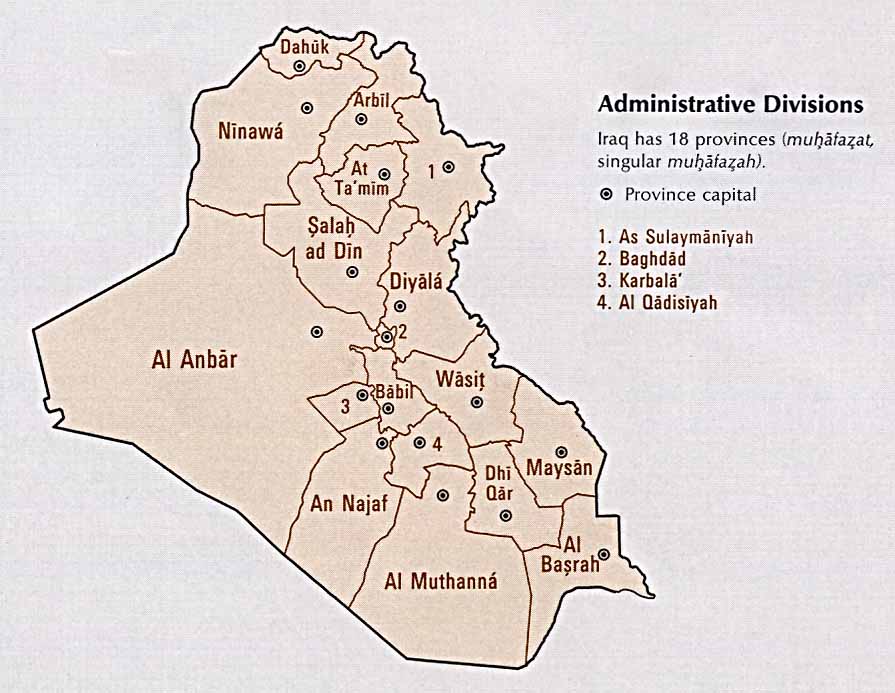
% Of Households Living In Slum Conditions By Province
Irbil 38%
Sulaymaniya 42%
Salahaddin 46%
Dohuk 49%
Karbala 49%
Babil 52%
Baghdad 52%
Basra 54%
Ninewa 56%
Wasit 58%
Dhi Qar 59%
Anbar 59%
Najaf 64%
Muthanna 67%
Qadisiyah 73%
Tamim 78%
Maysan 82%
Diyala 86%
Iraq overall 57%
The U.N. doesn’t believe this situation will be alleviated anytime soon because of a number of issues. Among them are laws limiting private investment, banks that give few personal loans, and a government that is slow to open public land to development. There is legislation, for example, that bars companies from owning land. Strong Iraqi nationalism that opposes foreign corporations, a largely state-run economy, and election year politics all deter Iraqi politicians from changing the laws and regulations. Like so many other things, Iraq is facing a growing problem that needs a response, yet the government is unwilling and unable to meet the challenge.
SOURCES
Abbas, Mohammed, “Iraq aims to allow foreign investors to own land,” Reuters, 5/25/09
Inter-Agency Information and Analysis Unit, “Fact Sheet: Housing & Shelter in Iraq,” UN Habitat for a Better Future, 10/5/09
Ryan, Missy and al-Ansary, Khalid, “Iraq investment still hindered by politics, bureaucracy,” Reuters, 10/7/09
Thursday, October 22, 2009
Inflation Worries Return For Iraq
The latest statistics for Iraq show that core inflation is creeping back up in the country. Since early 2008 core inflation, that which excludes fuel, electricity, communication, and transport costs, has dropped in Iraq from 15.9% in April to 3.8% in April 2009. Since then however, it has crept back up to 10.8% in August. A United Nations report from that same month warned that food prices were rising sharply in Iraq, while other costs like medicine and rents have also increased.
Overall inflation has not followed the same pattern. In February 2008 it stood at 8.1%, only to drop to -6.3% in June, then rose at the end of the year to 7.6% by October. After that it dropped again to -5.7% in April 2009, and has since gone back up to -0.3% by August.
While of concern, these numbers are nowhere near what inflation was like before. In 2002 it was around 60%. The instability and sectarian violence after the U.S. invasion caused inflation to rise to 65% by 2006. After the Central Bank tightened the money supply, and linked the Iraqi dinar to the U.S. dollar inflation has largely been under control. By 2007 for example, it was down to 12%. Those policies have increased the buying power of the average Iraqi, and any increase in inflation will cut into that.
Iraq’s Inflation/Core Inflation Rate
2008
Jan. 1.3%/10.8%
Feb. 8.1%/13.8%
March 5.6%/12.1%
April 5.5%/15.9%
May 4.6%/14.7%
June -6.3%/12.4%
July -1.4%/13.6%
Aug. -5.2%/12.0%
Sep. 0.3%/12.9%
Oct. 7.6%/13.6%
Nov. 6.7%/12.7%
Dec. 6.8%/11.7%
2009
Jan. 0.6%/9.2%
Feb. 0.2%/7.1%
March -3.1%/8.3%
April -5.7%/3.8%
May-5.6%/4.7%
June 0.7%/8.8%
July -1.5%/7.9%
Aug. -0.3%/10.8%
SOURCES
Department of Defense, “Measuring Stability and Security in Iraq,” March 2008
Inter-Agency Information and Analysis Unit, “Iraq Food Prices Analysis,” August 2009
Reuters, “Iraq inflation rises to 8.11 pct in August,” 9/21/08
Special Inspector General for Iraq Reconstruction, “Quarterly Report and Semiannual Report to the United States Government,” 7/30/07
- “Quarterly Report and Semiannual Report to the United States Congress,” 7/30/09
U.S. Department of State, “Iraq Status Report,” 1/28/09
- “Iraq Status Report,” 6/10/09
- “Iraq Status Report,” 10/7/09
Whitelaw, Kevin, “After The Fall,” U.S. News & World Report, 12/2/02
Overall inflation has not followed the same pattern. In February 2008 it stood at 8.1%, only to drop to -6.3% in June, then rose at the end of the year to 7.6% by October. After that it dropped again to -5.7% in April 2009, and has since gone back up to -0.3% by August.
While of concern, these numbers are nowhere near what inflation was like before. In 2002 it was around 60%. The instability and sectarian violence after the U.S. invasion caused inflation to rise to 65% by 2006. After the Central Bank tightened the money supply, and linked the Iraqi dinar to the U.S. dollar inflation has largely been under control. By 2007 for example, it was down to 12%. Those policies have increased the buying power of the average Iraqi, and any increase in inflation will cut into that.
Iraq’s Inflation/Core Inflation Rate
2008
Jan. 1.3%/10.8%
Feb. 8.1%/13.8%
March 5.6%/12.1%
April 5.5%/15.9%
May 4.6%/14.7%
June -6.3%/12.4%
July -1.4%/13.6%
Aug. -5.2%/12.0%
Sep. 0.3%/12.9%
Oct. 7.6%/13.6%
Nov. 6.7%/12.7%
Dec. 6.8%/11.7%
2009
Jan. 0.6%/9.2%
Feb. 0.2%/7.1%
March -3.1%/8.3%
April -5.7%/3.8%
May-5.6%/4.7%
June 0.7%/8.8%
July -1.5%/7.9%
Aug. -0.3%/10.8%
SOURCES
Department of Defense, “Measuring Stability and Security in Iraq,” March 2008
Inter-Agency Information and Analysis Unit, “Iraq Food Prices Analysis,” August 2009
Reuters, “Iraq inflation rises to 8.11 pct in August,” 9/21/08
Special Inspector General for Iraq Reconstruction, “Quarterly Report and Semiannual Report to the United States Government,” 7/30/07
- “Quarterly Report and Semiannual Report to the United States Congress,” 7/30/09
U.S. Department of State, “Iraq Status Report,” 1/28/09
- “Iraq Status Report,” 6/10/09
- “Iraq Status Report,” 10/7/09
Whitelaw, Kevin, “After The Fall,” U.S. News & World Report, 12/2/02
Tuesday, October 20, 2009
Iraq’s Oil Exports Continue To Rise And Fall
The October 7, 2009 State Department Iraq Status Report, found that while Iraq’s oil production has continued to increase since the beginning of the year, its exports took a dip over the last two months. 2008 saw the highest average monthly oil production since the U.S. invasion. For that year, Iraq produced an average of 2.41 million barrels per day, and exported 1.84 million barrels. For the first nine months of 2009 Iraq has been pumping less, an average of 2.39 million barrels, but exporting more, 1.91 million barrels. The 2009 budget however called for 2 million barrels a day in foreign sales. That was achieved for only two months, July and August, constituting the most oil exported since 2003. Since that peak, exports have dipped while overall production has continued to rise. In July Iraq produced 2.48 million barrels and exported 2.08 million. The next month it produced the same amount, but exports dropped to 2.0 million barrels. Finally, in September production climbed again to 2.5 million barrels, but foreign sales dropped to 1.95 million barrels.
The results of this uneven output has been a financial pinch for the government. Iraq is currently running a $19 billion budget deficit. Since international oil prices have not recovered from the world recession that means Iraq will continue to have these problems next year as well. Baghdad is already in negotiations with the International Monetary Fund (IMF) for a $5 billion loan to help with its 2010 and 2011 budgets, but the Finance Minister said that it needs $7 billion. The IMF is also calling for cuts in spending. In a speech, Prime Minister Nouri al-Maliki said that the Fund wanted a slash in salaries, something Baghdad was not willing to do. The Iraqi government is the largest employer in Iraq, and Maliki claimed 74% of the budget goes to their wages. Elections are scheduled for January 2010, which is probably why the Prime Minister is weary of reducing pay.
Iraq’s oil industry is wracked by political divisions, lax maintenance, deteriorating infrastructure, and lacks foreign investment. Its production has continually fluctuated up and down as a result, and the government has never met its production goals. At the same time, the other parts of the country’s economy have declined since 2003, leaving Iraq more dependent upon oil than ever before. Until the country overcomes its internal divisions, this situation is unlikely to change, and only a full recovery in the international economy and a spurt in oil prices will provide Iraq any financial relief.
2009 Iraqi Oil Production/Exports in Millions of Barrels Per Day
Jan. 2.15/1.91
Feb. 2.32/1.77
Mar. 2.37/1.81
Apr. 2.37/1.83
May 2.41/1.9
Jun. 2.43/1.96
Jul. 2.48/2.08
Aug. 2.48/2.0
Sep. 2.50/1.94
SOURCES
Agence France Presse, “Iraq made ‘good progress’ in IMF loan talks: IMF,” 10/6/09
Associated Press, “Iraq predicts budget crunch for next year,” 9/29/09
Madhani, Aamer, “Iraq’s economy sputters as oil prices drop,” USA Today, 1/28/09
Reuters, “Iraq PM Says Cannot Cut Public Pay To Suit IMF,” 10/7/09
U.S. Department of State, “Iraq Status Report,” 10/7/09
Zawya, “Iraq Central Bank Opposes Issuing Treasury Bills To Finance Projects,” 9/27/09
The results of this uneven output has been a financial pinch for the government. Iraq is currently running a $19 billion budget deficit. Since international oil prices have not recovered from the world recession that means Iraq will continue to have these problems next year as well. Baghdad is already in negotiations with the International Monetary Fund (IMF) for a $5 billion loan to help with its 2010 and 2011 budgets, but the Finance Minister said that it needs $7 billion. The IMF is also calling for cuts in spending. In a speech, Prime Minister Nouri al-Maliki said that the Fund wanted a slash in salaries, something Baghdad was not willing to do. The Iraqi government is the largest employer in Iraq, and Maliki claimed 74% of the budget goes to their wages. Elections are scheduled for January 2010, which is probably why the Prime Minister is weary of reducing pay.
Iraq’s oil industry is wracked by political divisions, lax maintenance, deteriorating infrastructure, and lacks foreign investment. Its production has continually fluctuated up and down as a result, and the government has never met its production goals. At the same time, the other parts of the country’s economy have declined since 2003, leaving Iraq more dependent upon oil than ever before. Until the country overcomes its internal divisions, this situation is unlikely to change, and only a full recovery in the international economy and a spurt in oil prices will provide Iraq any financial relief.
2009 Iraqi Oil Production/Exports in Millions of Barrels Per Day
Jan. 2.15/1.91
Feb. 2.32/1.77
Mar. 2.37/1.81
Apr. 2.37/1.83
May 2.41/1.9
Jun. 2.43/1.96
Jul. 2.48/2.08
Aug. 2.48/2.0
Sep. 2.50/1.94
SOURCES
Agence France Presse, “Iraq made ‘good progress’ in IMF loan talks: IMF,” 10/6/09
Associated Press, “Iraq predicts budget crunch for next year,” 9/29/09
Madhani, Aamer, “Iraq’s economy sputters as oil prices drop,” USA Today, 1/28/09
Reuters, “Iraq PM Says Cannot Cut Public Pay To Suit IMF,” 10/7/09
U.S. Department of State, “Iraq Status Report,” 10/7/09
Zawya, “Iraq Central Bank Opposes Issuing Treasury Bills To Finance Projects,” 9/27/09
Thursday, October 08, 2009
Iraq’s 2009 Drought
Iraq is facing a drought again. Officially, it has been going on for the last two years. Unofficially the United Nations says four. The lack of rain, no government water policy, and population growth are the main causes, but Baghdad has been blaming its neighbors as well. Iran, Syria, and Turkey have all built dams that affect Iraq’s two main rivers, the Euphrates and Tigris, along with smaller tributaries. Iraq needs 500 cubic meters per second from both major rivers according to the Water Ministry, but as of August 2009 was only receiving 440 cubic meters per second from the Euphrates and 100-160 cubic meters from the Tigris. All four countries have been holding meetings over water issues, with few results.
Together these problems are having larger and larger effects upon Iraq’s agriculture, rural areas, and power supply. Iraq’s rice production has dropped from 500,000 tons per year to 250,000 tons. Wheat has declined from 3.5 million tons to 1 million tons. As a result, Iraq has become one of the largest food importers in the world, when it was self-sufficient in the 1980s. It will need to import 4 million tons of wheat alone this year, at a cost of $1.4 billion. Overall, Iraq will have to buy 80% of its food needs this year. The drought is also leading to population shifts. 3,000 people in Basra have left their homes because of rising salt levels in the land. In Ninewa, 60 out of 150 villages in the Al-Tal district are deserted in what was once the most productive wheat and barley area of the province. 90% of the land is also desert or suffering from desertification. A report by the European Water Associated warned that Iraq could become barren like Saudi Arabia if something isn’t done. Hydroelectric power production is also down. In the city of Nasiriyah in Dhi Qar province, two of four turbines have been shut down because water levels are so low.
With no government planning, little money to support farmers, minimal international aid, and a lack of cooperation so far from its neighbors, Iraq’s water situation is likely to get worse before it gets better. More rain is likely to be the only respite, otherwise it will face another year of drought, whose effects are spreading from the countryside to Iraq’s cities with migration, decreased power production, and food imports.
Farmland Affected
Affected farmland 36,919 square kilometers
Total farmland 96,706 square kilometers
% of affected farmland 38.7%
Babil, Irbil, Ninewa, Salahaddin, Tamim, – 46-56%
Dhi Qar, Diyala, Maysan – 31-45%
Baghdad, Karbala, Najaf, Qadisiyah – 26-30%
Anbar, Basra, Muthanna, Wasit – 6-25%
Sulaymaniya – 4-5%
Dohuk – 0%
SOURCES
Blua, Antoine, “Iraq Tussles With Neighbors Over Water,” Radio Free Europe/Radio Liberty, 9/13/09
Chulov, Martin, “Water shortage threatens two million people in southern Iraq,” Guardian, 8/26/09
DiPaola, Anthony and Alexander, Caroline, “Iraq Drought Cuts Harvest, Boosts Imports as Oil Cash Slips,” Bloomberg, 8/5/09
Hope, Bradley, “Iraq digs in to rebuild agricultural sector,” The National, 8/30/09
Inter-Agency Information and Analysis Unit, “The Humanitarian Situation In Iraq, Inter-Agency Fact Sheet,” United Nations Office for the Coordination of Humanitarian Affairs, August 2009
IRIN, “IRAQ: Drought hits rice, wheat staples,” 8/31/09b
Kamal, Adel, “desertification destroys ninawa villages,” Niqash, 7/17/09
Raphaeli, Dr. Nimrod, “Water Crisis in Iraq: The Growing Danger of Desertification,” The Middle East Media Institute, 7/23/09
Sly, Liz, “Iraq in throes of environmental catastrophe, experts say,” Los Angeles Times, 7/30/09
Special Inspector General for Iraq Reconstruction, “Quarterly Report and Semiannual Report to the United States Congress,” 7/30/09
Tharp, Mike, “Once world’s bread basket, Iraq now a farming basket case,” McClatchy Newspapers, 7/17/09
Williams, Timothy, “Idle Iraqi Date Farm Show Decline of Economy,” New York Times, 8/15/09
Together these problems are having larger and larger effects upon Iraq’s agriculture, rural areas, and power supply. Iraq’s rice production has dropped from 500,000 tons per year to 250,000 tons. Wheat has declined from 3.5 million tons to 1 million tons. As a result, Iraq has become one of the largest food importers in the world, when it was self-sufficient in the 1980s. It will need to import 4 million tons of wheat alone this year, at a cost of $1.4 billion. Overall, Iraq will have to buy 80% of its food needs this year. The drought is also leading to population shifts. 3,000 people in Basra have left their homes because of rising salt levels in the land. In Ninewa, 60 out of 150 villages in the Al-Tal district are deserted in what was once the most productive wheat and barley area of the province. 90% of the land is also desert or suffering from desertification. A report by the European Water Associated warned that Iraq could become barren like Saudi Arabia if something isn’t done. Hydroelectric power production is also down. In the city of Nasiriyah in Dhi Qar province, two of four turbines have been shut down because water levels are so low.
With no government planning, little money to support farmers, minimal international aid, and a lack of cooperation so far from its neighbors, Iraq’s water situation is likely to get worse before it gets better. More rain is likely to be the only respite, otherwise it will face another year of drought, whose effects are spreading from the countryside to Iraq’s cities with migration, decreased power production, and food imports.
Farmland Affected
Affected farmland 36,919 square kilometers
Total farmland 96,706 square kilometers
% of affected farmland 38.7%
Babil, Irbil, Ninewa, Salahaddin, Tamim, – 46-56%
Dhi Qar, Diyala, Maysan – 31-45%
Baghdad, Karbala, Najaf, Qadisiyah – 26-30%
Anbar, Basra, Muthanna, Wasit – 6-25%
Sulaymaniya – 4-5%
Dohuk – 0%
SOURCES
Blua, Antoine, “Iraq Tussles With Neighbors Over Water,” Radio Free Europe/Radio Liberty, 9/13/09
Chulov, Martin, “Water shortage threatens two million people in southern Iraq,” Guardian, 8/26/09
DiPaola, Anthony and Alexander, Caroline, “Iraq Drought Cuts Harvest, Boosts Imports as Oil Cash Slips,” Bloomberg, 8/5/09
Hope, Bradley, “Iraq digs in to rebuild agricultural sector,” The National, 8/30/09
Inter-Agency Information and Analysis Unit, “The Humanitarian Situation In Iraq, Inter-Agency Fact Sheet,” United Nations Office for the Coordination of Humanitarian Affairs, August 2009
IRIN, “IRAQ: Drought hits rice, wheat staples,” 8/31/09b
Kamal, Adel, “desertification destroys ninawa villages,” Niqash, 7/17/09
Raphaeli, Dr. Nimrod, “Water Crisis in Iraq: The Growing Danger of Desertification,” The Middle East Media Institute, 7/23/09
Sly, Liz, “Iraq in throes of environmental catastrophe, experts say,” Los Angeles Times, 7/30/09
Special Inspector General for Iraq Reconstruction, “Quarterly Report and Semiannual Report to the United States Congress,” 7/30/09
Tharp, Mike, “Once world’s bread basket, Iraq now a farming basket case,” McClatchy Newspapers, 7/17/09
Williams, Timothy, “Idle Iraqi Date Farm Show Decline of Economy,” New York Times, 8/15/09
Tuesday, August 18, 2009
Unemployment And Underemployment Numbers For Iraq
The new quarterly report by the Special Inspector General for Iraq Reconstruction (SIGIR) includes the latest figures on Iraq’s unemployment and underemployment rates. The national averages were 17.3% unemployment and 29.4% underemployment. That compares to a United Nations survey conducted in January 2009 that found 18% of those questioned out of work and 10% underemployed. The SIGIR report shows that joblessness and lack of steady employment are spread throughout the different provinces of Iraq with no real regional patterns, while the U.N. survey pointed out that the young are the worst effected.
The SIGIR broke down employment numbers by province. Wasit, Irbil, Baghdad, Tamim, and Qadisiyah had the lowest unemployment rates ranging from 13.6% to 15.9%. Dhi Qar, Muthanna, Salahaddin, Dohuk, and Ninewa on the other hand with jobless rates going from 20.9% to 36.5% did the worst. The top and bottom five showed that there was no real connection between region and employment. Northern Iraq for example, had both one of the best labor markets in Tamim, and one of the worst in Ninewa. Kurdistan, which has a much more stable environment than the rest of Iraq had 14.5% unemployment in Irbil, but 21.6% in Dohuk. The same was true for southern Iraq with Wasit and Qadisiyah at the top, and Muthanna and Dhi Qar at the absolute bottom.
Unemployment by Province July 2009
Wasit 13.6%
Irbil 14.5%
Baghdad 14.5%
Tamim 15.7%
Qadisiyah 15.9%
Babil 15.9%
Sulaymaniya 16.0%
Maysan 17.3%
Anbar 17.4%
Najaf 18.6%
Basra 18.8%
Diyala 19.0%
Karbala 19.1%
Ninewa 20.9%
Dohuk 21.6%
Salahaddin 21.9%
Muthanna 30.5%
Dhi Qar 36.5%
National Avg. 17.3%
That order didn’t quite hold up for underemployment. Wasit with the lowest jobless rate in Iraq had the highest underemployment at 51.4%. Irbil however with the second best labor market also had the lowest underemployment with 18.1%, while Muthanna was in the bottom five in both categories. The three Kurdish provinces tended to do better with underemployment than the rest of the country, but otherwise the problem was evenly distributed across the other regions of Iraq.
Underemployment By Province July 2009
Irbil 18.1%
Sulaymaniya 21.1%
Najaf 21.1%
Basra 21.6%
Dohuk 23.2%
Dhi Qar 25.8%
Tamim 26.0%
Salahaddin 27.1%
Baghdad 27.3%
Qadisiyah 27.3%
Karbala 31.1%
Diyala 31.9%
Maysan 32.9%
Anbar 33.3%
Muthanna 33.5%
Ninewa 37.5%
Babil 40.9%
Wasit 51.4%
National Avg. 29.4%
What is another pressing issue is the fact that the United Nations found that young people were the most likely to be jobless in a society facing increasing demographic pressure from that exact group. The U.N. survey reported that men between the ages of 15-29 had a 28% unemployment rate. They made up 57% of all the unemployed in Iraq. 26% of all women were without a job. They were also only 17% of the labor market. The U.N. said one of the major causes of this was the fact that the government, which provided 43% of all the jobs in the country, 60% of full time work, and was the largest employer in fourteen of Iraq’s eighteen provinces, preferred hiring older males. This in a society where 313,000 males turn 18 each year, and 38.8% of the population is 14 or under.
The overall employment situation would probably be even worse if the government hadn’t increased its hiring in recent years. Many state-run industries, for example have far more workers than needed. Reuters went to a power plant in Baghdad that was supposed to have 2,500 employees, but had hired 4,370. The Minister of Industry and Minerals in a July 27, 2009 interview said that because of this bloated work force, the average public employee only works two hours a day. This also distorts the labor market as everyone wants a government job because of its security, which means fewer people available for private business.
Iraq is still a state-run economy despite all the attempts by the Americans at reform. A whole range of structural and security issues hinders the private sector, and foreign investment, while increasing, is still very limited. All together that means that the government will play the determining factor in employment in the future. Unless the civil service diversifies its practices, that means an increasing jobless rate as more and more young people enter the labor market to no avail, which could lead to more unrest and greater dissatisfaction with Baghdad.
SOURCES
Abbas, Mohammed, “Iraq investors face bloated workforce dilemma,” Reuters, 8/10/09
Cordesman, Anthony, “Iraq’s Fracture Lines: Recidivism or Reassertion,” Center for Strategic and International Studies, 7/28/09
Inter-Agency Information and Analysis Unit, “Iraq Labour Force Analysis 2003-2008,” United Nations Office for the Coordination of Humanitarian Affairs, January 2009
Special Inspector General for Iraq Reconstruction, “Quarterly Report and Semiannual Report to the United States Congress,” 1/30/09
- “Quarterly Report and Semiannual Report to the United States Congress,” 7/30/09
The SIGIR broke down employment numbers by province. Wasit, Irbil, Baghdad, Tamim, and Qadisiyah had the lowest unemployment rates ranging from 13.6% to 15.9%. Dhi Qar, Muthanna, Salahaddin, Dohuk, and Ninewa on the other hand with jobless rates going from 20.9% to 36.5% did the worst. The top and bottom five showed that there was no real connection between region and employment. Northern Iraq for example, had both one of the best labor markets in Tamim, and one of the worst in Ninewa. Kurdistan, which has a much more stable environment than the rest of Iraq had 14.5% unemployment in Irbil, but 21.6% in Dohuk. The same was true for southern Iraq with Wasit and Qadisiyah at the top, and Muthanna and Dhi Qar at the absolute bottom.
Unemployment by Province July 2009
Wasit 13.6%
Irbil 14.5%
Baghdad 14.5%
Tamim 15.7%
Qadisiyah 15.9%
Babil 15.9%
Sulaymaniya 16.0%
Maysan 17.3%
Anbar 17.4%
Najaf 18.6%
Basra 18.8%
Diyala 19.0%
Karbala 19.1%
Ninewa 20.9%
Dohuk 21.6%
Salahaddin 21.9%
Muthanna 30.5%
Dhi Qar 36.5%
National Avg. 17.3%
That order didn’t quite hold up for underemployment. Wasit with the lowest jobless rate in Iraq had the highest underemployment at 51.4%. Irbil however with the second best labor market also had the lowest underemployment with 18.1%, while Muthanna was in the bottom five in both categories. The three Kurdish provinces tended to do better with underemployment than the rest of the country, but otherwise the problem was evenly distributed across the other regions of Iraq.
Underemployment By Province July 2009
Irbil 18.1%
Sulaymaniya 21.1%
Najaf 21.1%
Basra 21.6%
Dohuk 23.2%
Dhi Qar 25.8%
Tamim 26.0%
Salahaddin 27.1%
Baghdad 27.3%
Qadisiyah 27.3%
Karbala 31.1%
Diyala 31.9%
Maysan 32.9%
Anbar 33.3%
Muthanna 33.5%
Ninewa 37.5%
Babil 40.9%
Wasit 51.4%
National Avg. 29.4%
What is another pressing issue is the fact that the United Nations found that young people were the most likely to be jobless in a society facing increasing demographic pressure from that exact group. The U.N. survey reported that men between the ages of 15-29 had a 28% unemployment rate. They made up 57% of all the unemployed in Iraq. 26% of all women were without a job. They were also only 17% of the labor market. The U.N. said one of the major causes of this was the fact that the government, which provided 43% of all the jobs in the country, 60% of full time work, and was the largest employer in fourteen of Iraq’s eighteen provinces, preferred hiring older males. This in a society where 313,000 males turn 18 each year, and 38.8% of the population is 14 or under.
The overall employment situation would probably be even worse if the government hadn’t increased its hiring in recent years. Many state-run industries, for example have far more workers than needed. Reuters went to a power plant in Baghdad that was supposed to have 2,500 employees, but had hired 4,370. The Minister of Industry and Minerals in a July 27, 2009 interview said that because of this bloated work force, the average public employee only works two hours a day. This also distorts the labor market as everyone wants a government job because of its security, which means fewer people available for private business.
Iraq is still a state-run economy despite all the attempts by the Americans at reform. A whole range of structural and security issues hinders the private sector, and foreign investment, while increasing, is still very limited. All together that means that the government will play the determining factor in employment in the future. Unless the civil service diversifies its practices, that means an increasing jobless rate as more and more young people enter the labor market to no avail, which could lead to more unrest and greater dissatisfaction with Baghdad.
SOURCES
Abbas, Mohammed, “Iraq investors face bloated workforce dilemma,” Reuters, 8/10/09
Cordesman, Anthony, “Iraq’s Fracture Lines: Recidivism or Reassertion,” Center for Strategic and International Studies, 7/28/09
Inter-Agency Information and Analysis Unit, “Iraq Labour Force Analysis 2003-2008,” United Nations Office for the Coordination of Humanitarian Affairs, January 2009
Special Inspector General for Iraq Reconstruction, “Quarterly Report and Semiannual Report to the United States Congress,” 1/30/09
- “Quarterly Report and Semiannual Report to the United States Congress,” 7/30/09
Monday, August 03, 2009
Kurdistan Lacks Services And Employment

Kurdistan recently held parliamentary elections on July 25, 2009. The main topics in the vote were the rule of the Patriotic Union of Kurdistan (PUK) and the Kurdistan Democratic Party (KDP), and corruption. Just as important could be the economy. While there are many who tout the relative stability in Kurdistan and its foreign investment, the region actually lags behind in almost all humanitarian and economic indicators compared to the rest of the country.
The Kurdistan Region is made up of three provinces, Dohuk, Erbil, and Sulaymaniya. Irbil and Sulaymaniya have over one million inhabitants each, while Dohuk only has around 500,000. Dohuk is also home to over 100,000 internally displaced Iraqis.
Population
Dohuk 505,491
Irbil 1,542,421
Sulaymaniya 1,893,617
Internally Displaced In Kurdistan
Sulaymaniya 36,000
Ibril 62,034
Dohuk 112,392
The relative stability and security in Kurdistan has not provided the population there the opportunities or services one would expect. The employment situation in the Kurdistan Regional Government (KRG) is mixed. In Iraq overall 12% of men and 13% of women are without jobs. Men in Irbil and Sulaymaniya do better at 9% and 10% respectively, but in Dohuk 13% of men are lacking employment. Women do far worse however. In Irbil the unemployment rate for them is 16%, followed by 26% in Sulaymaniya and 30% in Dohuk. The percentage of men and women involved in the labor force are also lower in Kurdistan compared to Iraq. In the rest of the country 18% of women and 81% of men are either employed or looking for work. The labor force participation in Dohuk is only 7% for women and 76% for women. Irbil at 12% of women, 77% of men, and Sulaymaniya at 15% of women and 78% of men, only do slightly better.
Unemployment
Iraq: 13% women, 12% men
Irbil: 16% women, 9% men
Sulaymaniya: 26% women, 10% men
Dohuk: 30% women, 13% men
Labor Force Participation
Iraq: 18% women, 81% men
Dohuk: 7% women, 76% men
Irbil: 12% women, 77% men
Sulaymaniya: 15% women, 78% men
In terms of poverty Kurdistan actually does better than Iraq in general. 22% of Iraqis live in the lowest per capita income quintile. Irbil at 15% and Sulaymaniya at 18% do better, although in Dohuk 33% of the population is in the bottom group.
Poverty - % Living In The Lowest Per Capita Income Quintile
Iraq: 22%
Irbil: 15%
Sulaymaniya: 18%
Dohuk: 33%
Where the KRG lags behind is in education. Kurdistan has higher illiteracy rates, with 43% of women and 21% of men in Dohuk, 40% of women and 20% of men in Sulaymaniya, and 44% of women and 18% of men in Irbil in this situation, compared to 24% of women and 11% of men nationally. This is due to lower education levels. In Iraq 47% of women and 31% of men have less than a primary education. In Dohuk the rate is 65% of women and 49% of men, followed by 64% of women and 49% of men in Sulaymaniya, and 64% of women and 42% of men in Irbil.
Illiteracy
Iraq: 24% women, 11% men
Irbil: 44% women, 18% men
Sulaymaniya: 43% women, 20% men
Dohuk: 43% women, 21% men
% With Less Than A Primary Education
Iraq: 47% women, 31% men
Irbil: 64% women, 42% men
Sulaymaniya: 64% women, 49% men
Dohuk: 65% women, 49% men
Services are also worse in the KRG. Kurds receive much less electricity than the rest of the country. 55% of Iraqis have more than 11 hours of power cuts per day or are not connected to the power network at all. In Kurdistan more than 80% of the population in all three provinces experience these difficulties. Kurdistan is also lacking in sanitation. 26% of Iraqis are not connected to the sanitation system. Dohuk is close to the national average at 28% not being connected, but Sulaymaniya at 38% and Irbil at 48% don’t do as well.
Electricity – More Than 11 Hours of Power Cuts Or No Connection To Network
Iraq: 55%
Irbil: 84%
Sulaymaniya: 88%
Dohuk: 85%
Not Connected To the Sanitation Network
Iraq: 26%
Dohuk: 28%
Sulaymaniya: 38%
Irbil: 48%
Since 2003, Kurdistan has been one of the most stable parts of Iraq due to its tight security, limits on migration, and domination by the Kurdistan Democratic Party (KDP) and Patriotic Union of Kurdistan (PUK). These two ruling parties however, have not been able to take advantage of that to provide jobs, education, or services to the population. Instead the PUK and KDP have been more interested in maintaining their control, and building up their two major strongholds, the cities of Irbil and Sulaymaniya. Outside of those urban areas the rest of the KRG has been left underdeveloped. This was the first year that this became an issue when Kurds went to the polls. Even then, the PUK and KDP seem to have maintained their control of the KRG. If the elections lead to an actual opposition however, those two parties may finally begin serving the population rather than themselves because now they actually have to compete for the loyalties of the people.
SOURCES
Dagher, Sam, “Strong Showing Seen for Kurdish Challengers,” New York Times, 7/26/09
Danly, James, “The 2009 Kurdish Elections,” Institute for the Study of War, 7/23/09
Inter-Agency Information and Analysis Unit, “Dahuk Governorate Profile,” United Nations Office for the Coordination of Humanitarian Affairs, April 2009
- “Erbil Governorate Profile,” United Nations Office for the Coordination of Humanitarian Affairs, July 2009
- “Sulyamaniyah Governorate Profile,” United Nations Office for the Coordination of Humanitarian Affairs, July 2009
Sunday, July 05, 2009
Administration Needs to Prepare Congress and Public For A Long Stay In Iraq Says Iraq Analyst
As U.S. combat troops prepare to withdraw from Iraq’s cities, Anthony Cordesman, one of the top military analysts on Iraq from the Center for Strategic and International Studies, argues that the administration needs to build up support for a long-term presence there. This is a position that he has consistently called for. Cordesman worries that too much emphasis is being put on withdrawal, when the goal should be institutionalizing support for Iraq so that it can become a strong U.S. ally in the region. This is especially important because Cordesman does not believe that the U.S. has won in Iraq, but rather will continue to face challenges there before Iraq becomes a stabile and independent state. Cordesman wrote about these issues in a memorandum to General Ray Odierno after a recent trip to Iraq.
The main problems America faces in Iraq today are not what they use to be. Violence is down, and the Iraqi security forces are better. The sectarian war is over, and he does not believe that the Sunnis and Shiites want to return to fighting each other. Rather the main divisions today are over politics. The two main ones are between Arabs and Kurds, and with Prime Minister Nouri al-Maliki and his critics. The ethnic divisions are now the most pressing issue in his opinion as tensions are rising between Arabs and Kurds, and the two sides are losing patience with each other. Politically, Iraq is still dealing with integrating the Sunnis, and they themselves still lack strong leadership. This struggle has now become entangled with the Prime Minister, as the Sunnis have become the major opponent of Maliki trying to assert power.
Iraq faces an additional problem developing its economy. Iraq is almost completely dependent upon oil for revenues. That industry and the rest are all underdeveloped. Iraq needs to diversify, and open up to foreign investment so that it can build up its infrastructure and provide better services. The Iraqi government has been incapable of doing either so far, even with better security. Cordesman believes that Baghdad lacks the knowledge of how to create effective business deals and legislation, and politicians are too caught up in either defending their country against the perceived threats of foreign corporations or thinking about the possible profits, rather than on how to make things better.
Cordesman believes that these two issues will require constant attention and mediation by the Americans. The main tool he believes in using is aid. First, the U.S. needs to maintain its level of financial assistance flowing to Iraq. This is especially hard now with most Americans focused upon getting out of Iraq and the economic crisis at home. The U.S. also needs to help with the country’s political and economic troubles. American aid and mediation for example, could help integrate the Kurdish peshmerga into the security forces, an idea that is now dead due to the political divisions. This could assure the Kurds of security, while allowing Baghdad to continue with its plans of expanding its military. On the economic side, the U.S. should provide business models for Iraq to improve their contacts with foreign companies. The Americans have been working to revive the State Owned Enterprises, which have the potential to add much needed jobs as well. The U.S. should also get the World Bank involved with development more because the U.S. presence will shrink with the withdrawal of combat forces. To accomplish this the U.S. needs to maintain both military and civilian advisers in Iraq past the 2011 deadline for withdrawal.
Cordesman found that some planning for this is already being done in Iraq. The military especially is trying to transition from a security operation to a rebuilding mode. He did not see as much evidence of that on the civilian side however. Too many political and economic plans he saw were focused upon finishing specific programs rather than looking at the bigger picture of what needs to be done in the future.
Overall, Cordesman argues that the U.S. will be remembered for what they leave behind in Iraq, rather than on how they got there. The U.S. military and diplomatic staff in Iraq is thinking this way, but he’s not sure Washington is. Too much emphasis is being put on short-term goals such as pulling out of the cities this summer, and the withdrawal in 2011. Cordesman, like many other American Iraq experts, believes that the U.S. should have a long-term presence in Iraq that may last as long as 2020 or further. Unless the administration begins setting the groundwork for this by telling the public and Congress of the sacrifices needed, and the journey ahead, no one will support it, and Cordesman worries that will mean all the blood and money spent in Iraq will go to waste.
This will ultimately come down to whether President Obama wants to make this kind of commitment. There will be a diplomatic presence in Iraq no matter what. His real task is deciding on whether he will maintain troops there or not. He has been very open to his military commanders, and they will assuredly ask for tens of thousands of American advisers to stay past 2011. Coming up with the money for a robust assistance package however after most combat troops are out will be much harder as the public and Congress have already lost interest in Iraq.
The main problem with Cordesman and other similar analysts is that they often overlook the system of dependence the Iraqis have built up upon the Americans, which a long-term presence will only continue. Cordesman mentions this once when discussing the opening of the oil sector to foreign investment. He writes that Baghdad has offered oil contracts, but then expects Washington to do the rest of the work, pushing international companies to sign them. This is true for a whole range of other issues as well. As reported earlier, the U.S. has spent millions trying to build up the maintenance and logistics capacity of the Iraqi Army, but they have refused responsibility for much of it, leading to the Americans to do most of the work instead. The Americans need to get the Iraqis to do more rather than hold their hands for the next ten years. That’s basically what Cordesman and others want the administration to do. They want every issue in Iraq to be dealt with before a full withdrawal. This will not be like the U.S. presence in South Korea either as President Bush once suggested, because Iraq is likely to see violence during that entire stay. The Obama White House needs to do a cost-benefit analysis of what its willing to expend on Iraq, and how much responsibility they want to have for it because Cordesman, other Iraq experts, and the U.S. military are asking for an open-ended commitment.
SOURCES
Cordesman, Anthony, “Observations From a Visit to Iraq,” 6/15/09
Gwertzman, Bernard, “U.S. ‘Winning’ Unpopular War in Iraq, but ‘Losing’ Popular War in Afghanistan,” Council on Foreign Relations, 9/8/08
Nagl, John and Burton, Brian, “After the Fire: Shaping the Future U.S. Relationship with Iraq,” Center for a New American Security, June 2009
The main problems America faces in Iraq today are not what they use to be. Violence is down, and the Iraqi security forces are better. The sectarian war is over, and he does not believe that the Sunnis and Shiites want to return to fighting each other. Rather the main divisions today are over politics. The two main ones are between Arabs and Kurds, and with Prime Minister Nouri al-Maliki and his critics. The ethnic divisions are now the most pressing issue in his opinion as tensions are rising between Arabs and Kurds, and the two sides are losing patience with each other. Politically, Iraq is still dealing with integrating the Sunnis, and they themselves still lack strong leadership. This struggle has now become entangled with the Prime Minister, as the Sunnis have become the major opponent of Maliki trying to assert power.
Iraq faces an additional problem developing its economy. Iraq is almost completely dependent upon oil for revenues. That industry and the rest are all underdeveloped. Iraq needs to diversify, and open up to foreign investment so that it can build up its infrastructure and provide better services. The Iraqi government has been incapable of doing either so far, even with better security. Cordesman believes that Baghdad lacks the knowledge of how to create effective business deals and legislation, and politicians are too caught up in either defending their country against the perceived threats of foreign corporations or thinking about the possible profits, rather than on how to make things better.
Cordesman believes that these two issues will require constant attention and mediation by the Americans. The main tool he believes in using is aid. First, the U.S. needs to maintain its level of financial assistance flowing to Iraq. This is especially hard now with most Americans focused upon getting out of Iraq and the economic crisis at home. The U.S. also needs to help with the country’s political and economic troubles. American aid and mediation for example, could help integrate the Kurdish peshmerga into the security forces, an idea that is now dead due to the political divisions. This could assure the Kurds of security, while allowing Baghdad to continue with its plans of expanding its military. On the economic side, the U.S. should provide business models for Iraq to improve their contacts with foreign companies. The Americans have been working to revive the State Owned Enterprises, which have the potential to add much needed jobs as well. The U.S. should also get the World Bank involved with development more because the U.S. presence will shrink with the withdrawal of combat forces. To accomplish this the U.S. needs to maintain both military and civilian advisers in Iraq past the 2011 deadline for withdrawal.
Cordesman found that some planning for this is already being done in Iraq. The military especially is trying to transition from a security operation to a rebuilding mode. He did not see as much evidence of that on the civilian side however. Too many political and economic plans he saw were focused upon finishing specific programs rather than looking at the bigger picture of what needs to be done in the future.
Overall, Cordesman argues that the U.S. will be remembered for what they leave behind in Iraq, rather than on how they got there. The U.S. military and diplomatic staff in Iraq is thinking this way, but he’s not sure Washington is. Too much emphasis is being put on short-term goals such as pulling out of the cities this summer, and the withdrawal in 2011. Cordesman, like many other American Iraq experts, believes that the U.S. should have a long-term presence in Iraq that may last as long as 2020 or further. Unless the administration begins setting the groundwork for this by telling the public and Congress of the sacrifices needed, and the journey ahead, no one will support it, and Cordesman worries that will mean all the blood and money spent in Iraq will go to waste.
This will ultimately come down to whether President Obama wants to make this kind of commitment. There will be a diplomatic presence in Iraq no matter what. His real task is deciding on whether he will maintain troops there or not. He has been very open to his military commanders, and they will assuredly ask for tens of thousands of American advisers to stay past 2011. Coming up with the money for a robust assistance package however after most combat troops are out will be much harder as the public and Congress have already lost interest in Iraq.
The main problem with Cordesman and other similar analysts is that they often overlook the system of dependence the Iraqis have built up upon the Americans, which a long-term presence will only continue. Cordesman mentions this once when discussing the opening of the oil sector to foreign investment. He writes that Baghdad has offered oil contracts, but then expects Washington to do the rest of the work, pushing international companies to sign them. This is true for a whole range of other issues as well. As reported earlier, the U.S. has spent millions trying to build up the maintenance and logistics capacity of the Iraqi Army, but they have refused responsibility for much of it, leading to the Americans to do most of the work instead. The Americans need to get the Iraqis to do more rather than hold their hands for the next ten years. That’s basically what Cordesman and others want the administration to do. They want every issue in Iraq to be dealt with before a full withdrawal. This will not be like the U.S. presence in South Korea either as President Bush once suggested, because Iraq is likely to see violence during that entire stay. The Obama White House needs to do a cost-benefit analysis of what its willing to expend on Iraq, and how much responsibility they want to have for it because Cordesman, other Iraq experts, and the U.S. military are asking for an open-ended commitment.
SOURCES
Cordesman, Anthony, “Observations From a Visit to Iraq,” 6/15/09
Gwertzman, Bernard, “U.S. ‘Winning’ Unpopular War in Iraq, but ‘Losing’ Popular War in Afghanistan,” Council on Foreign Relations, 9/8/08
Nagl, John and Burton, Brian, “After the Fire: Shaping the Future U.S. Relationship with Iraq,” Center for a New American Security, June 2009
Wednesday, June 10, 2009
May 2009 International Organization for Migration Report On Iraq's Displaced
At the end of May 2009 the International Organization for Migration (IOM) released its latest report on Iraq's displaced. They specifically are worried about the fate of the two million plus Iraqis that have not returned home yet. They note that while thousands of displaced have gone back to their original provinces, the vast majority have not. Both groups continue to face problems such as finding work and housing, and gaining access to services and assistance. The IOM is concerned that many of these Iraqis will become permanent refugees.
Since 2007 the IOM has noted that Iraqis displaced after the February 2006 Samarra bombing, which triggered the sectarian war, have begun to return. The IOM has counted 49,464 of these families, or 296,598 people, that have come back. Only 7%, of those, 3,443 families, were refugees. That is a small fraction of the estimated 1.6 million that lost their homes after the 2006 attack. They have gone back to 765 different locations in Iraq. 90% of the post-Samarra displaced came from Baghdad, Diyala and Ninewa, so it should be no surprise that those three provinces, plus Anbar have seen the most returns. Qadisiyah, Muthanna, and Dhi Qar had the least with 44, 64, and 108 families respectively. 61% of displaced families surveyed said they wanted to go home.
Post-Feb. 2006 Displaced And Refugee Family Returns (Not Including Kurdistan)
Province | Returning Families | % That Are Refugee Families |
Iraq | 49,464 | 7% |
Baghdad | 31,497 | 4% |
Diyala | 8,779 | 1% |
Anbar | 4,536 | 27% |
Ninewa | 1,602 | 1% |
Maysan | 626 | 49% |
Tamim | 620 | 37% |
Basra | 500 | 0% |
Karbala | 298 | 21% |
Babil | 258 | 9% |
Najaf | 215 | 55% |
Salahaddin | 191 | 35% |
Dhi Qar | 108 | 31% |
Muthanna | 64 | 88% |
Qadisiyah | 44 | 23% |
A major factor in returning is the proximity of the displaced to their original homes. 68% of the families that came back resided within their home province. That compared to 21% that were in another province, and 11% that came back from another country. That varied however across each province. In Muthanna and Najaf for example, 100% of the returnees were refugees, while none of those that came back to Basra and Ninewa were in foreign nation beforehand.
Origins Of Returnees By Province
Location | Refugees | Displaced Within Same Province | Displaced In Another Province |
TOTAL | 11% | 68% | 21% |
Anbar | 36% | 52% | 12% |
Babil | 15% | 52% | 33% |
Baghdad | 6% | 71% | 23% |
Basra | 0% | 0% | 100% |
Diyala | 6% | 61% | 33% |
Karbala | 92% | 0% | 8% |
Maysan | 0% | 0% | 100% |
Muthanna | 100% | 0% | 0% |
Najaf | 100% | 0% | 0% |
Ninewa | 0% | 100% | 0% |
Salahaddin | 88% | 13% | 0% |
Tamim | 58% | 11% | 31% |
Wasit | 50% | 0% | 50% |
Conditions in Iraq appeared to be another major reason why families come back. 36.7% of returnees interviewed by the IOM said that better security was the top cause for returning. That was followed by 35.7% that believed a combination of improved security and difficult conditions where they lived was the major factor. Only 15.5% felt that they left because of the hardships they were going through.
Reasons For Return
Reasons for Return | % |
Improved security in home area | 36.7% |
Improved security in home area and difficult conditions | 35.7% |
Very difficult conditions | 15.5% |
Other | 5.8% |
Government returnee payments | 4.2% |
Improved security in home area, difficult conditions, returnee payments | 1.8% |
Very difficult conditions and returnee payments | 0.3% |
The majority of families feel safe after their returns, but there are still some troubling incidents. 59.6% of those polled by the IOM said they felt safe all of the time after going back, while 39.4% said they only felt safe some of the time. There are various anecdotal stories of attacks and threats against displaced. In the Dora neighborhood of Baghdad an IED targeted displaced. Eighteen families in Abu Ghraib came back, but couldn't stay in their homes and became displaced again. Two families from Diyala went back, but were attacked by a militia, which led to the death of two family members. They left the province again as a result. According to IraqSlogger, in Adhamiya, Baghdad, the Sons of Iraq put "X"s on the houses of Shiites that had been displaced telling them not to come back in April 2009. The state of their property is another issue for returnees. 49.1% said that their houses were in good condition, but 38.7% found some damage to them.
The government has also been actively encouraging Iraqis to come back. Baghdad offered $851 for families that did. The authorities have recently announced that they were no longer registering people anymore, which was a prerequisite to receive the money. Not many returnees signed up for this program in the first place, and the government paid even fewer. The IOM found that only 44% of those surveyed had applied for the money, and of those, only 36% said they got it.
For those still displaced, finding work, services, and aid are major problems. 50.4% of male-headed households were out of work, and 97.3% of female-led ones were. Overall, 35% of those surveyed said they could work, but couldn't find a job. Salahaddin, 75%, Muthanna 70%, and Babil, 64%, had the highest responses in that category. In total, 56% of the displaced are unemployed. 64.2% of those surveyed claimed they had six hours or less of electricity. 83.8% did say they had access to the national water system, but that doesn't mean that it is potable. Almost all of the displaced, 98%, said they had their food ration card, but their access varied. 32% said they regularly got their rations, 60% said it was irregular, and 8% said they never got them. Ninewa was the worst with 99% saying they got their rations infrequently. Getting health care also varied greatly from province to province. 90% or more in Anbar, Maysan, Muthanna, Najaf, Ninewa and Salahaddin said they had adequate access, while 57% of returnees in Baghdad, 65% in Basra, and 78% in Tamim claimed they had none. When asked what their greatest needs were, displaced families said food, 63%, fuel, 51%, and health care, 40% were the top priorities. 88% also said they had received no aid outside of the government.
Unemployment
Total: 44% employed, 56% unemployed
Male-headed household: 49.6% employed, 50.4% unemployed
Female-headed household: 2.7% employed, 97.3% unemployed
Overall the IOM is worried about what will happen to the millions of Iraqis that have lost their homes because of the war. Only a small fraction has returned, and those that haven't face a plethora of problems, most importantly finding work and food. Those that have come back also face a similar set of problems. Neither the government, nor non-government organizations such as the IOM have the resources to deal with such a large population. The fear is that many of them will simply have to fend for themselves, perhaps creating a permanent class of displaced both within and without of Iraq for the foreseeable future.
SOURCES
International Organization for Migration, "IOM Emergency Needs Assessments; Post February 2006 Displacement In Iraq, Monthly Report," 4/1/09
- "IOM Monitoring And Needs Assessments of Iraqi Return, May 2009," May 2009
Smith, Daniel and al-Timimi, Yousif, "Residents: Some Sahwa Still Keeping Shi'a Out," IraqSlogger.com, 4/21/09
U.S. Reconstruction In Iraq Coming To An End
U.S. reconstruction in Iraq is coming to an end. The effort to rebuild the country following the 2003 invasion was the largest in American history, with the U.S. budgeting $51 billion for the project. That amount has almost all been spent, and no new large outlays are expected in the future, especially with the U.S. planning on withdrawing. The Special Inspector General for Iraq Reconstruction (SIGIR) believes that most of this money failed to achieve its goals. While the Iraqi security forces were successfully reconstituted, the larger goal of boosting services and the economy of Iraq failed.
Since March 2003 the U.S. has promised $51.0 billion for reconstruction in Iraq. $24.43 billion was for security, and $26.57 for the economy, government, and services. $42.16 billion of the total amount has been obligated for projects, while $37.89 billion was actually spent. Of the remaining $3.01 billion in unspent funds, $2.82 billion is for the Iraqi armed forces and police. The new Obama administration has asked for an additional $700 million, $449 million of which is supposed to go to reconstruction. The White House did not ask for any new money for the Iraqi security forces. Instead, the President wants to extend $1 billion in bridge funds left over from 2008 for that purpose.
The American program was originally aimed at rebuilding Iraq’s infrastructure and building a democracy, but as violence rose in the country, more and more money was appropriated for security. By April 2009 the Iraqi security forces took almost half of the funding at $24.43 billion compared to $11.82 billion for infrastructure like electricity, oil, gas, water, sanitation, transportation, and communications. The SIGIR reported that the rise in attacks in Iraq derailed much of the reconstruction program, delaying projects and adding additional costs.
The U.S. program has not been without success. The one area that the SIGIR believes has seen the best effort is the rebuilding of the Iraqi security forces. They now stand at over 700,000 strong. The Americans have also added 1.2 million cubic meters of sewage treatment capacity, brought up water production to 2.4 million cubic meters of potable water per day, and for three straight quarters electricity production has gone up. Power output is now higher than pre-invasion levels. The problem is since the overthrow of Saddam, demand for services has skyrocketed amongst Iraqis, and the U.S.-funded increases have not kept up. Only around 25% of Iraqis polled say they were satisfied with the sewage system for example.
Today, U.S.-reconstruction is coming to an end, leaving Iraq increasingly in charge. There are no current oil projects on-line for example. There is still $224.39 million going to be spent on electricity however. Now the Iraqi government is the largest source of funding for rebuilding. Its capital budget used for investment has recently gone down from $13.1 billion in 2008 to $12.7 billion this year. Iraq has also never been able to spend all of its money, like the Electricity Ministry that only spent 12% of its budget last year.
Now that Iraqis are taking control, transferring projects is becoming an issue. An April 26, 2009 SIGIR audit found that the U.S. had been turning over projects to Iraqis with no unified plan or process. Many are given to the Iraqi government whether they can handle them or not. Most transfers are also done at the local level, and the information is not passed up to Baghdad or Washington. Of $13.5 billion in projects studied by SIGIR, 72% were handed over to local authorities, and only 13% to the central government. That means neither government has a real idea on what has been done so far. Some of these projects were not even wanted by the Iraqis, and were left unused or were not maintained. The Iraqis in general also don’t have the experience or training in much of the equipment installed by the Americans. For instance, examinations of Iraqi health care facilities found that gear wasn’t always installed and Iraqis didn’t always know how to operate them. The SIGIR is worried that this will mean much of the U.S. investment will be wasted. The U.S. is trying to address this by spending $313.7 million on training and spare parts. That still doesn’t address the larger issue of how the Iraqis will take control of the thousands of projects built by the Americans.
In its review of the U.S. reconstruction effort, the SIGIR believes that much of the U.S. reconstruction project has failed. Iraqis are largely unhappy with the state of the economy, services, and government. Production of many services such as electricity is higher than under Saddam, but it’s only meeting a fraction of demand. The main problem was the lack of security, which was not planned for. That derailed and delayed much of the work. Violence also shifted the focus of the Americans to the point that the security forces received just as much money as building up the economy and government combined. The U.S. also tended to impose their views of what Iraq should have, rather than asking Iraqis what they wanted. Many of the large infrastructure projects therefore were not used properly, left to break down, or were never wanted. Some of the $51 billion budgeted for Iraq has gone to good work, especially the money appropriated by U.S. commanders to local Iraqis. The larger projects however are more of a mixed bag.
Total Outlays By U.S.
Security - $24.43 billion
$21.18 billion obligated
$18.58 billion expended
$3.24 billion unspent
$6.84 billion for equipment and transportation
$5.79 billion for infrastructure
$5.67 billion for training and operations
$2.42 billion for sustainment
$1.72 billion for rule of law
$1.0 billion for other
Infrastructure - $11.82 billion
$11.41 billion obligated
$10.86 billion expended
$553 million unspent
Infrastructure – Electricity - $5.09 billion
$4.98 billion obligated
$4.75 billion spent
Infrastructure – Water and Sanitation - $2.25 billion
$2.17 billion obligated
$2.01 billion spent
Infrastructure – Oil and Gas - $2.05 billion
$1.93 billion obligated
$1.88 billion spent
Infrastructure – Other - $1.31 billion
Infrastructure – Transportation and Communication - $1.12 billion
$1.09 billion obligated
$965 million spent
Governance - $7.02 billion
$5.64 billion spent
$2.38 billion obligated for capacity development
$1.92 billion obligated for democracy and civil society
$1.88 billion obligated for public services
$0.81 billion obligated for humanitarian relief
Economy - $1.47 billion
$1.25 billion spent
SOURCES
Special Inspector General for Iraq Reconstruction, “Asset-Transfer Process for Iraq Reconstruction Projects Lacks Unity and Accountability,” 4/26/09
- “Hard Lessons,” 1/22/09
- “Quarterly Report to the United States Congress,” 4/30/09
Since March 2003 the U.S. has promised $51.0 billion for reconstruction in Iraq. $24.43 billion was for security, and $26.57 for the economy, government, and services. $42.16 billion of the total amount has been obligated for projects, while $37.89 billion was actually spent. Of the remaining $3.01 billion in unspent funds, $2.82 billion is for the Iraqi armed forces and police. The new Obama administration has asked for an additional $700 million, $449 million of which is supposed to go to reconstruction. The White House did not ask for any new money for the Iraqi security forces. Instead, the President wants to extend $1 billion in bridge funds left over from 2008 for that purpose.
The American program was originally aimed at rebuilding Iraq’s infrastructure and building a democracy, but as violence rose in the country, more and more money was appropriated for security. By April 2009 the Iraqi security forces took almost half of the funding at $24.43 billion compared to $11.82 billion for infrastructure like electricity, oil, gas, water, sanitation, transportation, and communications. The SIGIR reported that the rise in attacks in Iraq derailed much of the reconstruction program, delaying projects and adding additional costs.
The U.S. program has not been without success. The one area that the SIGIR believes has seen the best effort is the rebuilding of the Iraqi security forces. They now stand at over 700,000 strong. The Americans have also added 1.2 million cubic meters of sewage treatment capacity, brought up water production to 2.4 million cubic meters of potable water per day, and for three straight quarters electricity production has gone up. Power output is now higher than pre-invasion levels. The problem is since the overthrow of Saddam, demand for services has skyrocketed amongst Iraqis, and the U.S.-funded increases have not kept up. Only around 25% of Iraqis polled say they were satisfied with the sewage system for example.
Today, U.S.-reconstruction is coming to an end, leaving Iraq increasingly in charge. There are no current oil projects on-line for example. There is still $224.39 million going to be spent on electricity however. Now the Iraqi government is the largest source of funding for rebuilding. Its capital budget used for investment has recently gone down from $13.1 billion in 2008 to $12.7 billion this year. Iraq has also never been able to spend all of its money, like the Electricity Ministry that only spent 12% of its budget last year.
Now that Iraqis are taking control, transferring projects is becoming an issue. An April 26, 2009 SIGIR audit found that the U.S. had been turning over projects to Iraqis with no unified plan or process. Many are given to the Iraqi government whether they can handle them or not. Most transfers are also done at the local level, and the information is not passed up to Baghdad or Washington. Of $13.5 billion in projects studied by SIGIR, 72% were handed over to local authorities, and only 13% to the central government. That means neither government has a real idea on what has been done so far. Some of these projects were not even wanted by the Iraqis, and were left unused or were not maintained. The Iraqis in general also don’t have the experience or training in much of the equipment installed by the Americans. For instance, examinations of Iraqi health care facilities found that gear wasn’t always installed and Iraqis didn’t always know how to operate them. The SIGIR is worried that this will mean much of the U.S. investment will be wasted. The U.S. is trying to address this by spending $313.7 million on training and spare parts. That still doesn’t address the larger issue of how the Iraqis will take control of the thousands of projects built by the Americans.
In its review of the U.S. reconstruction effort, the SIGIR believes that much of the U.S. reconstruction project has failed. Iraqis are largely unhappy with the state of the economy, services, and government. Production of many services such as electricity is higher than under Saddam, but it’s only meeting a fraction of demand. The main problem was the lack of security, which was not planned for. That derailed and delayed much of the work. Violence also shifted the focus of the Americans to the point that the security forces received just as much money as building up the economy and government combined. The U.S. also tended to impose their views of what Iraq should have, rather than asking Iraqis what they wanted. Many of the large infrastructure projects therefore were not used properly, left to break down, or were never wanted. Some of the $51 billion budgeted for Iraq has gone to good work, especially the money appropriated by U.S. commanders to local Iraqis. The larger projects however are more of a mixed bag.
Total Outlays By U.S.
Security - $24.43 billion
$21.18 billion obligated
$18.58 billion expended
$3.24 billion unspent
$6.84 billion for equipment and transportation
$5.79 billion for infrastructure
$5.67 billion for training and operations
$2.42 billion for sustainment
$1.72 billion for rule of law
$1.0 billion for other
Infrastructure - $11.82 billion
$11.41 billion obligated
$10.86 billion expended
$553 million unspent
Infrastructure – Electricity - $5.09 billion
$4.98 billion obligated
$4.75 billion spent
Infrastructure – Water and Sanitation - $2.25 billion
$2.17 billion obligated
$2.01 billion spent
Infrastructure – Oil and Gas - $2.05 billion
$1.93 billion obligated
$1.88 billion spent
Infrastructure – Other - $1.31 billion
Infrastructure – Transportation and Communication - $1.12 billion
$1.09 billion obligated
$965 million spent
Governance - $7.02 billion
$5.64 billion spent
$2.38 billion obligated for capacity development
$1.92 billion obligated for democracy and civil society
$1.88 billion obligated for public services
$0.81 billion obligated for humanitarian relief
Economy - $1.47 billion
$1.25 billion spent
SOURCES
Special Inspector General for Iraq Reconstruction, “Asset-Transfer Process for Iraq Reconstruction Projects Lacks Unity and Accountability,” 4/26/09
- “Hard Lessons,” 1/22/09
- “Quarterly Report to the United States Congress,” 4/30/09
Sunday, June 07, 2009
How Did The Outgoing Provincial Councils Do?
All of Iraq’s new provincial councils have now been seated. The Special Inspector General for Iraq Reconstruction (SIGIR) released its quarterly report to Congress on April 30, which contains the latest data on how those outgoing politicians did. The previous councils were in office from 2005 to 2009. Most came to power with little to no experience in government. Their last two years should be their best performance because they were able to learn on the job, had the benefit of U.S. and international training, and saw a dramatic drop in violence.
In 2008 the provinces were budgeted $9,830.69 million. They spent 67% of it, or $6,596.8 million. The three Kurdish provinces of Dohuk, Irbil, and Sulaymaniya received almost a third of the overall amount, $3,701.49 million. The Kurdish Regional Government (KRG) does not provide information about its spending however, so both Baghdad and the U.S. tend to count all of the money sent north as spent. In 2008 the SIGIR said Kurdistan spent 100% of their budget, which skews the overall number for Iraq’s provinces upwards. Without the KRG, the remaining fifteen governorates were budgeted $6,129.2 million, and only spent 47% of it, $2,894.7 million. This was an improvement over 2007 when the provinces were budgeted $3,631 million and spent over $2,137 million, 58%+. Minus Kurdistan the provinces spent $650 mil of their $2,071 budget, 31.3% however. While getting better, these numbers show that Iraq’s local governments still have a ways to go in appropriating and investing their money. The public sector is the largest part of the economy, so it’s important that the provinces expend as much as possible. 47% in 2008, especially with the dramatic drop in violence, is still an inadequate amount given the demands of average Iraqis.
In terms of individual provinces, outside of Kurdistan, Maysan, Karbala, Najaf, Babil, and Anbar did the best in executing their budget in that order in 2008. Maysan, which was controlled by the Sadrists, spent 86.4% of their 2008 budget. The Supreme Islamic Iraqi Council (SIIC) controlled Karbala, 85.3%, Najaf, 75.7%, and Babil 63.5%. The Iraqi Islamic Party ran Anbar, which rounded out the top five, spending 54.4% of its budget. In 2007 many of the same provinces and parties were at the top, starting with Najaf, 64%, Maysan, 51%, Babil, 49%, Karbala, 41%, and Wasit, 41%, the last of which had a Sadrist governor and a provincial council run by the Iraq Elites Gathering.
Ninewa, 36.6%, Dhi Qar, 33.1%, Qadisiyah, 31.5%, Diyala, 28.2%, and Muthanna, 26.8%, were at the bottom last year. The Supreme Council ran Qadisiyah alone. In Dhi Qar, the council was split between the Fadhila Party and the SIIC, and Diyala and Muthanna had a SIIC-Dawa coalition. Ninewa was controlled by the Kurdish Alliance of the Kurdistan Democratic Party (KDP) and Patriotic Union of Kurdistan (PUK), with an independent Arab governor. In 2007 Baghdad, 31%, Ninewa, 26%, Basra, 21%, Muthanna, 19%, and Anbar, 3.7%, did the worst. The Supreme Council controlled Baghdad, and all of them except for Muthanna were some of the most violent in the country that year, which greatly complicated governing them. The provinces that did the best and worst in this category show that the ruling party had little to do with performance. The Supreme Council for example controlled three of the top five governorates that spent the most money, but also had a hand in ruling four of the bottom five. It seems that local officials, and their training and expertise would be much more important factors than what national parties they belonged to when it came to executing their budgets.
2008 Provincial Budget Execution – Ruling Parties
Total: Budgeted $9,830.69 mil, Spent $6,596.8 mil, 67%
Not Including Kurdistan: Budgeted $6,129.2 mil, Spent $2,894.7 mil, 47%
Kurdistan - Budgeted: $3,701.49 mil, Spent $3,702.1 mil, 100% - KDP-PUK
Maysan - Budgeted $194.59 mil, Spent $168.09 mil, 86.4% - Sadrists
Karbala - Budgeted $164.03 mil, Spent $139.86 mil, 85.3% - SIIC
Najaf - Budgeted $328.18 mil, Spent $248.41 mil, 75.7% - SIIC
Babil - Budgeted $409.09 mil, Spent $259.83 mil, 63.5% - SIIC
Anbar - Budgeted $367.15 mil, Spent $199.68 mil, 54.4% - Iraqi Islamic Party
Wasit - Budgeted $217.59 mil, Spent $117.16 mil, 53.8% - Iraq Elites Gathering-Sadrists
Baghdad - Budgeted $1,433.52 mil, Spent $670.66 mil, 46.8% - SIIC
Salahaddin - Budgeted $243.47 mil, Spent $112.25 mil, 46.1% - KDP-PUK
Basra - Budgeted $660.04 mil, Spent $287.37 mil, 43.5% - SIIC-Fadhila
Tamim - Budgeted $285.52 mil, Spent $108.19 mil, 37.9% - KDP-PUK
Ninewa - Budgeted $538.43 mil, Spent $197.11 mil, 36.6% - KDP-PUK
Dhi Qar - Budgeted $377.09 mil, Spent $124.84 mil, 33.1% - Fadhila-SIIC
Qadisiyah - Budgeted $240.45 mil, Spent $75.67 mil, 31.5% - SIIC
Diyala - Budgeted $443.11 mil, Spent $124.81 mil, 28.2% - Dawa-SIIC
Muthanna - Budgeted $226.94 mil, Spent $60.77 mil, 26.8% - Dawa-SIIC
2007 Provincial Budget Execution – Ruling Parties
Total: Budgeted $3,631 mil, Spent $2,137+ mil, 58%+
Not Including Kurdistan: Budgeted $2,071 mil, Spent $650 mil, 31.3%+
Kurdistan - Budgeted $1,560 mil, Spent $1,487, 95% - KDP-PUK
Najaf – Budgeted $88 mil, Spent $54.6 mil, 64% - SIIC
Maysan – Budgeted $76 mil, Spent $39 mil, 51% - Sadrists
Babil – Budgeted $127 mil, Spent $61.9 mil, 49% - SIIC
Karbala – Budgeted $71 mil, Spent $29.4 mil, 41% - SIIC
Wasit – Budgeted $83 mil, Spent $33.7 mil, 41% - Iraq Elites Gathering-Sadrists
Dhi Qar – Budgeted $138 mil, Spent $54.8 mil, 40% - Fadhila-SIIC
Qadisiyah – Budgeted $64 mil, Spent $24.7 mil, 39% - SIIC
Salahaddin – Budgeted $93 mil, Spent $31.5 mil, 34% - KDP-PUK
Tamim – Budgeted $91 mil, Spent $31 mil, 34% - KDP-PUK
Baghdad – Budgeted $560 mil, Spent $174.4 mil, 31% - SIIC
Ninewa – Budgeted $226 mil, Spent $58.5 mil, 26% - KDP-PUK
Basra – Budgeted $195 mil, Spent $40.8 mil, 26% - SIIC-Fadhila
Muthanna – Budgeted $52 mil, Spent $9.9 mil, 19% - Dawa-SIIC
Anbar – Budgeted $107 mil, Spent $4 mil, 3.7% - Iraqi Islamic Party
Diyala – Budgeted $100 mil, Spent N/A – Dawa-SIIC
The aggregate numbers on the amount budgeted and spent in each province only tells half of the story. In 2008, Maysan was ranked the top province in spending its budget outside of Kurdistan at 86.4%. However that money only led to 41 of 241 projects being completed there. For another view, the SIGIR report also included assessments of the U.S.-led Provincial Reconstruction Teams (PRTs), which operate in each of Iraq’s governorates. They rated Maysan as the least developed of all of Iraq’s provincial economies.
The PRTs assess governance, political development, reconciliation, economic development, and rule of law. These topics are ranked beginning, developing, sustaining, performing, or self-reliant. From February 2008 to February 2009 Kurdistan was given the highest rating, Wasit, Babil, and Karbala had the most improvement, while Ninewa, Anbar, Diyala, Baghdad, Muthanna, and Basra all saw reversals. Karbala, run by the SIIC, was rated the most successful province outside of Kurdistan, progressing from developing to performing in political development, reconciliation, and rule of Law, and from developing to sustaining in governance and economic development. Wasit was the only province that was given a self-reliant mark, and that was in reconciliation. Muthanna had a similar rating in February 2008, but fell back to sustaining a year later.
PRT Rankings:
Beginning: Little progress on decision-making, provision of services, political participation, fighting corruption, basic freedoms, infrastructure, and unemployment.
Developing: Small improvements in economic development, government, and security. Still lack budget spending, basic freedoms, political participation, jobs, banks, and effort against corruption.
Sustaining: Getting better at working with national government, building political parties, political participation, and police. Still lacks coordination, appropriations, banks, and still has tribal influences.
Performing: Social and financial institutions and infrastructure working, coordination, political participation, and transparency exists. Banks opening, appropriations improving, transportation available, police and legal system building, security forces in the lead, and tribes deferring to government.
Self-Reliant: Independent government with basic freedoms, security, political and economic institutions working, religious tolerance, working legal system, and self-sufficient security forces.
Anbar
Governance – Sustaining
Political Development – Sustaining
Reconciliation – Sustaining
Economic Development – Advanced from Developing to Sustaining
Rule of Law – Moved down from Sustaining to Developing
Babil
Governance – Developing
Political Development – Advanced from Beginning to Performing
Reconciliation – Advanced from Beginning to Sustaining
Economic Development – Sustaining
Rule of Law – Advanced from Sustaining to Performing
Baghdad
Governance – Advanced from Developing to Sustaining
Political Development – Advanced from Developing to Sustaining
Reconciliation – Advanced from Developing to Sustaining
Economic Development – Advanced from Developing to Sustaining
Rule of Law – Moved down from Sustaining to Developing
Basra
Governance – Moved down from Sustaining to Developing
Political Development – Advanced from Sustaining to Performing
Reconciliation – Sustaining
Economic Development – Advanced from Developing to Sustaining
Rule of Law – Developing
Dhi Qar
Governance – Sustaining
Political Development – Sustaining
Reconciliation – Sustaining
Economic Development – Sustaining
Rule of Law - Sustaining
Diyala
Governance – Moved down from Sustaining to Developing
Political Development – Developing
Reconciliation – Developing
Economic Development – Advanced from Developing to Sustaining
Rule of Law – Beginning to Developing
Karbala
Governance – Advanced from Developing to Sustaining
Political Development – Advanced from Developing to Performing
Reconciliation – Advanced from Developing to Performing
Economic Development – Advanced from Developing to Sustaining
Rule of Law – Advanced from Developing to Performing
Kurdistan
Governance – Sustaining
Political Development – Performing
Reconciliation – Performing
Economic Development – Advanced from Sustaining to Performing
Rule of Law – Advanced from Sustaining to Performing
Maysan
Governance – Advanced from Beginning to Developing
Political Development – Developing
Reconciliation – Sustaining
Economic Development – Beginning
Rule of Law – Developing
Muthanna
Governance – Advanced from Developing to Sustaining
Political Development – Advanced from Beginning to Performing
Reconciliation- Moved down from Self-Reliant to Sustaining
Economic Development – Advanced from Developing to Sustaining
Rule of Law – Advanced from Developing to Sustaining
Najaf
Governance – Sustaining
Political Development – Advanced from Developing to Performing
Reconciliation – Advanced from Developing to Sustaining
Economic Development – Sustaining
Rule of Law – Sustaining
Ninewa
Governance – Developing
Political Development – Advanced from Developing to Sustaining
Reconciliation – Advanced from Beginning to Developing
Economic Development – Developing
Rule of Law – Moved down from Sustaining to Developing
Qadisiyah
Governance – Advanced from Developing to Sustaining
Political Development – Advanced from Developing to Sustaining
Reconciliation – Beginning
Economic Development – Advanced from Beginning to Sustaining
Rule of Law – Advanced from Developing to Sustaining
Salahaddin
Governance – Sustaining
Political Development – Advanced from Sustaining to Performing
Reconciliation – Advanced from Developing to Sustaining
Economic Development – Developing
Rule of Law – Developing
Tamim
Governance – Advanced from Developing to Sustaining
Political Development – Sustaining
Reconciliation – Advanced from Developing to Sustaining
Economic Development – Advanced from Developing to Sustaining
Rule of Law – Advanced from Developing to Sustaining
Wasit
Governance – Developing
Political Development – Advanced from Developing to Sustaining
Reconciliation – Advanced from Beginning to Self-Reliant
Economic Development – Advanced from Beginning to Sustaining
Rule of Law – Advanced from Developing to Performing
The SIGIR also provided the unemployment figures for each province. A recent January 2009 United Nations survey of Iraqis found the jobless rate at 18%. The SIGIR’s numbers were close at 19.5%. Wasit had the lowest unemployment rate at 13.6%. It also spent more than half of its budget at 53.8%, and had one of the largest jumps in economic development from beginning to sustaining according to the PRTs. Wasit was followed by Baghdad, 14.5%, Tamim, 15.7%, Babil, 15.9%, and Qadisiyah, 15.9%. Those four provinces were all over the place in spending their budgets from Qadisiyah that was third from last, only executing 31.5% of its money, to Babil, which spent 63.5% of its budget. The PRTs also ranked all of them at the sustaining level as well. At the opposite end of the spectrum were Karbala, 19.1%, Ninewa 20.9%, Salahaddin, 21.9%, Muthanna, 30.5%, and Dhi Qar, 36.5%, that had the highest unemployment. Ninewa and Salahaddin were both given developing marks in economics by the PRTs, the second to last rating, and were in the middle to bottom in spending their money. Muthanna and Dhi Qar were given sustaining ranks by the PRTs, but barely executed their budgets, with Muthanna in last place.
Unemployment By Province
Wasit 13.6%
Baghdad 14.5%
Tamim 15.7%
Babil 15.9%
Qadisiyah 15.9%
Kurdistan 16.7%
Maysan 17.3%
Anbar 17.4%
Najaf 18.6%
Basra 18.8%
Diyala 19.0%
Karbala 19.1%
Ninewa 20.9%
Salahaddin 21.9%
Muthanna 30.5%
Dhi Qar 36.5%
Avg. 19.5%
The budget execution and unemployment numbers provided by the SIGIR and the PRT assessments are some of the best available information on Iraq’s provinces. They can point out the overall economic situation of each area, and give hints at how they were governed. Overall, the statistics show that party affiliation does not translate into either good or bad policies. The Supreme Council for example ran half of Iraq’s provinces, but that only meant they were both at the top and bottom in terms of developing their areas. The real difference was the growth and performance of local officials, many of which were amateurs when they were elected in 2005. Some provinces showed great improvement according to the PRTs, and that was reflected in their spending and unemployment situation. All eighteen governorates however still needed to get much better at appropriating their money and providing jobs. The problem is that many of the new incoming councils are novices as well, which could mean another long process of learning the nuts and bolts of governing and budgeting with the provinces suffering in the meantime.
SOURCES
Aswat al-Iraq, “41 out of 241 projects implemented in Missan,” 12/30/08
Inter-Agency Information and Analysis Unit, “Iraq Labour Force Analysis 2003-2008,” United Nations Office for the Coordination of Humanitarian Affairs, January 2009
Knights, Michael and McCarthy, Eamon, “Provincial Politics in Iraq: Fragmentation or New Awakening?” Washington Institute for Near East Policy, April 2008
Robertson, Campbell and Glanz, James, “Iraqi Figures Back U.S. View on Low Spending for Reconstruction,” New York Times, 8/21/08
Special Inspector General for Iraq Reconstruction, “Quarterly and Semiannual Report to the United States Congress,” 7/30/08
- “Quarterly Report to the United States Congress,” 4/30/09
In 2008 the provinces were budgeted $9,830.69 million. They spent 67% of it, or $6,596.8 million. The three Kurdish provinces of Dohuk, Irbil, and Sulaymaniya received almost a third of the overall amount, $3,701.49 million. The Kurdish Regional Government (KRG) does not provide information about its spending however, so both Baghdad and the U.S. tend to count all of the money sent north as spent. In 2008 the SIGIR said Kurdistan spent 100% of their budget, which skews the overall number for Iraq’s provinces upwards. Without the KRG, the remaining fifteen governorates were budgeted $6,129.2 million, and only spent 47% of it, $2,894.7 million. This was an improvement over 2007 when the provinces were budgeted $3,631 million and spent over $2,137 million, 58%+. Minus Kurdistan the provinces spent $650 mil of their $2,071 budget, 31.3% however. While getting better, these numbers show that Iraq’s local governments still have a ways to go in appropriating and investing their money. The public sector is the largest part of the economy, so it’s important that the provinces expend as much as possible. 47% in 2008, especially with the dramatic drop in violence, is still an inadequate amount given the demands of average Iraqis.
In terms of individual provinces, outside of Kurdistan, Maysan, Karbala, Najaf, Babil, and Anbar did the best in executing their budget in that order in 2008. Maysan, which was controlled by the Sadrists, spent 86.4% of their 2008 budget. The Supreme Islamic Iraqi Council (SIIC) controlled Karbala, 85.3%, Najaf, 75.7%, and Babil 63.5%. The Iraqi Islamic Party ran Anbar, which rounded out the top five, spending 54.4% of its budget. In 2007 many of the same provinces and parties were at the top, starting with Najaf, 64%, Maysan, 51%, Babil, 49%, Karbala, 41%, and Wasit, 41%, the last of which had a Sadrist governor and a provincial council run by the Iraq Elites Gathering.
Ninewa, 36.6%, Dhi Qar, 33.1%, Qadisiyah, 31.5%, Diyala, 28.2%, and Muthanna, 26.8%, were at the bottom last year. The Supreme Council ran Qadisiyah alone. In Dhi Qar, the council was split between the Fadhila Party and the SIIC, and Diyala and Muthanna had a SIIC-Dawa coalition. Ninewa was controlled by the Kurdish Alliance of the Kurdistan Democratic Party (KDP) and Patriotic Union of Kurdistan (PUK), with an independent Arab governor. In 2007 Baghdad, 31%, Ninewa, 26%, Basra, 21%, Muthanna, 19%, and Anbar, 3.7%, did the worst. The Supreme Council controlled Baghdad, and all of them except for Muthanna were some of the most violent in the country that year, which greatly complicated governing them. The provinces that did the best and worst in this category show that the ruling party had little to do with performance. The Supreme Council for example controlled three of the top five governorates that spent the most money, but also had a hand in ruling four of the bottom five. It seems that local officials, and their training and expertise would be much more important factors than what national parties they belonged to when it came to executing their budgets.
2008 Provincial Budget Execution – Ruling Parties
Total: Budgeted $9,830.69 mil, Spent $6,596.8 mil, 67%
Not Including Kurdistan: Budgeted $6,129.2 mil, Spent $2,894.7 mil, 47%
Kurdistan - Budgeted: $3,701.49 mil, Spent $3,702.1 mil, 100% - KDP-PUK
Maysan - Budgeted $194.59 mil, Spent $168.09 mil, 86.4% - Sadrists
Karbala - Budgeted $164.03 mil, Spent $139.86 mil, 85.3% - SIIC
Najaf - Budgeted $328.18 mil, Spent $248.41 mil, 75.7% - SIIC
Babil - Budgeted $409.09 mil, Spent $259.83 mil, 63.5% - SIIC
Anbar - Budgeted $367.15 mil, Spent $199.68 mil, 54.4% - Iraqi Islamic Party
Wasit - Budgeted $217.59 mil, Spent $117.16 mil, 53.8% - Iraq Elites Gathering-Sadrists
Baghdad - Budgeted $1,433.52 mil, Spent $670.66 mil, 46.8% - SIIC
Salahaddin - Budgeted $243.47 mil, Spent $112.25 mil, 46.1% - KDP-PUK
Basra - Budgeted $660.04 mil, Spent $287.37 mil, 43.5% - SIIC-Fadhila
Tamim - Budgeted $285.52 mil, Spent $108.19 mil, 37.9% - KDP-PUK
Ninewa - Budgeted $538.43 mil, Spent $197.11 mil, 36.6% - KDP-PUK
Dhi Qar - Budgeted $377.09 mil, Spent $124.84 mil, 33.1% - Fadhila-SIIC
Qadisiyah - Budgeted $240.45 mil, Spent $75.67 mil, 31.5% - SIIC
Diyala - Budgeted $443.11 mil, Spent $124.81 mil, 28.2% - Dawa-SIIC
Muthanna - Budgeted $226.94 mil, Spent $60.77 mil, 26.8% - Dawa-SIIC
2007 Provincial Budget Execution – Ruling Parties
Total: Budgeted $3,631 mil, Spent $2,137+ mil, 58%+
Not Including Kurdistan: Budgeted $2,071 mil, Spent $650 mil, 31.3%+
Kurdistan - Budgeted $1,560 mil, Spent $1,487, 95% - KDP-PUK
Najaf – Budgeted $88 mil, Spent $54.6 mil, 64% - SIIC
Maysan – Budgeted $76 mil, Spent $39 mil, 51% - Sadrists
Babil – Budgeted $127 mil, Spent $61.9 mil, 49% - SIIC
Karbala – Budgeted $71 mil, Spent $29.4 mil, 41% - SIIC
Wasit – Budgeted $83 mil, Spent $33.7 mil, 41% - Iraq Elites Gathering-Sadrists
Dhi Qar – Budgeted $138 mil, Spent $54.8 mil, 40% - Fadhila-SIIC
Qadisiyah – Budgeted $64 mil, Spent $24.7 mil, 39% - SIIC
Salahaddin – Budgeted $93 mil, Spent $31.5 mil, 34% - KDP-PUK
Tamim – Budgeted $91 mil, Spent $31 mil, 34% - KDP-PUK
Baghdad – Budgeted $560 mil, Spent $174.4 mil, 31% - SIIC
Ninewa – Budgeted $226 mil, Spent $58.5 mil, 26% - KDP-PUK
Basra – Budgeted $195 mil, Spent $40.8 mil, 26% - SIIC-Fadhila
Muthanna – Budgeted $52 mil, Spent $9.9 mil, 19% - Dawa-SIIC
Anbar – Budgeted $107 mil, Spent $4 mil, 3.7% - Iraqi Islamic Party
Diyala – Budgeted $100 mil, Spent N/A – Dawa-SIIC
The aggregate numbers on the amount budgeted and spent in each province only tells half of the story. In 2008, Maysan was ranked the top province in spending its budget outside of Kurdistan at 86.4%. However that money only led to 41 of 241 projects being completed there. For another view, the SIGIR report also included assessments of the U.S.-led Provincial Reconstruction Teams (PRTs), which operate in each of Iraq’s governorates. They rated Maysan as the least developed of all of Iraq’s provincial economies.
The PRTs assess governance, political development, reconciliation, economic development, and rule of law. These topics are ranked beginning, developing, sustaining, performing, or self-reliant. From February 2008 to February 2009 Kurdistan was given the highest rating, Wasit, Babil, and Karbala had the most improvement, while Ninewa, Anbar, Diyala, Baghdad, Muthanna, and Basra all saw reversals. Karbala, run by the SIIC, was rated the most successful province outside of Kurdistan, progressing from developing to performing in political development, reconciliation, and rule of Law, and from developing to sustaining in governance and economic development. Wasit was the only province that was given a self-reliant mark, and that was in reconciliation. Muthanna had a similar rating in February 2008, but fell back to sustaining a year later.
PRT Rankings:
Beginning: Little progress on decision-making, provision of services, political participation, fighting corruption, basic freedoms, infrastructure, and unemployment.
Developing: Small improvements in economic development, government, and security. Still lack budget spending, basic freedoms, political participation, jobs, banks, and effort against corruption.
Sustaining: Getting better at working with national government, building political parties, political participation, and police. Still lacks coordination, appropriations, banks, and still has tribal influences.
Performing: Social and financial institutions and infrastructure working, coordination, political participation, and transparency exists. Banks opening, appropriations improving, transportation available, police and legal system building, security forces in the lead, and tribes deferring to government.
Self-Reliant: Independent government with basic freedoms, security, political and economic institutions working, religious tolerance, working legal system, and self-sufficient security forces.
Anbar
Governance – Sustaining
Political Development – Sustaining
Reconciliation – Sustaining
Economic Development – Advanced from Developing to Sustaining
Rule of Law – Moved down from Sustaining to Developing
Babil
Governance – Developing
Political Development – Advanced from Beginning to Performing
Reconciliation – Advanced from Beginning to Sustaining
Economic Development – Sustaining
Rule of Law – Advanced from Sustaining to Performing
Baghdad
Governance – Advanced from Developing to Sustaining
Political Development – Advanced from Developing to Sustaining
Reconciliation – Advanced from Developing to Sustaining
Economic Development – Advanced from Developing to Sustaining
Rule of Law – Moved down from Sustaining to Developing
Basra
Governance – Moved down from Sustaining to Developing
Political Development – Advanced from Sustaining to Performing
Reconciliation – Sustaining
Economic Development – Advanced from Developing to Sustaining
Rule of Law – Developing
Dhi Qar
Governance – Sustaining
Political Development – Sustaining
Reconciliation – Sustaining
Economic Development – Sustaining
Rule of Law - Sustaining
Diyala
Governance – Moved down from Sustaining to Developing
Political Development – Developing
Reconciliation – Developing
Economic Development – Advanced from Developing to Sustaining
Rule of Law – Beginning to Developing
Karbala
Governance – Advanced from Developing to Sustaining
Political Development – Advanced from Developing to Performing
Reconciliation – Advanced from Developing to Performing
Economic Development – Advanced from Developing to Sustaining
Rule of Law – Advanced from Developing to Performing
Kurdistan
Governance – Sustaining
Political Development – Performing
Reconciliation – Performing
Economic Development – Advanced from Sustaining to Performing
Rule of Law – Advanced from Sustaining to Performing
Maysan
Governance – Advanced from Beginning to Developing
Political Development – Developing
Reconciliation – Sustaining
Economic Development – Beginning
Rule of Law – Developing
Muthanna
Governance – Advanced from Developing to Sustaining
Political Development – Advanced from Beginning to Performing
Reconciliation- Moved down from Self-Reliant to Sustaining
Economic Development – Advanced from Developing to Sustaining
Rule of Law – Advanced from Developing to Sustaining
Najaf
Governance – Sustaining
Political Development – Advanced from Developing to Performing
Reconciliation – Advanced from Developing to Sustaining
Economic Development – Sustaining
Rule of Law – Sustaining
Ninewa
Governance – Developing
Political Development – Advanced from Developing to Sustaining
Reconciliation – Advanced from Beginning to Developing
Economic Development – Developing
Rule of Law – Moved down from Sustaining to Developing
Qadisiyah
Governance – Advanced from Developing to Sustaining
Political Development – Advanced from Developing to Sustaining
Reconciliation – Beginning
Economic Development – Advanced from Beginning to Sustaining
Rule of Law – Advanced from Developing to Sustaining
Salahaddin
Governance – Sustaining
Political Development – Advanced from Sustaining to Performing
Reconciliation – Advanced from Developing to Sustaining
Economic Development – Developing
Rule of Law – Developing
Tamim
Governance – Advanced from Developing to Sustaining
Political Development – Sustaining
Reconciliation – Advanced from Developing to Sustaining
Economic Development – Advanced from Developing to Sustaining
Rule of Law – Advanced from Developing to Sustaining
Wasit
Governance – Developing
Political Development – Advanced from Developing to Sustaining
Reconciliation – Advanced from Beginning to Self-Reliant
Economic Development – Advanced from Beginning to Sustaining
Rule of Law – Advanced from Developing to Performing
The SIGIR also provided the unemployment figures for each province. A recent January 2009 United Nations survey of Iraqis found the jobless rate at 18%. The SIGIR’s numbers were close at 19.5%. Wasit had the lowest unemployment rate at 13.6%. It also spent more than half of its budget at 53.8%, and had one of the largest jumps in economic development from beginning to sustaining according to the PRTs. Wasit was followed by Baghdad, 14.5%, Tamim, 15.7%, Babil, 15.9%, and Qadisiyah, 15.9%. Those four provinces were all over the place in spending their budgets from Qadisiyah that was third from last, only executing 31.5% of its money, to Babil, which spent 63.5% of its budget. The PRTs also ranked all of them at the sustaining level as well. At the opposite end of the spectrum were Karbala, 19.1%, Ninewa 20.9%, Salahaddin, 21.9%, Muthanna, 30.5%, and Dhi Qar, 36.5%, that had the highest unemployment. Ninewa and Salahaddin were both given developing marks in economics by the PRTs, the second to last rating, and were in the middle to bottom in spending their money. Muthanna and Dhi Qar were given sustaining ranks by the PRTs, but barely executed their budgets, with Muthanna in last place.
Unemployment By Province
Wasit 13.6%
Baghdad 14.5%
Tamim 15.7%
Babil 15.9%
Qadisiyah 15.9%
Kurdistan 16.7%
Maysan 17.3%
Anbar 17.4%
Najaf 18.6%
Basra 18.8%
Diyala 19.0%
Karbala 19.1%
Ninewa 20.9%
Salahaddin 21.9%
Muthanna 30.5%
Dhi Qar 36.5%
Avg. 19.5%
The budget execution and unemployment numbers provided by the SIGIR and the PRT assessments are some of the best available information on Iraq’s provinces. They can point out the overall economic situation of each area, and give hints at how they were governed. Overall, the statistics show that party affiliation does not translate into either good or bad policies. The Supreme Council for example ran half of Iraq’s provinces, but that only meant they were both at the top and bottom in terms of developing their areas. The real difference was the growth and performance of local officials, many of which were amateurs when they were elected in 2005. Some provinces showed great improvement according to the PRTs, and that was reflected in their spending and unemployment situation. All eighteen governorates however still needed to get much better at appropriating their money and providing jobs. The problem is that many of the new incoming councils are novices as well, which could mean another long process of learning the nuts and bolts of governing and budgeting with the provinces suffering in the meantime.
SOURCES
Aswat al-Iraq, “41 out of 241 projects implemented in Missan,” 12/30/08
Inter-Agency Information and Analysis Unit, “Iraq Labour Force Analysis 2003-2008,” United Nations Office for the Coordination of Humanitarian Affairs, January 2009
Knights, Michael and McCarthy, Eamon, “Provincial Politics in Iraq: Fragmentation or New Awakening?” Washington Institute for Near East Policy, April 2008
Robertson, Campbell and Glanz, James, “Iraqi Figures Back U.S. View on Low Spending for Reconstruction,” New York Times, 8/21/08
Special Inspector General for Iraq Reconstruction, “Quarterly and Semiannual Report to the United States Congress,” 7/30/08
- “Quarterly Report to the United States Congress,” 4/30/09
Subscribe to:
Posts (Atom)


