The United Nations Assistance Mission for Iraq (UNAMI) released its latest human rights report for Iraq covering the first half of 2009. The U.N. noted the decrease in violence in Iraq, but that there were still deaths everyday in the country. More importantly, it recorded continued institutional abuses in the justice system, and reminders of the old regime.
The number of deaths and unidentified bodies found are down greatly. In the last half of 2008 for example, 434 people were found dead in the streets, compared to 210 in the first six months of 2009. There were still daily attacks, but the U.N. made an important observation that it is becoming increasingly difficult to tell political violence from ones involving crime, especially because many gangs also work as militias and insurgents. The major targets in Iraq are the security forces, government officials, professionals, Sons of Iraq (SOI) members, and tribal leaders. Two generals were killed and one escaped a car bombing during the first half of 2009, along with four SOI leaders killed or wounded in four areas in Diyala.
Iraq’s minorities are also targets. Yazidis, Sabeans, Shabaks and Christians claim that their numbers have been drastically reduced because of the violence, with many becoming refugees. Yazidis say their population went from 500,000 before the war to 300,000 now. Sabeans reported 35,000 followers in 2003, and 7,000-8,000 now. There were 1.4 million Christians in the 1987 census, and they now believe there are only 500,000-800,000. All of these groups complain about being arrested by the Kurdish security forces, and being pressured to vote for pro-Kurdish parties.
With the dramatic decrease in militant activity, cultural and institutional abuses are gaining more prominence. UNAMI has been focusing upon women’s issues for the last year or two, concentrating upon the Kurdistan region. The U.N has found continued honor killings and suicides due to abuses there. Few of these cases are ever reported to the police, as they are considered family matters. Journalists also say they face regular harassment by the security forces and politicians’ bodyguards. One NGO reported 64 cases of abuse in 3 days in Baghdad, Basra, Babil, and Anbar. The Kurdistan Regional Government (KRG) has also arrested and convicted journalists for criticizing the authorities.
Most importantly the U.N. reports that Iraq’s justice system remains overwhelmed by the number of detainees, and its reliance upon confessions leads to widespread abuses. From January to June 2009 the number of prisoners held by the government increased from 27,466 to 29,871. Detainees are regularly held for long periods of time without charges or seeing a lawyer. Torture and beatings are common, and this includes against children held. That led to a series of protests by prisoners in June 2009 against corruption, lack of trials, and abuses in Maysan and Qadisiyah provinces. That same month, the Interior Minister announced that 43 police officers were going to be prosecuted for abuses. Similar conditions and treatment are also prevalent in Kurdistan. UNAMI interviewed people who were held for 5 years or more in the region without charges or trials, while noting that the KRG has begun a program to renovate and improve conditions in its prisons.
Finally, the authorities are finding remains of the Saddam era. In May and June 2009 dozens of mass graves were found in Qadisiyah, Najaf, Basra, Karbala, and Tamim. Most of those contained hundreds of Kurdish victims of Saddam’s Anfal campaign, while two sites were found in Karbala that had Kuwaiti prisoners of war that were killed during the Gulf War. The Ministry of Human Rights believes that they may be 270 unopened mass graves throughout the country.
Iraq remains a troubled nation. The insurgency has been largely defeated, but there are still terrorist attacks everyday that continue to take a human toll. With the fighting largely over, other problems are coming to the fore including overcrowding and abuses in Iraqi prisons and the justice system, lack of rights for women, and limits on press freedom. This shows that Iraq remains a fragile, developing state, with a large terrorist threat.
SOURCES
United Nations Assistance Mission for Iraq, “Human Rights Report 1 January – 30 June 2009,” 12/15/09
Showing posts with label Christians. Show all posts
Showing posts with label Christians. Show all posts
Tuesday, December 29, 2009


Sunday, December 06, 2009
Human Rights Watch: Ninewa’s Minorities Under Pressure From Both Sunni Insurgents and Kurds
In November 2009 Human Rights Watch released a new report detailing the plight of minorities in Ninewa province entitled “On Vulnerable Ground.” The report covers the history of successive governments in Baghdad to Arabize Ninewa by pushing out minorities and Kurds and replacing them with Arabs, and then the ascendancy of Kurds there after the U.S. invasion. They turned around and tried to Kurdicize those same regions to advance their plans to annex the disputed territories there. At the same time, the Sunni Arab insurgency has targeted minorities for being non-believers or cooperators with the Americans. Minorities such as Christians, Shabaks, and Yazidis are therefore in a precarious situation being pressured from all sides to either leave or comply with stronger forces.
 Map of Mosul Province
“On Vulnerable Ground” starts with some historical background to Ninewa. Beginning in the 1930s the Iraqi central government started a program to Arabize Ninewa, which has historically been one of the most diverse areas in the country. It is the home to Arabs, Kurds, Christians, Shabaks, and Yazidis, especially in an area known as the Ninewa plains, which are the districts immediately to the east of Mosul. In the 1970s Baghdad stepped up its efforts to move Arabs into Ninewa and push Kurds and minorities out that only got worse under Saddam Hussein. After the Gulf War in 1991 Baghdad tried to pressure Kurds and minorities to register as Arabs, and would not give birth certificates to babies with non-Arab names for instance. They also pressured minorities to join militias and perform other tasks to prove their loyalty or face expulsion. Many Kurds and minorities moved to Kurdistan, which had gotten its autonomy in 1991.
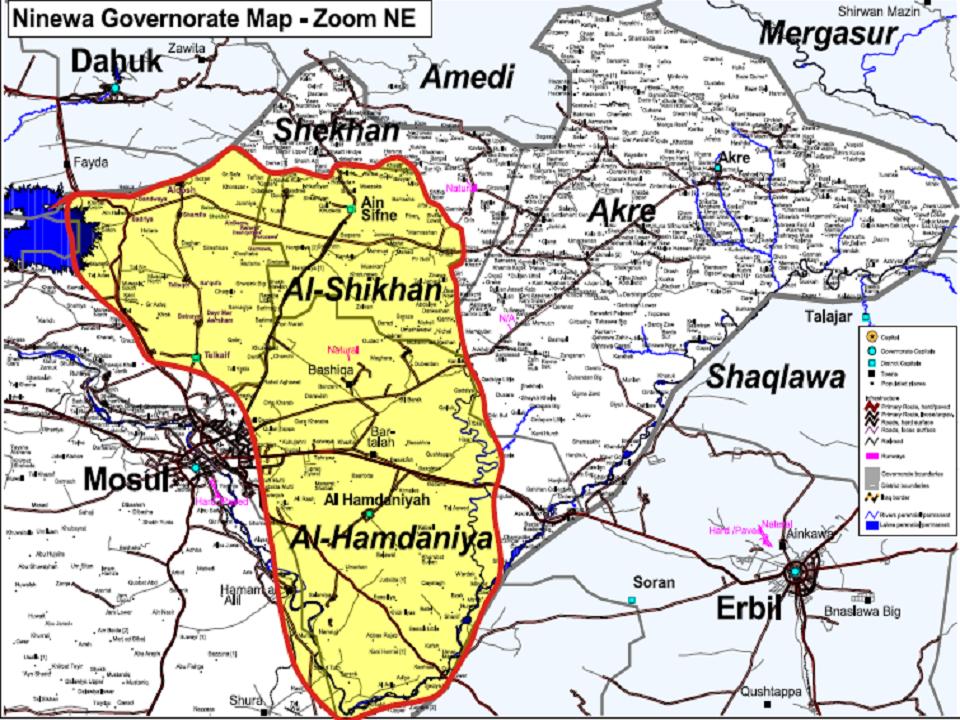 Map of the Ninewa Plain
After the U.S. invasion, the Kurdish peshmerga swept south into Ninewa with U.S. forces. Many Arabs who had moved there under the government’s programs fled before the advance. In the days after the fall of Mosul, the capital of Ninewa, the peshmerga also began kicking out Arab families from towns in the surrounding areas. These factors together increased the ethnic tensions in the province. In all the areas where the Kurds occupied they eventually established their influence through the presence of their peshmerga forces and control of the administration. The divide between Arabs and Kurds intensified after the 2005 provincial elections, when the Sunni Arabs decided to boycott. This allowed the Democratic Patriotic Alliance of Kurdistan, which was made up of the two major Kurdish parties, the Patriotic Union of Kurdistan and the Kurdistan Democratic Party, to win 31 of the 41 council seats in Ninewa.
The ascendancy of the Kurds, and the displacement and loss of power of the Sunni Arabs directly led to the growth of the insurgency in Ninewa. As reported before, Mosul remains the last urban stronghold of the Sunni militants. They in turn, have carried out some of the largest attacks in the Iraq war against Ninewa’s minorities. Christians, Yazidis, and Shabaks have all been singled out for mass casualty bombings, and targeted killings, taking thousands of lives, and forcing many minorities to flee the region. In one spate in October 2008 for example, the Christians of Mosul faced an organized campaign of murder and intimidation to drive them out of the city. 40 were killed, and 12,000 fled Mosul. Arabs and Kurds exchanged blame for the attacks, but Human Rights Watch’s interviews led them to believe that it was definitely the work of Arab insurgents. Some of the largest bombings in Ninewa this year have also been against Yazidis and Shabaks. Sunni militants consider all three groups, Christians, Yazidis, and Shabaks, to be non-believers or collaborators with the Americans.
From 2005 to the present the Kurds also carried out a systematic campaign to co-opt, cajole, threaten, and intimidate Ninewa’s minorities to support the Kurdistan Regional Government’s (KRG) plans to annex the disputed areas in the province. This has followed a two-pronged carrot and stick approach. First, the KRG has spent millions of dollars on minorities to win over their loyalty and create patronage systems. For example, the KRG’s Finance Minister Sarkis Aghajan, a Christian, was ordered by the KRG Prime Minister Nerchivan Barzani to build churches, fund Christian community organizations, and create Christian militia groups. They also used these means to undermine those who opposed the KRG’s plans. Second, the Kurds have used pressure and intimidation. Christians told Human Rights Watch that they were encouraged to sign forms calling for the annexation of Ninewa’s disputed areas by Kurdistan. The KRG also considers Yazidis and Shabaks to be Kurds, and have pressured them to register themselves as such to gain aid. Minority leaders and activists have also been targeted with the Kurds implicated in the attacks. Two Yazidi activists opposed to Kurdish aims were arrested and tortured for six months in 2007. The leader of the Shabak Democratic Gathering was killed by gunmen in July 2008 a few meters from a peshmerga checkpoint who did nothing before, during, or after the attack. Another Shabak politician claimed he was attacked by men wearing Kurdish uniforms before the 2009 provincial elections. Other minorities said they were stopped from attending political rallies by anti-Kurdish groups before the 2009 elections, and were warned that if they didn’t vote for the Kurdish Fraternal List they would lose their homes and jobs. Many of these tactics reminded Human Rights Watch of Saddam’s and earlier Arab government policies. Both the Kurds and minorities were victimized and expelled from Ninewa under the Arabization program. Now the Kurds are repeating many of these same policies to annex the northern regions of Ninewa to Kurdistan.
The 2009 elections turned out to be a major setback for the Kurds’ plans. They lost to the Arab led al-Hadbaa party who took all of the provincial offices, shutting the Kurds out of power, and calling for the withdrawal of the peshmerga. In response, the Kurdish Fraternal list is boycotting the provincial council, have refused to allow Arab officials to carry out their duties in Kurdish controlled areas, and have threatened to break away 16 towns and districts from Ninewa and create their own administration in protest. In June 2009 the KRG made the situation worse when it passed a draft constitution that claimed all of the disputed areas in Ninewa as part of Kurdistan, and said that the peshmerga had the right to operate in Ninewa.
In the end, Human Rights Watch is very worried about the future of minorities in Ninewa province. They are concerned as well, as a Christian leader recently said he is worried about increased attacks on his community in Mosul as Christmas approaches. They are facing the violence of Sunni insurgents, and the forced assimilation and co-option by the Kurds. They are also caught in the middle between the dispute between the central government, the al-Hadbaa provincial government, and the KRG for control of the disputed territories in Ninewa. Human Rights Watch’s findings are also not new. In December 2008 two similar reports were released, one by the United States Commission on International Religious Freedom on Iraqi minorities throughout the country, and another by the Brookings Institution and the University of Bern on minorities and displacement. They both noted the relentless attacks minorities have faced at the hands of insurgents, and the tactics the Kurds have employed against them. Due to these circumstances, Iraq’s minorities have been left with only two real options. First, many have fled becoming displaced or refugees. 20% of Iraq’s refugees for example are believed to be Christians. Second, those that have stayed in Ninewa have tried to align with one of the more powerful actors, whether it be the Kurds, or now the central government and the al-Hadbaa provincial council. None of these provide the protection and rights Ninewa’s minorities deserve, and as long as the divide exists between the KRG and Baghdad their situation is unlikely to get any better.
SOURCES
AK News, “Christians fear escalation of attacks with approach of Christmas,” 11/28/09
Badkhen, Anna, “Kurds evicting Arabs in north Iraq,” San Francisco Chronicle, 4/19/03
Ferris, Elizabeth and Stoltz, Kimberly, “Minorities, Displacement and Iraq’s Future,” Brookings Institution-University of Bern, December 2008
Human Rights Watch, “On Vulnerable Ground,” 11/10/09
United States Commission on International Religious Freedom, "Iraq Report - 2008," December 2008
Map of Mosul Province“On Vulnerable Ground” starts with some historical background to Ninewa. Beginning in the 1930s the Iraqi central government started a program to Arabize Ninewa, which has historically been one of the most diverse areas in the country. It is the home to Arabs, Kurds, Christians, Shabaks, and Yazidis, especially in an area known as the Ninewa plains, which are the districts immediately to the east of Mosul. In the 1970s Baghdad stepped up its efforts to move Arabs into Ninewa and push Kurds and minorities out that only got worse under Saddam Hussein. After the Gulf War in 1991 Baghdad tried to pressure Kurds and minorities to register as Arabs, and would not give birth certificates to babies with non-Arab names for instance. They also pressured minorities to join militias and perform other tasks to prove their loyalty or face expulsion. Many Kurds and minorities moved to Kurdistan, which had gotten its autonomy in 1991.
Map of the Ninewa PlainAfter the U.S. invasion, the Kurdish peshmerga swept south into Ninewa with U.S. forces. Many Arabs who had moved there under the government’s programs fled before the advance. In the days after the fall of Mosul, the capital of Ninewa, the peshmerga also began kicking out Arab families from towns in the surrounding areas. These factors together increased the ethnic tensions in the province. In all the areas where the Kurds occupied they eventually established their influence through the presence of their peshmerga forces and control of the administration. The divide between Arabs and Kurds intensified after the 2005 provincial elections, when the Sunni Arabs decided to boycott. This allowed the Democratic Patriotic Alliance of Kurdistan, which was made up of the two major Kurdish parties, the Patriotic Union of Kurdistan and the Kurdistan Democratic Party, to win 31 of the 41 council seats in Ninewa.
The ascendancy of the Kurds, and the displacement and loss of power of the Sunni Arabs directly led to the growth of the insurgency in Ninewa. As reported before, Mosul remains the last urban stronghold of the Sunni militants. They in turn, have carried out some of the largest attacks in the Iraq war against Ninewa’s minorities. Christians, Yazidis, and Shabaks have all been singled out for mass casualty bombings, and targeted killings, taking thousands of lives, and forcing many minorities to flee the region. In one spate in October 2008 for example, the Christians of Mosul faced an organized campaign of murder and intimidation to drive them out of the city. 40 were killed, and 12,000 fled Mosul. Arabs and Kurds exchanged blame for the attacks, but Human Rights Watch’s interviews led them to believe that it was definitely the work of Arab insurgents. Some of the largest bombings in Ninewa this year have also been against Yazidis and Shabaks. Sunni militants consider all three groups, Christians, Yazidis, and Shabaks, to be non-believers or collaborators with the Americans.
From 2005 to the present the Kurds also carried out a systematic campaign to co-opt, cajole, threaten, and intimidate Ninewa’s minorities to support the Kurdistan Regional Government’s (KRG) plans to annex the disputed areas in the province. This has followed a two-pronged carrot and stick approach. First, the KRG has spent millions of dollars on minorities to win over their loyalty and create patronage systems. For example, the KRG’s Finance Minister Sarkis Aghajan, a Christian, was ordered by the KRG Prime Minister Nerchivan Barzani to build churches, fund Christian community organizations, and create Christian militia groups. They also used these means to undermine those who opposed the KRG’s plans. Second, the Kurds have used pressure and intimidation. Christians told Human Rights Watch that they were encouraged to sign forms calling for the annexation of Ninewa’s disputed areas by Kurdistan. The KRG also considers Yazidis and Shabaks to be Kurds, and have pressured them to register themselves as such to gain aid. Minority leaders and activists have also been targeted with the Kurds implicated in the attacks. Two Yazidi activists opposed to Kurdish aims were arrested and tortured for six months in 2007. The leader of the Shabak Democratic Gathering was killed by gunmen in July 2008 a few meters from a peshmerga checkpoint who did nothing before, during, or after the attack. Another Shabak politician claimed he was attacked by men wearing Kurdish uniforms before the 2009 provincial elections. Other minorities said they were stopped from attending political rallies by anti-Kurdish groups before the 2009 elections, and were warned that if they didn’t vote for the Kurdish Fraternal List they would lose their homes and jobs. Many of these tactics reminded Human Rights Watch of Saddam’s and earlier Arab government policies. Both the Kurds and minorities were victimized and expelled from Ninewa under the Arabization program. Now the Kurds are repeating many of these same policies to annex the northern regions of Ninewa to Kurdistan.
The 2009 elections turned out to be a major setback for the Kurds’ plans. They lost to the Arab led al-Hadbaa party who took all of the provincial offices, shutting the Kurds out of power, and calling for the withdrawal of the peshmerga. In response, the Kurdish Fraternal list is boycotting the provincial council, have refused to allow Arab officials to carry out their duties in Kurdish controlled areas, and have threatened to break away 16 towns and districts from Ninewa and create their own administration in protest. In June 2009 the KRG made the situation worse when it passed a draft constitution that claimed all of the disputed areas in Ninewa as part of Kurdistan, and said that the peshmerga had the right to operate in Ninewa.
In the end, Human Rights Watch is very worried about the future of minorities in Ninewa province. They are concerned as well, as a Christian leader recently said he is worried about increased attacks on his community in Mosul as Christmas approaches. They are facing the violence of Sunni insurgents, and the forced assimilation and co-option by the Kurds. They are also caught in the middle between the dispute between the central government, the al-Hadbaa provincial government, and the KRG for control of the disputed territories in Ninewa. Human Rights Watch’s findings are also not new. In December 2008 two similar reports were released, one by the United States Commission on International Religious Freedom on Iraqi minorities throughout the country, and another by the Brookings Institution and the University of Bern on minorities and displacement. They both noted the relentless attacks minorities have faced at the hands of insurgents, and the tactics the Kurds have employed against them. Due to these circumstances, Iraq’s minorities have been left with only two real options. First, many have fled becoming displaced or refugees. 20% of Iraq’s refugees for example are believed to be Christians. Second, those that have stayed in Ninewa have tried to align with one of the more powerful actors, whether it be the Kurds, or now the central government and the al-Hadbaa provincial council. None of these provide the protection and rights Ninewa’s minorities deserve, and as long as the divide exists between the KRG and Baghdad their situation is unlikely to get any better.
SOURCES
AK News, “Christians fear escalation of attacks with approach of Christmas,” 11/28/09
Badkhen, Anna, “Kurds evicting Arabs in north Iraq,” San Francisco Chronicle, 4/19/03
Ferris, Elizabeth and Stoltz, Kimberly, “Minorities, Displacement and Iraq’s Future,” Brookings Institution-University of Bern, December 2008
Human Rights Watch, “On Vulnerable Ground,” 11/10/09
United States Commission on International Religious Freedom, "Iraq Report - 2008," December 2008
Wednesday, March 18, 2009
The State Of Ninewa Province
As reported here before, Ninewa is about to go through an important political transition as the provincial council will pass from the hands of the Kurds to the new Al-Hadbaa List. The leader of Al-Hadbaa has said that he wants to develop the economy of the province by encouraging the private sector. He believes that there are ample resources that could make Ninewa prosper. Whether that’s possible or not is yet to be seen. What is known is that Ninewa rates worse in education, health, and a number of other fields when compared to the Iraqi average, and it is the second most violent province in the country.
Population and Territory
Ninewa is the third largest province in Iraq in area, and the second most populated. It has 2,811,091 people, 9% of the country’s total. Only Baghdad has more. The province is divided into eight districts, Baaj, Hamdaniya, Hatra, Mosul, Shikhan, Sinjar, Tel Afar, and Tilkaif. Mosul, the provincial capital is the third largest city in Iraq behind Baghdad and Basra. The population is also a mix of Arabs, Kurds, Christians, and other smaller religious minorities. Sinjar, Tilkaif, and Shikhan are also disputed territories that have parts that the Kurds claim. This is the source of one of the major disputes between Arabs and Kurds in the province, and country.
Ninewa’s Population
Total: 2,811,091
Shikhan: 49,396
Hatra: 55,157
Baaj: 133,291
Hamdaniya: 143,462
Tilkaif: 190,403
Sinjar: 237,073
Tel Afar: 382,050
Mosul: 1,620,259
Security
Security was worse in Ninewa in the second half of 2007 before improving in 2008. By June 2008 there were approximately 300 security incidents. That jumped to 375 in September, but then declined afterwards, leveling off at around 225 incidents by November. Deaths have had a slow and steady decline during that same time period. In June there were around 130 deaths. That increased to 150 in July, and was at 100 by the end of 2008. In October Christians were also attacked in Mosul, which led almost 2,000 families to flee. 80% of those have now returned. In total, Ninewa still has around 19,100 families that were displaced during the violence there.
Education
Ninewa province rates worse in education, especially amongst women, compared to the rest of the country. In Iraq, 24% of women are illiterate. In Ninewa it ranges from 23% in Hamdaniya to a high of 60% in Hatra. That’s mainly because so few women attend school. Overall, 47% of women over ten years old have less than a primary education in Iraq. Only the Hamdaniya district at 44% beats that national average. Otherwise the rate goes from 52% of women with less than a primary education in Mosul up to 90% in Hatra. The men of Ninewa only do slightly better. In Iraq 11% of males are illiterate, compared to 12% in Ninewa. Sinjar and Hatra have the most illiteracy for men at 25% and 37% respectively. 31% of men over 10 years old have less than a primary education in the country, but in Ninewa it’s at 41%. Hamdaniya does the best at 27%, but the other eight districts range from 37%-68%.
Women Over 10 Years Old With Less Than Primary Education
Iraq: 47%
Hamdaniya: 44%
Mosul: 52%
Baaj: 53%
Ninewa: 58%
Tel Afar: 66%
Sinjar: 72%
Shikhan: 74%
Tilkaif: 76%
Hatra: 90%
Illiterate Women:
Iraq: 24%
Hamdaniya: 23%
Mosul: 24%
Ninewa: 30%
Baaj: 30%
Tilkaif: 31%
Tel Afar: 32%
Shikhan: 48%
Sinjar: 57%
Hatra: 60%
Men Over 10 Years Old With Less Than Primary Education
Iraq: 31%
Hamdaniya: 27%
Mosul: 37%
Tel Afar: 45%
Baaj: 45%
Sinjar: 46%
Shikhan: 49%
Tilkaif: 54%
Hatra: 68%
Illiterate Men
Iraq: 11%
Mosul: 8%
Hamdaniya: 9%
Tilkaif: 10%
Tel Afar: 15%
Baaj: 19%
Shikhan: 19%
Sinjar: 25%
Hatra: 37%
Employment
Similarly women do far worse than men in finding employment in Ninewa and in the country. In Iraq only 18% of women are employed or looking for a job. In only one district, Hatra at 30%, does Ninewa do better than that. Otherwise anywhere from 3% of women are in the labor force in Baaj and Tilkaif to up to 10% in Mosul and Hamdaniya. Female unemployment is also much higher in Ninewa, 35%, compared to the rest of the country, 13%. Tilkaif has the lowest unemployment rate for women at 9%, and Tel Afar matches the country’s rate at 13%. The remaining six districts however have unemployment for women ranging from 14% in Hamdaniya up to 62% in Hatra. Even for men, there is high unemployment in areas, even though more males are involved in the labor force than in Iraq overall. 81% of Iraqi men participate in the labor force, compared to 85% in Ninewa. Baaj 90% and Hatra 91% have the high numbers. Unemployment is still slightly higher in Ninewa, 13%, than the national average, 12%. Tel Afar, 21%, Shikhan, 23%, and Hatra, 33%, have the most jobless men.
Female Labor Force Participation 15-64 Years Old
Iraq: 18%
Ninewa: 8%
Baaj: 3%
Tilkaif: 3%
Tel Afar: 5%
Shikhan: 6%
Sinjar: 6%
Mosul: 10%
Hamdaniya: 10%
Hatra: 30%
Female Unemployment
Iraq: 13%
Ninewa: 35%
Tilkaif: 9%
Tel Afar: 13%
Hamdaniya: 14%
Sinjar: 14%
Shikhan: 30%
Baaj: 36%
Mosul: 40%
Hatra: 62%
Male Labor Force Participation 15-64
Iraq: 81%
Ninewa: 85%
Sinjar: 78%
Tel Afar: 81%
Hamdaniya: 82%
Mosul: 86%
Shikhan: 86%
Tilkaif: 87%
Baaj: 90%
Hatra: 91%
Male Unemployment
Iraq: 12%
Ninewa: 13%
Baaj: 3%
Hamdaniya: 8%
Sinjar: 9%
Mosul: 12%
Tilkaif: 13%
Tel Afar: 21%
Shikhan: 23%
Hatra: 33%
Poverty
The lack of jobs has resulted in high rates of poverty in the province. 22% of Iraqis are in the lowest per capita income quintile. In Ninewa that ranges from 57% in Tel Afar down to 25% in Mosul.
% In Lowest Per Capita Income Quintile
Iraq: 22%
Mosul: 25
Sinjar: 27%
Hamdaniya: 36%
Baaj: 37%
Tilkaif: 40%
Shikhan: 49%
Hatra: 54%
Tel Afar: 57%
Services
Services like electricity and water, are also limited in Ninewa. 52% of Iraq has more than eleven hours of power cuts or are not connected to the national network. In Sinjar and Baaj 100% of the residents have more than 11-hour electricity outages, followed by Hamdaniya 93%, Tilkaif 80%, and Shikhan 76%. Many Iraqis rely upon private generators or buy electricity for those that do to supplement the national power grid. 21% of Iraqis however have no alternative source of power, compared to 57% in Ninewa. Access to the water network is also limited in some parts of the province. Only in Tilkaif is the entire district connected to the water system. Otherwise anywhere from 7% in Mosul and Shikhan up to 83% in Sinjar, 86% in Hatra, and 100% in Baaj do not have access.
More Than 11 Hours Power Cut Or No Connection To Network
Iraq: 52%
Hatra: 15%
Tel Afar: 26%
Mosul: 50%
Shikhan: 76%
Tilkaif: 80%
Hamdaniya: 93%
Sinjar: 100%
Baaj: 100%
No Alternative Electricity Source
Iraq: 21%
Mosul: 7%
Shikhan: 17%
Tilkaif: 32%
Baaj: 37%
Sinjar: 49%
Hamdaniya: 59%
Hatra: 81%
Tel Afar: 90%
Not Connected to Water Network
Iraq: 26%
Tilkaif: 0%
Mosul: 7%
Shikhan: 7%
Hamdaniya: 20%
Tel Afar: 53%
Sinjar: 83%
Hatra: 86%
Baaj: 100%
Food
The majority of Iraqis depend upon the government’s food ration system, which is the largest in the world. There is still malnutrition in Iraq however. 22% of Iraqis face chronic malnutrition. Shikhan does the best in this department with only 11% affected, followed by Hatra 20%, and Hamdaniya 22%, while Baaj 42%, Sinjar and Tel Afar at 48% each do the worst.
Chronic Malnutrition
Iraq: 22%
Shikhan: 11%
Hatra: 20%
Hamdaniya: 22%
Tilkaif: 26%
Mosul: 27%
Baaj: 42%
Sinjar: 48%
Tel Afar: 48%
SOURCES
Inter-Agency Information and Analysis Unit, “Ninewa Governorate Profile,” United Nations Office for the Coordination of Humanitarian Affairs, February 2009
Kamal, Adel, “new ninawa governor: no possibility of Kurdish alliance,” Niqash, 2/24/09
Radio Free Europe/Radio Liberty, “Iraqi Christians Returning To Mosul,” 3/5/09
Reuters, “UN Says 1 Million Iraqis Lack Food,” 11/12/08
Friday, February 27, 2009
Election Monitoring Report From The Ninewa Plains
Ninewa is one of the most diverse and volatile provinces in Iraq. It is the home to Arabs, Kurds, Christians, Yazidis, and Shabaks. The Arabs and Kurds are both vying for power there, and the small minority groups have been caught in the middle. In the 2005 election the Kurds were accused of disenfranchising Christians and others. For this reason the United Nations sent monitors from their Unrepresented Nations and Peoples Organization working with the Assyria Council of Europe to Ninewa to observe the January 2009 provincial elections. They recently released a report on their work that found the voting and procedures went routinely, but that many displaced Iraqis were not allowed to participate.
In the January 2005 provincial elections the Kurds were accused of violating the rights of minorities in Ninewa. The Kurds issued threats, refused to open voting centers, didn’t deliver ballot boxes, and took part in fraud to ensure their control of the province. The Kurdish militia the peshmerga for example stopped voting boxes being delivered to Christian areas in the Ninewa plains. Thousands of minorities were believed to have been denied the right to vote as a result. It was for this reason that the United Nations decided to send in teams to that area for the 2009 election.
Election monitors were made up of members of the U.N.’s Unrepresented Nations and People Organization and the Assyria Council of Europe. They worked in the Tellkaif and Hamadaniya districts of Ninewa. These were the same areas where minorities were disenfranchised in 2005.
The U.N. found that campaigning before the vote was free and open. In 2005 the Sunni Arabs boycotted, which allowed the Kurds to take control of the provincial election. This time the Arabs were enthusiastic about the balloting because they wanted power. The Kurds on the other hand expected a defeat, but wanted to minimize their loses. All sides used posters, TV commercials, and rallies to garner support. The openness of the electioneering showed the improvement in security compared to 2005.
The Iraqi Election Commission also launched a robust voter education program. They had materials in both Kurdish and Arabic, which were handed out widely. They also regularly ran TV shows on how to vote. Finally, the Commission also held public meetings to educate people.
The U.N. monitors received three complaints of possible violations. The first came from a parliamentarian from the Yazidi Movement for Reform and Progress who told a reporter in Baghdad that Yazidis were being intimidated by the Kurdish peshmerga after they complained to the Election Commission about violations by the Kurdistan Democratic Party (KDP). Yazidis claimed that KDP officials were using military vehicles to campaign with, and employed soldiers at their rallies. A Shabak lawmaker from the Shabak Democratic Assembly told the U.N. that an unnamed political party was pressuring Shabaks to vote for them. The parliamentarian said he had filed a complaint with the Election Commission. Finally, on election day a voter claimed that he and others were given a ride to the voting center in return for their votes. None of these stories could be confirmed during the time the U.N. team was working in Ninewa.
During the election the largest problem the monitors witnessed were displaced Iraqis not being able to vote. One voting center was told to open two stations for the displaced immediately before the balloting. Those two eventually ran out of ballots. More importantly, over 100 displaced were not allowed to vote because they did not have their documents in order. As reported before, similar incidents were reported across the country.
Otherwise the monitors said the elections went well. Security was tight around the voting centers. Most of the voting materials were used appropriately with only minor problems. They did receive complaints about political parties attempting to manipulate voters, but none of those stories could be checked. The greatest issue was the disenfranchisement of internal refugees. It seems as if the Election Commission did not do a good enough job informing the displaced about how and where they were to register. They could either vote in their home provinces, or in their current residencies, but either way they had to sign up with the Commission. This did not get through and an unknown amount of refugees were not allowed to participate in the provincial election as a result.
SOURCES
United States Commission on International Religious Freedom, “Iraq Report – 2008,” December 2008
Unrepresented Nations and Peoples Organization-Assyria Council of Europe, “Election Observation Mission, Nineveh Plain, Iraq, January 28-February 2, 2009” 2/13/09
Friday, January 23, 2009
United States Commission on International Religious Freedom Dec. 08 Report on Iraq
The attacks on Christians in Mosul in October 2008 seemed to spur interest by a variety of different groups on Iraq’s minorities. As reported earlier, the Brookings Institution and the University of Bern released a study on the subject noting that all of Iraq’s small ethnic and religious groups were disenfranchised, displaced, and victims of attacks. They are also caught in the power struggle between Arabs and Kurds in the northern section of the country. At the same time, the United States Commission on International Religious Freedom released a report on religious tensions overall in Iraq that largely focused upon minorities. Their findings were that while fighting between Shiites and Sunnis has largely subsided, violence against minorities such as Christians, Mandeans, and Yazidis is on going. All of Iraq’s smaller religious groups have been targeted, and the government has failed to protect them. Many have fled the country as a result, and they are not coming back. The Commission concluded by saying they are fearful for the future of Iraq’s minorities, and believes their continued existence is at risk.
The victimization of Iraq’s minorities begun under Saddam Hussein, but was greatly exasperated by the U.S. invasion. Saddam discriminated against Iraq’s smaller religious groups. His Arabization program of the south not only forced out Kurds, but Turkomen and Christians as well. After 2003 tensions increased. The 2005 Iraqi elections, while touted at the time as a step towards democracy and reconciliation, actually increased divisions, which turned into the sectarian war in 2006. Minorities proved to be the most vulnerable during this time. They continue to face attacks today, especially in the northern section of the country where they are concentrated in cities like Mosul and Ninewa province. Most minorities have fled Iraq except for the Ninewa Plains and Kurdistan.
The government has done little to help them. Services and reconstruction aid have not been distributed to them evenly. The Kurds have tried to exploit them, and also mistreated them. During the 2005 elections for example, Kurds worked to exclude minorities from voting through threats and denying them ballot boxes in their areas. The 2008 Provincial Election law originally dropped Article 50 that set up quotas for minorities. When this was later re-instated, the quotas were much lower than before. Minorities were supposed to have twelve seats, but ended up with six instead. Prime Minister Nouri al-Maliki has tried to address the concerns of minorities by created a committee to deal with their issues, but it has been largely rejected as not being representative since the Prime Minister picked all of its members.
Christians
Iraq is home to a variety of Christian groups including Chaldeans, Assyrian Orthodox, Assyrian Church of the East, Syriac Orthodox, Armenians, Protestants, and Evangelicals. In 2003 there were approximately 1.4 million Christians in Iraq, today there is around 500,000-700,000. Their victimization since the U.S. invasion is shown by the fact that before 2003 they were 3% of Iraq’s population, but make 15-20% of the registered refugees in Jordan and Syria, and 35-64% of the refugees in Lebanon and Turkey.
The most recent attacks against Christians occurred in Mosul in October 2008. Fourteen Christians were killed in the city, which led 13,000 to flee. 400 families went to Syria. The United Nations believes that was half of the city’s Christian population. By early November some had come back to Mosul, and Prime Minister Nouri al-Maliki sent extra police to help with security. However on November 11, two Christian sisters were killed in their home, keeping the fear level high and deterring most families from returning.
Violence against Christians was widespread before Mosul, beginning in 2004. Since that year 40 churches and Christian buildings have been destroyed. On January 8, 2008 six churches in Mosul and Baghdad were bombed in a single day. From January to June 2008, the U.N. reported 17 attacks and kidnappings, including the murders of ten Christians. Community leaders have been murdered, tortured, and kidnapped. In February 2008, the Chaldean Bishop of Mosul, Paulos Faraj Raho was kidnapped and later found dead. In April 2008 an Assyrian Orthodox priest was killed in Baghdad. Many churches have closed as a result. Shiite and Sunni extremists have also tried to impose Islamic codes on Christians. Businesses such as alcohol shops, beauty salons, movie theaters, and video stores owned by Christians have been attacked. Christians also suffered during the ethnic cleansing of Baghdad during the sectarian war. There use to be 2,000 Christian families living in the Dora section of Baghdad, but by the summer of 2007 there were only 300 left due to concerted efforts by Sunni insurgents. There have been small signs of change however as in 2007 and 2008 Christians were able to celebrate Christmas in the capital, and 45 families did return to Dora.
Mandeans
Sabean Mandeans are followers of John the Baptist. 90% have either fled the country of been killed. There are only 3,500-5,000 left in Iraq. Of the 28 religious leaders that were in the country during the Saddam era, only five are left. The community’s top religious leader fled to Syria after he was threatened. The Mandean Human Rights Group said that from April 2003 to March 2007 144 Mandeans were killed, 254 kidnapped, 238 threatened or attacked, 11 raped, and 35 forced to convert to Islam. From January 2007 to February 2008 42 were killed, 46 kidnapped, 10 threatened, and 21 attacked.
Mandeans are faced with the added difficulty of being pacifists, which means they can’t protect themselves. They are also afraid of extinction because one can only be born into the religion, and the displacement may make it harder and harder for them to find marriage partners. Mandean refugees also do not want to go back to Iraq, and wish to be repatriated to a third country.
Yazidis
Most Yazidis are concentrated in the north of Iraq in Dohuk and Ninewa provinces. Like Mandeans, they can only be born into the religion. Some believe that they originate from Zoroastrianism. Muslims do not consider them “People of the Book,” and have persecuted them as a result. On April 22, 2007 gunmen killed 23 Yazidis in the Kurdish town of Bashika after stopping a bus and only taking the Yazidis off of it. On August 14, 2007 four suicide bombings in the towns of Qahtaniya and Jazeera killed 786 Yazidis and wounded 1,562. Around 1,000 families became homeless as a result. Attacks on the community have continued into 2008 with 2 killed in a liquor store in Mosul on December 7, and seven were killed in Sinjar. Many are now afraid to leave their own communities. Many have stopped practicing their religion openly in fear that it will bring attention and attacks. Many farmers have either gone out of business or now rely upon middlemen to sell their products because Muslims refuse to work for them.
Other Minorities
There are around 2,000 Bahais in Iraq. They face legal repression as a 1970 law prohibits their religion. In April 2007 the Interior Ministry cancelled Regulation 358 from 1975, which said identity cards could not be given to Bahais, but now that they can receive them they are listed as Muslims instead of their own faith.
Iraq also used to have a small Jewish community. Now there are ten or less left. Those that have stayed in the country are hiding their religion. Like most of the Arab world, anti-Semitism is alive in Iraq.
Internally Displaced
Most of the displaced minorities have moved to the north, specifically Kurdistan and Ninewa. According to the International Organization for Migration 52.2% of the displaced in that province are Christians. This is because 53% of Ninewa are minorities. The Ninewa Plains for example, have been the historical homeland of Iraq’s Christians. The problem is that the north is one of the most violent areas of Iraq, especially Mosul, which remains the last major insurgent redoubt left in the country. Kurdistan has also been a popular destination. 24.6% of the displaced there are Christians. They have an easier time than Muslims to gain entry because they are not considered suspicious by the authorities. Kurdistan is also more secure than the rest of the country, which also makes it a draw. Yazidis are historically from Ninewa and Dohuk. Christians, Mandeans, and Yazidis all told the Commission that they are free to practice their religion in Kurdistan, and can set up their own private schools as well.
Political Pressure
Their residence in the north has placed minorities in the center of the increasing battle between Arabs and Kurds for political power. The United Nations reported that political parties in Diyala, Tamim, and Ninewa are attempting to pressure minorities to vote for them in the 2009 elections. The U.N. also reports that minorities are being forced from their houses, and their farms are being confiscated as part of this intimidation campaign. Many are pressured to identify themselves as either Kurds or Arabs. One of the major reasons why the number of seats set aside for minorities was reduced was because Arabs were afraid the minorities would vote with the Kurds for annexation of disputed territories in the north, while Kurds did not want them listed as minorities fearing that they would dilute the Kurdish vote.
Kurds have also been intimidating and pressuring minorities. They have set up an extensive patronage system that hands out money for churches and relief to win over loyalties. At the same time the Kurdish militia the Peshmerga have gone into disputed territories, taken land from minorities, only given them services if they agree to back the Kurds, stopped minorities from forming their own local security forces, and joining the police to protect themselves.
Christians have been one of the main focuses of this carrot and stick approach by the Kurdish Regional Government (KRG). In 2006, the deputy governor of Ninewa stopped Baghdad from using Christian police in the Ninewa Plains. Instead they were sent to Mosul. The Chaldean Syrian Syriac Council of America said that the Ninewa council attempted to deny jobs to Christians in the provincial police. Those that have been able to join say they have been marginalized within the force. By mid-2008 there were reports that there was some progress on this situation with 269 Christians being hired. The Kurds have also only allowed the Christians to form their own security forces if they are funded by the KRG. The Kurdish Minister of Finance Sarkis Aghajan Mamendu is a Christian, and is in charge of funding for Christians by the Kurds. Christians have also been pressured to sign forms supporting the annexation of their areas into Kurdistan, and the Kurds have cut off water to certain Christian villages.
The Yazidis have also come under similar pressure. They claim that the Kurds are trying to Kurdify them. In 2008 the State Department said that the Kurds confiscated Yazidi land and started to build settlements on them illegally. The Kurdish Finance Minister said that the Kurds would return that land, but it would take up to two years. Yazidis have also said that their villages are the last to receive aid from the KRG. In March 2008, the Kurdish Interior Ministry told the Commission that they were working on forming a Yazidi police force.
Refugees
Because of all the violence and political pressure, a disproportionate number of minorities have fled the country. Minorities are only 3% of Iraq’s population, but are 15% of the U.N. registered refugees in Jordan and 20% of those in Syria. Christians are 64% of the registered refugees in Turkey, and 35% of those in Lebanon. The Ministry of Migration and Displacement believes that 50% of the country’s minorities have left since 2003. Many will probably never come back because they do not believe they have a future in Iraq, and are seeking asylum in other countries.
Iraqi refugees in general are finding it harder and harder to live in neighboring countries, and minorities have it especially difficult. Iraqis are facing stricter controls on their entry, and many are running out of money. They are increasingly feeling that they will be kicked out or imprisoned for staying illegally. Access to services is extremely limited. In all of the countries except for Lebanon, Iraqis are not permitted to work. There are reports of women turning to prostitution, and children not going to school to support their families. Mandeans report that they are discriminated against in Jordan, and are hiding their religion as a result.
Because of these hardships, Iraqis have begun returning to their country. This is not true of its minorities. The Ministry of Displacement and Migration counted 3,657 families registered as returnees in Baghdad, and an additional 6,000 wanted to at the end of 2007, but there are no reports of minorities going back however.
The Commission ended with some recommendations. First Baghdad needs to ensure free and fair elections that will include the selection of at least six new minority representatives in the provinces due to the quotas. The government also needs to provide security for everyone, and set up police for minority communities. Iraqi identity cards should also not state religion or ethnicity, and the lingering sectarianism needs to be eliminated from the government and security forces. Baghdad also needs to work with minorities to ensure their needs are being met. The Kurds need to respect minority rights. Finally, the U.S. should provide aid to minorities, and help their refugees. Few of these suggestions are likely to happen as the government is increasingly divided between Arabs and Kurds who see minorities as a pawn between them in the north. This will only increase as elections near, and both sides are looking for votes.
Conclusion
The United States Commission on International Religious Freedom did a good job detailing the situation of Iraq’s major minority groups. All of them have been singled out for attacks because of their beliefs and being different. This has threatened the existence of some, and forced members of all groups to leave. These fissures in Iraq are unlikely to be overcome any time soon. The divisions between the major groups in the country still exist. To expect the smallest groups to be treated equally and be given representation before the larger problems are overcome is hard to believe. Until then, Iraq’s minorities will continue to be attacked, and will be the focus of political manipulation between Arabs and Kurds, which threatens their ability to maintain their religion and communities.
SOURCES
Ferris, Elizabeth and Stoltz, Kimberly, “Minorities, Displacement and Iraq’s Future,” Brookings Institution-University of Bern, December 2008
United States Commission on International Religious Freedom, "Iraq Report - 2008," December 2008
Thursday, January 22, 2009
International Organization for Migration’s Report On Displaced In Kurdistan
The situation of the displaced in the three provinces of Kurdistan, Dohuk, Irbil and Sulaymaniya, are different from the rest of the country. The stability of Kurdistan has been a draw for displaced from across the country. Professionals and manual labors alike have found jobs there. A large number of Iraqi minorities fled there. Most of the displaced in the three provinces also left their homes before the February 2006 Samarra bombing that set off the sectarian war. At the same time Kurdistan has strict restrictions on the entry of non-Kurds, and there are fears amongst officials that these refugees will upset the demographics of the region. In December 2008, the International Organization for Migration released its latest report on the displaced in Kurdistan.
The relative security of Kurdistan has led many displaced Iraqis to try to move there, but at the same time it is the hardest part of the country to gain entry into. The Kurdistan Regional Government (KRG) is worried about Arab insurgents entering, as well as non-Kurds disrupting the Kurdish majority. The KRG also doesn’t want to take care of so many displaced families. As a result, Kurdish security forces tightly control the border. People that don’t originally come form Kurdistan must have sponsors to enter. The Kurds are especially suspicious of Arabs, but requirements are looser for minorities who are seen as victims of terrorism. Once a family has entered Kurdistan they have to go through a complicated series of offices and requirements to stay. Every three months they have to renew their residency permit. For individuals, they have to renew it every month. If they don’t they are considered illegal residents. These tight restrictions have led many displaced to hide their movements outside the region, for example to collect their food rations from their home province, out of fear that they will be caught by the authorities and expelled.
Most of Iraq’s minorities live in the north. As reported before, they have been singled out for attack since the U.S. invasion. Many have fled to Kurdistan as a result because of its safety and proximity. 22.8% of the displaced in the region are Christians for example, compared to 5% in the rest of the country.
Kurdistan also has the largest amount of pre-2006 displaced. Most of these are Kurds, Turkomen, and Christians forced out by Saddam Hussein’s Arabization policy and Anfal campaign. Over 600,000 people came to Dohuk, Irbil and Sulaymaniya before 2006 as a result.
The displaced have caused both problems, and been welcomed in the region. The refugees can strain a community by increasing demand for services, and competing for jobs. In Khabat in the Irbil district there are more than 2,000 displaced families causing problems with the health facilities and schools. There are also reports of women turning to prostitution for money, and child labor. In Dohuk there are stories of women being raped to keep their jobs. Another problem is that the displaced have to know Kurdish to get jobs. Those that have stayed longer, usually have developed some language skills, and are thus better suited to find work. At the same time, because of the better security situation there are more jobs in Kurdistan than the rest of the country. The displaced have added both skilled and unskilled labor to the regional economy. This is seen in the fact that 56.6% of the displaced surveyed had at least one family member working compared to 34.8% in the rest of the country.
The ability to receive services and assistance by the displaced has been mixed. There is little coordination between the KRG and the Ministry of Trade that runs the food rations system. In a survey 74.6% of the displaced said they don’t get any food rations at all. Less then 3% said they received food aid, compared to the 43% national average. In Irbil no displaced received any food assistance. Only 23% said they received any aid period, compared to 63% in the rest of the country. Dohuk was the exception with 57% saying they had gotten some form of aid. 66% of the displaced said they also had no access to fuel, higher than the 33% average in the rest of Iraq. People in Kurdistan also pay higher prices for fuel, which adds more strain to the displaced that often have financial difficulties. Schools are a special problem for the displaced because classes are conducted in Kurdish. Some displaced Kurds are not use to the written form of the language either. Even so, there is a very high percentage of the displaced attending schools. 62.3% of families said all their girls were going, and 73.9% said their boys were as well. Water supply and access to health care however, are better than the rest of the country for internal refugees.
Dohuk
Dohuk has the least amount of pre-2006 displaced, and the most post-2006 refugees of the three Kurdish provinces. The majority came from Baghdad 52% and Ninewa 47%. The largest amount of people came during the summer of 2006, and has since declined. There are concerns that because of economic hardships some families are turning to crime to support themselves. Services and aid are mixed there. Electricity is available for an average of six hours per day, leaving many to turn to private generators or buying power from private businesses to make up the difference. 99.1% say they have no access to fuel, higher than the 65.9% average for the region and 32.7% rate for the country. Dohuk also has the least amount of displaced people working. Only 33.5% said they had at least one family member working compared to 56.6% in Kurdistan. Refugee families do have the best access to humanitarian aid out of the region.
Statistics On The Displaced In Dohuk
Overall:
Population: 954,087
Total pre-Feb 06 displaced: 22,474 families, approx. 138,844 people
Total post-Feb 06 displaced: 17,390 families, approx 104,824 people
Background:
Religion & ethnicity of displaced:
Sunni Kurd 39.7%
Chaldean Christian 29.0%
Assyrian Christian 19.8%
Armenian Christian 3.4%
Sunni Arab 2.1%
Shiite Arab 2.0%
Turkomen Shiite 0.7%
Shiite Kurd 0.3%
Christian Kurd 0.2%
Other 0.1%
Place of origin:
Baghdad 51.79%
Ninewa 46.65%
Tamim 0.58%
Basra 0.48%
Anbar 0.32%
Muthanna 0.05%
Salahaddin 0.05%
Babil 0.03%
Diyala 0.03%
Irbil 0.03%
Reasons For Displacement:
Fear 92.8%
Violence 88.1%
Direct Threat 71.2%
Armed Conflict 33.7%
Forced From Home 7.3%
Other 0.4%
Reason For Being Targeted:
Sect 68.20%
Ethnicity 22.84%
Political opinion 18.29%
Social group 14.57%
Don’t think targeted 7.42%
Intentions of Displaced:
Integrate locally 60.2%
Return to place of origin 22.0%
Services And Employment:
Access to food rations:
Yes 2.7%
Sometimes 4.3%
Never 92.9%
Water source:
Municipal water 89.8%
Water tanks/trucks 31.9%
Others 4.7%
Wells 6.8%
Rivers, streaks, lakes 5.1%
Broken pipes 0.2%
Electricity access:
Four or more hours per day 86.4%
1-3 hours per day 8.9%
No electricity 4.7%
Fuel access:
No access 99.1%
Propane 0.6%
Benzene 0.0%
Kerosene 0.5%
Diesel 0.1%
Other 0.0%
Have been visited by health worker in last 30 days?
No 31.1%
Yes 68.5%
Employment:
At least one family member working 33.5%
No one working 66.5%
Assistance:
Sources of aid:
No aid 42.7%
Iraqi Red Crescent 23.6%
Religious group 21.0%
Relatives 19.7%
Humanitarian group 6.3%
Other government agency 14.6%
Host community 4.1%
Other 3.0%
Food aid source:
No aid 98.6%
Federal government 0.0%
Humanitarian group 0.0%
Regional government 0.0%
Religious group 0.9%
Others 0.3%
Needs:
Jobs 95%
Housing 60%
Food 50%
Other 50%
Health 20%
School 10%
Water 5%
Sanitation 1%
Legal aid 1%
Hygiene 0%
Irbil
Most of the displaced in Irbil come from Baghdad 47% and Ninewa 45%. The largest amount of people came in the beginning of 2007. Around 150 Christian families have recently fled to the Ainkawa district after they were attacked in Mosul at the end of 2008. Electricity has improved over the last six months. Families average four hours a day with three extra hours every other day. Displaced in Irbil have the worst access to humanitarian aid in the region with 92.4% saying they received no assistance compared to 76.5% in Kurdistan and 36.7% in Iraq.
Statistics On The Displaced In Dohuk
Overall: Population: 1,392,093
Total pre-Feb 06 displaced: 32,813 families, approx 196,878 people
Total post-Feb 06 displaced: 6,599 families, approx 52,007 people
Background:
Religion & ethnicity of displaced:
Sunni Kurd 39.9%
Sunni Arab 29.4%
Chaldean Christian 19.3%
Assyrian Christian 4.9%
Shiite Arab 1.4%
Armenian Christian 0.9%
Other 0.4%
Christian Kurd 0.2%
Sabean Mandean 0.1%
Christian Arab 0.1%
Place of origin:
Baghdad 47.11%
Ninewa 45.12%
Tamim 2.4%
Diyala 2.08%
Anbar 0.93%
Salahaddin 0.63%
Basra 0.26%
Babil 0.15%
Muthanna 0.07%
Qadisiyah 0.07%
Karbala 0.06%
Najaf 0.04%
Maysan 0.04%
Reasons for displacement:
Fear 97.6%
Violence 53.4%
Direct Threat 9.9%
Armed Conflict 0.3%
Other 0.1%
Reason for being targeted:
Sect 59.98%
Don’t think targeted 22.84%
Ethnicity 17.27%
Social group 3.98%
Political opinion 0.13%
Intentions of displaced:
Integrate locally 18.3%
Return to place of origin 62.5%
Services And Employment:
Access to food rations:
Yes 14.5%
Sometimes 27.2%
Never 57.6%
Water source:
Municipal water 97.7%
Water tanks/trucks 1.3%
Others 0.2%
Wells 6.80.2%
Electricity access:
Four or more hours per day 98.8%
1-3 hours per day 0.0%
No electricity 0.1%
Fuel Access:
No access 68.1%
Propane 29.4%
Benzene 23.2%
Kerosene 4.5%
Diesel 0.2%
Other 0.0%
Have been visited by health worker in last 30 days?
No 73.1%
Yes 25.3%
Assistance:
Sources of aid:
No aid 92.4%
Iraqi Red Crescent 0.1%
Religious group 4.00%
Relatives 0.1%
Humanitarian group 2.2%
Other government agency 0.0%
Host community 0.0%
Other 0.0%
Food aid source:
No aid 98.9%
Federal government 0.0%
Humanitarian group 0.0%
Regional government 0.0%
Religious group 0.0%
Others 0.0%
Needs:
Jobs 90.9%
Housing 97.9%
Food 2.8%
Other 0.7%
Health 0.1%
School 28.2%
Water 0.0%
Sanitation 0.0%
Legal aid 25%
Hygiene 0%
Sulaymaniya
Most displaced in Sulaymaniya come from Baghdad 46% and Diyala 45%. The biggest surge in families to the province came during the summer of 2007. Of the three Kurdish provinces, Sulaymaniya averages the most electricity at 9 to 10 hours per day. That’s expected to go up to twelve hours when a new power station opens. It also has the best access to fuel in the region with 60% of the displaced saying they could obtain one form or another, but it is still below the national average.
Statistics For the Displaced In Sulaymaniya
Overall:
Population: 1,715,585
Total pre-Feb 06 displaced: 50,465 families, approx. 302,790 people
Total post-Feb 06 displaced: 14,585 families, approx. 80,935 people
Background:
Religion & ethnicity of displaced:
Sunni Arab 62.7%
Sunni Kurd 22.4%
Shiite Arab 10.5%
Shiite Kurd 2.7%
Sabean Mandean 0.3%
Chaldean Christian 0.2%
Assyrian Christian 0.1%
Other 0.1%
Christian Arab 0.1%
Origin of origin:
Baghdad 46.12%
Diyala 45.92%
Anbar 2.88%
Ninewa 1.88%
Salahaddin 0.95%
Tamim 0.67%
Basra 0.51%
Babil 0.40%
Wasit 0.24%
Dhi Qar 0.11%
Sulaymaniyah 0.11%
Karbala 0.07%
Muthanna 0.04%
Reasons for displacement:
Fear 90.0%
Violence 88.0%
Armed Conflict 52.7%
Direct Threat 46.2%
Other 6.3%
Forced From Home 3.8%
Reason for being targeted:
Sect 78.53%
Don’t think targeted 18.85%
Ethnicity 10.46%
Political opinion 6.28%
Social group 3.96%
Intentions of displaced:
Integrate locally 25.9%
Return to place of origin 65.7%
Services And Employment:
Access to food rations:
Yes 11.8%
Sometimes 9.7%
Never 78.5%
Water source:
Municipal water 77.0%
Water tanks/trucks 5.1%
Others 19.3%
Wells 3.2%
Rivers, streaks, lakes 0.2%
Electricity access:
Four or more hours per day 60.4%
1-3 hours per day 35.2%
No electricity 4.4%
Fuel access:
No access 41.3%
Propane 58.6%
Benzene 1.0%
Kerosene 15.6%
Diesel 0.7%
Other 0.2%
Have been visited by health worker in last 30 days?
No 79.8%
Yes 19.8%
Assistance:
Sources of aid:
No aid 84.0%
Iraqi Red Crescent 7.5%
Religious group 1.1%
Relatives 0.1%
Humanitarian group 5.5%
Other government agency 1.7%
Host community 4.3%
Other 0.4%
Food aid source:
No aid 94.7%
Federal government 2.8%
Humanitarian group 1.5%
Regional government 1.1%
Religious group 0.5%
Others 0.9%
Needs:
Jobs 44%
Housing 16.7%
Food 85.8%
Other 81.2%
Health 1.3%
School 32.3%
Water 0.7%
Sanitation 1.0%
Legal aid 2.2%
Hygiene 0.5%
SOURCES
International Organization for Migration, “Dahuk, Erbil & Sulaymaniyah, Governorate Profiles Post-February 2006 IDP Needs Assessments,” December 2008
Tuesday, January 13, 2009
Brookings-University of Bern report on Iraq’s Minorities
In late December 2008 the Brookings Institution and the University of Bern, Germany released a report on Iraq’s minorities and refugees entitled “Minorities, Displacement and Iraq’s Future.” Although the paper was meant to be about all of Iraq’s minority groups, it largely focused upon the country’s Christians. It’s major findings were that Iraq’s small religious and ethnic groups have been targeted and attacked relentlessly since the U.S. invasion, driving a disproportionate amount from their homes, and out of the country. Unless these groups are re-integrated Iraq will be less diverse and tolerant, and a largely segregated country due to the sectarian war.
Estimates On Iraq’s Minorities:
Christians: 2003: 1-1.4 million, Today, 600,000-800,000
Jews: 2003: a few hundred, Today: 10-15
Mandeans: 2003: 30,000, Today: Fewer than 13,000
Palestinians: 2003: 35,000, Today: 15,000
Turkomen: 2003: 800,000 claimed, Today: as few as 200,000
Yazidis: 2003: No known, Today: around 550,000
The Brookings Institution and the University of Bern defined Iraq’s minorities as the country’s smallest religious and ethnic groups. These consist of the Armenian, Syriac, and Chaldo-Assyrian Christian, Bahai, Jewish, Mandean, and Yazidi religions, along with the Faili Kurds, Palestinians, Shabaks, and Turkomen. Many of these groups have lived in Iraq for over 1,000 years. All of them were treated differently under the Saddam Hussein regime. The Bahais and Fayli Kurds were persecuted, while the Palestinians were given special treatment. Since the U.S. invasion they have all faced similar situations. These include a lack of power, persecution, and attacks. The country’s Jews for example have mostly disappeared, having fled Iraq, while the Palestinians are trapped with nowhere to go.
The religious and ethnic parties studied in the report are different from the Sunnis and Kurds who each are numerical minorities. The Sunnis ran the country under Saddam, have large numbers of politicians, and are a junior partner in the ruling coalition behind Prime Minister Nouri al-Maliki. They have also conducted a bloody insurgency that still continues in parts of Iraq. The Kurds on the other hand, were attacked and persecuted under Saddam, but since the Gulf War have gained more and more autonomy. Under the old regime, Kurds faced Saddam’s Arabization program and Operation Anfal that pushed out over 100,000 from northern Iraq, and killed around the same amount. After 2003, the Kurds were able to form the Kurdistan Regional Government incorporating the provinces of Dohuk, Irbil, and Sulamaniyah. The Kurds were also one of the major groups that drafted the constitution, and got Article 140 included that provides a mechanism for them to annex disputed areas such as Kirkuk. They are also the second largest bloc in parliament after the Shiites. Most of the Kurdish refugees have also resettled in Kurdistan rather than in other countries. Only 1% of Iraqis living in Syria, Jordan, Lebanon, Egypt and Turkey are Kurds. Many have also been able to resettle in areas of northern Iraq where Saddam forced them out. None of these experiences are the same as the minorities looked at by Brookings and the University of Bern.
All of Iraq’s minorities have been singled out for discrimination and attacks. Christians and Yazidis were prominent in the alcohol industry, which has brought on attacks by both Shiite and Sunni Islamists. Christians were seen as a symbol of the West, and killed by both Al Qaeda in Iraq and the Mahdi Army. In October 2008, Christians in Mosul were attacked riving out over 2,000 families. Only one-third has returned since then. As a result of this violence, a large number of each group has been displaced or fled to other countries. The Iraqi Ministry of Displacement and Migration estimates that about half of Iraq’s minorities have left the country. The United Nations High Commissioner for Refugees (UNHCR) believes 30% of Iraqi refugees are minorities. The Mandeans fear that this displacement might mean their end because they won’t be able to find marriage partners. You can only be a member of their religion by being born into it.
Because many of Iraq’s minorities live in the north, they are also caught in the middle of the political battle between the Arabs and Kurds. This is especially true in places like Mosul and Kirkuk. In those areas and others Kurds have aspirations to annex large swaths of territory, which Arabs generally oppose. Many feel pressed to assimilate to one of the larger groups for protection and patronage. The minorities lack tribal affiliations, large numbers of politicians, and some are pacifists. The smaller minorities then either have to align with a larger group or leave because of the relentless pressure upon them.
The Kurds especially in places like Ninewa province have been playing on these fears. They provide aid, security, housing and funding for churches to Christians, but many believe this is to win over their votes and form a patronage system with them so that they become dependent upon the Kurds.There are reports that Christians can’t get jobs unless they join one of the major Kurdish parties for example. Their policy has apparently worked as the Christian community is split over the future of Ninewa. The largest Assyrian Christian Party, the Assyrian Democratic Movement, has supported the central government against the Kurds, but the three smaller Christian parties have joined with the Kurds and called for the annexation of northern sections of Ninewa to Kurdistan believing that they would be safer with the Kurds than with Baghdad.
The Provincial Election Law shows how minorities are caught up in this larger power struggle between Kurds, Shiites, and Sunnis. When the act was finally passed it dropped a provision to provide quotas for minority seats on provincial councils. Later, an amendment was added, but it only gave six out of 440 seats for minorities when the United Nations had asked for 12. Christians got one seat each in Baghdad, Ninewa, and Basra, Yazidis got one seat in Ninewa, the Sabeans one in Baghdad, and the Shabaks a seat in Ninewa. Minorities can run for other seats, but Iraqis have tended to vote along sectarian lines. The law was heralded as another step towards reconciliation, but not for the country’s minorities. They felt slighted, and believed this was another way to keep them marginalized and powerless.
The reason why their numbers were reduced in the final election amendment was because of the conflict between Arabs and Kurds. The Arabs believed that most of these minorities would vote with the Kurds, and support their plans for expansion. The Kurds on the other hand did not want many of these groups designated as minorities because they consider them Kurds. With minority quotas they were afraid they would not get as many votes. Many Yazidis for example do consider themselves Kurds. Both sides also believed that with no quota minorities would be more dependent upon them to get government assistance.
In order to resolve this issue the Brookings Institution and the Bern University say that the thousands of minorities that have fled the country need to return, be re-integrated, and be protected. A small portion of Iraq’s four million plus refugees have begun going back to their homes and provinces. The UNHCR has recorded no minorities coming back however. In order for this to happen, they have to be assured of their safety first. This has not happened for those still in the country. The government also needs to deal with property disputes. Baghdad has started some policies on evicting squatters, but they are not being applied evenly. There is also not enough evidence yet that this is having any influence on whether Iraqis come back or not. The election law was also not something that would encourage minorities. If they don’t come back, then Iraq will be a less diverse and tolerant country the paper warns. When minorities leave, those left behind are often victimized making the whole situation worse.
If minorities do come back they need to be able to return to their original communities as well. This would be part of the process of reversing the sectarian cleansing that occurred from 2006 to 2007. If minorities, along with all the Sunnis and Shiites can’t return to their neighborhoods than Iraq will be a segregated nation. Families will be internally displaced living with friends or relatives where their group is the majority. Iraq could end up like Bosnia where international effort has led to a country that still has hundreds of thousands of displaced thirteen years after the Dayton Peace Accords.
Finally, the report ends with six suggestions to help relieve this problem. First, Baghdad needs to prevent future displacement, which is the basic job of any government to protect its citizens. This also includes providing jobs and services. Second, Brookings and Bern believe the government and the international community shouldn’t focus just upon specific groups, but all minorities in general. This will make for more equitable policies. Third, a property resolution system needs to be created. Fourth, the international community needs to consult with the minorities about their needs. Fifth, the host countries where many of these minorities have fled need to receive aid to help support them. Last, because some people may never go back to Iraq they need to be repatriated to Europe and the United States.
The Brookings Institution and the University of Bern provide a general overview of the problems facing Iraq’s minorities. All of the country’s small religious and ethnic groups have been victimized since the U.S. invasion. Thousands have fled their homes, and the country as a result. This has placed entire communities in jeopardy. In fact, some of the smaller groups like the Mandeans fear that they will go extinct if this continues. Many of those still in the country are concentrated in the north where they are trapped in the rivalry between the Arabs and Kurds. As the Provincial Election Law amendment on quotas shows, without strong representation minorities are open to political manipulation, which again does not bode well for their future in Iraq as the larger and more powerful groups can largely determine their future. The major problem with the report is that it only really gives evidence of the Christians, without really telling what’s happening to the other groups in any detail. Providing the larger structural problems is not all bad however. In the end, given their position, it doesn’t appear that Iraq’s minorities will have a safe future in Iraq any time soon. Iraq has to overcome all of its major divisions first, before it can even deal with the smaller groups. Until then, the country’s minorities will most likely continue to be pawns in the larger struggles between Arabs and Kurds, while still being attacked for being different.
SOURCES
Ferris, Elizabeth and Stoltz, Kimberly, “Minorities, Displacement and Iraq’s Future,” Brookings Institution-University of Bern, December 2008
Hanna, Michael Wahid, “Through the cracks,” The National, 12/19/08
Paley, Amit, “Strip of Iraq ‘on the Verge of Exploding,’” Washington Post, 9/13/08
Timmerman, Kenneth, “Christians Face Extinction in Northern Iraq,” Newsmax.com, 4/24/08
Friday, January 02, 2009
International Organization for Migration Report on Internally Displaced In Tamim, Ninewa and Salahaddin
In December 2008 the International Organization for Migration (IOM) released its year-end reports on the displaced in Iraq’s eighteen provinces. One report covered Tamim, Ninewa and Salahaddin. Outside of Baghdad these are the most violent governorates in the country, and have deep seated ethnic tensions in two major cities, Mosul and Kirkuk, between Arabs and Kurds that are nowhere near being reconciled. This means there were will continue to be conflict there and displacement as was recently seen when thousands of Christians fled Mosul in October 2008. Because of these on-going disputes only a few thousand families have returned to the region. Those still displaced face a variety of problems from lack of basic services and food to jobs. As long as the three provinces remain unstable it is unlikely that the displaced will be coming back in large numbers any time soon.
The Displaced In Ninewa
Ninewa is one of Iraq’s northern most provinces located next to Anbar, Salahaddin, Dohuk and Irbil. It is rich in oil, and contains the third largest city in the country, Mosul, behind Baghdad and Basra. The city has a mix of Arabs, Kurds, Shabaks, Assyrians, Turkomen and Armenians. Security got worse in the second half of 2008 with an increase in kidnappings, assassinations, militia attacks, and general violence. Ethnic tensions also heated up when Christians were attacked in Mosul leading to almost 2,000 families fleeing. While some have come back, the majority have not and are still afraid of what might happen to them if they do. There are still military operations going on in Ninewa, specifically in Mosul. Until this situation is settled, the displaced problem will not be resolved.
Ninewa received two waves of displaced. The first came after the invasion, and consisted mostly of former Baathists and government officials from Baghdad and the south who were afraid of retribution. That would account for the large number of Iraqis from Basra 6.33% who now reside in Ninewa. There were also another group that fled military operations in the province such as a large number of Turkomen who left Telafar because of the fighting there. The second wave came in 2006 during the sectarian war. That’s shown by the fact that major reason why families fled was violence, 79.6% and fear 65.5%.
In the beginning of 2006 there were only about 100 displaced a month entering the province. After April however, it took off to around 1,400 coming in June. Displacement slowed afterwards, only to spike to its highest level of 2,000 in September. It then dropped to 250 in October, then went up against to 1,600 in November. Since then the number of refugees in the province has dropped consistently to 100 in April 2007. It has gone down to almost 0 since then with slight increases in January and October 2008.
Overall, 50% of the internal refugees in Ninewa came from Baghdad, but there were others that fled because of the Arab-Kurdish conflict. There are also a large number of displaced from within the province itself. Unlike the rest of the country, the largest displaced group is not Arab Muslims, but Assyrian Christians.
The province has no restrictions on the entry of displaced. To get food rations, families have to have their IDs, rations cards and documents, and register with the local office of the Ministry of Displacement and Migration. While the displaced have been generally welcomed in the province, resentment is growing against them as they are blamed for rising costs, especially rents, while some have joined armed groups. 59.8% say they want to go back to the original homes, while 6.4% said they want to be integrated into Ninewa.
Like the displaced in the rest of the country, those in Ninewa face a whole series of problems receiving basic services, along with finding housing and jobs. Next to legal help for retrieving their lost property, jobs was the second most important issue to displaced at 88%. In the Makhmoor and Hawiga districts there is high unemployment. Out of those surveyed by the IOM 81.1% said they had no family members working. Arabs and Turkomen especially find it hard to find work. The government is suppose to provide food rations to every Iraqi, but 56.6% of those polled said they received no rations at all. The water system in Ninewa is also in great disrepair. In the Mosul district there are villages that have no sewage system and the pipe system has been damaged by constant traffic by military vehicles. There was also maintenance done on the district’s electrical system, which reduced the number of hours per day with power to 4-6. 41.8% of displaced polled said they only got 1-3 ours of power per day on average.
A majority of the displaced said that they had received some type of aid to assist them with their predicament. 75% said they had received help. The largest provider was the Ministry of Displacement and Migration that served 43.2%. All government agencies combined provided for 45.1% of the displaced. Humanitarian groups in total helped 50.1%. That still left out a large number of people. 30.0% for example said they had no food aid. This is common throughout most of the country, and is made worse by the lack of security in the province.
Statistics On Displaced In Ninewa
Overall:
Population: 2,811,091
Total pre-February 2006 internally displaced: 6,572 families, approx. 39,432 people
Total post-February 2006 internally displaced: 12,546 families, approx. 75,276 people
Number of returnees: 605 families, approx 3,630 people
Internally Displaced vs Refugees Amongst Returns: All 605 were internally displaced
Sect Of Displaced: Christian Assyrian 39.0%, Sunni Arab 26.0%, Sunni Turkomen 12.4%, Sunni Kurd 12.4%, Other 3.3%, Sunni Kurd 3.2%, Shiite Turkomen 2.2%, Shiite Arab 0.8%, Yazidi Arab 0.3%, Christian Armenian 0.2%
Origin Of Displaced: Baghdad 49.63%, Basra 6.33%, Diyala 1.12%, Tamim 0.90%, Salahaddin 0.59%, Anbar 0.55%, Babil 0.45%, Wasit 0.18%, Qadisiyah 0.12%, Dhi Qar 0.06%, Irbil 0.03%, Karbala 0.01%
Reason for Displacement:
General violence 79.6%
Fear 65.5%
Direct threat to life 42.8%
Armed conflict 4.2%
Other 2.5%
Forced from home 1.7%
Reasons for Being Targeted:
Sect 85.7%
Don’t think targeted 12.7%
Ethnic group 1.9%
Social group 1.7%
Political views 0.5%
Security Situation:
Checkpoints 24.8%
Death or injury in family 21.9%
Missing family member 7.0%
Need authorization to move 5.4%
Other restrictions on movement 0.0%
Type of Housing:
Renting 78.2%
Living with host family or relatives 14.7%
Other 4.7%
Collective settlement 1.1%
Public building 0.8%
Tent near house of host family 0.6%
Former military base 0.1%
Tent in camp 0.0%
Access To Food Rations:
Sometimes 79.1%
Not at all 8.4%
Always 12.4%
Water Sources:
Municipal water 92.0%
Water tanks/trucks 51.5%
Wells 11.4%
Broken pipes 9.3%
Rivers 7.8%
Others 1.5%
Electricity Supply:
No power 4.9%
1-3 hours per day 41.8%
Four or more hours per day 51.8%
Fuel Access:
No access 75.2%
Propane 13.3%
Benzene 21.5%
Kerosene 12.7%
Diesel 9.9%
Other 0.0%
Employment:
At least one member in family works 18.9%
No one works 81.1%
Type Of Property Left Behind:
Other 64.9%
Land for farming 17.3%
Land for housing 5.3%
House 11.9%
Shop/business 0.0%
Apartment or room 0.5%
Status of Property Left Behind:
Don’t know 61.5%
Accessible 12.9%
Occupied 4.6%
Destroyed 3.7%
Used by military 0.8%
Taken over by Government 0.4%
Source of Assistance:
Ministry of Displacement and Migration 43.2%
Iraqi Red Crescent 31.6%
Religious group 29.8%
Host community 29.5%
Relatives 26.6%
No aid received 24.3%
Humanitarian group 18.5%
Other 6.8%
Other government agency 1.9%
Type of Aid Received:
Food 67.8%
Non-food items 60.2%
Other 15.5%
Health 8.5%
Food Aid Source:
Humanitarian group 34.8%
Religious charity 30.3%
No aid 30.0%
Others 21.6%
Federal government 10.5%
Provincial government 6.0%
Needs:
Legal Help 89%
Jobs 88%
Shelter 63%
Food 28%
Other 12%
Health 7%
Water 5%
Hygiene 4%
School 2%
Sanitation 1%
The Displaced In Salahaddin Ninewa
Salahaddin province is just north of Baghdad. It is mostly Arab with some Turkomen and Kurds. The city of Tikrit was a Baathist stronghold and the birthplace of Saddam Hussein. Because of this there was a lot of fighting between the Coalition and insurgents there. Although there is still violence in Salahaddin, the security situation is relatively stable. Militias and insurgents are losing influence.
Many people in Salahaddin were displaced because of the intense fighting there. The majority however, came during the sectarian war. 49.5% come from Baghdad, then Tamim 15% and Basra 12%. Most of those from the south fled to Salahaddin because they were Baathist and government officials, and were afraid of reprisals. 60.6% left their homes because of direct threats on their lives, while 47.5% gave their reason as general violence. The increase in displaced began in January 2006, with a big spike in June to 2,000. The rate declined until September 2006, and then took off again to 1,500 by December. The rate of displacement then steadily dropped until it was almost at zero by August 2007 with a few bumps up since then.
The province has no restrictions on displaced. Most have been welcomed, and received aid from the local communities. The Ministry of Interior is now telling families from Anbar and Diyala to go home because security has been established there, but the order is not being enforced. 50.1% of the displaced said they want to return to their homes, while 12.7% prefer to stay in Salahddin and resettle there. Because of the continued instability in the province, only 96 families have come back. 56 were internally displaced, while 40 came back from other countries. All of the latter are former Baathists and government officials, and are keeping low because they don’t want to face persecution for their past lives.
The displaced in Salahaddin face problems with food, jobs, and shelter. 88% said they needed food, followed by jobs 75%, and shelter 66%. Children of the displaced often have to work to support their families. Even then, only 71.7% of the displaced said they had anyone in their family working. Most displaced there have registered with the local authorities and receive their food rations, although 23.0% said they hadn’t received any yet. Salahaddin also suffered from the country’s drought during the summer. Water is still scarce in some sections of the province. In Tikrit the displaced have access to water 20 hours per day. In Samarra its 18 hours, but in other areas it goes down to only 5-6 hours. In parts of the Al-Daur district it gets as low as only 1-3 hours of water a day. Salahaddin is home to one of the country’s major power stations at Beiji. Despite this electricity is extremely scare for the displaced. 45% said they only get 1-3 hours of electricity per day. There are parts of Tikrit that receive no power at all. The province also lacks hospital staff. Only 34% of the displaced that were surveyed said they had access to the medications they need, while only 29% had been visited by a health worker in the last 30 days. The education system is also poor with many schools made out of mud, and others that need repairs.
A little under half of Salahaddin’s displaced are not being served by any organization. 47.6% said they had received no aid at all. Of those that had, local communities was the largest provider. The government on the other hand had only helped 5.8%. Humanitarian groups did a much better job reaching 50.1%. With food being their greatest need, 57.3% said they had received no food assistance. Government agencies only provided food to 1.7% of those surveyed. Even with security improving in Salahaddin, things have not improved much for the displaced there.
Statistics On Displaced In Salahaddin
Overall:
Population: 1,191,403
Total pre-February 2006 internally displaced: 7,790 families, approx. 45, 614people
Total post-February 2006 internally displaced: 15,795 families, approx. 94,770people
Number of returnees: 96 families, approx. 576 people
Internally Displaced vs Refugees Amongst Returns: 56 internally displaced, 40 international refugees
Sect of Displaced: Sunni Arab 95.8%, Shiite Arab 2.5%, Sunni Kurd 0.5%, Shiite Turkomen 1.0%, Sunni Turkomen 0.1%, Other 0.1%
Origin of Displaced: Baghdad 49.5%, Tamim 14.94%, Basra 12.22%, Diyala 10.36%, Anbar 1.90%, Ninewa 1.89%, Irbil 1.72%, Wasit 0.7%, Babil 0.68%, Dhi Qar 0.65%, Qadisiyah 0.10%, Karbala 0.04%
Reason for Displacement:
Direct threat to life 60.6%
General violence 47.5%
Fear 29.5%
Forced from home 15.4%
Armed conflict 2.2%
Other 0.8%
Reasons for Being Targeted:
Sect 55.0%
Ethnic group 21.3%
Social group 22.2%
Political views 5.1%
Don’t think targeted 0.7%
Security Situation:
Checkpoints 9.9%
Death or injury in family 8.3%
Need authorization to move 6.3%
Missing family member 3.5%
Other restrictions on movement 1.0%
Type of Housing:
Renting 67.9%
Living with host family or relatives 11.9%
Other 7.9%
Public building 6.8%
Collective settlement 3.9%
Former military base 1.0%
Tent near house of host family 0.4%
Tent in camp 0.1%
Access To Food Rations:
Sometimes 41.2%
Not at all 23.0%
Always 34.6%
Water Sources:
Municipal water 85.9%
Water tanks/trucks 28.0%
Wells 22.6%
Broken pipes 1.3%
Rivers 10.3%
Others 2.0%
Electricity Supply:
No power 2.1%
1-3 hours per day 45.0%
Four or more hours per day 52.3%
Fuel Access:
Propane 56.7%
No access 40.8%
Benzene 22.8%
Other 8.8%
Kerosene 4.1%
Diesel 1.1%
Employment:
At least one member in family works 28.3%
No one works 71.7%
Types of Property Left Behind:
Other 93.7%
Shop/business 4.0%
Land for housing 1.3%
Apartment or room 0.4%
House 0.4%
Land for farming 0.0%
Status of Property Left Behind:
Don’t know 61.6%
Occupied 13.8%
Accessible 7.2%
Destroyed 2.9%
Used by military 1.1%
Taken over by Government 0.0%
Source of Assistance:
No aid received 47.6%
Host community 33.4%
Iraqi Red Crescent 23.0%
Relatives 11.1%
Religious group 9.7%
Ministry of Displacement and Migration 4.4%
Other government agency 1.4%
Other 0.8%
Humanitarian group 0.3%
Type of Aid Received:
Food 52.1%
Non-food items 30.8%
Health 16.8%
Other 2.5%
Food Aid Source:
No aid 57.3%
Others 21.7%
Humanitarian group 12.4%
Religious charity 11.0%
Federal government 1.3%
Provincial government 0.4%
Needs:
Food 88%
Jobs 75%
Shelter 66%
Other 25%
Health 18%
Water 12%
Hygiene 7%
School 4%
Legal Help 2%
Sanitation 2%
The Displaced In Tamim
Tamim was once known as Kirkuk province. Its name was changed in 1972. It is home to large oil reserves and ethnic tensions. The city of Kirkuk is one of the most contested pieces of territory in the country. Because of these divisions security worsened in the second half of 2008. Assassinations, kidnappings, attacks and explosions were al up. Violence and sexual assault against the displaced is also common.
Like Ninewa and Salahaddin, Tamim saw two waves of displacement. The first came during the Saddam years when he carried out his Arabization policy forcing out Kurds. Many of these families have since returned, but that has led to Arabs being pushed out. Then the sectarian war began, and vast more lost their homes or moved to Tamim as a result. 75% said they fled because of direct threats to their lives. Unlike other provinces in Iraq, most of the displaced in Tamim come from Diyala rather than Baghdad. The number of displaced saw a slow increase with a few ups and down until it hit its highest point in May 2007 at 1,700. It then dropped to almost zero, but with a few increases in October 2007, February 2008, and May 2008.
Tamim does have restriction on displaced entering the country. In order to register and receive food rations, families need to go to the local city council and the local branch of the Ministry of Displacement and Migration, and then go to Kirkuk for more paperwork. Many times families get rejected because of their ethnicity. There are many unregistered families living on the outskirts of Kirkuk as a result. If families don’t register they can be evicted as well. These strict rules have led many displaced to live with relatives because they can’t legally rent a place. If a family has had a member killed, kidnapped, or an orphaned child however, they can receive an exception from the Ministry of Displacement and Migration. The displaced are also treated differently depending upon whom they live with. If they are not of the same sect than they are often discriminated against. There are even reports of threats and harassment that have led some to move away.
79.0% of the displaced in Tamim say they want to return to their original homes, while 17.0% said they want to stay in their new communities. Families have begun to return to Al-Jamasa and Al-Shaheria villages in Al-Hawiga district after a Sons of Iraq unit was set up there and stabilized the area. Families that came back to Gareeb Sofla nearby found their homes destroyed, and are living without electricity, water, medical services, schools, and jobs. Some are living in mud huts. The rate of return has been limited with under 1000 individuals coming back so far. Unlike the rest of the country, they are split evenly between internally displaced and refugees who came back from other countries. The latter have been concentrated in the Daqduq district.
Displaced women are facing a number of difficulties in Tamim. Prostitution has grown in the province because of lack of jobs and poverty faced by the displaced. Families sometimes force their wives and children into the industry. In the Abo Al Shees village in Hawiga district there are pregnant women doing hard labor with little health care. Girls don’t go to school their either because they have to work, and there is a high level of child labor.
Besides jobs the major needs of displaced in Tamim are food, 96% and shelter 93%, along with a number of other issues. A whopping 98.8% of the displaced in the IOM survey said they had no one in their family working. In Kirkuk and Hawiga districts there are over 50 families facing evictions for squatting or because they can’t afford to pay their rents. In total, about 12% of the displaced said they were facing the los of their residences. Over 80% of the displaced have no to limited access to government food rations. Families in Daqduq and Dibis districts say they are regularly missing items in their packages. The major reason why the province is having such trouble delivering these goods is because of lack of security. Only 49% of the displaced in the province have access to water. In Daquq distrit there is a village with no access to water, which leads them to use a local river that increases the risk of disease. 41% say they use a broken pipe for this need. 71.6% of the displaced have access to four or more hours of electricity per day, but 16.5% had no power at all, and 11.3% said they only got it for 1 to 3 hours per day. Only 31% had access to health care, and 70% said they couldn’t get the medications they need. Just 9% were visited by a health worker in 30 days.
Government and humanitarian groups are largely failing the displaced in the province. 77% said they received no aid at all. The largest provider were unnamed groups at 16.9%. The government only helped 17.9%, while non-government organizations did worse at 11.5%. 77% received no food aid, with the government only assisting 9.8%. Like Ninewa, the lack of security there and continued instability will hamper efforts to help the displaced in this part of Iraq.
Statistics On Displaced In Tamim
Overall:
Population: 902,019
Total pre-February 2006 internally displaced: 1,252 families, approx. 7,512 people
Total post-February 2006 internally displaced: 7,911 families, approx. 43,623 people
Number of returnees: 165 families, approx. 990 people
Internally Displaced vs Refugees Amongst Returns: 82 internally displaced, 83 international refugees
Sect of Displaced: Sunni Arab 51.5%, Sunni Kurd 18.8%, Shiite Turkomen 18.0%, Sunni Turkomen 3.2%, Shiite Arab 3.0%, Christian Assyrian 2.0%, Sunni Kurd 0.9%, Other 0.3%, Christian Aremnian 0.2%, Yazidi Arab 0.1%
Origin of Displaced: Diyala 26.11%, Baghdad 16.27%, Ninewa 15.94%, Salahaddin 15.35%, Anbar 3.99%, Irbil 1.28%, Sulaymaniyah 0.15%, Basra 0.34%, Babil 0.12%
Dhi Qar 0.04%, Najaf 0.03%
Reason for Displacement:
Direct threat to life 75.0%%
General violence 17.9%
Forced from home 16.0%
Fear 13.5%
Armed conflict 11.4%
Other 1.6%
Reasons for Being Targeted:
Sect 59.4%
Don’t think targeted 38.3%
Ethnic group 2.0%
Political views 1.1%
Social group 0.6%
Security Situation:
Death or injury in family 57.9%
Checkpoints 30.3%
Other restrictions on movement 25.3%
Missing family member 24.1%
Need authorization to move 21.4%
Type of Housing:
Living with host family or relatives 28.1%
Other 27.2%
Renting 22.7%
Public building 9.5%
Tent near house of host family 8.3%
Collective settlement 3.8%
Former military base 0.3%
Tent in camp 0.1%
Access To Food Rations:
Sometimes 24.9%
Not at all 56.6%
Always 18.1%
Water Sources:
Municipal water 55.8%
Water tanks/trucks 51.8%
Wells 43.4%
Broken pipes 41.9%
Rivers 17.4%
Others 0.6%
Electricity Supply:
No power 16.5%
1-3 hours per day 11.3%
Four or more hours per day 71.6%
Fuel Access:
No access 78.5%
Benzene 18.8%
Propane 12.6%
Diesel 11.9%
Kerosene 6.1%
Other 0.1%
Employment:
At least one member in family works 1.2%
No one works 98.8%
Type Of Property Left Behind:
Other 68.3%
Land for housing 16.6%
Shop/business 9.7%
Apartment or room 2.5%
House 1.6%
Land for farming 1.3%
Status of Property Left Behind:
Don’t know 76.1%
Accessible 8.1%
Occupied 6.8%
Destroyed 3.8%
Used by military 0.4%
Taken over by Government 0.2%
Source of Assistance:
No aid received 60.0%
Other 16.9%
Ministry of Displacement and Migration 16.4%
Relatives 13.2%
Humanitarian group 7.9%
Host community 5.7%
Religious group 5.1%
Iraqi Red Crescent 3.6%
Other government agency 1.5%
Type of Aid Received:
Food 33.6%
Non-food items 28.8%
Health 8.6%
Other 5.2%
Food Aid Source:
No aid 77.0%
Others 8.4%
Provincial government 7.2%
Humanitarian group 4.7%
Federal government 2.6%
Religious charity 1.4%
Needs:
Food 96%
Shelter 93%
Jobs 51%
Legal Help 24%
Water 11%
Health 9%
Other 5%
Sanitation 5%
School 3%
Hygiene 0%
SOURCES
International Organization for Migration, “Kirkuk, Ninewa & Salah al-Din, Governorate Profiles,” December 2008
Subscribe to:
Posts (Atom)


