Friday, October 10, 2008

Disputes Over Tribal Support Councils

The following commentary originally appeared in Musings On Iraq

Baghdad has been setting up tribal Support Councils across southern and central Iraq recently. The first such councils were actually created by the United States to help formalize the Sons of Iraq program in Sunni areas. Beginning in March 2008 however, Prime Minister Nouri al-Maliki began creating his own councils during security operations in Basra and Maysan provinces. Later, he started spreading them throughout southern Iraq, and even just outside of Baghdad. Originally, these were a way to organize local tribes to support the government against Moqtada al-Sadr’s Mahdi Army militia, but they were later used to counter the Sons of Iraq and expand Maliki’s political base.

Prime Minister Nouri al-Maliki took up the idea of the tribal Support Councils from the United States during his crackdowns on Sadr in southern Iraq. The first councils were originally set up by the United States in Anbar, Diyala, Ninewa, and Salahaddin to legitimize the Sons of Iraq units, give tribes a say in local governance, and create bottom up reconciliation. In March 2008, when Maliki launched Operation Knight’s Charge in Basra against the Mahdi Army he too reached out to local tribes for help with the crackdown. The Prime Minister offered them 10,000 positions in the security forces in return for their support, something tribes were all to willing to give him since there was high unemployment in the area. By early April, Maliki had gained the support of dozens of local sheikhs, who would form the basis of the first Support Council in the city with 2,500 fighters.

In June, Maliki sent forces to Maysan to again subdue the Sadrists that controlled the province. As in Basra, Baghdad turned to the tribes to counter the influence of the Sadr Trend. By the middle of the month the government announced the formation of 17 tribal councils in Maysan.

By the end of June, Maliki was even trying to create Support Councils in the Baghdad area. In Radwainiyah, just outside of the capitol, the government was courting a local Sunni sheikh to form a Support Council. This time, however, instead of responding to a perceived security threat like the Sadrists, the government was attempting to split the local Sunni tribes from the U.S.-funded Sons of Iraq that were operating in the area. That same month, Maliki met with representatives of the powerful Jabouri tribe about setting up a national council of tribes to support the government. Again, the Jabouri had been instrumental in working with the United States to create tribal Sons of Iraq, and now Baghdad was trying to win them over to their side.

From September to October the government attempted to create Support Councils across the rest of the south, but to the ire of the SIIC, governors, and the provincial councils. In September one was created in Babil. The governor, who was a member of the SIIC, was opposed to the idea because he said it did not include 1200 sheikhs. The SIIC controlled provincial government in Wasit was against a Support Council being created there as well, saying that it was not needed. The provincial council stated that there was already cooperation between the local government and the tribes, so a Support Council would be redundant. The Dawa governor of Karbala and the SIIC governor of Dhi Qar both voiced similar complaints. The Karbala governor claimed that the provincial council was trying to unseat him because he was against the Support Councils there, while the Dhi Qar governor questioned why Baghdad was creating 20 Support Councils in his province, without any coordination with the local government. The head of the security and defense committee in parliament and the SIIC itself have also questioned Maliki’s moves. The security and defense committee chairman said that the councils were unconstitutional. One SIIC member asked whether the tribal councils were a means to create a Dawa militia, while another said it was political maneuvering by Maliki before the provincial elections.

In 2008, the status quo changed in Iraq, and Maliki attempted to benefit from it through the creation of tribal Support Councils. First, Maliki’s main political and military rival, Moqtada al-Sadr had his militia scattered by security operations in Basra, Sadr City, and Maysan. Reaching out to tribes in Basra and Maysan was a way to protect against the Sadrists’ return, and to gain new supporters in areas where Maliki was weak before. The tribal council in Radwainiyah, was a shrewd move to undercut the local Sons of Iraq, which Maliki has never liked, and which he wishes to disband. Finally, the new councils in Babil, Wasit and Dhi Qar are direct challenges to the SIIC that rules those provinces. There is little coordination between the central and provincial governments, so even Dawa officials in those three areas felt that Malii was trying to usurp their power by creating independent tribal councils that answered to him rather than the local authorities. The 2009 provincial elections are the main backdrop for these movies. Dawa has always been the weakest of the three main Shiite parties. It was also the only one that lacked an armed militia. The Support Councils address both those issues by setting up a new Maliki dependent patronage system, and organizing armed tribesmen on his behalf. As 2008 ends, Maliki finds himself in a much stronger military and political situation, and the Support Councils have helped him with that.

SOURCES
Ahmed, Farook and Cochrane, Marisa, “Recent Operations against Special Groups and JAM in Central and Southern Iraq,” Institute for the Study of War, 4/7/08
Alsumaria, “Rows growing between two major Iraqi parties,” 9/18/08
Cochrane, Marisa, “The Battle for Basra,” Institute for the Study of War, 5/31/08
Cordesman, Anthony, “The Shi’ite Gamble: Rolling the Dice for Iraq’s Future,” Center for Strategic and International Studies, 4/21/08
Dagher, Sam, “Basra strike against Shiite militias also about oil,” Christian Science Monitor, 4/9/08
- “U.S., Iraqi forces meet no Sadr resistance in Amara,” Christian Science Monitor, 6/23/08
Farrell, Stephen and Glanz, James, “More Than 1,000 in Iraq’s Forces Quit Basra Fight,” New York Times, 4/4/08
Hendawi, Hamza, “Program in Iraq against al-Qaida faces uncertainty,” Associated Press, 6/29/08
Iraqi News, “Three Support Councils established in Diala,” 1/24/08
McCallister, William, “Sons of Iraq: A Study in Irregular Warfare,” Small Wars Journal, 9/8/08
Missing Links Blog, “What’s up with Maliki’s latest tribal-council proposal,” 7/1/08
Multi-National Corps – Iraq, “Diyala leaders meet to establish tribal support councils (Diyala),” 3/21/08
Parker, Sam, “ISCI/Da’wa alliance showing strain,” Abu Muqawama Blog, 9/17/08
Raghavan, Sudarsan, “Basra’s Wary Rebirth,” Washington Post, 5/31/08
Scarborough, Rowan, “Tribe helps al-Maliki win control of south,” Washington Times, 5/23/08
Voices of Iraq, “Government is the only authority and no negotiations with ‘the gangs’ – PM,” 3/28/08
- “Karbala governor says no-confidence vote proposal is political pressure tool,” 10/1/08
- “PM announces formation of 17 tribal councils in Missan,” 6/23/08
- “Sunni, Shiite figures hold reconciliation conference in Diala,” 3/21/08
- “Thi-Qar governor slams govt’s plan of installing support councils,” 10/3/08
- “Tribal chieftain announces opening 20 Supports Councils offices in Thi-Qar,” 10/1/08
- “Wassit clans agree to back security agencies,” 4/6/08
- “Wassit province refuses to establish support councils,” 9/24/08

Thursday, October 09, 2008

EPIC to Join Groups Working to Alleviate Crisis at Oct. 24th National Symposium

At this year's Iraq Action Days, EPIC supporters like you came to Washington DC to urge the Bush administration and Congress to do more to help innocent Iraqis affected by the war. Among the hundreds who participated was Kevin Murphy, an Iraq War veteran and Rutgers law student who has been a passionate advocate for Iraqi refugees since his return home.

Following Iraq Action Day, Kevin Murphy went back to his campus and got to work. Today, thanks to the extraordinary efforts of Kevin and his colleagues at Rutgers, we are proud to announce the next step in bringing the urgent humanitarian crisis to the center of our national discourse on Iraq:

IRAQ AT THE CROSSROADS: Protecting Refugees,
Rescuing Our Allies, and Empowering Iraqi Law

A National Symposium at Rutgers School of Law, Newark, NJ
October 24th, 2008 (Friday), 8:30 am - 5:30 pm
http://lawrecord.typepad.com/


This important conference will explore the plight of Iraqi refugees and internally displaced persons, the unique dangers faced by Iraqis who helped the U.S., and how existing Iraqi law can be empowered to create peace in the country. Learn from and network with fellow activists, knowledgeable experts, and organizations taking humanitarian action for peace in Iraq.

Gathering two weeks before the Presidential election, featured speakers include Iraqi Judge Ra'id Juhi of the Saddam Hussein trial, Emily Gish of Mercy Corps, Bob Carey of International Rescue Committee, Zahir Janmohamed of Amnesty International, Sam Parker of the U.S. Institute of Peace, Kirk Johnson of The List Project,
Congressman Bill Pascrell, and Hilary Ingraham of the U.S. State Department.

We hope you will join us on October 24 for this powerful symposium on the Iraqi Crisis. For more information please visit: http://lawrecord.typepad.com/

Wednesday, October 08, 2008

In the Next Obama-McCain Debate, Who Will Speak Up for Millions of Vulnerable Iraqis?

Kurdish refugee camp in northern Iraq.Here at EPIC we're disappointed but not surprised that we didn't hear Tom Brokaw ask a question about the humanitarian crisis facing millions of Iraqis. Given the global economic crisis, Americans are understandably focused on pocketbook issues close to home.

But in an increasingly interconnected world, it's important for the United States to be responsibly engaged in facing global challenges, especially challenges that we helped create.

Since the U.S. invasion of Iraq, millions of Iraqis have been forced to flee their homes. Years of violence, economic dislocation, and failures in the delivery of essential services have left 17 million Iraqis without reliable access to drinkable water. More than 4 million Iraqis live in fear of hunger. While security has improved significantly over the past year, the vast majority of Iraqi refugees and internally displaced persons (IDPs) are staying put. With their own safety or that of their families in mind, they worry about the sustainability of recent security gains. For those who fled direct threats of persecution, they fear any return as long as their persecutor remains free.

Dear friends, we think it's time we had a broader conversation about Iraq. A conversation that goes beyond shallow, partisan questions like "Did the surge work or not?" There are additional questions that the candidates ought to answer: How will you help millions of Iraqis affected by a conflict that we helped create? Will you increase U.S. admissions of vulnerable Iraqi refugees? Will you strengthen humanitarian assistance to the region? Are you committed to supporting Iraq's peace and development?

We need to take these questions directly to the candidates.

In one week, Barack Obama and John McCain will square up for one last debate. Here’s your chance to ask them questions about our issues and to offer the answers you'd like to hear. If you keep your submission to a paragraph or less, you increase your chances of reaching a senior communications adviser or even one of the candidate.

Send your questions and talking points to each candidate via their websites:

Barack Obama | John McCain

Here's a sample from yours truly: Americans and Iraqis are interconnected by events over the past five and a half years. It's not enough to say you support "victory" or "ending the war" in Iraq, we want to know what you plan to do -- specifically -- to help millions of Iraqis who desperately need humanitarian relief and protection. In addition, what do you see as America's moral and international obligation to the people of Iraq?

Photo caption: Kurdish refugee camp in northern Iraq. Jasper Young/Panos Pictures

U.S. Leaders Reinforced Sectarian Division, says Iraq scholar Nabil Al-Tikriti

Among the most provocative speakers at the 2008 Iraq Action Days Forum was Nabil al-Tikriti, a Senior Fellow at the U.S. Institute for Peace (USIP) and a passionate critic of U.S. Iraq policy. His presentation details how a chain of uninformed decisions made by senior U.S. officials like former Defense Secretary Donald Rumsfeld and Ambassador Paul Bremer reinforced sectarian divisions.


Panel 1 Part 2 (19:59) from Sarah Shannon on Vimeo.

Al-Tikriti’s talk clarifies numerous assumptions about the sectarian rift in Iraq: “Iraqis historically got along well unless there was external interference.”

Al-Tikriti contrasts the dominant U.S. narrative of ancient sectarian blood fueds (e.g. “why they hate each other”) with the Iraqi narrative of intermarriage, pluralism, and shared histories and cultures. He raises serious questions about how U.S. policy makers’ without sufficient knowledge of Iraq's history and culture were allowed to make decisions that affected the entire population. He adamantly rejects the idea of partitioning Iraq as a solution to the conflict, a position supported by Vice-presidential Candidate Joe Biden.

Instead he boldly suggests that D.C. pundits advocating the partitioning of Iraq should be forced at gunpoint to load up their BMWs and relocate to Mississippi where they are given shelter in a crowded public building.

Among the important questions that Mr. al-Tikriti raises about U.S. involvement in Iraq: Is the surge successful and sustainable? What are the legacies of the U.S. led invasion of Iraq? How can any negative ramifications be reversed?

Tuesday, October 07, 2008

Pentagon Public Opinion Poll of Iraqis

The Pentagon recently released its latest quarterly report to Congress, “Measuring Stability and Security in Iraq” for September 2008. (1) It contains results from a public opinion poll conducted within Iraq in August 2008. It is the latest such information available on what Iraqis are thinking.

Most of the questions had to do with security, but there were a few on public services as well. The survey found that over 70% of Iraqis feel secure in their own area. 91% said the situation was the same or better in their neighborhood as well over the last 6 months. They were apprehensive about the situation across the country however as only 37% said they felt secure outside of their neighborhood, and only 21% said Iraq was calm.

The public believed the Iraqi security forces and the government, rather than the U.S. or other armed groups were responsible for the improved security. Over 60% said they feel safe around the Iraqi Army or police, and over 80% said they believed in the abilities of both. Over 60% of Iraqis believed that the government could also protect them, although those numbers declined from the last Pentagon survey conducted in November 2007. Iraqis on the other hand, did not see the American military in that good of a light, despite the Surge. Only 22% of Iraqis for example, said they believed the U.S. could provide security, and that was a 15% decrease from the November poll, while just 3% said the U.S. was responsible for security in their neighborhood. Armed groups, militias, and the Sons of Iraq fared even worse in the poll with 7% of Iraqis believing in the Sons of Iraq to provide security in their neighborhood, 5% in their tribe, and 1% in militias.

When asked about whether they had adequate electricity or water, the poll numbers also declined between August 2008 and the last time Iraqis were asked this question by the U.S. military. Still, almost 60% said they had access to clean water, while only about a third said they had enough power. The lack of government services has been an on-going problem within Iraq.

Here are the polling results published in the Pentagon report.

Note: When it says “increase” or “decrease” that’s compared to the last Defense Department poll done in November 2007, except for Government Services, which is compared to other Pentagon surveys

Security in neighborhoods
73% said security in their neighborhood was good, 12% increase
91% said security same or better in their neighborhood over last 6 months, 3% increase
75% said feel safe in their neighborhood, 1% decrease
37% said feel safe outside of their neighborhood, 7% decrease

Security across Iraq

21% said it was calm across Iraq
79% said security in whole country was better or the same, down 1%
41% said Iraq was stable, 16% increase

Iraqi Security Forces

65% said feel safe with Iraqi Army, 14% increase
61% said feel safe with police, 8% increase
68% said Army was winning, 16% increase
58% said police were winning, 8% increase
83% said they believe in the Army to provide security
81% said they believe in the police to provide security
35% said the Iraqi Army was most responsible for security in their neighborhood, 12% increase
38% said police most responsible for security in their neighborhood, 5% decrease
84% said Iraqi Army could protect their families from threats
81% said police could protect their families from threats

Iraqi Government
41% said government was effective, 3% increase
62% said local government could provide security, 17% decrease
68% said provincial government could provide security, 9% decrease
63% said central government could provide security, 5% decrease
63% said local government could protect their family from threats
67% said provincial government could protect their family from threats
63% said central government could protect their family from threats

U.S.
22% said U.S. could provide security, 15% decrease
3% said U.S. was responsible for their neighborhood
24% said U.S. could protect their families from threats

Other Groups And Security
13% said armed groups could provide security, 16% decrease
12% said militias could provide security, 4% decrease
7% said Sons of Iraq responsible for security in their neighborhood, 5% increase
5% said their tribe was responsible for security in their neighborhood
3% said their neighbors were responsible for security in their neighborhoods
2% said religious leaders were responsible for security in their neighborhood
1% said militias were responsible for security in their neighborhood
11% said armed groups could protect their family from threats
11% said militias could protect their family from threats

Government Services
34% sad they have enough electricity, decrease from early 2008
58% said they have access to clean water, 11% decrease from August 2007

SOURCE

Department of Defense, “Measuring Stability and Security in Iraq,” September 2008

Baghdadis Celebrate Eid-al-Fitr Openly in the Streets

Eid al-Fitr, the festival of the breaking of the fast, begins with the sighting of the first crescent of the new moon of Shawwal, the 10th month of the Islamic lunar calendar. For the world's 1.4 billion Muslims, Eid al-Fitr celebrates the end of dawn-to-dusk fasting during the holy month of Ramadan.

Traditionally, the 3-day Eid celebration begins on the morning after the crescent moon is sighted. However, the sighting of the Shawwal moon varies for different sects of Islam and in different parts of the world. For most Sunnis, including those of Iraq, Eid began last Tuesday after religious authorities in Saudi Arabia reported seeing the rise of the Shawwal moon. But for Sunni Muslims who live far beyond the Arabian pennisula and who look to Islamic scholars in their respective countires, from Indonesia to the United States, the sighting of the Shawwal moon came a day or two later. The Grand Ayatollahs of most Shiites sighted the Shawwal moon on Tuesday, so most Shiites began their 3 days of celebration last Wednesday.

For the Muslims of Iraq, Shiite and Sunni, this year’s Eid festivities come at the end of the most peaceful Ramadan season since 2006. This confirms the hopeful optimism of many Iraqis which I shared with you at the beginning of Ramadan.

Attacks in Iraq are down 83% since 2007 which emboldened many Iraqis to observe Ramadan and celebrate Eid as they have during more peaceful times. According to AFP, the U.S. commander for Baghdad Major General Jeffery Hammond reports: the first 21 days of Ramadan saw just 60 attacks compared with 600 in 2007 and 800 in 2006 -- the year when sectarian violence erupted across Iraq. Baghdadis flocked to local parks and public squares to celebrate Eid in the open air.

Of course there are still cement barricades, security check points, and other daily reminders of ongoing dangers to public safety. At Baghdad's al-Zawra park, armed guards patrolled the perimeter and families received full body pat-downs before entering. The decision to venture beyond the walls of their homes remains a wary one for many Iraqis. Um Abdullah, a teacher in Baghdad, told the Washington Post: "There is a kind of inner conflict" about whether to risk going outside. But ultimately she decided that this year: "We should go outside and live."

Although safer than recent years, Ramadan did not pass without incident. Five bombing attacks shook the streets of Baghdad on September 28th, killing dozens of innocent civilians. Yet for this year's Eid, the bloodshed was not enough to deter Baghdad’s National Theatre from showing its first nighttime performance since the invasion. Even after a car bomb killed three people across the street two hours before the opening curtain, the Theatre defied the terrorist violence and managed to open as scheduled. Salam Mijbil, a Theatre official, proudly proclaimed:
"We cannot let the terrorists control us. This bombing is the wind of hate. We will resist this wind and not buckle."
Other signs of Iraqi resilience and determination eased apprehension throughout Baghdad during Eid as well. There were children playing games in the parks, Iraqis enjoying rides on a local Ferris wheel and people lining up to buy ice cream. Some women even felt safe enough to dress in the knee length skirts they commonly wore before the war began.

However, not all Iraqis were able to celebrate without inhibition or sorrow. For many, the tragedy of war and the absence of loved ones forced to flee tainted the festivities. Since the U.S. led invasion in 2003, far too many Iraqis have lost their lives and millions have been forced to flee their homes, leaving many Eid al-Fitr dinner tables with empty seats. According to Abu Muhammad, an Iraqi journalist whose relatives have sought refuge abroad:
“We can't feel this is Eid. It's Eid when you're with your family."
Photo Caption: Muslims start celebrating Eid al-Fitr
October 12, 2007: muslimstoday

Monday, October 06, 2008

Who Rules Iraq’s Provinces And How Are They Doing?

The following commentary originally appeared in Musings On Iraq

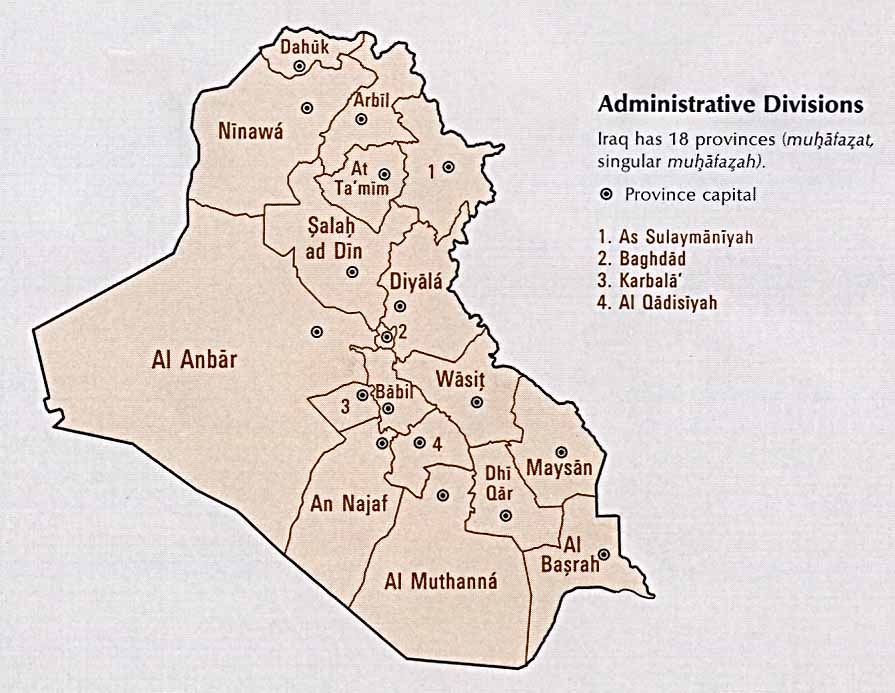
Now that Iraq’s parliament has finally passed a new provincial election law, there should be a discussion of what political parties currently run Iraq’s eighteen provinces, and what they are like. Here is a breakdown of some general information about each, mostly based upon U.S. agencies.

Overview of Iraq’s Major Parties and What Provinces They Control

Kurds (Kurdistan Democratic Party and Patriotic Union of Kurdistan): Dahuk, Irbil, Ninewa, Salahaddin, Sulaymaniyah, Tamim
SIIC: Babil, Baghdad, Dhi Qar, Diyala, Muthanna (but Dawa governor), Najaf, Qadisiyah, Wasit
Dawa (Jaafari faction) - Karbala
Fadhila – Basra - governor, but SIIC & Dawa control provincial council
Iraqi Islamic Party – Anbar
Sadrists – Maysan


Notes:

1) Many of the major political parties do not run under their names such as the Supreme Islamic Iraqi Council (SIIC) in the provinces, and the monikers they do use are interpreted several different ways from Arabic into English.

2) Iraq did not pass its 2008 budget until February 2008, which accounts for the low percentage spent by the provinces by March 2008, the latest numbers available.


3) The U.S. Provincial Reconstruction Teams have five rankings for how Iraq’s provinces are doing governing in the following order: Beginning, Developing, Performing, Sustaining, Self-Reliant


Anbar
Population: 1,280,000
Religion: 99% Sunni, 1% Shiite
Control of provincial council: Iraqi Islamic Party (Part of Iraqi Accordance Front)
Economy: Farming, livestock, glass and ceramics
Capital budget:
2007: Appropriated: $107 million Spent: $4 million Percentage: 3.7%
Up To March 2008: Appropriated: $192 million Spent: N/A Percentage: N/A
U.S. Provincial Reconstruction Teams Rankings from 11/30/07-2/29/08
Governance: Developing to Sustaining
Political Development: Developing to Performing
Reconciliation: no change - Performing
Economic Development: Beginning to Developing
Rule of Law: no change - Performing
Governance: Lack of coordination with Baghdad. Has several different authorities operating independently of each other. Corruption
Average Daily Electricity Provided/Demand (megawatts): 161/304
Services: Lacks adequate electricity and water
U.S. projects: 7,139, $1.7 billion
Number of displaced living in province: 64,536
Average daily attacks from December 07 to February 08: 2.37
Average daily attacks from February 08 to May 08: 1.95

Babil
Population: 1,444,400
Religion: 5% Sunni, 95% Shiite
Control of provincial council: Society of Faithful Iraqis (SIIC)
Economy: Farming, 52% of GDP of province. Has some of the most advanced farming in country
Capital budget:
2007: Appropriated: $127 million Spent: $61.9 million Percentage: 49%
Up To March 2008: Appropriated: $206 million Spent: $5.1 million Percentage: 3%
U.S. Provincial Reconstruction Teams Rankings from 11/30/07-2/29/08
Governance: no change - Developing
Political Development: no change - Beginning
Reconciliation: no change – Beginning
Economic Development: no change - Performing
Rule of Law: no change - Performing
Average Daily Electricity Provided/Demand (megawatts): 133/260
Services: Water shortage
U.S. projects: 2,178, $433 million
Number of displaced living in province: 77,914
Average daily attacks from December 07 to February 08: 0.57
Average daily attacks from February 08 to May 08: 0.73

Baghdad
Population: 6,386,100
Religion: 20% Sunni, 80% Shiite
Control of provincial council: Baghdad Nation (SIIC)
Economy: Farming, which is improving, but still uses outdated techniques. Business in south improving with better security
Capital budget:
2007: Appropriated: $560 million Spent: $174.4 million Percentage: 31%
Up To March 2008: Appropriated: $885 million Spent: $14.5 million Percentage: 2%
U.S. Provincial Reconstruction Teams Rankings from 11/30/07-2/29/08
Governance: no change - Developing
Political Development: no change - Developing
Reconciliation: no change - Developing
Economic Development: no change - Developing
Rule of Law: Beginning to Performing
Average Daily Electricity Provided/Demand (megawatts): 989/2,047
U.S. projects: 17,153, $7 billion
Number of displaced living in province: 563,771
Average daily attacks from December 07 to February 08: 15.60
Average daily attacks from February 08 to May 08: 24.02, most violence province in Iraq

Basra
Population: 1,761,000
Religion: 100% Shiite
Control of provincial council: Islamic Basra (Coalition of SIIC, Dawa and 6 others)
Economy: Oil, trade, only port in Iraq. Business improving after March 2008 security crackdown
Capital budget:
2007: Appropriated: $195 million Spent: $40.8 million Percentage: 21%
Up To March 2008: Appropriated: $322 million Spent: $0 Percentage: 0%
U.S. Provincial Reconstruction Teams Rankings from 11/30/07-2/29/08
Governance: Beginning to Sustaining
Political Development: Beginning to Performing
Reconciliation: Beginning to Performing
Economic Development: Beginning to Developing
Rule of Law: Beginning to Developing
Average Daily Electricity Provided/Demand (megawatts): 615/762
U.S. projects: 3,306, $2.1 billion
Number of displaced living in province: 35,718
Average daily attacks from December 07 to February 08: 1.21
Average daily attacks from February 08 to May 08: 1.28

Dahuk
Population: 616,600
Religion: 39% Sunni, 3% Shiite, 58% Other
Control of provincial council: Kurdistan Democratic Party
Economy: Farming, tourism
Capital budget:
2007: Appropriated: Spent: Percentage: See Kurdistan
Up To March 2008: Appropriated: Spent: Percentage: See Kurdistan
U.S. Provincial Reconstruction Teams Rankings from 11/30/07-2/29/08
Governance: N/A
Political Development: N/A
Reconciliation: N/A
Economic Development: N/A
Rule of Law: N/A
Average Daily Electricity Provided/Demand (megawatts): 120/201
U.S. projects: 476, $164 million
Number of displaced living in province: 104,948
Average daily attacks from December 07 to February 08: 0
Average daily attacks from February 08 to May 08: 0, Turkey does attack Kurdistan Workers’ Party (PKK) bases in province

Dhi Qar
Population: 1,427,200
Religion: 100% Shiite
Control of provincial council: Fadhila (Islamic Virtue Party)
Economy: Farming, livestock, oil
Capital budget:
2007: Appropriated: $138 million Spent: $54.8 million Percentage: 40%
Up To March 2008: Appropriated: $219 million Spent: $100,000 Percentage: 0.1%
U.S. Provincial Reconstruction Teams Rankings from 11/30/07-2/29/08
Governance: Beginning to Sustaining
Political Development: Beginning to Performing
Reconciliation: Beginning to Performing
Economic Development: Beginning to Performing
Rule of Law: Beginning to Performing
Average Daily Electricity Provided/Demand (megawatts): 213/298
Services: Water shortage
U.S. projects: 1,217, $919 million
Number of displaced living in province: 47,825
Average daily attacks from December 07 to February 08: 0.24
Average daily attacks from February 08 to May 08: 0.23

Diyala
Population: 1,373,900
Religion: 52% Sunni, 48% Shiite
Control of provincial council: Coalition of Islamic Forces and Patriots in Diyala (Coalition of SIIC and Dawa)
Economy: Farming, livestock, facing drought
Capital budget:
2007: Appropriated: $100 million Spent: N/A Percentage: N/A
Up To March 2008: Appropriated: $168 million Spent: N/A Percentage: N/A
U.S. Provincial Reconstruction Teams Rankings from 11/30/07-2/29/08
Governance: Performing to Sustaining
Political Development: no change - Developing
Reconciliation: Beginning to Developing
Economic Development: no change - Developing
Rule of Law: no change - Beginning
Average Daily Electricity Provided/Demand (megawatts): 157/225
U.S. projects: 3,074, $912 million
Number of displaced living in province: 103,426
Average daily attacks from December 07 to February 08: 5.26
Average daily attacks from February 08 to May 08: 3.58

Irbil
Population: 1,845,200
Religion: 62% Sunni, 2% Shiite, 365 Other
Control of provincial council: Democratic Voice of Kurdistan List (Kurdistan Democratic Party)
Economy: Oil, farming, hit by drought
Capital budget:
2007: Appropriated: Spent: Percentage: See Kurdistan
Up To March 2008: Appropriated: Spent: Percentage: See Kurdistan
U.S. Provincial Reconstruction Teams Rankings from 11/30/07-2/29/08
Governance: no change - Sustaining
Political Development: no change - Sustaining
Reconciliation: no change - Performing
Economic Development: no change - Performing
Rule of Law
Average Daily Electricity Provided/Demand (megawatts): 174/370
U.S. projects: 839, $481 million
Number of displaced living in province: 31,783
Average daily attacks from December 07 to February 08: 0.02
Average daily attacks from February 08 to May 08: 0.01

Karbala
Population: 756,000
Religion: 100% Shiite
Control of provincial council: SIIC
Economy: Tourism 37% of province’s GDP, trade 25%, farming 15%
Capital budget:
2007: Appropriated: $71 million Spent: $29.4 million Percentage: 41%
Up To March 2008: Appropriated: $170 million Spent: $7.4 million Percentage: 4%
U.S. Provincial Reconstruction Teams Rankings from 11/30/07-2/29/08
Governance: no change - Developing
Political Development: no change - Developing
Reconciliation: Beginning to Developing
Economic Development: no change - Developing
Rule of Law: no change - Performing
Average Daily Electricity Provided/Demand (megawatts): 100/215
Services: Power outages, lack of basic services, water, electricity.
U.S. projects: 710, $192 million
Number of displaced living in province: 55,962
Average daily attacks from December 07 to February 08: 0.02
Average daily attacks from February 08 to May 08: 0.06

Kurdistan (Dahuk, Irbil, Sulaymaniyah)
No figures are available for the individual provinces’ capital budget, only the total for all three
Capital budget:
2007: Appropriated: $1,560 million Spent: $1,487 million Percentage: 95%
Up To March 2008: Appropriated: $2,528 million Spent: $266 million spent Percentage: 11%

Maysan
Population: 743,400
Religion: 100% Shiite
Control of provincial council: Al-Hussayni Thought Forum (Sadrists)
Economy: 75% of province works in farming. Has ageing state owned industries. Poorest province in Iraq, 64% below poverty level
Capital budget:
2007: Appropriated: $76 million Spent: $39 million Percentage: 51%
Up To March 2008: Appropriated: $124 million Spent: $17.4 million Percentage: 14%
U.S. Provincial Reconstruction Teams Rankings from 11/30/07-2/29/08
Governance: decreased from Developing to Beginning, lowest in Iraq
Political Development: no change - Developing
Reconciliation: no change Performing
Economic Development: decreased from Developing to Beginning
Rule of Law: no change - Developing
Average Daily Electricity Provided/Demand (megawatts): 99/182
Services: Ranked as having one of the lowest levels of services such as electricity, schools, medical car, etc. in country. U.S. says so bad that it is “population-repelling”
U.S. projects: 727, $299 million
Number of displaced living in province: 46,948
Average daily attacks from December 07 to February 08: 0.02
Average daily attacks from February 08 to May 08: 0

Muthanna
Population: 536,300
Religion: 100% Shiite
Control of provincial council: SIIC
Economy: Subsistence farming, livestock. One of poorest in Iraq. 60% unemployed
Capital budget:
2007: Appropriated: $52 million Spent:$9.9 million Percentage: 19%
Up To March 2008: Appropriated: $87 million Spent: N/A Percentage: N/A
U.S. Provincial Reconstruction Teams Rankings from 11/30/07-2/29/08
Governance: no change - Developoing
Political Development: decreased from Developing to Beginning
Reconciliation: no change Self-Reliant
Economic Development: no change - Developing
Rule of Law: no change - Developing
Average Daily Electricity Provided/Demand (megawatts): 85/170
Services: Few services such as electricity, housing. During summer has water shortages
U.S. projects: 741, $316 million
Number of displaced living in province: 18,351
Average daily attacks from December 07 to February 08: 0.04
Average daily attacks from February 08 to May 08: 0.02

Najaf
Population: 946,300
Religion: 100% Shiite
Control of provincial council: SIIC
Economy: Tourism 30% of provinces GDP, trade 20%, farming 15%
Capital budget:
2007: Appropriated: $88 million Spent: $56.4 million Percentage: 64%
Up To March 2008: Appropriated: $150 million Spent: $18.7 million Percentage: 13%
U.S. Provincial Reconstruction Teams Rankings from 11/30/07-2/29/08
Governance: no change - Sustaining
Political Development: no change - Developing
Reconciliation: Beginning to Developing
Economic Development: no change - Performing
Rule of Law: Developing to Performing
Average Daily Electricity Provided/Demand (megawatts): 134/241
Services: Lacks infrastructure, no desire to improve especially electricity, roads, bridges
U.S. projects: 1,153, $272 million
Number of displaced living in province: 58,032
Average daily attacks from December 07 to February 08: 0
Average daily attacks from February 08 to May 08: 0.03

Ninewa
Population: 2,473,700
Religion: 42% Sunni, 5% Shiite, 53% Other
Control of provincial council: National Democratic Kurdistan List (Coalition of Kurdistan Democratic Party, Patriotic Union of Kurdistan, and six others)
Economy: Farming, has closed down industries
Capital budget:
2007: Appropriated: $226 million Spent: $58.5 million Percentage: 26%
Up To March 2008: Appropriated: $359 million Spent: $0 Percentage: 0%
U.S. Provincial Reconstruction Teams Rankings from 11/30/07-2/29/08
Governance: no change - Developing
Political Development: no change - Developing
Reconciliation: no change - Beginning
Economic Development: no change - Beginning
Rule of Law: Beginning to Developing
Average Daily Electricity Provided/Demand (megawatts): 408/736
Services: Electrical and water shortages
U.S. projects: 4,008, $983 million
Number of displaced living in province: 106,750
Average daily attacks from December 07 to February 08: 16.30
Average daily attacks from February 08 to May 08: 13.55, 2nd most violence province

Qadisiyah
Population: 866,700
Religion: 100% Shiite
Control of provincial council: Martyr of the Sanctuary Sayyid (SIIC)
Economy: Farming 47% of province’s GDP, using old techniques, old industries, high unemployment, inflation
Capital budget:
2007: Appropriated: $64 million Spent: $24.7 million Percentage: 39%
Up To March 2008: Appropriated: $137 million Spent: $0 Percentage: 0%
U.S. Provincial Reconstruction Teams Rankings from 11/30/07-2/29/08
Governance: no change - Developing
Political Development: no change - Developing
Reconciliation: no change - Beginning
Economic Development: no change - Developing
Rule of Law: no change – Performing
Governance: Corruption
Average Daily Electricity Provided/Demand (megawatts): 118/227
Services: Lacks basic services such as trash collection, medical care
U.S. projects: 1,450, $312 million
Number of displaced living in province: 26,320
Average daily attacks from December 07 to February 08: 0.08
Average daily attacks from February 08 to May 08: 0.18

Salahaddin
Population: 1,077,800
Religion: 96% Sunni, 4% Shiite
Control of provincial council: United Democratic Council List in Salah al-Din Governorate (Coalition of Patriotic Union of Kurdistan and Kurdistan Democratic Party)
Economy: Farming, oil, gas, salt, sulphur
Capital budget:
2007: Appropriated: $93 million Spent: $31.5 million Percentage: 34%
Up To March 2008: Appropriated: $150 million Spent: $16.1 million Percentage: 11%
U.S. Provincial Reconstruction Teams Rankings from 11/30/07-2/29/08
Governance: Developing to Sustaining
Political Development: Developing to Performing
Reconciliation: Beginning to Developing
Economic Development: no change - Developing
Rule of Law: no change - Developing
Average Daily Electricity Provided/Demand (megawatts): 227/323
U.S. projects: 3,249, $814 million
Number of displaced living in province: 45,762
Average daily attacks from December 07 to February 08: 8.73
Average daily attacks from February 08 to May 08: 6.28, 3rd most violence in Iraq

Sulaymaniyah
Population: 2,159,800
Religion: 88% Sunni, 12% Shiite
Control of provincial council: Patriotic Union of Kurdistan
Economy: Farming, inflation
Capital budget:
2007: Appropriated: Spent: Percentage: See Kurdistan
Up To March 2008: Appropriated: Spent: Percentage: See Kurdistan
U.S. Provincial Reconstruction Teams Rankings from 11/30/07-2/29/08
Governance: N/A
Political Development: N/A
Reconciliation: N/A
Economic Development: N/A
Rule of Law: N/A
Average Daily Electricity Provided/Demand (megawatts): 138/301
Services: Limited, government doesn’t use money well
U.S. projects: 646, $212 million
Number of displaced living in province: 79,672
Average daily attacks from December 07 to February 08: 0.02
Average daily attacks from February 08 to May 08: 0.02, Iran strikes Kurdistan Workers’ Party (PKK) bases there

Tamim
Population: 839,100
Religion: 73% Sunni, 22% Shiite, 5% Other
Control of provincial council: List Brother Kirkuk (Coalition of Kurdistan Democratic Party and Patriotic Union of Kurdistan)
Economy: Farming, industry, oil, natural gas. Hit by drought
Capital budget:
2007: Appropriated: $91 million Spent: $31 million Percentage: 34%
Up To March 2008: Appropriated: $146 million Spent: $13.7 million Percentage: 9%
U.S. Provincial Reconstruction Teams Rankings from 11/30/07-2/29/08
Governance: no change - Developing
Political Development: no change - Performing
Reconciliation: no change - Developing
Economic Development: no change - Developing
Rule of Law: no change - Developing
Average Daily Electricity Provided/Demand (megawatts): 179/254
Services: Not enough electricity and water, shortage of medical care and schools
U.S. projects: 3,413, $983 million
Number of displaced living in province: 36,202
Average daily attacks from December 07 to February 08: 2.63
Average daily attacks from February 08 to May 08: 1.8

Wasit
Population: 941,800
Religion: 100% Shiite
Control of provincial council: Gather of Iraq Elites (SIIC)
Economy: Farming, oil, gravel, natural gas. Not much development of natural resources because of lack of government planning and direction
Capital budget:
2007: Appropriated: $83 million Spent: $33.7 million Percentage: 41%
Up To March 2008: Appropriated: $137 million Spent: $300,000 Percentage: 0.2%
U.S. Provincial Reconstruction Teams Rankings from 11/30/07-2/29/08
Governance: Beginning to Developing
Political Development: Beginning to Developing
Reconciliation: no change - Beginning
Economic Development: no change - Beginning
Rule of Law: Beginning to Developing
Average Daily Electricity Provided/Demand (megawatts): 90/189
U.S. projects: 1,404, $452 million
Number of displaced living in province: 75,325
Average daily attacks from December 07 to February 08: 0.23
Average daily attacks from February 08 to May 08: 0.57

SOURCES:
Institute for the Study of War, “Fact Sheet on Iraq’s Major Shi’a Political Parties and Militia Groups,” April 2008
- “Iraq’s Major Shi’a Political Parties and Militias,” 4/14/08
Middle East Reference.org, “Governorate elections held in Iraq on 31 January 2005”
Special Inspector General for Iraq Reconstruction, “Quarterly and Semiannual Report to the United States Congress,” 7/30/08

Saturday, October 04, 2008

Carrot and the Stick With Diyala’s Sons of Iraq, Or Just The Sticks?

The following commentary originally appeared in Musings On Iraq

Baghdad is claiming that it is integrating the Sons of Iraq (SOI) in Diyala province. On September 24, 2008 the general in charge of the National Command Center said that the Interior Ministry had hired 2,000 SOI from Diyala into the provincial police force since the beginning of Operation Promise of Good in late July, and was looking for a total of 4,000. The Defense Ministry also said that it wanted to recruit 3,000 as soldiers. Any SOI that had special skills or education were also promised government jobs. In the beginning of August, the Interior said that all the SOI in Diyala were going to be given employment. A few days later, the Prime Minister offered 3,000 police jobs to any SOI that assisted in the security crackdown.

The government’s claims are hard to believe, because as reported earlier, Iraqi forces have had nothing but conflicts with the local SOI. In May 2008 Baghdad issued arrest warrants for several SOI leaders. This was just two days after they had set up a political party to run in the provincial elections, and one day before they could begin forming coalitions. The warrants disqualified them from participating however. When the security operation began there in late July, the security forces also shut down SOI offices in the provincial capitol Baquba and other cities, told them to leave the streets, and arrested at least five leaders and 100 fighters. They have banned all weapons in the province, something that is illegal according to the Constitution, which allows each Iraqi family an AK-47 in their home. The order was obviously meant to give the security forces an excuse to arrest any SOI that was manning their post. The head of the SOI in Baquba, Abu Talib, had an arrest warrant for him. With the help of the U.S. he was not detained after a meeting with the provincial police chief, but he later met with an advisor to Maliki who told him he should hide. That led him to flee to Syria.

The security forces have also gone after the SOI’s allies in the provincial government. The Iraqi Islamic Party’s headquarters in Diyala have been raided three times for example. Some of their leading politicians have also been arrested. Most damning was an August 18 raid on the provincial offices where a special counterterrorism police unit arrested and beat Islamic Party official Hussein al-Zubaidi, the head of the provincial council’s security office. Zubaidi was known as a supporter of the local SOI. The U.S. says that there was no reason for Zubaidi to be arrested or held.

Many SOI in Diyala believe the government is out to disband them, and it is hard not to see where their suspicions come from. During the Surge, U.S. officials and military officers said that the Sons of Iraq were an example of an “Iraqi solution for Iraqi problems.” Ambassador Ryan Crocker said in January 2008 that things had progressed to the point where Iraqis could find solutions to their own problems. When it comes to the government and the SOI, it seems like an Iraqi solution will be the arrest of many of their leaders, the disbandment of many, and then the integration of the truncated leftovers.

SOURCES:
Alsumaria, “Popular committees to join security forces,” 8/4/08
Garcia-Navarro, Lourdes, “Iraq Paramilitary Group Targeted, Despite Success,” Morning Edition, NPR, 9/4/08
- “Sunni Group Says It’s Being Harrassed,” Morning Edition, 9/29/08
Levinson, Charles, “Awakening Councils in hiding as arrests on rise,” USA Today, 9/22/08
Parker, Sam, “Guest Post: Behind the Curtain in Diyala,” Abu Muqawama Blog, 8/20/08
Ricks, Thomas and DeYoung, Karen, “For U.S., The Goal Is Now ‘Iraqi Solution,’” Washington Post, 1/10/08
Russo, Claire, “The Maliki Government Confronts Diyala,” Institute for the Study of War,” 9/23/08
Shachtman, Noah, “Ominous Future for Iraq’s Militias,” Danger Room Blog, Wired, 3/14/08
UPI, “Sons of Iraq join Diyala offensive,” 8/6/08
Voices of Iraq, “MOI hires 2,000 Sahwa fighters in Diala,” 9/24/08

Friday, October 03, 2008

Numbers on Internally Displaced Iraqis

The following commentary originally appeared in Musings On Iraq

In August 2008, the Middle East Institute published a special issue of Viewpoints that focused upon Iraq’s refugee crisis. The report included some of the most up to date statistics on Iraq’s displaced available, based upon a number of sources such as the International Organization for Migration, the Brookings Institute, etc.

The number most commonly used for Iraq’s internal refugees comes from the United Nations, but there are others sources that say the total might be less. The U.N. says there are 2.7 million refugees. 1.2 million of those came before the February 2006 Samarra shrine bombing, which is credited for setting off the sectarian war. The other 1.5 million were a result of that fighting. The Special Inspector General for Iraq Reconstruction (SIGIR) used the U.N.’s numbers, but when it broke down those that have registered province by province, it only found 1,579,245. The Middle East Institute’s numbers were only an estimate, but came very close to the SIGIR’s at 1,607,994. The International Crisis Group released a report on Iraq’s refugees in July 2008 that noted there was a wide range of numbers on the displaced for a number of reasons. Those included the fact that some don’t register with authorities, foreign countries don’t have the ability to track many of them, illegal immigration, different groups use different methods, and the fact that governments change the numbers for political reasons.

Here’s a breakdown of the Viewpoints’ findings.

Note: The percentages for causes and aid do not add up to 100%

Internally Displaced Iraqis Since April 2003

2003 400,000
2004 800,000
2005 1,200,000
2006 2,000,000
2007 2,740,000
2008 2,770,000

Overview
  • Most displaced before Feb. 2006: Sulaymaniyah 50.465 families (approx. 302,790 people)
  • Most displaced after Feb. 2006: Baghdad 92,936 families (approx. 563,771 people)
Sect:
  • Highest Percentage of Shiite Arabs: Basra, Dhi Qar, Muthana, Qadisiyah and
  • Wasit 99.99%
  • Highest Percentage of Sunni Arabs: Anbar 99.3%
  • Highest Percentage of Kurds: Irbil 39.7%
Aid:
  • Highest Percentage Ministry of Displacement and Migration Wasit 84.5%
  • Lowest Percentage of Ministry of Displacement and Migration Dahuk 0.1%
  • Highest Percentage Other Government Agency Dahuk 17.1%
  • Lowest Percentage Other Government Agency Muthana 0.3%
  • Highest Percentage Iraqi Red Crescent Najaf 69.7%
  • Lowest Percentage Iraqi Red Crescent Irbil 0.1%
  • Highest Percentage Humanitarian Group Anbar 66.8%
  • Lowest Percentage Humanitarian Group Salahadin 0.4%
  • Highest Percentage Non-Government Organization or U.N. Wasit 28.5%
  • Lowest Percentage Non-Government Organization or U.N. Naaf 0.2%
  • Highest Percentage of No Aid Kirkuk 58.6%
  • Lowest Percentage of No Aid Najaf 1.6%

Anbar
Total displaced before Feb. 2006: 1,025 families (approx. 29,418 people)
Total displaced after Feb. 2006: 8,876 families (approx. 51,487 people)
Origin: Baghdad 77.27%, Anbar 16.41%, Basra 6.19%
Sect: 99.3% Sunni Arab, 0.5% Shiite Arab
Causes: General Violence 43.7%, Threats on Life 30.1%, Forced Out 28.5%, Fighting 19.1%, Fear 8.9%
Security Statistics: Checkpoints 57.8%, Other Limits on Movement 23.1%, Death or Injury 22.1%
Aid: Humanitarian Groups 66.8%, Community 57.8%, Religious Group 57.4%, Family 22.3%, Iraqi Red Crescent 19.5%, No Aid 6.6%, Ministry of Displacement and Migration 2.2%

Babil
Total displaced before Feb. 2006: 1,475 families (approx. 8,850 people)
Total displaced after Feb. 2006: 12,799 families (approx. 77,914 people)
Origin: Baghdad 82.6%, Diyala 5.84%, Babil 5.65%, Salahadin 2.06%, Anbar 1.93%, Wasit 1.06%, Kirkuk 0.66%, Other 0.2%
Sect: 94.4% Shiite Arab, 5.3% Sunni Arab
Causes: Threats on Life 59.5%, Fear 57.2%, Forced Out 54.7%, Violence 50.5%
Security Statistics: Checkpoints 16.7%, Other Limits on Movement 10.4%, Need Pass to Move From Residence 7.1%, Death Or Injury 6%, Missing Group Members 3.4%
Aid: Community 62%, Iraqi Red Crescent 56.9%, Ministry of Displacement and Migration 30.2%, No Aid 26.1%, Family 27.4%, Other Government Agency 13.2%, Non-Government Organization or U.N. 1.4%

Baghdad
Total displaced before Feb. 2006: 3,867 families (approx. 23,202 people)
Total displaced after Feb. 2006: 92,936 families (approx. 563,771 people)
Origin: Baghdad 80.29%, Diyala 16.4%, Anbar 1.71%, Salahadin, 0.9%, Kirkuk 0.35%, Ninewa, 0.32%, Babil 0.16%, Other 0.22%
Sect: 80% Shiite, 19.8% Sunni, 0.1% Shiite Kurd, 0.02% Yazidi Arab
Causes: Threats on Life 56.5%, Fear 39.5%, Forced Out 39.4%, Violence 36.4%, Fighting 24.8%
Security Statistics: Death Or Injury 25.6%, Need Pass to Move From Residence 4.5%, Missing Group Members 3.0%, Other Limits on Movement 1.4%, Checkpoints 0.2%
Aid: No Aid 54.8%, Family 30%, Religious Group 27.2%, Community 20.9%, Iraqi Red Crescent 16%, Humanitarian Groups 14%, Ministry of Displacement and Migration 10.7%, Other Government Agency 2.6%

Basra
Total displaced before Feb. 2006: 15,778 families (approx. 94,668 people)
Total displaced after Feb. 2006: 6,031 families (approx. 35,718 people)
Origin: Baghdad 51.64%, Salahadin 26.54%, Anbar 8.13%, Diyala 6.4%, Kirkuk 4.15%, Babil 2.01%, Basra 0.66%, Other 0.l22%
Sect: 99.99% Shiite, 0.01% Sunni Arab
Causes: Threats on Life 95.5%, Fear 5.2%, Forced Out 2.1%, Violence 0.6%, Fighting 0.5%
Security Statistics: Death Or Injury 13.5%, Missing Group Members 1.4%, Need Pass to Move From Residence 0.6%
Aid: No Aid 46.4%, Iraqi Red Crescent 33.1%, Family 23.4%, Ministry of Displacement and Migration 20.8%, Community 14.1%, Religious Group 12.5%, Humanitarian Group 4.4%, Other Government Agency 1.6%

Dahuk
Total displaced before Feb. 2006: 22,474 families (approx. 134,844 people)
Total displaced after Feb. 2006: 18,733 families (approx. 104,948 people)
Origin: Baghdad 56.51%, Ninewa 41.69%, Kirkuk 0.69%, Basra 0.50%, Anbar 0.38%, Salahadin, 0.06%, Muthanna 0.03%, Other 0.06%
Sect: 35.6% Sunni Kurd, 31.5% Chaldean Christian, 20.8% Assyrian Christian, 4.0% Armenian Christian, 2.4% Sunni Arab, 2.1% Shiite
Causes: Fear 91.3%, Violence 88.1%, Threats on Life 71.6%, Fighting 37%
Security Statistics: Death or Injury 13.3%, Missing Group Members 2.5%, Checkpoints 0.9%, Need Pass to Move From Residence 0.6%, Other Limits on Movement 0.2%
Aid: No Aid 45%, Religious Group 19.8%, Iraqi Red Crescent 19.1%, Other Government Agency 17.1%, Family 12.8%, Humanitarian Group 4.2%, Community 4%, Ministry of Displacement and Migration 0.1%

Dhi Qar
Total displaced before Feb. 2006: 4,226 families (approx. 25,356 people)
Total displaced after Feb. 2006: 7,138 families (approx. 47,925 people)
Origin: Baghdad 68.42%, Salahadin 13.21%, Diyala 8.57%, Anbar 3.06%, Kirkuk 2.82%, Babil 2.43%, Wasit 1.1%
Sect: 99.99% Shiite Arab, 0.01% Sunni Arab
Causes: Threats 75.1%, Violence 58.6%, Forced Out 34%, Fear 33.7%, Fighting 7.1%
Security Statistics: Missing Family Member 15.2%, Need Pass to Move From Residence 12.4%, Death or Injury 7.8%, Checkpoints 0.1%
Aid: Relatives 45.1%, Religious Group 41.6%, Iraqi Red Crescent 40.7%, Community 35.7%, Ministry of Displacement and Migration 33.1%, No Aid 27.6%, Humanitarian Group 18%, Other Government Agency 0.6%

Diyala
Total displaced before Feb. 2006: 9,100 families (approx. 54,600 people)
Total displaced after Feb. 2006: 17,198 families (approx. 103,426 people)
Origin: Diyala 83.47%, Baghdad 15.84%, Anbar 0.19%, Babil 0.l6%, Kirkuk 0.15%, Salahadin 0.12%, Basra 0.04%, Qadisiyah 0.02%
Sect: 50.7% Sunni Arab, 39.5% Shiite Arab, 7.8% Shiite Kurd, 1.37% Sunni Kurd, 0.5% Shiite Turkomen, 0.13% Sunni Turkomen
Causes: Violence 57.4%, Forced Out 55.1%, Threats on Life 53.2%, Fear 36.8%, Fighting 27.2%, Other 1.6%
Security Statistics: Checkpoints 50.7%, Death or Injury 39.4%, Missing Group Members 16.1%, Other Limits on Movement 11.5%, Need Pass to Move From Residence 8.8%
Aid: Community 59.3%, Family 44.2%, Iraqi Red Crescent 34%, No Aid 20.3%, Ministry of Displacement and Migration 19.9%, Humanitarian Group 16.9%, Religious Group 16.6%, Other Government Agency 2.2%

Irbil
Total displaced before Feb. 2006: 32,813 families (approx. 196,878 people)
Total displaced after Feb. 2006: 10,339 families (approx. 62,034 people)
Origin: Ninewa 46.76%, Baghdad 45.78%, Kirkuk 2.52%, Diyala 1.94%, Salahadin 0.76%, Anbar 0.74%, Basra 0.71%, Other 0.53%
Sect: 39.7% Sunni Kurd, 23.56% Chaldean Christian, Sunni Arab 21.8%, Assyrian Christian 5.9%, Christian Kurd/Other/Arab 2.9%, Shiite Arab 1.6%
Causes: Fear 97.2%, Violence 48.4%, Threats on Life 11.1%, Fighting 0.3%
Security Statistics: Need Pass to Move From Residence 95.8%, Checkpoints 89.9%, Missing Group Member 0.5%, Death or Injury 0.5%, Other Limits on Movement 0.1%
Aid: Religious Group 4.9%, Humanitarian Group 0.8%, Iraqi Red Crescent 0.1%, Family 0.1%

Karbala
Total displaced before Feb. 2006: 18,818 families (approx. 112,908 people)
Total displaced after Feb. 2006: 8,617 families (approx. 55,962 people)
Origins: Baghdad 53.78%, Diyala 23.38%, Anbar 8.5%, Babil 3.05%, Kirkuk 2.82 %, Salahadin 1.67%, Karbala 1.65%, Wasit 0.16%
Sect: 98.2% Shiite, 1.4% Shiite Turkomen
Causes: Threats on Life 78.6%, Fear 48.2%, Violence 41%, Forced Out 32.5%, Fighting 32%
Security Statistics: Checkpoints 28.3%, Missing Group Members 24.3%, Death or Injury 17.1%, Need Pass to Move From Residence 14.3%, Other Limits on Movement 0.1%
Aid: Iraqi Red Crescent 53.7%, Family 48.5%, No Aid 47.7%, Ministry of Displacement and Migration 41.9%, Community 28.3%, Other Government Agency 11%, Non-Government Organization or U.N. 1.5%

Kirkuk
Total displaced before Feb. 2006: 1,252 families (approx. 7,512 people)
Total displaced after Feb. 2006: 7,958 families (approx. 47,748 people)
Origins: Diyala 28.96%, Baghdad 18.92%, Salahadin 17.14%, Ninewa 16.3%, Kirkuk 15.17%, Anbar 2.17%, Irbil 0.32%, Other 0.49%
Sect: 51.8% Sunni Arab, 18.8% Shiite Turkomen, 18.2% Sunni Kurd, 3.2% Sunni Turkomen, 2.8% Shiite Arab
Causes: Violence 84.6%, Fear 68.4%, Threats on Life 45.3%, Fighting 4.2%, Forced Out 1.6%
Security Statistics: Missing Family Members 48.4%, Other Limits on Movement 27.1%, Need Pass to Move From Residence 27.0%, Death or Injury 23.1%, Checkpoints 17.2%
Aid: No Aid 58.6%, Family 15.%, Ministry of Displacement and Migration 14.4%, Community 5.9%, Religious Group 5.7%, Humanitarian Group 5.2%, Iraqi Red Crescent 3.9%, Other Government Agency 1%

Maysan
Total displaced before Feb. 2006: 18,871 families (approx. 113,226 people)
Total displaced after Feb. 2006: 6,858 families (approx. 46,948 people)
Origins: Baghdad 83.84%, Diyala 7.67%, Salahadin 4.65%, Kirkuk 1.55%, Anbar 1.02%, Wasit 0.47%, Babil 0.34%
Sect: 99.9% Shiite, 0.1% Sabean Mandean
Causes: Fear 63.4%, Threats on Life 43.4%, Forced Out 30.7%, Violence 18.4%, Fighting 10.7%
Security Statistics: Checkpoints 3.3%, Missing Family Members 2.5%, Other Limits on Movement 1.9%, Need Pass to Move From Residence 1%
Aid: Ministry of Displacement and Migration 52%, Religious Group 37.9%, Community 28.4%, No Aid 27.7%, Iraqi Red Crescent 23.1%, Family 3%, Non-Government Organization or U.N. 2.6%

Muthana
Total displaced before Feb. 2006: 861 families (approx. 5,166 people)
Total displaced after Feb. 2006: 2,641 families (approx. 18,351 people)
Origins: Baghdad 72.44%, Diyala 14.1%, Anbar 7.64%, Babil 1.82%, Salahadin 1.31%, Ninewa 1.11%, Wasit 0.71%
Sect: 99.99% Shiite, 0.01% Sunni ARab
Causes: Threats on Life 74.8%, Fear 48.3%, Fighting 41.1%, Forced Out 34.7%, Violence 20.4%
Security Statistics: Need Pass to Move From Residence 9.8%, Missing Family Members 6%, Death or Injury 0.8%, Checkpoints 0.6%
Aid: Iraqi Red Crescent 41.5%, Ministry of Displacement and Migration 29.5%, No Aid 27.9%, Family 18.7%, Community 5.9%, Religious Group 5.3%, Humanitarian Group 2.3%, Other Government Agency 0.3%

Najaf
Total displaced before Feb. 2006: 3,993 families (approx. 23,958 people)
Total displaced after Feb. 2006: 10,140 families (approx. 58,032 people)
Origins: Baghdad 87.9%, Diyala 5.76%, Anbar 2.01%, Ninewa 1.62%, Babil 0.96%, Salahadin 0.94%, Kirkuk 0.8%, Wasit 0.02%
Sect: 98.2% Shiite, 1.4% Shiite Turkomen
Causes: Threats on Life 98%, Violence 12.7%, Forced Out 12.3%, Fear 3.2%, Fighting 1%
Security Statistics: Death or Injury 28.2%, Need Pass to Move From Residence 15.9%, Missing Family Members 2.5%
Aid: Iraqi Red Crescent 69.7%, Community 28.3%, Ministry of Displacement and Migration 21.6%, Family 13.4%, Other Government Agency 1.7%, No Aid 1.6%, Non-Government Organization or U.N. 0.2%

Ninewa
Total displaced before Feb. 2006: 6,572 families (approx. 39,432 people)
Total displaced after Feb. 2006: 19,126 families (approx. 106,750 people)
Origins: Baghdad 52.68%, Ninewa 36.57%, Basra 6.56%, Diyala 1.21%, Kirkuk 0.87%, Salahadin 0.64%, Anbar 0.58%
Sect: 40.1% Christian Assyrian, 27.6% Sunni Arab, 12.2% Christian Chaldean, 12% Sunni Turkomen, 2.7% Sunni Kurd
Causes: Threats 62.9%, Violence 42.5%, Fear 28.8%, Forced Out 17.8%, Fighting 1.7%
Security Statistics: Missing Family Member 20.2%, Need Pass to Move From Residence 19.1%, Checkpoint 7.5%, Other Limits on Movement 5.5%
Aid: Ministry of Displacement and Migration 42.1%, Community 32.6%, Iraqi Red Crescent 32.2%, Religious Group 30.2%, Family 28.6%, No Aid 23.5%, Humanitarian Group 14.9%, Other Government Agency 2.1%

Qadisiyah
Total displaced before Feb. 2006: 1,154 families (approx. 6,924 people)
Total displaced after Feb. 2006: 4,111 families (approx. 26,320 people)
Origins: Baghdad 81.44%, Diyala 6.54%, Anbar 4.62%, Salahadin 2.99%, Kirkuk 2.38%, Babil 1.66%, Wasit 0.26%
Sect: 99.99% Shiite Arab
Causes: Threats 93.3%, Fear 25.8%, Violence 21.2%, Forced Out 0.9%, Fighting 0.5%
Security Statistics: Other Limits on Movement 7.9%, Missing Family Member 0.6%
Aid: Religious Group 46.3%, Iraqi Red Crescent 40.7%, Ministry of Displacement and Migration 36.3%, Community 30.7%, Non-Government Organization or U.N. 17.6%, No Aid 15.2%, Family 2.3%

Salahadin
Total displaced before Feb. 2006: 3,366 families (approx. 20,196 people)
Total displaced after Feb. 2006: 7,817 families (approx. 45,762 people)
Origins: Baghdad 62.3%, Basra 14.35%, Diyala 9.34%, Salahadin 5.37%, Kirkuk 2.6%, Anbar 2.45%, Wasit 0.99%
Sect: 95% Sunni Arab, 3.1% Shiite Arab, 1.2% Shiite Turkomen, 0.6% Sunni Kurd, 0.1% Sunni Turkomen
Causes: Threats 75.9%, Violence 21.5%, Forced Out 19.2%, Fighting, 14.6%, Fear 10.7%
Security Statistics: Need Pass to Move From Residence 9.9%, Other Limits on Movement 7.4%, Missing Family Members 7.2%, Checkpoints 4%, Death or Injury 0.2%
Aid: No Aid 55%, Community 25.7%, Iraqi Red Crescent 17%, Family 12.2%, Religious Group 10.5%, Ministry of Displacement and Migration 4.3%, Other Government Agency 0.7%, Humanitarian Group 0.4%

Sulaymaniyah
Total displaced before Feb. 2006: 50,465 families (approx. 302,790 people)
Total displaced after Feb. 2006: 14,254 families (approx. 79,672 people)
Origins: Diyala 48.95%, Baghdad 43.28%, Anbar 2.92%, Ninewa 1.78%, Salahadin 0.9%, Kirkk 0.61%, Basra 0.47%
Sect: 64.1% Sunni Arab, 22.2% Sunni Kurd, 9.8% Shiite Arab, 2.5% Shiite Kurd, 0.4% Yazidi Kurd
Causes: Fear 90.4%, Violence 88.4%, Fighting 53.8%, Threats 46.6%, Forced Out 3.8%
Security Statistics: Death or Injury 2.2%, Missing Family Member 1.2%, Other Limits on Movement 0.9%, Need Pass to Move From Residence 0.95
Aid: Iraqi Red Crescent 6.8%, Humanitarian Group 6.1%, Community 4.8%, Other Government Agency 1.9%, Religious Group 1.2%, Family 0.1%

Wassit
Total displaced before Feb. 2006: 2,030 families (approx. 12,180 people)
Total displaced after Feb. 2006: 12,259 families (approx. 75,326 people)
Origins: Baghdad 65.17%, Diyala 32.88%, Babil 1.04%, Kirkuk 0.48%, Anbar 0.3%, Salahadin 0.14%
Sect: 99.99 Shiite Arab, 0.01% Sunni Arab
Causes: Violence 97.9%, Forced Out 1.9%, Fear 1.7%, Threats 1.3%, Fighting 0.1%
Security Statistics: Death or Injury 1%, Need Pass To Move From Residence 1%, Missing Family Members 0.7%, Checkpoints 0.3%
Aid: Ministry of Displacement and Migration 84.5%, Community 53.6%, Religious Group 47.2%, Iraqi Red Crescent 43.8%, Non-Government Organization or U.N. 28.5%, No Aid 11%, Family 2.3%

SOURCES:
Ferris, Elizabeth, “The Looming Crisis: Displacement and Security in Iraq,” Brookings Institution, August 2008
International Crisis Group, “Failed Responsibility: Iraqi Refugees In Syria, Jordan and Lebanon,” 7/10/08
Special Inspector General for Iraq Reconstruction, “Quarterly and Semiannual Report to the United States Congress,” 7/30/08
Viewpoints, “Iraq’s Refugee and IDP Crisis: Human Toll and Implications,” August 2008

Thursday, October 02, 2008

Sen. Clinton Joins Rep. Hastings in Championing Bill to Authorize Multi-year Humanitarian Funding for Vulnerable Iraqis

Last week Senator Hillary Clinton (D-NY) introduced Senate companion legislation to Representative Hastings' (D-FL) bill H.R. 6496, The Iraqi Refugee and Internally Displaced Persons Humanitarian Assistance, Resettlement, and Security Act of 2008. The bill — S.3541 — addresses the humanitarian crisis in and surrounding Iraq, authorizing multi-year funding for a comprehensive humanitarian plan to assist millions of Iraqis who have fled violence and instability in their homeland. According to the UN Refugee Agency (UNHCR), more than 2 million Iraqis are internally displaced and another 2 million Iraqis have found refuge in the neighboring countries of Jordan, Syria, Iran, Lebanon and Egypt and Turkey.
“The United States has an obligation to address this great and growing crisis in Iraq and other countries in the region,” said Clinton. “This legislation will take important steps to ease the burden on host countries that have seen this influx of refugees and to help resettle the displaced population within Iraq.”
H.R.6496/S.3541 would require the U.S. to:
  • Authorizes $700 million for FY 2009, 2010 and 2011 for the relief of Iraqi refugees, internally displaced persons, and other vulnerable Iraqis;
  • Increases direct accountable bilateral assistance, as appropriate under U.S. law, and funding for international organizations and NGOs working in the region;
  • Authorizes $500 million to increase humanitarian aid and infrastructure support for Jordan;
  • Develop an immediate and long-term strategy for Iraq, in coordination with the Government of Iraq, United Nations (UN), nongovernmental organizations (NGO’s), and host countries, to meet the humanitarian and security needs of refugees and Internally Displaced People (IDP’s); and
  • Work with the Government of Iraq, the UN, and NGO’s to improve the Iraqi Government’s capacity and ability to provide relief for all communities of vulnerable populations throughout Iraq.
  • Lead efforts in resettling persecuted Iraqis by raising the ceiling on U.S. admissions of Iraqi refugees by at least 20,000 during fiscal years 2009, 2010, and 2011.
This bill brings much needed attention to the plight of Iraqis traumatized by violence, persecution, and the loss of loved ones. If passed into law,
H.R.6496/S.3541 would require U.S. humanitarian action for peace in Iraq.

We hope you'll join us in supporting this important legislation. Urge your Senators and Representative to cosponsor The Iraqi Refugee and Internally Displaced Persons Humanitarian Assistance, Resettlement, and Security Act of 2008. You can reach your elected Member of Congress via the Capitol switchboard at (202) 225-3121 or (202) 226-3121.

Organizations supporting H.R.6496/S.3541 include:

The Campaign for Innocent Victims of Conflict (CIVIC)
CHF International
Church World Service
Congregation of Divine Providence of San Antonio, TX
Congregation of the Sisters of Charity of the Incarnate Word, Houston, Texas
Education for Peace in Iraq Center (EPIC)
International Medical Corps
International Rescue Committee
The Iraq Foundation
The Leadership Conference on Women Religious
The Maryknoll Office for Global Concerns
Mercy Center
Mercy Corps
National Catholic Peace Movement
NETWORK
Office of Justice and Peace of the Sisters of Charity of New York
Open Society Policy Center
Pax Christi USA: the Presbyterian Church (USA)
Refugees International
Save the Children
Sisters of Charity of the Blessed Virgin Mary of Dubuque, Iowa
Sisters of Charity of Leavenworth, Kansas City, Kansas
Sisters of Mercy of the Americas Institute Justice Team
Sisters of St. Francis in Tiffin, Ohio,
Sisters of St. Joseph NW, Pennsylvania

Photo caption: Joined by fellow Democratic Senator Evan Bayh, Clinton speaks with Iraqi Prime Minister Nuri al-Maliki in Baghdad, Iraq. Courtesy of Ali Al-Saadi-Pool, Getty Images.

Wednesday, October 01, 2008

Iraq’s Displaced Not Excited About Election

The following commentary originally appeared on Musings On Iraq

Iraq’s refugees appear to have little interest in the passage of the new provincial election law. As reported earlier, Iraqis have had since July to register. Iraq’s external refugees can’t vote, but the internally displaced can, and they need to sign up on a special list. The Wall Street Journal said that 100,000 of Iraq’s estimated 2.7 million internal refugees had registered. The Institute for War & Peace Reporting claimed that only 72,000 have so far. This is despite a government public relations campaign aimed at the displaced. Posters have been put up throughout Baghdad for example, encouraging them to register for the upcoming election. A major problem seems to be widespread apathy amongst Iraqis over the vote. A member of the Shiite United Iraqi Alliance said that the government’s inability to improve the living conditions of many average Iraqis was a major reason why citizens were not enthusiastic about registering. This would be doubly true for Iraq’s refugees. The head of parliament’s Displacement and Migration Committee said that only 20,000 families, roughly 120,000 people had come back to Iraq so far, with half going to Baghdad. Many have come back from other countries because they have run out of money or because of the new restrictions that have been placed on Iraqis. Many of those that have returned, have found their homes occupied, destroyed, or militias controlling their neighborhoods, leading to more internally displaced as families are forced to other areas. Faced with those problems it’s no wonder that so few of Iraq’s domestic refugees have signed up to vote.

SOURCES:
Abouzeid, Rania, “Growing Apathy Toward Iraqi Elections,” Time, 9/5/08
Chon, Gina and Naji, Zaineb, “Iraq Drive for Voters Lags,” Wall Street Journal, 9/18/08
IRIN, “Parliament demands financial help for IDPs, refugees,” 9/25/08
Naji, Zaineb, “Voter Apathy Among Iraq Displaced,” Institute for War & Peace Reporting, 9/24/08
Voices of Iraq, “IHEC opens 563 voter registration update centers – UNAMI,” 7/15/08

Tuesday, September 30, 2008

Senators Casey & Cardin Call for Humanitarian Strategy to Assist Vulnerable Iraqis

New Senate legislation has brought much needed attention to the plight of Iraqis, a move that has energized organizers and advocates for peace and justice in Iraq. On September 17, 2008 U.S. Senators Bob Casey (D-PA) and Ben Cardin (D-MD) introduced S.3509 ‘Support for Vulnerable and Displaced Iraqis Act of 2008’. The bill would require the Secretary of State to develop a comprehensive plan to:
“address the ongoing humanitarian crisis in Iraq and potential security breakdown resulting from the mass displacement of Iraqis inside Iraq and as refugees into neighboring countries.”
Senator Casey’s bill cites some startling statistics. According to the United Nations High Commissioner for Refugees (UNHCR), up to 2,000,000 Iraqis have fled their homes due to instability and violence within the region. Most of these refugees are unable to obtain legal status needed to work in the host countries and have limited access to healthcare and education. Lack of NGO and UN resources to identify and aid the refugees compounds the crisis. Within Iraqi borders the situation is just as unsettling. Another 2,700,000 estimated Internally Displaced Persons (IDPs) as well as other vulnerable populations are currently lacking adequate food, shelter, healthcare, clean water and other basic necessities. According to a recent statement made by Senator Casey,
“We have a moral responsibility to help the millions of Iraqis who have been displaced from their homes. It is my hope that this bill will take the necessary first steps to develop a long-term strategy to address the needs of vulnerable Iraqis.”
Additional findings made by Congress emphasize the destabilizing affects of massive displacement within Iraq and the overwhelming social, economic and security stresses placed on bordering host countries due to an immense influx of refugees. The bill asserts that these factors have yet to be addressed by the government. In a recent statement, Senator Cardin highlights this point:
“The lack of planning on the part of this administration and the absence of any long-term comprehensive plan to deal with refugees, threatens to destabilize the entire region and undermine security in Iraq.”
S.3509 further states that the U.S. should take the lead in combating the humanitarian crisis in Iraq. However, the bill stresses that Iraq’s direct involvement and cooperation with the U.S. is key if the two countries want to alleviate suffering in the short-term and ultimately have successful resettlement of refugees, IDP’s and other vulnerable populations. Identifying what conditions are necessary for “voluntary, safe, sustainable” return of displaced Iraqis is a pivotal part of this process. The final objective stated in the bill calls for Congress to decide what policies are most urgently needed to reduce instability in the region.

There is enthusiastic backing for S.3509 among the non-profit community. Some of the organizations who have already given their full support are:

Campaign for Innocent Victims in Conflict (CIVIC)
CHF International
EPIC: Promoting a Free & Secure Iraq
International Medical Corps
International Rescue Committee
Maryknoll Office for Global Concerns
Mercy Corps
NETWORK
Presbyterian Church (USA), Washington Office
Refugees International
Save the Children
U.S. Committee for Refugees and Immigrants
Friends Committee on National Legislation (FCNL)

Endorsement of this bill is growing because the 2008 ‘Support for Vulnerable and Displaced Iraqis Act’ is groundbreaking. Iraq is a frequent topic of debate in Congress yet the humanitarian aspect of the dilemma was often sidelined or given inadequate attention until now. S.3509 centers on the millions of Iraqis who have been forced to flee or relocate. If passed, this bill will bring the plight of displaced Iraqis squarely into the debate surrounding future U.S. policies toward Iraq. Call your Senators and urge them to support this important legislation.

Photo caption: Senators Casey and Durbin with Iraqi Deputy Prime Minister Barham Salih in the Green Zone.

Cold War Between Baghdad and Kurds Turns Hot

The following commentary was originally posted on Musings On Iraq

On September 27, Iraqi police and Kurdish forces got into a shoot out in the town of Jalawlaa in the Khanaqin district of Diyala province. There are two versions of what happened. According to Iraqi forces, a unit of the Emergency Police raided the Kurdish Democratic Party (KDP) headquarters in Jalawlaa and arrested two members. According to UPI, the target was the Kurdish intelligence agency the Asayesh. Kurdish officials then went to the Emergency Police Unit’s offices to demand the release of the two Kurds, but that resulted in a shootout that left a policeman and a member of the KDP dead, and two officers wounded. The other version comes from the Peshmerga who claim that two Arab policemen stopped three members of the Asayesh in a market. When they refused to show their identity cards they were arrested and taken to a police station. A member of the KDP went there to demand their release. He was successful, but as they were exiting, police began shooting at them, killing one of the Asayesh officers. A police official said the police who opened fire were being investigated.

The Khanaqin district has been the scene of growing conflict between Prime Minister Nouri al-Maliki’s central government and the Kurdistan Regional Government (KRG). On August 11, 2008 Iraqi forces reached the outskirts of Khanaqin as part of Operation Omens of Prosperity. They entered the towns of Qara Taba, Saidyah, and Khanaqin and demanded that the Kurdish Peshmerga militia withdraw within 24 hours and that all government buildings be evacuated. The Kurds refused at first, but after high level negotiations, agreed to pull their forces out of Qara Taba and Jalawlaa, but not Khanaqin. The security forces immediately broke that deal by moving into Khanaqin on August 24. The Kurdish parties organized demonstrations against the Iraqi forces and refused to leave. By the end of the month, another round of negotiations led to both the army and Peshmerga to withdraw leaving the Kurds still in political control of the area. By September 9 however, a Baghdad spokesman denied that any deal had been signed. On September 18, the Iraqi army again announced that the Peshmerga had to pull out of Jalawaaa. Three days later it appeared the Kurds had agreed when they announced that they would evacuate government owned buildings. All that has gone up in smoke with yesterday’s shootout.

Although the Kurds represent one of the foundations of Prime Minister Maliki’s ruling coalition, the two sides have been disagreeing more and more. The most prominent was when the Kurds vetoed the provincial election law in July 2008. The Kurds also occupy 300 square miles of territory outside of Kurdistan, which they wish to annex. The Khanaqin district is one of those. There was no security situation to speak of there when the Iraqi forces moved into the area in August. Maliki’s action was an attempt to pressure the Kurds and assert the central government’s control over all sections of the country. The Prime Minister must have been pleased to have so many high level Kurds come to his office, including Kurdish President Massoud Barzani, to work out a deal over Khanaqin. The arguments between the two sides were heated, but stayed verbal. Yesterday’s incident was the first time they turned violent, and obviously threatens all the talks over the future of the area and Maliki’s power play. Already Kurdish President Barzani and the speaker of the Kurdish Assembly have begun talking about conspiracies against the Kurds and the return of Baathism to Baghdad. This shootout will only lead to the growing paranoia of Kurdish leaders, and will probably make working with them even harder.

SOURCES:
Agence France Presse, “Man dies as Iraqi forces raid Kurdish peshmerga post,” 9/27/08
Gera, Vanessa, “Iraq: Kurdish politician killed in disputed region,” Associated Press, 9/27/08
Al-Ily, Naseer and Aziz, Hewa, “The Baghdad-Arbil Crisis Escalates,” Asharq Alawsat, 9/12/08
Middle East Online, “Iraqi forces raid Kurdish peshmerga post,” 9/27/08
Muhammed, Ako, “Kurds and their Iraqi allies see differences,” Kurdish Globe, 9/11/08
Paley, Amit, “Strip of Iraq ‘on the Verge of Exploding,’” Washington Post, 9/13/08
Press TV, “Iraq army sets deadline for Kurds,” 9/18/08
Russo, Claire, “The Maliki Government Confronts Diyala,” Institute for the Study of War,” 9/23/08
Voices of Iraq, “2 killed in clashes between policemen, Kurdish party supporters in Jalawlaa,” 9/27/08
- “Consensus solution about Khanaqin achieved – lawmaker,” 9/16/08
- “Kurdish parties to flee offices in Diala,” 9/21/08
- “No deal struck between central gov’t, Kurds over Khanaqin-spokesman,” 9/5/08

Monday, September 29, 2008

Back To Mosul

The following commentary was originally posted on Musings On Iraq:

On Wednesday August 17, 2008, Prime Minister Nouri al-Maliki admitted that the security operation in Mosul had failed to reach its goal of improving the situation in Ninewa. Maliki blamed the citizens for failing to secure their province. He said in other security crackdowns, the population had cooperated and helped the government forces round up militants, but this didn’t happen in Mosul. A member of the Interior Minister said that security forces would launch a new operation there soon.

On May 10, 2008, Maliki announced the beginning of Operation Lion’s Roar/Mother of Two Rivers that was aimed at dislodging insurgents from their last major urban stronghold in Mosul. Maliki had been talking about clearing the city since December 2007, and early operations began in February 2008. Because of the crackdowns on the Sadrists that started in March, large numbers of Iraqi forces were not able to deploy to Mosul until May. The offensive was considered a success, but as reported earlier, it actually had little affect on the number of attacks and deaths in the city.

Here is a breakdown of attacks and incidents in Mosul before and after Operation’s Lion’s Roar/Mother of Two Rivers:

January 2008:
  • 32 attacks/19 incidents – 1.03 attacks/day – 1.65 attacks & incidents/day
  • 109 killed – 3.52 deaths/day
  • 362 wounded – 11.68 wounded/day
February 2008:
  • 47 attacks/8 incidents 1.62 attacks/day – 1.9 attacks & incidents/day
  • 86 killed – 2.97 killed/day
  • 80 wounded 2.76 wounded/day
  • 6 kidnapped
March 2008:
  • 54 attacks/13 incidents – 1.74 attacks/day – 2.16 attacks & incidents/day
  • 97 killed – 3.13 killed/day
  • 147 wounded – 4.74 wounded/day
  • 3 kidnapped
April 2008:
  • 53 attacks/10 incidents – 1.77 attacks/day – 2.1 attacks & incidents/day
  • 71 killed 2.37 killed/day
  • 209 wounded 7.0 wounded/day
  • 42 kidnapped
June 2008:
  • 49 attacks/incidents – 1.63 attacks/day – 1.97 attacks & incidents/day
  • 100 killed 3.33 killed/day
  • 279 wounded 9.3 wounded/day
  • 4 kidnapped
July 2008:
  • 67 attacks/7 incidents – 2.16 attacks/day – 2.39 attacks & incidents/day
  • 96 killed 3.1 killed/day
  • 111 wounded 3.58 wounded/day
  • 2 kidnapped
August 2008:
  • 50 attacks/16 incidents – 1.61 attacks/day – 2.12 attacks & incidents/day
  • 55 killed 1.77 killed/day
  • 111 wounded 3.58 wounded/day
  • 5 kidnapped

The numbers show little change in the number of attacks or the amount of people killed or wounded before and after the offensive until August. That month, the number of attacks did drop by an average of one per day, and deaths were down by almost two a day, but the amount injured stayed the same. If you include incidents that involved violence, there was little drop off from July to August.

The major reason why the situation in Mosul has remained unstable is because the offensive did not address the underlying causes of the violence there. Unlike in Basra, Sadr City, and Maysan where the Sadrists were directly challenged on the military, political, economic, and social fronts, Operation Lion’s Roar/Mother of Two Rivers turned out to be solely a military affair that only nabbed, killed, or ran off insurgents. Maliki promised $100 million in reconstruction after the offensive, but little of that has shown up. The political situation remained untouched, with the city divided between Kurds and Arabs, with Kurds controlling the eastern half and the Arabs the west. The presence of the Kurds has allowed insurgent groups like Al Qaeda in Iraq to portray themselves as the protectors of the Arabs. The Kurds have not helped since they do have aspirations to annex the city to Kurdistan and control the Ninewa provincial council. Until those issues are addressed there will probably still be latent violence in the area, with the new offensive reducing attacks while it is in affect, with a likely rise afterwards as happened after May.

SOURCES:
Ali, Fadhil, “Iraqi Government Launches Operation to Expel al-Qaeda from Mosul,” Terrorism Focus, Jamestown Foundation, 5/20/08
DPA, “Iraq’s Islamic Party leader assassinated in Mosul,” 8/7/08
Gamel, Kim, “UN unveils plans to step up efforts in Iraq,” Associated Press, 8/31/08
Hammoudi, Laith, “Round-up of Daily Violence in Iraq – Wednesday 13 August 2008,” McClatchy Newspapers, 8/13/08
- “Round-up of Daily Violence in Iraq – Wednesday 27 August 2008,” McClatchy Newspapers, 8/27/08
Issa, Sahar, “Round-up of Daily Violence in Iraq, Monday 11 August 2008,” McClatchy Newspapers, 8/11/08
- “Round-up of Daily Violence in Iraq, Friday 22 August 2008,” McClatchy Newspapers, 8/22/08
Kuwait News Agency, “Iraqi PM admits failure of Umm Al-Rubai in military operation,” 9/18/08
Levinson, Charles, “Mosul offensive illustrates U.S. challenges,” USA Today, 2/10/08
Monsters & Critics, “Policeman, soldier killed in two incidents in Iraq (Extra),” 8/14/08
Reuters, “Bombs hit northern Iraq, forces expect more,” 8/13/08
- “FACTBOX – Security developments in Iraq, Aug 4,” 8/4/08
- “FACTBOX – Security developments in Iraq, Aug 5,” 8/5/08
- “FACTBOX – Security developments in Iraq, Aug 6,” 8/6/08
- “FACTBOX – Security developments in Iraq, Aug 8,” 8/8/08
- “FACTBOX – Security developments in Iraq, Aug 15,” 8/15/08
- “FACTBOX – Security developments in Iraq, Aug 18,” 8/18/08
- “FACTBOX – Security developments in Iraq, Aug 21,” 8/21/08
- “FACTBOX – Security developments in Iraq, Aug 23,” 8/23/08
- “FACTBOX – Security developments in Iraq, Aug 25,” 8/25/08
- “FACTBOX – Security developments in Iraq, Aug 27,” 8/27/08
- “FACTBOX – Security developments in Iraq, Aug 28,” 8/28/08
- “FACTBOX – Security developments in Iraq, Aug 30,” 8/30/08
- “FACTBOX – Security developments in Iraq, Aug 31,” 8/31/08
Voices of Iraq, “2 civilians injured, gunmen kidnap 2 truck drivers in Mosul,” 8/12/08
- “2 gunmen killed in eastern Mosul clashes,” 8/3/08
- “2 unknown bodies found, arms seized in Mosul,” 8/2/08
- “2 wounded, body found in Mosul,” 8/12/08
- “3 Iraqi soldiers wounded in Mosul,” 8/8/08
- “3 Turks wounded in Mosul blast,” 8/30/08
- “4 wounded as car bomb explodes in Mosul,” 8/25/08
- “92 targets achieved during operations’ first day – Ninewa operations commander,” 5/10/08
- “Cart bomb kills 3 cops in Mosul,” 8/7/08
- “Civilian, child injured by gunmen in western Mosul,” 8/5/08
- “Gunmen wound policeman in central Mosul – NOC,” 8/26/08
- “IED targets U.S. patrol, U.S. army denies incident,” 8/18/08
- “Maliki allocates $100 million for Mosul projects,” 5/18/08
- “Mortar shell hits al-Iraqia, al-Mosuliya channels in Mosul,” 8/19/08
- “Mosul university president’s bodyguard killed,” 8/25/08
- “Policeman killed by gunmen fire in Mosul,” 8/25/08
- “Security member wounded in 2nd Mosul blast,” 8/18/08
- “Violence in Diala reduced, Mosul the coming target – MOI,” 8/17/08
 
Clicky Web Analytics