Much of the commentary about Iraq is driven by U.S. experiences, which are not always the reality in Iraq. When the sectarian war took off in 2006 for example, much of the writing about the country was focused upon the Sunni-Shiite divide. A common argument was that these two interpretations of Islam had always been in conflict, and could not coexist in Iraq. Later, when the U.S. began working with the tribes in Anbar, which became known as the Awakening, a new line of thinking opened up claiming that Iraq was at heart a tribal society. This ignored the fact that many of the country’s largest tribes were a mix of Sunnis and Shiites. If the first argument held true, than the sectarian fighting should’ve destroyed many of Iraq’s tribes. Neither was completely true nor false. A quick review of Iraq’s tribal history shows that they are but one form of social organization and identity within the country amongst others. Their influence is usually directly related to the power of the state.
Many of Iraq’s tribes migrated there from the Arabian peninsula. Iraq’s tribes are divided into sub-tribes, clans, and their most basic unit, the extended family. Sheikhs are leaders within these communities. They control local economies, settle disputes, etc. The problem is there are so many it’s hard to determine which ones have real standing. About 75% of Iraq’s 26 million people belong to a tribe. There were originally nine tribes in Iraq, the Mutafiz, Zubayd, Dulaym, Ubayd, Khazal, Bani Lam, Al Bu Muhammad, Rabia, and Kab. By the 1800s there were several new groups included the Shammar, Anaza, Bani Tamim, and Zafire. Many of these groups have divided over the years leading to about 150 different tribes in the country, and around 2,000 clans today. The larger tribes are usually a mix of Sunnis and Shiites.
The power and role of Iraq’s tribes have gone up and down depending upon the rulers of the country. When the Ottomans originally ruled Iraq they had very loose control over the area, so the tribes held the real authority. By the mid-19th Century however, the Ottomans began encouraging people to give up their semi-nomadic lifestyle by settling in towns and cities, and instituted land reform, both of which diluted the standing of the tribes. That changed when the British took over and created Iraq in the wake of World War I. They turned to sheikhs as local partners to institute a form of indirect rule in the country. Many tribes became connected to specific villages at this time based upon extended families. Beginning in the 1920s when the monarchy tried to establish itself that again withered the power of the tribes. In 1968 when the Baathists took power they had a mixed policy towards the tribes. On the one hand the party wanted to modernize the state, and banned tribal names, encouraged migration from rural areas to the cities, again instituted land reform, which broke up the traditional structures many tribes relied upon, and emphasized Iraqi nationalism over other identities. At the same time, top Baathist leaders privileged their own personal kinsmen and gave them top positions in the new government.
Saddam ended up turning to the country’s tribes in the 1980s because of the wars and uprisings he faced, which eventually came back on him. First he looked to the tribes to organize soldiers to fight in the Iran-Iraq war. It was during this time that the Dulaym tribe in Anbar for example, gained privileged status from the government. After the 1991 Gulf War, Saddam relied even more upon the tribes to control the country after the Kurdish and Shiite uprisings. He gave tribes more autonomy and services, and in return, they agreed to provide security in their areas. He also played the tribal leaders off against each other, and created new tribes in a divide and rule policy. The sheikhs’ authority then was dependent upon the amount of support they received from the state. At the same time, their growing power was a sign that the Iraqi state was crumbling from the wars and sanctions. By the 1990s in fact, there were at least two tribal coup attempts against Saddam.
Immediately after the invasion in 2003, the U.S. had a contradictory attitude towards Iraq’s tribes. On the one hand, Paul Bremer wanted to get rid of the old order, which included the tribes. At the same time, in an attempt to create a sectarian and ethnically balanced Iraqi Governing Council and interim Iraqi government the Coalition Provisional Authority selected a few sheikhs to represent the Sunnis. Ghazi Ajil al-Taware of the Shammar tribe for example, was appointed Iraq’s interim president in 2004. The U.S. military also reached out to selected tribes to provide security, but many of those efforts proved futile. Many of the leaders the U.S. worked with proved largely powerless, unpopular, or were playing both sides in the conflict.
In the provinces, the overthrow of Saddam not only led to resistance, but the collapse of the Iraqi state. The situation was made worse when the Sunnis decided to boycott the January 2005 elections. Only 2% of Anbar for example, participated. The Iraqi Islamic Party came to power despite lacking any mandate or legitimacy. The provincial government only operated where U.S. forces could protect them, which was few and far between. Into this vacuum stepped in the insurgency and Al Qaeda in Iraq. Playing upon a sense of loss by the Sunni community, Iraqi nationalism, anti-Americanism, and cash, the militants recruited many young men to fight.
At first the tribes of Anbar aligned themselves with the insurgents, but then came to see Al Qaeda in Iraq as a threat. At first both had a common enemy in the Americans, but then a few tribes felt that the Islamists were attempting to take control of Anbar for themselves. This eventually led to the Anbar Awakening, which aligned itself with the United States. The Americans in turn gave them jobs in the local security forces, and directed reconstruction money to them. This gave rise to a new generation of sheikhs who replaced the old ones. The U.S. in fact, became the new patrons of the tribal leaders, playing a similar role to what Saddam did.
In the south, many tribes were co-opted by the Supreme Islamic Iraqi Council (SIIC) and of Shiite parties. When the U.S. tried to replicate the Awakening with Shiite tribes during the Surge they met stiff resistance by the Supreme Council who controlled many of the provincial governments in the region, and Prime Minister Nouri al-Maliki. Both considered the tribes their constituents. Maliki began winning over many from the Supreme Council in 2008 with his Tribal Support Councils. Like Saddam and the Americans, the Prime Minister created a patronage system to keep these tribes under his control.
The majority of Iraqis claim membership in tribes, but that is not their only identity. Urbanism, Islam, and Iraqi nationalism are other factors that shape Iraqis. Throughout the country’s history the tribes have risen and fallen in relation to the power of the central authorities. During the early Ottoman period, British rule, and after the U.S. invasion, the government was weak and the tribes were strong, while in the other periods their power was diluted. Today, the tribes have found a new space in Iraq, but it appears still conditional. In Anbar the Awakening tribes are trying to form themselves into a new political force, but in southern Iraq many have been co-opted by Prime Minister Maliki. Again, it is the strength of the government that seems to determine the influence of the tribes.
SOURCES
Burns, John and Glanz, James, “Iraqi Shiites Win, but Margin Is less Than Projection,” New York Times, 2/14/05
Byman, Daniel, “An Autopsy of the Iraq Debacle: Policy Failure or Bridge Too Far?” Security Studies, October 2008
Eisenstadt, Lieutenant Colonel Michael, “Iraq Tribal engagement Lessons Learned,” Military Review, September-October 2007
Gordon, Michael, “The Last Battle,” New York Times, 8/3/08
Hassan, Hussein, “Iraq: Tribal Structure, Social, and Political Activities,” Congressional Research Service, 4/7/08
International Crisis Group, “Iraq After The Surge I: The New Sunni Landscape,” 4/30/08
Long, Austin, “The Anbar Awakening,” Survival, April 2008
McCary, John, “The Anbar Awakening: An Alliance of Incentives,” Washington Quarterly, January 2009
Otterman, Sharon, “IRAQ: The Role of Tribes,” Council on Foreign Relations, 11/14/03
Smith, Major Neil and MacFarland, Colonel Sean, “Anbar Awakens: The Tipping Point,” Military Review, March-April 2008
Sunday, July 19, 2009


Friday, July 17, 2009
The Problems With Iraq’s Electricity Network
Iraq’s electricity production is far above what it was before the 2003 invasion, yet the lack of power is one of the main complaints average Iraqis have. The problem is two fold. First, after the invasion, those with money went on a buying spree purchasing air conditioners, refrigerators, etc., which greatly increased demand above what it was before when the country was under international sanctions. Second, the U.S. and Iraq have invested billions into the power system, yet much of the equipment can’t be maintained or supplied. Together this has caused continuing problems providing electricity to Iraq’s citizens.
In the first quarter of 2009 Iraq reached a new post-war high in electrical output. From January to March 2009 Iraq averaged 118,485 megawatts. With the importation of 13,021 megawatts from Iran and Turkey, total supply reached 131,506 megawatts. This was the third straight quarter that production was up, and was a 10% increase from the last three months of 2008. That averaged out to about 6,300 megawatts per day, which was far about the 4,075 megawatts supplied under Saddam in 2003 before the invasion, and the approximately 4,800 megawatts available in 2008.
Even with that increase the Special Inspector General for Iraq Reconstruction (SIGIR) estimates that the government only meets about 73% of demand in 2009. An Oxfarm International survey of Iraqi women in the second half of 2008 found that they felt access to power was worse in that year compared to 2006. A January 2009 survey also reported that 43% of respondents only got electricity half of the time. That was a 12% decrease from 2007.
Because Iraqis cannot rely upon the public power network, many turn to private generators to make up the difference. It’s unknown how much is produced this way, but it’s believed to be about 2,000-3,000 megawatts per day. 75% of respondents in the Oxfam survey said they used private generators. If families don’t own their own generator there are many individuals and businesses that offer the service for a fee. SIGIR visited the Haditha Primary Healthcare Center in Anbar for example, and found that it only got 5 hours of electricity from the government, and had to rely upon its own generator for the rest.
One reason that the municipal supply is inadequate is that the country is not generating as much power as it should. Iraq’s power plants operate at less than half of their feasible capacity. This is caused by a number of factors. First, Iraqis have problems operating, maintaining, and sustaining the plants installed by the Americans. Before the U.S. invasion, Iraq relied largely upon foreigners to operate their electrical system. These technicians have mostly left, and Iraq has a shortage of trained personnel because of the war. That means plants are often broken, under repair, or under producing. Another problem is that when the U.S. began its reconstruction effort in Iraq it installed western style turbines, which rely upon natural gas. Iraq has plenty of that resource, but it has never been developed. That means many of these turbines have to run on fuel instead, which burns out the equipment, causing more technical and maintenance difficulties. Iraq has also had severe fuel shortages to run the plants. To add to these difficulties, the Electricity Ministry has not gotten the money that it has requested, and has not been able to spend most of its budget anyway. In 2008 the Ministry got $1.389 billion, $1.3 billion of which was for its capital expenditures to invest in equipment. It only spent 12% of its money however. In 2009, because of the country’s budget problems, the Ministry is getting $1.08 billion for its capital budget, when it asked for $7 billion. The Electricity Minister worries that it won’t be able to keep up with its production this year as a result. This is especially true because the Ministry has bought new turbines, but not the equipment and contracted for the work to connect them to the distribution system.
With security improving in Iraq, the delivery of basic services is becoming a larger issue, and electricity is at the top of the list. Politicians ran on it during the January 2009 provincial elections, and it could be an issue again in the January 2010 provincial balloting. Both the American and Iraqi governments have invested billions into the electricity system, and production is far above what it was in the Saddam years, yet it is still not sufficient to meet demand. Kirkuk is reportedly the only city in the country that has 24-hour power, and that was just achieved in June 2009, (5) six years after the U.S. invasion. With budget, maintenance, fuel, and personnel issues, this could still be a problem six years from now.
SOURCES
Al-Khalid, Diaa, “twenty four hours of electricity in kirkuk!” Niqash, 6/30/09
Miller, T. Christian, “U.S. Missteps Leave Iraqis in the Dark,” Los Angeles Times, 12/25/05
Radio Free Europe/Radio Liberty, “Iraqi Official Says Power Outages To Ease,” 5/6/09
Special Inspector General For Iraq Reconstruction, “Hard Lessons,” 1/22/09
- “Quarterly Report to the United States Congress,” 4/30/09
Thursday, July 16, 2009
1st Oil Bidding Round Flops In Iraq
On June 29, 2009 the Iraqi Oil Ministry offered up six oil fields, and two natural gas fields for long-term deals with international companies. The process was one of the most open and transparent in recent history as it was broadcast live on Iraqi television. 35 companies were pre-approved to participate, but only 22 placed bids. The Oil Ministry was offering 20-year technical service agreements. The companies would be paid a flat fee to invest technology, but would also be paid a fee for each extra barrel of oil produced. The winning companies were also to pay a hefty signing bonus in the form of multi-million dollar loans. Because there were so many objections to the deals, the Oil Ministry claimed that Iraq would earn $1.7 trillion over 20-years from the contracts, while the companies would only be paid $16 billion. Iraq would also get up to $2.6 billion in loans from the signing bonuses.
In the end the process turned out to be a flop. The oil companies first offered an opening bid for how much they expected to be paid for each barrel of increased output, and then the government reveled their price. The two sides were then to negotiate and agree upon an amount. In the end, only one consortium of British Petroleum (BP) and China’s CNPC won a bid for the South Rumaila field in Basra. BP-CNPC wanted $3.99 per extra barrel, while the government asked for $2. BP-CNPC ended up agreeing to the Oil Ministry’s price. That was because it was the smallest gap between the companies’ demands and the Ministry’s. In comparison, the government was willing to pay $8.50 for extra production from the Akkas gas field in Anbar, while the foreign businesses wanted $38. One natural gas field in Diyala didn’t even receive a bid.
It was apparent that Baghdad had unrealistic expectations about their offers, something Anthony Cordesman from the Center for Strategic and International Studies warned about after a recent trip to Iraq. He wrote that Iraqi officials were just thinking about the possible profits, and not about workable business models that international companies would accept. The first round of bidding seems to have proven his point.
This event was supposed to be a defining moment for Iraq’s oil industry. The country relies upon petroleum for almost all of its revenue, and with the drop in oil prices and budget deficit, the Oil Ministry was promising that this first round of bidding would open the country up to the foreign know how necessary to boost production, while protecting the nation’s resources. In the end it turned out to be a fiasco. Only one deal was agreed upon, and the Oil Ministry proved that it was out of touch with economic realities. With oil prices down, the companies, not the oil producing nations have the upper hand, as the former are desperate for deals, which gives the corporations more leeway to negotiate. This could’ve been expected as the Oil Minister’s plans have been ad hoc at best, and he’s scrapped earlier ideas to increase output in 2008. Iraq’s oil wealth will continue to be underdeveloped and mismanaged with this continued leadership, robbing the country of the money that it so desperately needs after years of wars and international sanctions.
Oil And Natural Gas Fields And Bids
 South Rumaila Oil Field – Basra Province
Reserves: 7.3 billion barrels
Bidders:
1. British Petroleum and China’s CNPC
2. Exxon-Mobile and Malaysia’s Petronas
Initial Bid: BP-CNPC $3.99 per extra barrel
Oil Ministry’s Bid: $2 per extra barrel
Winning Bid: $2 per extra barrel by BP-CNPC
West Qurna Oil Field – Basra Province
Reserves: 7.4 billion barrels
Bidders:
1. Exxon-Mobile and Royal Dutch Shell
2. Spain’s Reposal with Denmark’s Maersk Oil and Gas and Norway’s Statoil Hydro
3. Russia’s Lukoi
4. France’s Total
5. China’s CNPC
Initial Bid: Exxon-Mobile and Royal Dutch Shell $4 per extra barrel
Oil Ministry’s Bid: $1 per extra barrel
No winners
Kirkuk Oil Field – Tamim Province
Reserves: 6.5 billion barrels
Bidders: Royal Dutch Shell and China’s Sinopec and Turkish Petroleum Corp
Initial Bid: $7.89 per extra barrel
Oil Ministry’s Bid: $2 per extra barrel
No winners
Zubair Oil Field – Basra Province
Reserves: 4 billion barrels
Bidders:
1. Italy’s Eni, China’s Sinopec, and South Korea’s Occidental and Korean Gas
2. India’s ONGC, Gazprom Russia, and Turkish Petroleum Corp
3. Exxon-Mobile, Royal Dutch Shell, and Petronas
4. British Petroleum and China’s CNPC
Initial Bid: Eni, Sinopec, Occidental and Korean Gas $4.80 per extra barrel
Oil Ministry’s Bid: Unknown
No winners
Maysan Group Oil Field – Maysan Province
Reserves: 2.5 billion barrels
Bidders: China’s CNOOC and Sinochem
Initial Bid: $21.40 per extra barrel
Oil Ministry’s Bid: $2.30 per extra barrel
Deal has been referred to Iraqi cabinet
Bai Hassan Oil Field – Maysan Province
Reserves: 2.3 billion barrels
Bidders: Conoco Phillips, China’s Sinopec and CNOOC
Initial Bid: $26.70 per extra barrel
Oil Ministry’s Bid: $4 per extra barrel
Deal has been referred to Iraqi cabinet
Akkas Natural Gas Field – Anbar Province
Reserves: 4,000-4,500 billion cubic feet
Bidders: Italy’s Edison, Malaysia’s Petronas, China’s CNPC, Turkey’s TPAO,
And Korea’s Gas Corp
Initial Bid: $38 for extra production
Oil Ministry’s Bid: $8.50 for extra production
No winners
Mansuriyah Natural Gas Field – Diyala Province
Reserves: 3,100 billion cubic feet
Bidders: None
SOURCES
Aswat al-Iraq, “Plan to develop Bai Hassan, Kirkuk oil fields,” 7/4/09
Chmaytelli, Maher and DiPaola, Anthony, “Iraq Says May Earn 100 Times More Than Oil Companies (Update1),” Bloomberg, 6/23/09
Chon, Gina, “Big Oil Ready for Big Gamble in Iraq,” Wall Street Journal, 6/24/09
- “Foreign Firms Bid for Iraqi Oil Licenses,” Wall Street Journal, 6/30/09
- “Oil Companies Reject Iraq’s Contract Terms,” Wall Street Journal, 7/1/09
Cordesman, Anthony, “Observations From a Visit to Iraq,” 6/15/09
Dow Jones, “UPDATE:Iraq Parliament Panel: Rumalia Deal Needs Lawmakers’ OK,” 7/3/09
Hafidh, Hassan, “FOCUS: Oil Majors Line Up For Iraq’s First Bid Round,” Dow Jones, 6/29/09
Hoyos, Carola, Warrell, Helen, and Bernard, Steve, “Crude Competition,” Financial Times, 6/30/09
Al Jazeera, “Foreign oil firms reject Iraq terms,” 6/30/09
Lando, Ben, “Oil bid debrief,” Iraq Oil Report, 7/8/09
Lando, Ben and Latif, Nizar, “One oil field awarded, many questions remain,” Iraq Oil Report, 6/30/09
Londono, Ernesto, Ibrahim, K.I., and Mufson, Steven, “Anxious Oil Giants Pass on Iraq,” Washington Post, 7/1/09
Reuters, “Iraq To Move Up Second Energy Bidding Round,” 7/2/09
Salaheddin, Sinan, “Iraqi PM dissatisfied with energy auction results,” Associated Press, 7/2/09
Sly, Liz, “Iraq awards BP-led consortium a contract to develop oil field,” Los Angeles Times, 7/1/09
In the end the process turned out to be a flop. The oil companies first offered an opening bid for how much they expected to be paid for each barrel of increased output, and then the government reveled their price. The two sides were then to negotiate and agree upon an amount. In the end, only one consortium of British Petroleum (BP) and China’s CNPC won a bid for the South Rumaila field in Basra. BP-CNPC wanted $3.99 per extra barrel, while the government asked for $2. BP-CNPC ended up agreeing to the Oil Ministry’s price. That was because it was the smallest gap between the companies’ demands and the Ministry’s. In comparison, the government was willing to pay $8.50 for extra production from the Akkas gas field in Anbar, while the foreign businesses wanted $38. One natural gas field in Diyala didn’t even receive a bid.
It was apparent that Baghdad had unrealistic expectations about their offers, something Anthony Cordesman from the Center for Strategic and International Studies warned about after a recent trip to Iraq. He wrote that Iraqi officials were just thinking about the possible profits, and not about workable business models that international companies would accept. The first round of bidding seems to have proven his point.
This event was supposed to be a defining moment for Iraq’s oil industry. The country relies upon petroleum for almost all of its revenue, and with the drop in oil prices and budget deficit, the Oil Ministry was promising that this first round of bidding would open the country up to the foreign know how necessary to boost production, while protecting the nation’s resources. In the end it turned out to be a fiasco. Only one deal was agreed upon, and the Oil Ministry proved that it was out of touch with economic realities. With oil prices down, the companies, not the oil producing nations have the upper hand, as the former are desperate for deals, which gives the corporations more leeway to negotiate. This could’ve been expected as the Oil Minister’s plans have been ad hoc at best, and he’s scrapped earlier ideas to increase output in 2008. Iraq’s oil wealth will continue to be underdeveloped and mismanaged with this continued leadership, robbing the country of the money that it so desperately needs after years of wars and international sanctions.
Oil And Natural Gas Fields And Bids
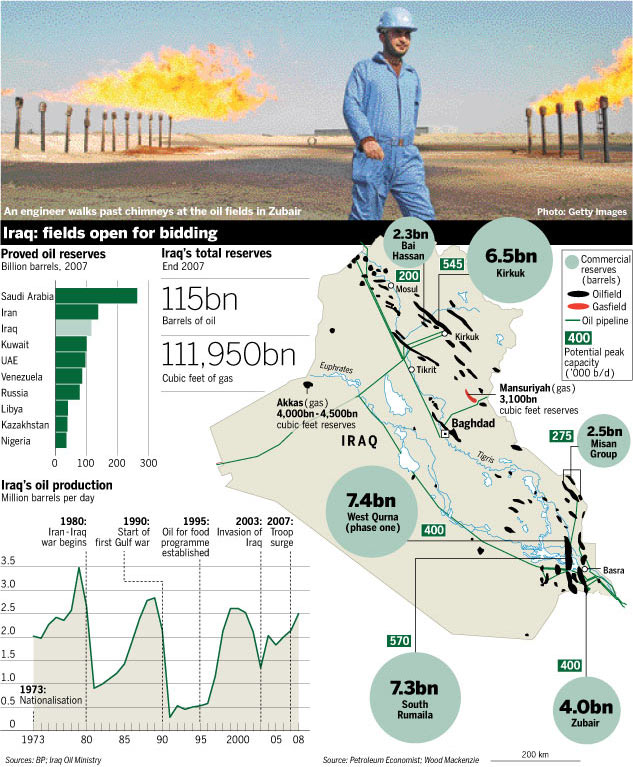 South Rumaila Oil Field – Basra Province
Reserves: 7.3 billion barrels
Bidders:
1. British Petroleum and China’s CNPC
2. Exxon-Mobile and Malaysia’s Petronas
Initial Bid: BP-CNPC $3.99 per extra barrel
Oil Ministry’s Bid: $2 per extra barrel
Winning Bid: $2 per extra barrel by BP-CNPC
West Qurna Oil Field – Basra Province
Reserves: 7.4 billion barrels
Bidders:
1. Exxon-Mobile and Royal Dutch Shell
2. Spain’s Reposal with Denmark’s Maersk Oil and Gas and Norway’s Statoil Hydro
3. Russia’s Lukoi
4. France’s Total
5. China’s CNPC
Initial Bid: Exxon-Mobile and Royal Dutch Shell $4 per extra barrel
Oil Ministry’s Bid: $1 per extra barrel
No winners
Kirkuk Oil Field – Tamim Province
Reserves: 6.5 billion barrels
Bidders: Royal Dutch Shell and China’s Sinopec and Turkish Petroleum Corp
Initial Bid: $7.89 per extra barrel
Oil Ministry’s Bid: $2 per extra barrel
No winners
Zubair Oil Field – Basra Province
Reserves: 4 billion barrels
Bidders:
1. Italy’s Eni, China’s Sinopec, and South Korea’s Occidental and Korean Gas
2. India’s ONGC, Gazprom Russia, and Turkish Petroleum Corp
3. Exxon-Mobile, Royal Dutch Shell, and Petronas
4. British Petroleum and China’s CNPC
Initial Bid: Eni, Sinopec, Occidental and Korean Gas $4.80 per extra barrel
Oil Ministry’s Bid: Unknown
No winners
Maysan Group Oil Field – Maysan Province
Reserves: 2.5 billion barrels
Bidders: China’s CNOOC and Sinochem
Initial Bid: $21.40 per extra barrel
Oil Ministry’s Bid: $2.30 per extra barrel
Deal has been referred to Iraqi cabinet
Bai Hassan Oil Field – Maysan Province
Reserves: 2.3 billion barrels
Bidders: Conoco Phillips, China’s Sinopec and CNOOC
Initial Bid: $26.70 per extra barrel
Oil Ministry’s Bid: $4 per extra barrel
Deal has been referred to Iraqi cabinet
Akkas Natural Gas Field – Anbar Province
Reserves: 4,000-4,500 billion cubic feet
Bidders: Italy’s Edison, Malaysia’s Petronas, China’s CNPC, Turkey’s TPAO,
And Korea’s Gas Corp
Initial Bid: $38 for extra production
Oil Ministry’s Bid: $8.50 for extra production
No winners
Mansuriyah Natural Gas Field – Diyala Province
Reserves: 3,100 billion cubic feet
Bidders: None
SOURCES
Aswat al-Iraq, “Plan to develop Bai Hassan, Kirkuk oil fields,” 7/4/09
Chmaytelli, Maher and DiPaola, Anthony, “Iraq Says May Earn 100 Times More Than Oil Companies (Update1),” Bloomberg, 6/23/09
Chon, Gina, “Big Oil Ready for Big Gamble in Iraq,” Wall Street Journal, 6/24/09
- “Foreign Firms Bid for Iraqi Oil Licenses,” Wall Street Journal, 6/30/09
- “Oil Companies Reject Iraq’s Contract Terms,” Wall Street Journal, 7/1/09
Cordesman, Anthony, “Observations From a Visit to Iraq,” 6/15/09
Dow Jones, “UPDATE:Iraq Parliament Panel: Rumalia Deal Needs Lawmakers’ OK,” 7/3/09
Hafidh, Hassan, “FOCUS: Oil Majors Line Up For Iraq’s First Bid Round,” Dow Jones, 6/29/09
Hoyos, Carola, Warrell, Helen, and Bernard, Steve, “Crude Competition,” Financial Times, 6/30/09
Al Jazeera, “Foreign oil firms reject Iraq terms,” 6/30/09
Lando, Ben, “Oil bid debrief,” Iraq Oil Report, 7/8/09
Lando, Ben and Latif, Nizar, “One oil field awarded, many questions remain,” Iraq Oil Report, 6/30/09
Londono, Ernesto, Ibrahim, K.I., and Mufson, Steven, “Anxious Oil Giants Pass on Iraq,” Washington Post, 7/1/09
Reuters, “Iraq To Move Up Second Energy Bidding Round,” 7/2/09
Salaheddin, Sinan, “Iraqi PM dissatisfied with energy auction results,” Associated Press, 7/2/09
Sly, Liz, “Iraq awards BP-led consortium a contract to develop oil field,” Los Angeles Times, 7/1/09
Wednesday, July 15, 2009
Little Changed In Security Situation In Mosul
Mosul remains the second most violent city in Iraq after Baghdad. From May to June 2009 little changed in the security situation. The number of attacks, deaths, and wounded only dipped slightly between the two months. In June there were a total of 73 attacks and incidents compared to 83 in May, which were reported in the press. The actual number of incidents is probably higher. The 73 attacks led to 181 casualties in June compared to 228 in June. The averages were roughly the same however with 1.93 deaths per day in June versus 2.06 per day in May, and 4.1 wounded in June against 4.7 in May. One major reason for the difference between the two months was that there was only one mass casualty bombing in June, which resulted in one killed, and 13 wounded. In May there were two such attacks, which resulted in 29 deaths and 40 wounded.
Mosul, like the rest of Iraq saw a dip in attacks and casualties at the end of 2008 as the January 2009 provincial elections neared. Insurgents seemed to hold off on attacks to allow Sunnis to participate after they had boycotted the last round of voting in 2005. In October 2008 for example, there were an average of 2.96 attacks per day, and 3.61 deaths. By January that had dipped to 1.67 attacks per day and 1.8 deaths. Since then the numbers have slowly crept back up, as they have in the rest of the country. A joint U.S.-Iraq security operation, Good Hope, launched in February 2009, has had no real impact on incidents in the city. Because of the continued violence U.S. advisers are going to stay in five joint operating bases across Mosul past the June 2009 deadline for combat troops to be out of Iraq’s cities. Originally the U.S. commander in Iraq, General Ray Odierno said that he hoped that Baghdad would allow combat troops to stay in the city, but that caused problems with Prime Minister Nouri al-Maliki who is hoping to capitalize on the U.S. withdrawal to help him in the January 2010 parliamentary vote.
The reason attacks have remained largely unabated in Mosul over the last few months is the fact that it is one of the flashpoints between Arabs and Kurds. The Kurdistan Regional Government hopes to annex several areas in northern Ninewa province, which has raised the ire of the local Arabs. Kurdish forces were also used to retake the city in November 2004 from insurgents, and stayed there for several years afterwards. Together this has allowed the insurgents to portray themselves as the protectors of the Arab population, and maintain a foothold there. Many militants were also forced north during the Surge.
A close eye needs to be kept on the city to see how it fares after most U.S. forces have withdrawn to outside Mosul’s borders. If attacks increase it could show holes in the abilities of the Iraqi security forces. If things stay relatively the same, it would show that they are capable of doing their jobs with less U.S. support. This could be a blueprint for post-2011 Iraq as U.S. combat troops will have to be withdrawn from the country, but a large contingent of U.S. advisors is expected to stay.
Attack Statistics In Mosul Based Upon Press Reports
June 2009
73 Attacks/Incidents – 2.43 attacks & incidents/day
58 Deaths – 1.93 deaths/day
123 Wounded – 4.1 wounded/day
May 2009
83 Attacks/Incidents – 3.06 attacks & incidents/day
64 Deaths – 2.06 deaths/day
164 Wounded – 4.70 wounded/day
April 2009
79 Attacks/Incidents – 2.63 attacks & incidents/day
53 Deaths – 1.76 deaths/day
191 Wounded – 6.36 wounded/day
March 2009
86 attacks/incidents – 2.77 attacks & incidents/day
69 deaths – 2.22 deaths/day
169 wounded – 5.45 wounded/day
February 2009
81 attacks/incidents – 2.89 attacks & incidents/day
58 deaths – 2.0 deaths/day
111 wounded – 3.96 wounded/day
January 2009
52 attacks/incidents – 1.67 attacks & incidents/day
56 deaths – 1.80 killed/day
85 wounded – 2.74 wounded/day
December 2008
65 attacks/incidents – 2.09 attacks & incidents/day
68 deaths – 2.19 deaths/day
181 wounded – 5.83 wounded/day
November 2008
65 attacks/incidents – 2.16 attacks & incidents/day
53 deaths – 1.76 deaths/day
249 wounded – 8.3 wounded/day
October 2008
92 attacks/incidents – 2.96 attacks & incidents/day
112 deaths – 3.61 deaths/day
188 wounded – 6.06 wounded/day
SOURCES
Arraf, Jane, “US troops to exit Iraq’s cities but new role still evolving,” Christian Science Monitor, 6/29/09
- “Why was top US general late for his own press conference? Iraqi security,” Christian Science Monitor, 6/15/09
Aswat al-Iraq, “2 civilians injured in Ninewa,” 6/8/09
- “2 construction workers wounded in blast in Mosul,” 6/2/09
- “2 cops wounded in eastern Mosul,” 6/1/09
- “2 Gunmen arrested while targeting military base in Mosul,” 6/15/09
- “2 policemen wounded in car bombing in Mosul,” 6/20/09
- “2 simultaneous explosions damage stores in Mosul,” 6/18/09
- “3 civilians injured by IED in Mosul,” 6/14/09
- “6 killed by car bomb blast in Ninewa,” 6/29/09
- “Body of civilian found in Mosul,” 6/7/09
- “Booby-trapped bridge kills two cops,” 6/29/09
- “Booby-trapped car leaves 14 casualties in Mosul,” 6/25/09
- “Boy killed by gunmen in Mosul,” 6/25/09
- “Car bomb injures 4 in Mosul,” 6/11/09
- “Civilian gunned down in Mosul,” 6/18/09
- “Cop killed, another wounded in Mosul shooting,” 6/3/09
- “Cop killed, father wounded by gunmen in Ninewa,” 6/20/09
- “Female body found northwest of Mosul,” 6/4/09
- “Former army officer gunned down in Mosul,” 6/15/09
- “Gunman killed in Western Mosul,” 6/30/09
- “Gunmen kill civilian in Mosul,” 6/22/09
- “Hand grenade kills child in Mosul,” 6/1/09
- “Hand grenade wounds 3 in Mosul,” 6/14/09
- “IED explodes near alcoholic beverages shop in Mosul,” 6/19/09
- “IED injures woman, daughter in Mosul,” 6/9/09
- “IED kills, wounds 4 in Mosul,” 6/21/09
- “IED wounds 3 in Mosul,”
- “Mosul car bomb casualties up to 17,” 6/4/09
- “Police officer escapes assassination attempt,” 6/8/09
- “Policeman killed, another wounded in Ninewa,” 6/24/09
- “Sniper wounds cop in Mosul,” 6/10/09
- “Soldier, civilian killed in Mosul,” 6/19/09
- “Sound bomb explodes near Ninewa province building,” 6/23/09
- “Student killed in central Mosul,” 6/8/09
- “U.S. forces injure 2 persons in Mosul,” 6/16/09
- “Woman gunned down in Mosul,” 6/22/09
- “Woman killed, cop wounded in Mosul incidents,” 6/17/09
Hammoudi, Laith, “Round-up of Daily Violence in Iraq – Thursday 18 June 2009,” 6/18/09
- “Round-up of Daily Violence in Iraq – Thursday 25 June 2009,” 6/25/09
Hammoudi, Laith and Issa, Sahar, “Round-up of Daily Violence in Iraq – Tuesday 16 June 2009,” 6/16/09
Issa, Sahar, “Round-up of Daily Violence in Iraq – Monday 8 June 2009,” 6/8/09
- “Round-up of Daily Violence in Iraq – Tuesday 9 June 2009,” 6/9/09
- “Round-up of Daily Violence in Iraq – Tuesday 23 June 2009,” 6/23/09
- “Round-up of Daily Violence in Iraq – Wednesday 24 June 2009,” 6/24/09
Issa, Sahar and Kadhim, Hussein, “Round-up of Daily Violence in Iraq – Wednesday 10 June 2009,” 6/10/09
Joshi, Mohit, “Four Iraqis killed in Mosul violence,” Top News, 6/18/09
Kami, Aseel, “Bus terminal bombing kills seven in Baghdad,” Reuters, 6/8/09
Reuters, “FACTBOX-Security developments in Iraq, June 1,” 6/1/09
- “FACTBOX-Security developments in Iraq, June 11,” 6/11/09
- “FACTBOX-Security developments in Iraq, June 13,” 6/13/09
- “FACTBOX-Security developments in Iraq, June 18,” 6/18/09
- “FACTBOX-Security developments in Iraq, June 19,” 6/19/09
- “FACTBOX-Security developments in Iraq, June 21,” 6/21/09
- “FACTBOX-Security developments in Iraq, June 22,” 6/22/09
- “FACTBOX-Security developments in Iraq, June 24,” 6/24/09
- “FACTBOX-Security developments in Iraq, June 26,” 6/26/09
- “FACTBOX-Security developments in Iraq, June 28,” 6/28/09
- “FACTBOX-Security developments in Iraq, June 29,” 6/29/09
Parker, Ned, “A battle for land in northern Iraq,” Los Angeles Times, 4/5/08
Tyson, Ann Scott and Raghavan, Sudarsan, “Gates Cautiously Upbeat on Iraq,” Washington Post, 12/6/07
Xinhua, “Retired officer killed, judge escapes bombing in northern Iraq,” 6/16/09
- “Suicide car bomb kills civilian in Iraq’s Mosul,” 6/4/09
Tuesday, July 14, 2009
More On The SOFA Referendum
By the end of this month, July 2009, there was supposed to be a referendum on the Status of Forces Agreement, which set the relationship between the U.S. and Iraq. That’s not going to happen now. Instead, the latest word out of Baghdad is that if the vote is held at all, it will coincide with the January 2010 parliamentary election.
During the negotiations over the SOFA in Iraq’s parliament in 2008, the Sunni Iraqi Accordance Front was worried that the deal would give too much power to Prime Minister Nouri al-Maliki. They successfully pushed for a Political Reform Document that was passed alongside the SOFA on November 27, 2008. The Reform Document called for power sharing in the government and security forces, and a July 2009 referendum on the security agreement. Maliki gave into the Accordance Front’s demands, because Grand Ayatollah Ali Al-Sistani had demanded widespread support for the deal, and the Front was one of the main Sunni coalitions in parliament and members of Maliki’s cabinet. The Reform Document wasn’t binding however. That’s why there has been no power sharing with Sunnis in the government since the bill was passed, and the referendum will not happen on its original date. It was simply a way to appease the Accordance Front and get them to support the SOFA.
If the referendum is delayed until January 2010 that would give Iraqi officials enough time to prepare for it. First the parliament needs to pass a law regulating the election and that sets aside a budget. The Iraqi Election Commission then needs two months to set up the actual election process.
The vote could have dramatic consequences for both U.S. and Iraqi politics. First, if the SOFA is voted down, the U.S. would have one year to withdraw from the country. As of now, the Obama administration has set December 31, 2011 as the date it will have all of its combat troops out of Iraq. If the SOFA doesn’t pass, American troops would have to leave by January 2011. Within Iraq, Prime Minister Maliki could also use the referendum against his political opponents. The Kurdish Alliance and the Accordance Front are two major opponents of Maliki in parliament, and both want the U.S. to stay to check his power. Since 2008 Maliki has been challenging the Kurds in the disputed territories in northern Iraq, as well as arresting selected Sons of Iraq (SOI) members, many of which are aligned with the Accordance Front. The U.S. has stepped in several times to mediate possible military confrontations between the Kurdish and Iraqi security forces, and to release some SOI members. Having the Americans leave is very popular in Iraq right now, so Maliki could use this against these two coalitions in the parliamentary vote.
Iraq is not a country ruled by law. Despite the Political Reform Document calling for a July 2009 referendum on the SOFA, it’s not likely to happen. Rather domestic Iraqi politics seem to be pushing it back to coincide with the January 2010 parliamentary election. It’s unknown how the Iraqi public will vote if the referendum is held, but the opposing Iraqi parties will definitely use it, and that will ultimately determine whether the U.S. timeline for withdrawal will be maintained or have to be dramatically revised.
SOURCES
Abdul-Zahra, Qassim, “Iraq Shiites, Kurds meet Sunni demand on US pact,” Associated Press, 11/26/08
- “Sunni Arab support key to US-Iraq security deal,” Associated Press, 11/25/08
Alsumaria, “Iraq-US pact referendum likely to be delayed,” 7/3/09
Ashton, Adam and Fadel, Leila, “Iraqi cabinet Okays U.S. troop withdraw, Parliament could scuttle,” McClatchy Newspapers, 11/16/08
Aswat al-Iraq, “IAF will not support pact – al-Dulaimi,” 11/17/08
- “Security deal to pass 5 stages before approval,” 11/17/08
Domergue, Jeremy and Cochrane, Marisa, “Balancing Maliki,” Institute for Understanding War, June 2009
Gwertzman, Bernard, “Iraq at Crossroads Amid U.S. Disengagement,” Council on Foreign Relations, 6/30/09
Hamad, Qassim Khidhir, “looming u.s. troop withdrawal creates alarm in mosul,” Niqash, 6/11/09
Mohsen, Amer, “Iraq Papers Mon: Tragedy Near Kirkuk,” IraqSlogger.com, 6/21/09
Parker, Ned, “Corruption plays key role in Iraqi justice,” Los Angeles Times, 6/29/09
Rubin, Alissa, Robertson, Campbell and Farrell, Stephen, “Iraqi Parliament Approves U.S. Security Pact,” New York Times, 11/27/08
Monday, July 13, 2009
Denmark Begins Deporting Iraqi Refugees
On June 25, 2009 Denmark deported six Iraqis back to Baghdad that had failed to gain asylum there. The Danish government has plans to deport 244 more. This follows an agreement signed in May 2009 between Iraq and Denmark to repatriate Iraqis who had their asylum requests rejected. The Danes are concerned about the flow of Iraqis to their country, and have been working on limiting their arrival since the beginning of the year. The Danish immigration service claims that Iraqis are traveling back and forth between the two countries, which proves that they are not refugees fleeing violence. The Danish National Police has been monitoring the movement of Iraqis since 2000, and claimed 370 visited Iraq since 2003. On Baghdad’s side, the government of Prime Minister Nouri al-Maliki is hoping to get Iraqi refugees to return, and close the file on the issue by the end of 2009. Maliki’s main motivation seems to be improving the image of Iraq, rather than the plight of the displaced.
Various human rights groups, the United Nations High Commission on Refugees, and the Iraqi Minister of Displacement and Migration are all against this policy. The Displacement Minister said that Iraq’s Foreign Minister signed this deal with Denmark without consulting him. As a sign of protest Baghdad International Airport and Kurdistan originally said that they would not accept any flight that included Iraqis forced to return to the country.
The amount of refugees in Denmark seems like an infinitesimal amount when considering the fact that Iraq has 2 million refugees. Iraqis however have been the largest group seeking asylum in other countries for the last two years. Most of them have tried to go to either Europe or the United States. None of these states have been enthusiastic about receiving them. As early as 2007 some European countries began deporting Iraqis as a result. The Iraqi government has also been pushing for their countrymen to come home for political purposes. Together this led to the Norwegian agreement. Despite the improved security very few of Iraq’s refugees have gone back, and the United Nations says it is still not time for them to return. It seems that forcing Iraqis home at this point is premature as so much is still unresolved right now. No one powerful seems to care about Iraq’s displaced however, so other countries may follow Denmark’s example in the future.
SOURCES
Agence France Presse, “Denmark, Iraq reach deal to repatriate Iraqi refugees,” 5/14/09
Alsumaria, “Iraqi Minister urges Denmark not to rush Iraqis refugees return,” 6/19/09
DPA, “Denmark begins forced deportation of Iraqis,” 6/25/09
Ferris, Elizabeth, “The Looming Crisis: Displacement and Security in Iraq,” Brookings Institution, August 2008
Middle East Online, “Iraqi refugees scoff at boasts of improved security,” 3/19/08
RC News, “Ministry to investigate refugee trips to Iraq,” 6/11/09
Reilly, Corinne, “Prospects are dismal for returning Iraqi refugees,” McClatchy Newspapers, 5/22/09
Sunday, July 12, 2009
Campaigning For Kurdistan’s Regional Parliament Begins
On July 25, 2009 the Kurdistan Regional Government (KRG) will hold elections for not only its parliament, but also a new constitution. 24 lists are running for 111 seats in the Kurdistan legislature. This year’s vote looks to be the most competitive since the first Kurdish election held in 1992. Then only seven parties ran, followed by thirteen in 2005. The two sets of balloting confirmed the dominant role of the Kurdistan Democratic Party (KDP) and Patriotic Union of Kurdistan (PUK). Both times they ran together, and took 104 of 111 seats in the last vote in 2005. This time the two are facing a serious challenge from PUK co-founder Nishurwan Mustafa and his Change List. He has a powerful media company, Wisha that he has run since 2006 to get out his message of reform. The PUK has also gone through a series of internal revolts over corruption, autocratic rule, and lack of transparency that have led to many defections. Wisha claims that 30,000 PUK members have been fired for associating with the Change List, while 200 officials have been expelled from the party as well for doing the same. Some early estimates believe that Mustafa could get 20% of the vote. Even that amount, could break the hegemony of the PUK-KDP alliance within the Kurdish parliament.
There are several other smaller reform parties running, along with a host of candidates for the regional president. Among those are the Service and Reform List made up of Islamic groups like the Kurdistan Islamic Group and the Kurdistan Islamic Union. The Progress List headed by Halo Ibrahim Ahmed, the brother-in-law of Iraqi President Jalal Talabani, and the Kurdish Reform Movement with its leader Abdul Musawer Barzani, cousin of KRG President Massoud Barzani. He is running for re-election to that post, along with Ahmed of the Progress List, London scholar Kamal Mirawdeli, and two businessmen, Hussein Karmiani and Safin Sheikh Mohammed.
In July Kurds will also vote for a controversial new constitution. The Kurdish parliament passed a draft of the document in mid-June. Among other things, it lays claim to Kirkuk, and other disputed territories in Ninewa and Diyala, calling them part of greater Kurdistan. These areas are one of the major divisions between Kurdistan and Baghdad. It is also playing out at the provincial level between the ruling al-Hadbaa party and the PUK-KDP led Fraternal List in Ninewa.
The 2009 election in Kurdistan could be a turning point for the region. If the Change List and the other reform tickets are able to gain a sizeable amount of seats they could break the strangle hold the KDP and PUK have over the legislature. That would only be a first step however. It’s been said that the parliament is only a rubber stamp as the PUK and KDP leaders make all the major decisions behind the scenes. Each party also runs its own peshmerga militia and Aseyash security force that have been accused of going after their opponents. This is part of separate administrations the two parties have, and a unification agreement between the two reserves all top posts in the government only for themselves. Presidents and councils of universities and scholarships are also only open to PUK and KDP party members, and any large business dealings in the region have to include party members, usually relatives or tribal members of the Barzani and Talabani families. Despite the image that the Kurdistan Regional Government likes to portray of itself, it still has a very long way to go to become an actual democratic region of Iraq.
Kurdish Lists Participating In The July 2009 Election
KURDISTAN LIST
Made up of the Kurdistan Democratic Party and the Patriotic Union of Kurdistan. The list is headed by Barham Saleh of the PUK and current Deputy Prime Minister of Iraq. The Kurdistan List calls for maintain the status quo. The KDP was founded in 1946 by Mullah Mustafa Barzani, the father of KRG President Massoud Barzani. Massoud Barzani is the current head of the KPD, Fadhil Mirani is the leader of the KDP politburo, and Nechirvan Barzani is the KRG Prime Minister. The PUK was formed b Jalal Tabani when he broke from the KDP in 1975. Kosrat Rasul, the KRG’s Vice President, is the head of the PUK’s politburo. Saleh is number three in the PUK.
CHANGE LIST
Former PUK co-founder Nishurwan Mustafa is the head of the Change List. He left the PUK in December 2006 criticizing it for not reforming itself. Most of the list is made up of former PUK officials. They want to separate political parties from the government and economy, resolve the dispute between Baghdad and Kurdistan through dialogue, and provide more transparency in the administration and budget.
SERVICE AND REFORM LIST
The List is made up of the Kurdistan Islamic Union, the Islamic Group of Kurdistan, the Kurdistan Socialist Democratic Party and the Future Party. It says it is fighting against corruption in the current government, claims disputed areas as part of Kurdistan, and wants to rule guided by Islam. Ali Bapir heads the Islamic Group of Kurdistan. He was arrested by the Americans in 2003 for ties with terrorist groups, and is said to be close to Iran. The Kurdistan Socialist Democratic Party is led by Muhammad Haji Mahmud, the Future Party is headed by Qadir Aziz. It is related to the Muslim Brotherhood.
KURDISTAN CONSERVATIVE PARTY
Zaid Surchi, a tribal leader is the head of the party. It has ties with the PUK.
ISLAMIC MOVEMENT OF KURDISTAN LIST
Shaykh Uthman Abdul-Aziz formed the list with other Sunni mullahs in 1979. It is based in Halabja, and headed by Sidiq Abdul Aziz and Ahmed Warte. It calls for the government to be based upon Islam, and wants greater transparency.
SOCIAL JUSTICE AND FREEDOM LIST
It is made up of the Kurdistan Communist Party, the Kurdistan Toilers Party, the Kurdistan Independent work Party, the Kurdistan Pro-Democratic Party, and the Democratic Movement of Kurdistan People. It calls for equal rights, rights for farmers, more housing, and secularism.
INDEPENDENT YOUTH LIST
Hiwa Abdul Karim Aziz, a journalist is the leader of the list, which only includes 10 people. It says it is standing for the young people of the KRG.
KURDISTAN REFORM MOVEMENT
Abdul Musawwar al-Barzani, cousing of Massoud Barzani, heads the movement. It calls for an end to corruption, rule of law, and human rights
PROGRESSION LIST
Jalal Talabani’s brother-in-law Halo Ibrahim Ahmed heads the list. They call for better living conditions. Ahmed was part of a dissident PUK group that was kicked out of the party.
KURDISTAN DEMOCRATIC NATIONAL PARTY LIST
Was founded in 1995 and calls for uniting Kurds across Iraq, Turkey, Iran and Syria. It wants more housing and women and youth rights.
KURDISTAN TOILERS AND WORKERS PARTY LIST
Calls for rule of law in the KRG.
IRAQI CONSTITUTIONAL PARTY
Was founded by Iraqi Interior Minister Jawad Bolani, who says he is no longer its official leader.
KURDISTAN BRIGHT FUTURE LIST
Is headed by Muhammad Saleh Hama Faraj, who lived in England until 2008. He wants the political parties out of administration and the justice system.
5 seats have been reserved for Turkmen
IRBIL TURKMEN LIST
Is led by Sherdil Tahsin Arsalan, Tafa Rostman Qasab, Thaura Saleh, Nafeh Rostam, and Artham Abdul Karim. It wants Kirkuk to be annexed, and it is against Turkish influence.
TURKMEN REFORM LIST
Is headed by Abdul Qadir Zangana. It wants more power for Turkmen and is against Turkish influence.
TURKMEN DEMOCRATIC MOVEMENT IN KURDISTAN
Is led by Karkhi Alti Barmak, who calls for Turkmen unity. It also wants Kirkuk to be annexed, and is against Turkish influence.
INDEPENDENT TURKMEN LIST
Is led by Kanhan Shakir Aziz. It calls for Kirkuk to be an independent region
5 seats have been reserved for Christians
UNIFIED CHALDEAN LIST
Is made up of the Chaldean Union Party and the Chaldean National Council
CHALDEAN SYRIAC ASSYRIAN AUTONOMY LIST
AL-RAFIDAIN LIST
Is led by Iraqi parliamentarian Yunadam Kanna. It wants a greater role for Christians in the peshmerga and Asayesh.
NATIONAL COUNCIL OF CHALDEAN SYRIAC ASSYRIANS
Is led by Sarkis Aghajan Mamendo. He calls for the Ninewa plaints to be annexed.
2 seats have been set aside for Armenians
Aram Shahine Dawood Bakoyan, Eshkhan Malkin Sargisyan, and Aertex Morses Sargisyan are running for these seats.
SOURCES
Abdulqadir, Mohammed Amin, “Kurds Still Without Govt After January Poll,” Inter Press Service, 5/26/05
Agence France Presse, “Iraq Kurds pass new constitution to include Kirkuk,” 6/24/09
Amnesty International, “Hope and Fear, Human rights in the Kurdistan Region of Iraq,” April 2009
Hamad, Qassim Khidhir, “kdp and puk face election challenge,” Niqash, 5/12/09
- “Kurdish election lists,” Niqash, 6/30/09
Jumani, Kamal, “kurdistan prepares for elections,” Niqash, 6/25/09
Khalil, Lydia, “Stability in Iraqi Kurdistan: Reality or Myth,” Brookings Institution, June 2009
Mahmoud Rebaz, “Election Fever Rises in Kurdistan,” Institute for War & Peace Reporting, 6/17/09
Friday, July 10, 2009
Iraq Completely Disappears From America’s Headlines
According to the Pew Research Center’s Project for Excellence in Journalism’s News Index Iraq failed to reach the top ten in any media format for the four full weeks of June 2009. March 2009 was the first month that the war did not reach the top ten news stories overall in the country, but Iraq was still in the top ten of at least one media outlet such as TV, radio, newspapers or the internet. Since then Iraq has continued to fade from America’s attention. In May 2009 for example, Iraq not only did not make the top stories for the four weeks of the month, but in two of those weeks did not make the top ten in any media format. June has now topped that. This was despite the number of mass casualty bombings that racked the country, and the preparation for the American withdrawal from Iraq’s cities.
Reporting on the war began fading at the beginning of 2007 due to four major reasons. First, reporting from Iraq was dominated by stories about the violence there. According to a December 2007 study by the Project for Excellence In Journalism, from January to October 2007 daily violence accounted for 46.9% of all stories out of Iraq. As the fighting decreased in the second half of 2007 so to did the majority of stories from within the country. More important than that was the domestic situation in the United States. In May 2007 Congress gave up on trying to set a withdrawal date for U.S. forces to be out of Iraq. After that Washington hardly discussed the war anymore. As a June 2009 report by the Council on Foreign Relations on the media’s role in the lead-up to the 2003 invasion pointed out, the major source for stories within the U.S. is the government. When politicians stopped discussing the war then, reports on it started drying up as well. A third reason was the beginning of the 2008 presidential campaign, which really took off in January 2007. That soon got tied up with the recession, both of which became the main story in the U.S. up to the present day. Finally, with most media outlets facing major financial problems, they only had so much money and resources to spend. As the focus of American moved to domestic politics, the news companies began pulling out their reporters from Iraq. Out of the three major network TV stations for example, only ABC still has a bureau in Baghdad, but with no reporters according to the Los Angeles Times’ Show Tracker Blog. NBC and CBS already withdrew their staff. CNN and FOX have maintained reporters there, but out of the print media, only the New York Times, Washington Post, McClatchy Newspapers, the Associated Press, and Reuters are still committed to reporting from the country.
The U.S. still has 131,000 troops in Iraq. That’s expected to drop to 50,000 by August 2010, before the final withdrawal deadline for all combat troops to be out of Iraq by December 31, 2011. After that the U.S. could maintain a large military advisory role in the country. That means continued casualties as well. Iraq also has massive political, social, and economy problems to overcome. All of this seems fated to go on without the American public getting the information it needs to evaluate the situation however. The role of the media in a democracy is to inform the people. It’s failing to do that job today with a war that has been going on for six years, and is likely to last several more years into the future.
SOURCES
Gelb, Leslie with Jeanne-Paloma Zelmati, “Mission Unaccomplished,” Democracy Journal, Summer 2009
Gold, Matea, “Show Tracker: What you’re watching,” Show Tracker: What you’re watching, Los Angeles Times, 1/7/09
Jurkowitz, Mark, “Why News of Iraq Dropped,” Pew Research Center’s Project For Excellence In Journalism, 3/26/08
Londono, Ernesto, “U.S. Troops, Civilians to Become Less Protected on July 1,” Washington Post, 6/26/09
Pew Research Center’s Project for Excellence in Journalism, “Concilation In Cairo Drives The News Agenda, PEJ News Coverage Index: June 1-7, 2009,” 6/8/09
- “Iran Dominates As The Media Are The Message, PEJ News Coverage Index: June 15-21, 2009,” 6/22/09
- “Media Swing From Protests In Iran To The Passing Of The King Of Pop, PEJ News Coverage Index: June 22-28, 2009,” 6/29/09
- “No Story Dominates, But Iran Fascinates, PEJ News Coverage Index: June 8-14, 2009,” 6/15/09
- “The Portrait from Iraq – How the Press Has Covered Events on the Ground,” 12/19/07
Schogol, Jeff, “Odierno: Troop levels to drop to 120,000,” Stars and Stripes, 7/1/09
Stetler, Brian, “TV News Winds Down Operation on Iraq War,” New York Times, 12/29/08
Thursday, July 09, 2009
U.S. Public Opinion As Combat Troops Exit Iraq's Cities
June 30, 2009 was the official deadline for U.S. combat troops to be out of Iraqi cities. At the same time two public opinion polls were released of Americans on what they thought about Iraq. CBS News and the New York Times did one, and the other was by Rasmussen. The former found that a majority of Americans thought that things were going well in Iraq, while the later reported that very few people in the U.S. feel that the war is over, but a majority is hoping that President Obama brings home the troops by the end of his term in 2012.
The CBS News/New York Times poll was conducted from June 12 to 16, 2009 and just focused on how people thought the U.S. was doing in Iraq. 62% replied that the U.S. was doing well. This was actually lower than the last two times this question was asked back in April and March 2009. In April 71% said America was doing well, and 64% responded that way in March. The drop in the polling numbers in June might have been caused by the spate of bombings and violence in Iraq in that month on the eve of the withdrawal.
The public first began feeling positive about Iraq in September 2008 when 52% responded that things were good there. The low point was in June 2007 when 77% said the war was going badly. Democrats, Republicans, and Independents all had positive views as well. 71% of Republicans felt things were going good, compared to 63% for Democrats, and 54% for Independents.
How Are Things Going For The U.S. In Iraq? 6/09 4/09 3/09 12/08 9/08 6/07 5/03 Well 62% 71% 64% 56% 52% 22% 72% Bad 31% 24% 33% 39% 46% 77% 24%
The Rasmussen survey focused upon whether the public felt that the war was ending or not, the effect of the withdrawal on Iraq, and when they felt the troops would be home. Only 16% said the war was finished, while 64% said it wasn't, and 20% were not sure. When asked how they felt security in Iraq's cities would be in the future, 81% said that it was likely or somewhat likely that they would turn violent. 44% said they were very likely to go bad. When asked what the U.S. should do if that happens, only 17% said that American forces should be sent back in to help. 68% said that the Iraqis should handle it, while 15% were not sure. Respondents were also split on what Iraq would be like in the next 6 months. 38% said it would get better, 25% said it would get worse, and 24% said Iraq would stay about the same.
There were two questions about the final U.S. withdrawal from Iraq as well. When asked would America be out by December 2011, 48% said they were confident or very confident that would happen, compared to 46% who said they were not. When asked about a longer timeline, 66% said it was likely or somewhat likely that President Obama would have combat troops out by the time his first term ended in 2012. 59% went on to say that it was more important to get the troops out than finish the job in Iraq.
Those surveyed also seemed to have been keeping up with recent events. 80% said they had been following the news on the withdrawal from the cities, while only 4% said they had not kept up with the story at all.
The Surge and the drop in violence can be attributed with the change in American attitudes about Iraq. Beforehand, the sectarian war and high U.S. casualties turned most of the public against the war. The dramatic drop in deaths from 2008 to the present, has the U.S. back to thinking optimistically about the future of the conflict. The main priority however, is to get the combat troops out as soon as possible. It will be interesting to see how the U.S. public feels if President Obama decides to keep a large advisory force in Iraq after the 2011 deadline for withdrawal. Perhaps they will be satisfied with most troops coming home, but then again since so many feel that Iraq needs to deal with its own problems, they might be upset with a residual force staying behind.
SOURCES
De Pinto, Jennifer, "Polls Show Most Say Things Are Going Well in Iraq," CBS News, 6/30/09
Rasmussen Reports, "64% Say War in Iraq Is Not Over Yet," 7/1/09
Tuesday, July 07, 2009
Iraq Casualties See Large Increase In June 2009
Iraqi casualties continue to climb upwards since the beginning of the year. June 2009 saw the largest amount of deaths for several months. This follows May, which had the fewest victims since the 2003 invasion. Even before the monthly totals were released, the number of mass casualty bombings (attacks that caused 10 or more casualties) pointed to a bloody June.
Starting from highest to lowest sources, Iraq Body Count had a preliminary number of 516 killed last month, the Associated Press counted 447, the Iraqi Health Ministry claimed 438, and icasualties had 367.
Iraqi Deaths Iraq Body Count icasualties. Org Brookings Iraq Index Iraqi Ministries Associated Press July 08 584 419 500 851 N/A Aug. 08 592 311 450 N/A 475 Sep. 08 535 366 400 440 503 Oct. 08 528 288 350 317 N/A Nov. 08 473 317 270 340 N/A Dec. 08 522 320 350 316 N/A Jan. 09 276 187 270 191 242 Feb. 09 343 202 230 258 288 March 09 416 278 260 252 335 April 09 484 347 340 355 371 May 09 325 188 N/A 165 225 June 09 516 367 N/A 438 447 Last 6 months of 2008 Average 539.0 336.8 386.6 452.8 5 of 6 months N/A First 6 months of 2009 Average 393.3 261.0 275.0 1st 4 months 276.5 317.5 According to the Brookings Institution's Iraq Index overall attacks in Iraq have leveled off since December 2008 with no noticeable increases up to the middle of May 2009. As Anthony Cordesman from the Center for Strategic and International Studies recently pointed out however, there is not a direct correlation between security incidents and casualties in Iraq. A more telling statistic to look at would be the number of mass casualty bombings occurring each month. In April 2009 for example there were 20 such bombings, compared to only 9 in May. The increase in casualties in June could be seen in the fact that there were 14 bombings. Those led to 174 deaths and 517 wounded. Number of Bombings and Casualty Statistics – April to June 2009 The trend over the last year was for attacks and deaths to decline in the second half of 2008 as the provincial elections neared in January 2009. It appears that the insurgency held off on attacks to allow Sunnis to participate after they had boycotted the last voting in 2005. Until May, January saw the lowest casualties since the U.S. invasion. Since then the number of deaths has crept back up each month, with the exception of May. Since the insurgency is extremely weakened, that month might have been the result of the militants expending all of their resources on bombings and such in April, which they had to recover from in May. June of course was the deadline for U.S. combat troops to be out of Iraq's cities, so perhaps the insurgents were also saving up for that. If this pattern continues than there should be another decline in Iraqi dead and wounded towards the end of the year as Sunnis gear up for the January 2010 parliamentary elections. This all points to the fact that domestic events rather than American ones largely determine the security situation in Iraq. SOURCES
Bombings: 20
Deaths: 197 + 32 Iranians
Wounded: 488 + 105 Iranians + 10 Americans
May 2009
Bombings: 9
Deaths: 111
Wounded: 262
June 2009
Bombings: 14
Deaths: 174
Wounded: 517
Agence France Presse, “Iraq Suicide Bomber Wounds 34 in Mosul Shopping Street,” 5/24/09
- “Seven dead in Baghdad bus station blast,” 6/25/09
- “Two children killed in blast targeting father,” 4/20/09
Ahmed, Hamid, “Iraqi police: 35 dead in double bombing,” Associated Press, 4/24/09
Associated Press, “Car bomb kills 10 in northern Iraq city,” 4/15/09
- “Car bomb wounds 15 people west of Baghdad,” 5/27/09
- “June is deadliest month for Iraqis this year,” 7/1/09
- “Police report 17 dead in Baghdad bombings,” 5/6/09
Aswat al-Iraq, “2 civilians wounded by IED in Baghdad,” 5/18/09
- “2 cops killed, 20 wounded in blast inside police station in Baghdad,” 5/21/09
- “Booby-trapped car leaves 14 casualties in Mosul,” 6/25/09
- “Car bomb injures 10 in Mosul,” 4/1/09
- “Car bomb kills 4, wounds 10 in Baghdad,” 5/27/09
- “Car bomb leaves 10 casualties in Kirkuk,” 5/11/09
- “Final toll of Kirkuk blast reaches 126 – medic,” 6/30/09
- “URGENT/27 killed, 32 wounded in Kirkuk’s market explosion,” 6/30/09
- “URGENT/Mosul suicide blast leaves 5 killed, 6 wounded,” 5/1/09
Bakri, Nada, “3 U.S. Troops, 23 Iraqis Killed in Bomb Attacks,” Washington Post, 5/22/09
BBC News, “Iraq: Bomb in Baghdad café kills nine,” 6/4/09
- “Suicide blast hits Iraq army base,” 4/16/09
Cordesman, Anthony, “Iraq: UNSCENTCOM and Iraqi Government Estimates of the Trends in the Patterns in Violence and Casualties,” Center for Strategic and International Studies, 5/1/09
Dhaher, Abdul Rahman, “Bombings kill at least 27 in Iraq,” Washington Post, 6/22/09
Gamel, Kim, “Motorcycle bomb kills 15 in Baghdad market,” Associated Press, 6/26/09
Hammoudi, Laith and Kadhim, Hussein, “Round-up of Daily Violence in Iraq – Saturday 11 April 2009,” 4/11/09
Icasualties
Iraq Body Count
Issa, Sahar and Kadhim, Hussein, “Round-up of Daily Violence in Iraq – Friday 10 April 2009,” 4/10/09
- “Round-up of Daily Violence in Iraq – Monday 1 June 2009,” 6/1/09
- “Round-up of Daily Violence in Iraq – Monday 6 April 2009,” 4/6/09
- “Round-up of Daily Violence in Iraq – Wednesday 10 June 2009,” 6/10/09
- “Round-up of Daily Violence in Iraq – Wednesday 6 June 2009,” 6/6/09
Kadhim, Hussein, “Roundup of Daily Violence in Iraq-Friday 24 April 2009,” 4/24/09
- “Roundup of Daily Violence in Iraq-Wednesday 8 April 2009,” 4/8/09
Londono, Ernesto and Bakri, Nada, “Blasts Kill 22 Across Baghdad,” Washington Post, 6/23/09
Londono, Ernesto and Mizher, Qais, “Attacks Across Baghdad Leave At Least 48 Dead, Scores Injured,” Washington Post, 4/30/09
Londono, Ernesto and Sabah, Zaid, “Market Blast Kills More Than 75 in Baghdad’s Sadr City,” Washington Post, 6/25/09
Middle East Online, “Six Iraqis killed in truck attack in Kirkuk,” 5/12/09
Monsters and Critics, “At least 6 killed, 15 wounded in Iraq suicide bombing (Roundup),” 4/22/09
Myers, Steven Lee, “Six Car Bombs Kill at Least 33 in Iraq,” New York Times, 4/6/09
O’Hanlon, Michael Campbell, Jason, “Iraq Index,” Brookings Institution, 6/25/09
Press TV, “Baghdad blast kills 9, wounds 31,” 6/4/09
Quinn, Patrick, “Iraqi bombings kill scores ahead of US withdrawal,” Associated Press, 6/25/09
Reuters, “Blast kills four, wounds eight in Baghdad,” 4/17/09
- “FACTOBX-Security developments in Iraq, April 29,” 4/29/09
- “FACTOBX-Security developments in Iraq, May 21,” 5/21/09
- “Suicide bomb kills 7 north of Baghdad – Iraq police,” 4/23/09
- “Suicide truck bomb kills 5 U.S. troops,” 4/10/09
Sly, Liz, “IRAQ: Death toll for Iraqis jumps in June,” Babylon & Beyond Blog, Los Angeles Times, 7/1/09
Tawfeeq, Mohammed, “Iraq: Death toll from huge suicide blast soars,” CNN, 6/21/09
Xinhua, “At least 2 killed, 15 injured in bomb explosion near Baghdad,” 4/10/09
Monday, July 06, 2009
How The Press Failed In Its Job In The Lead-up To The Iraq War
The Summer 2009 issue of Democracy Journal includes a piece by Leslie Gelb and Jeanne-Paloma Zelmati of the Council on Foreign Relations. In it they review and critique the media coverage of the New York Times, Washington Post, Wall Street Journal, Time magazine, and Newsweek, what they term “the elite media,” of four events surrounding the beginning of the Iraq War. Those are the congressional vote on the use of force, Secretary of State Colin Powell’s speech to the United Nations, President Bush’s mission accomplished speech, and the capture of Saddam Hussein. Gelb and Zelmati were inspired to write this piece because they didn’t feel there had been any comprehensive evaluation of the reporting leading up to the war. They believe that a democracy depends upon good information from the press, especially when one is considering whether or not to go to war. Overall, they found that the media did a mediocre job at best. Only occasionally did they question the reasons for the war or analyze the situation in Iraq. The most common form of reporting was simply to repeat the administration’s claims, and quote one or two experts who may or may not agree with the White House. The press only began critiquing the war when it was obvious things were going badly, which was too little, too late. In doing so, the media let the American public down, never giving them a full picture of what the arguments for and against the invasion were, and its consequences.
Gelb and Zelmati reviewed 576 stories and pieces by columnists on four events, the October 2002 Congressional debate an authorizing the use of force, Colin Powell’s February 2003 speech to the United Nations advocating for war, President Bush’s mission accomplished speech in May 2003, and the capture of Saddam Hussein on December 13, 2003. Each article was ranked 0-5. 0 was completely slanted towards the administration, 1 was somewhat biased, 2 reported statements by officials and experts, 3 raised some questions, 4 had fundamental doubts about the administration’s claims, and 5 did the best job reporting both the critics and the White House’s responses. Obviously they were privileging stories that questioned the White House, but they did that because those critics turned out to be right. On average they thought a story should rank a 3.0 or better on Iraq since it was such an important issue facing the country at the time. Too many times, in the press’ attempt to be neutral however it simply ended up supporting the administration by focusing mostly on what government officials said with little to no questioning.
The first two events largely received the same type of reporting. In October 2002 Congress debated whether or not to authorize the use of force against Iraq. On February 5, 2003 Secretary of State Colin Powell went before the United Nations arguing that the Security Council should pass a resolution allowing an attack on Saddam Hussein. In both cases the press mostly repeated the White House and Powell’s claims with little to no questioning. Powell’s speech especially was widely praised. A piece by Michael Gordon in the New York Times said that the Secretary had silenced the critics for example. Few asked whether Iraq really had weapons of mass destruction or were working with Al Qaeda, and even less went into what would happen in Iraq after an invasion. The articles that did mention critics usually had them at the end of the pieces. Columnists at the time were overwhelmingly advocating for the war. Coverage of the Congressional debate received a 2.0, while Powell’s speech got a 1.77, the lowest score of the study.
On May 1, 2003 President Bush gave his mission accomplished speech aboard the USS Abraham Lincoln aircraft carrier. Again, the press mostly repeated Bush’s remarks. Reporting on the problems then occurring in Iraq after the invasion was largely not included in the articles. Skepticism was growing however, but it mostly came from reporters in Iraq. Those in Washington were still basing their stories off of government officials. Columnists at this time were also beginning to raise questions, but were only marginally better than the regular stories. For that, the columnists received a 2.36 score, while the press overall got a 2.12.
The final event was the capture of Saddam Hussein on December 13, 2003 in his home of Tikrit. This time the press coverage was notably different from the other three times. Stories mentioned the insurgency and the reconstruction in Iraq. Many reports were also questioning whether the war was really over or not. For the first time, the media was using more Iraq reports than ones from Washington, which played a large part in changing the tone. What was still missing was any real discussion of the claims the White House made leading up to the war. Because of their questions however, the press received its highest score with a 2.24.
Overall, the reporting never reached the 3.0 standard set by Gelb and Zelmati. They believe that the elite print press should be held to the highest standards. They are the largest outlet for in-depth reporting, questioning, and analysis about decisions that affect the country. Gelb and Zelmati believe that one of the biggest problems with them is institutional. The first job of a reporter is to tell what’s going on. The main way they do that is to report what the government says. The authors argue that editors need to push their staff to bring in more critics in their reporting to provide more of a debate on leading issues in the country. A way to compensate for that is to also use more overseas reporters during foreign policy crises since they are obviously removed from Washington. Another major problem is that many stories emphasize politics over policy. Many reporters simply don’t know enough about any given issue to really go into depth about it, but anyone can talk about Democrats versus Republicans and liberals versus conservatives. In the lead up to the war, that’s what many in the press did.
Eventually the media did change its tone, coming to criticize the White House and its handling of the war, but the study believes they went too far in the other direction. Gelb and Zelmati think this led the media to miss the importance of the Surge when it was launched at the beginning of 2007. When Bush changed policy, the press underreported its effects. They mostly focused just on the increase in troops, and not the new tactics used. They also did not connect the operation with Moqtada al-Sadr’s cease-fire, the emergence of the Anbar Awakening, the creation of the Sons of Iraq, and Prime Minister Nouri al-Maliki becoming a real leader, all of which helped end the sectarian war, and created a new status quo.
Gelb and Zelmati finish by calling for the media to do a better job questioning the government when important decisions come up. This is unlikely to happen as the major media outlets are facing declining sales, and more emphasis upon making profits as a result. A push to make money usually does not contribute to more in depth reporting. The methodology American journalists are trained in, and the culture in pressrooms is also not conducive to much analysis. It’s mostly getting out whatever the top story is as quickly as possible and relying upon proven sources, which usually come from the government. Also, when it comes to war group think usually sets in and the media supports the White House initially. Even now that the media is much more critical of the war, it doesn’t matter much because Iraq has largely disappeared from American reporting. It seems that the press has failed again in the process. It did not give the public the information it needed to assess going to war, and it is doing the same now on what Iraqi is like, and what that means for the U.S. since it is expected to have a major presence in the country for the foreseeable future.
SOURCES
Gelb, Leslie with Jeanne-Paloma Zelmati, “Mission Unaccomplished,” Democracy Journal, Summer 2009
Subscribe to:
Posts (Atom)


